
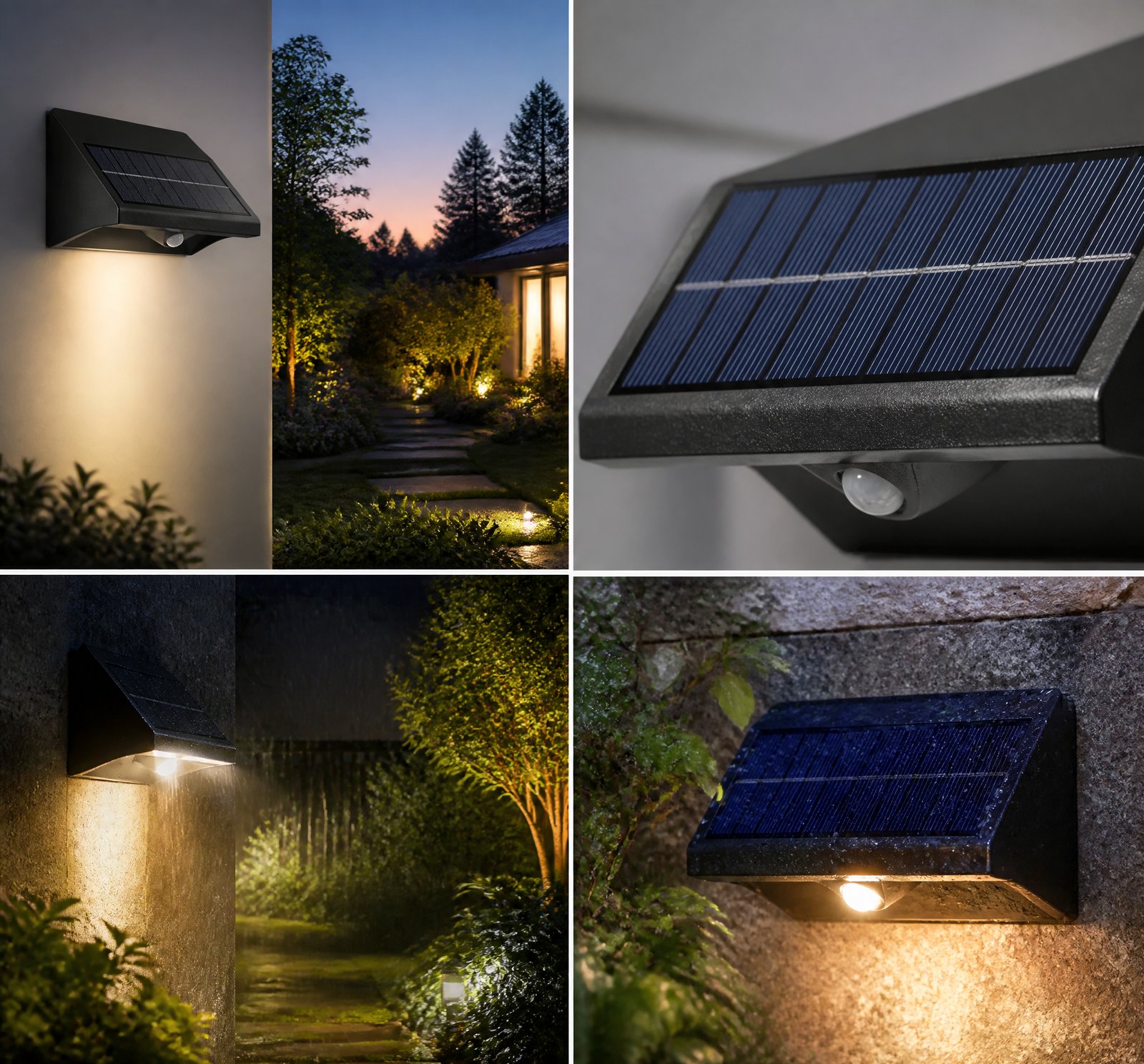
> Quick answer: Dusk-to-dawn automation in solar lamps uses a light-sensing mechanism to switch the lamp on when ambient light falls below a threshold at dusk [4][5][6][25], and off when it exceeds a higher threshold at dawn, ensuring seasonal adaptability without manual recalibration.
Solar lamps equipped with dusk-to-dawn automation offer a smart way to illuminate outdoor spaces in Romania. These devices rely on real-time ambient light sensing rather than fixed schedules, making them highly efficient and reliable for year-round use.
How Dusk-Dawn Automation Works
Dusk-to-dawn automation is driven by a photosensitive component—typically a photodiode or similar sensor—that continuously monitors the surrounding illumination [14][25]. When the ambient light falls below a pre-set threshold, indicating dusk, the lamp turns on. Conversely, when the light exceeds a higher threshold at dawn, the lamp switches off automatically.
Light Sensing Mechanism
The system uses dual thresholds to ensure precise activation and deactivation of the lamp [4][5][6][25]. A microprocessor or embedded circuit interprets sensor data and manages power supply through switches or relays. When ambient light drops below the turn-on threshold, a signal is sent to allow current from the battery to flow to the light source. Conversely, when light exceeds the turn-off threshold, the processor disengages the circuit [14][25].
Advantages Over Timer-Based Systems
Compared to timer-based systems that rely on user-programmed settings, dusk-to-dawn automation eliminates the need for seasonal manual adjustments. This adaptability ensures energy efficiency and reliability regardless of day length variations [1][4][5][6][21]. The system responds to actual light levels, not fixed times, making it particularly effective in environments with variable weather conditions.
Advanced Features and Design Variations
Some advanced solar lamps integrate additional features such as dimming schedules that adjust brightness during the dusk-to-dawn cycle [7][12]. These systems can increase output near dawn for better visibility. Some designs incorporate motion sensors to conserve energy during inactive periods, while others use wireless communication for remote monitoring and adjustments [20].
Dual-Purpose Solar Panels
Certain models utilize the solar panel itself as a light sensor, eliminating the need for an additional photodiode [18]. This design is efficient, using one component for both energy harvesting and environmental sensing.
Manual Override Capabilities
Surprisingly, some systems allow manual override of the automatic function. Users can force the lamp on or off regardless of ambient light levels, providing flexibility for testing or special events [9][18].
Key Takeaways
- Dusk-to-dawn automation relies on real-time light sensing to turn lamps on and off.
- Dual-threshold mechanisms ensure precise activation and deactivation based on actual daylight changes.
- Advanced features like dimming schedules and motion sensors enhance energy efficiency.
Comparison Table
| Feature | Description |
|–––––––––|–––––––––––––––––|
| Light Sensing | Uses photodiodes or ambient light sensors |
| Dual Thresholds | Precise dusk-on and dawn-off switching |
| Microprocessor Control | Manages power supply through switches |
| Advanced Features | Dimming schedules, motion sensing |
Frequently Asked Questions
[
{
„q”: „How does the sensor determine when to turn on?”,
„a”: „The sensor continuously monitors ambient light and triggers the lamp to turn on when the light level falls below a predefined threshold at dusk [4][5].”
},
{
„q”: „Can these lamps be manually overridden?”,
„a”: „Yes, some systems allow manual override, enabling users to force the lamp on or off regardless of ambient light levels [9][18].”
},
{
„q”: „What makes dusk-to-dawn automation more efficient than timer-based systems?”,
„a”: „Dusk-to-dawn systems automatically adapt to seasonal changes without manual recalibration, ensuring precise and energy-efficient lighting based on actual daylight conditions [1][4][5][6].”
}
]
References
- [1] US11653436B2_-_Systems_and_methods_for_outdoor_luminaire__4401458d — patent
source passage
ballasts) and/or thermal management techniques (e.g., passive or active cooling). Providing illumination only when needed can be achieved manually by a user of the lighting system, or automatically by a control mechanism. Automatic control mechanisms generally fall into two broad categories, timers and environmental sensors. Timer based control mechanisms turn light sources ON and OFF based on time. The times are typically user configurable. Such relies on the user to account for changes or variations in the length of daylight in a 24 hour cycle which may occur throughout a year. Very often, timer based control mechanisms are set once and never updated. Environmental sensor based control mechanisms sense light or illumination levels and/or motion or proximity. Light or illumination level based control mechanisms are commonly referred to as dusk-to-dawn sensors. Dusk-to-dawn light or illumination level based control mechanisms turn the light sources ON when a level of light or illumination in an environment falls below a turn ON threshold (i.e., dusk threshold), and turn the light sources OFF when the level of light or illumination exceeds a turn OFF threshold (i.e., dawn threshold). Light or illumination level based control subsystems advantageously automatically accommodate changes in length of day light throughout the year. Example outdoor lighting systems may include a number of individual luminaires mounted on poles and that are each controlled by a photocontrol (or other
- [4] US10390414B2_-_Systems_and_methods_for_outdoor_luminaire__2c6afe22 — patent
source passage
user to account for changes or variations in the length of daylight in a 24 hour cycle which may occur throughout a year. Very often, timer based control mechanisms are set once and never updated. Environmental sensor based control mechanisms sense light or illumination levels and/or motion or proximity. Light or illumination level based control mechanisms are commonly referred to as dusk-to-dawn sensors. Dusk-to-dawn light or illumination level based control mechanisms turn the light sources ON when a level of light or illumination in an environment falls below a turn ON threshold (i.e., dusk threshold), and turn the light sources OFF when the level of light or illumination exceeds a turn OFF threshold (i.e., dawn threshold). Light or illumination level based control subsystems advantageously automatically accommodate changes in length of day light throughout the year. Example outdoor lighting systems may include a number of individual luminaires mounted on poles and that are each controlled by a photocontrol (or other mechanism) that controls the AC power to the luminaire for daytime and nighttime operation. This is often accomplished through a standard wired 3-pin twist-lock receptacle (e.g., ANSI C136.10 compliant receptacle) on the luminaire that mates with a compatible photocontrol plug interface (e.g., ANSI C136.10 compliant plug). The photocontrol switches the luminaire power ON/OFF based on the dusk/dawn events. There are also scenarios where groups of luminaires are
- [5] US10904992B2_-_Systems_and_methods_for_outdoor_luminaire__a8ec96e4 — patent
source passage
the length of daylight in a 24 hour cycle which may occur throughout a year. Very often, timer based control mechanisms are set once and never updated. Environmental sensor based control mechanisms sense light or illumination levels and/or motion or proximity. Light or illumination level based control mechanisms are commonly referred to as dusk-to-dawn sensors. Dusk-to-dawn light or illumination level based control mechanisms turn the light sources ON when a level of light or illumination in an environment falls below a turn ON threshold (i.e., dusk threshold), and turn the light sources OFF when the level of light or illumination exceeds a turn OFF threshold (i.e., dawn threshold). Light or illumination level based control subsystems advantageously automatically accommodate changes in length of day light throughout the year. Example outdoor lighting systems may include a number of individual luminaires mounted on poles and that are each controlled by a photocontrol (or other mechanism) that controls the AC power to the luminaire for daytime and nighttime operation. This is often accomplished through a standard wired 3-pin twist-lock receptacle (e.g., ANSI C136.10 compliant receptacle) on the luminaire that mates with a compatible photocontrol plug interface (e.g., ANSI C136.10 compliant plug). The photocontrol switches the luminaire power ON/OFF based on the dusk/dawn events. There are also scenarios where groups of luminaires are controlled together by an AC contactor that
- [6] US10219360B2_-_Systems_and_methods_for_outdoor_luminaire__f38ec181 — patent
source passage
account for changes or variations in the length of daylight in a 24 hour cycle which may occur throughout a year. Very often, timer based control mechanisms are set once and never updated. Environmental sensor based control mechanisms sense light or illumination levels and/or motion or proximity. Light or illumination level based control mechanisms are commonly referred to as dusk-to-dawn sensors. Dusk-to-dawn light or illumination level based control mechanisms turn the light sources ON when a level of light or illumination in an environment falls below a turn ON threshold (i.e., dusk threshold), and turn the light sources OFF when the level of light or illumination exceeds a turn OFF threshold (i.e., dawn threshold). Light or illumination level based control subsystems advantageously automatically accommodate changes in length of day light throughout the year. Example outdoor lighting systems may include a number of individual luminaires mounted on poles and that are each controlled by a photocontrol (or other mechanism) that controls the AC power to the luminaire for daytime and nighttime operation. This is often accomplished through a standard wired 3-pin twist-lock receptacle (e.g., ANSI C136.10 compliant receptacle) on the luminaire that mates with a compatible photocontrol plug interface (e.g., ANSI C136.10 compliant plug). The photocontrol switches the luminaire power ON/OFF based on the dusk/dawn events. There are also scenarios where groups of luminaires are control
- [7] US20170055324A1_-_Apparatus_retrofit_kit_and_-_Google_Patents__f5522dda — patent
source passage
percentage or fraction of total dusk-to-dawn cycle, or clock cycles of a timer or clock before the turn OFF event. – the time for the turn OFF event can, for instance, be predicted or estimated using the time of the occurrence of turn OFF event on one or more preceding days or daily cycles. – the at least one processor can monitor for occurrence of a defined time (e.g., real world time) or condition (e.g., solar midnight, solar noon, midway between solar midnight and solar noon). – the at least one processor causes the light emitted or produced by the light source(s) of the luminaire(s) to be increased to a fourth non-zero level of illumination, as specified by the illumination adjustment or dimming schedule, for example as specified by a selected illumination adjustment or dimming schedule. – the at least one processor can, for example, control a switch, relay or other electrical or electronic component, either directly or indirectly, to adjust the illumination level. – the at least one processor can directly or indirectly adjust: i) a duty cycle of a pulse width modulated wave form, ii) a voltage, and/or iii) a current, or a number of light sources which are active at any given time. – the fourth non-zero level of illumination can be the same as some other non-zero level, for instance the same as the first non-zero level of illumination. – the control system or a component thereof determines whether a turn OFF condition has occurred. For example, at least one processor or o
- [9] Mobile_solar-powered_light_tower_-_US8833985B2_-_Google_Patents__45f19772 — patent
source passage
of such automated clock timers (with manual override) that are separate from the main controller and that allow for automated on/off lighting control by a specific clock time and also for manual on/off control of the lights. This is a highly desirable characteristic as end users often prefer to maintain the option to set one or multiple user-defined automated on/off times per night via a clock timer that can also vary by day of the week while retaining the ability to manually override the on time while retaining the automated off times and/or manually turning the system on/off. This is in contrast to known systems using commonly available charge/light controllers designed for unattended street lighting which allow the user only to program automatic on/off settings using a dusk (on) to dawn (off) or dusk (on) plus a certain number of hours before turning the lights off, typically without the option for manual on/off. While such controllers may be sufficient for unattended street lights where the solar panels are installed above the lights, problems arise in actual use with portable light towers where the lights are positioned higher than the solar panels. Known systems cannot easily leave the solar wings up for long unattended periods of time while using the automated settings because when the system lights turn on or the system receives ambient light from adjacent fixed or portable lights, the solar panels below frequently receive enough light that triggers the controller tha
- [12] US20170055324A1_-_Apparatus_retrofit_kit_and_-_Google_Patents__f5522dda — patent
source passage
cause an illumination level or intensity level, or even color temperature, emitted by a light source of the luminaire to adjust upward at some time or point before the light source is turned OFF during a dusk-to-dawn portion of a daily or diurnal cycle, or alternatively at some time or point after the light source is initially turned ON during a dusk-to-dawn portion of a daily or diurnal cycle. – the time or point for the upward adjustment may be specified in various manners, for instance as a time period (e.g., 1 hour) before turn OFF, or as a percentage (e.g., 6%) or fraction (e.g., 1/12) of the total dusk-to-dawn portion of the daily or diurnal cycle before turn OFF. – a time period e.g., 1 hour – a percentage e.g., 6% – fraction e.g., 1/12 – one or more illumination adjustment or dimming schedules may include more than one downward, and/or more than one upward adjustments to non-zero illumination levels which are scheduled to occur between the initial turn ON and turn OFF associated with dusk and dawn conditions, respectively. – one or more illumination adjustment or dimming schedules may specify turn ON and turn OFF conditions and/or parameters. – the at least one controller or other circuitry may implement conventional motion sensing or motion activated operation in conjunction with the illumination adjustment or dimming schedule operation. – the at least one controller or other circuitry may cause the light sources to emit at a maximum illumination level or intensity i
- [14] US20170055324A1_-_Apparatus_retrofit_kit_and_-_Google_Patents__f5522dda — patent
source passage
circuitry may determine whether a level of illumination in an ambient environment in which the luminaire is located is below a turn ON threshold, for instance a turn ON threshold indicative of dusk. The at least one processor or other circuitry may employ signals from an ambient light sensor or dusk/dawn sensor (e.g., photodiode). – a control system or a component thereof determines whether a turn ON condition has occurred. For example, at least one processor or other circuitry may determine whether a level of illumination in an ambient environment in which the luminaire is located is below a turn ON threshold, for instance a turn ON threshold indicative of dusk. – the at least one processor or other circuitry may employ signals from an ambient light sensor or dusk/dawn sensor (e.g., photodiode). – the ambient light sensor or dusk/dawn sensor may be part of the luminaire or may have been installed with the luminaire which constitutes a legacy device or legacy system, as compared to the control system. – the control system may, on the other hand, constitute a retrofit system, installed after the installation of the luminaire and/or installation of the ambient light sensor or dusk/dawn sensor. – the control system may, for example, have been installed along with a dischargeable and/or rechargeable energy storage device and/or renewable power generation device (e.g., photovoltaic array, wind powered micro-turbine). – the at least one processor causes at least one light source of
- [18] US11002418B1_-_Solar_lamp_with_flame_effect_-_Google_Patents__22f637f8 — patent
source passage
a three-position switch, and enables user choice of three modes: 1. All Off, 2. White LEDs On, 3. Colored LEDs On in Flame Pattern. In the same embodiment, the solar cells 30 have the function of a light sensor and the controlling circuitry will not power the LEDs 32, 33 if the solar cells 30 detect ambient light above a predetermined level. Other modes of operation may be provided. For example, a second user-operable switch may be provided to override the solar cells' detection of ambient light, so that the LEDs will operate in all ambient lighting conditions. In another example, two switches could independently turn the white LEDs on and the colored LED flame pattern on, so the user could select both to be on at the same time. It will also be understood that the ornamental appearance of solar lamp as shown and described is within the scope of the subject technology. While specific embodiments of the invention have been shown and described in detail to illustrate the application of the principles of the invention, it will be understood that the invention may be embodied otherwise without departing from such principles. It will also be understood that the present invention includes any combination of the features and elements disclosed herein and any combination of equivalent features. The exemplary embodiments shown herein are presented for the purposes of illustration only and are not meant to limit the scope of the invention. Claims (8) 1. A lamp for selectively emitting s
- [20] US11778713B2_-_Street_lamp_intelligent_measurement_and__d925289c — patent
source passage
control with time control. The switching-dimming strategy of combining light control with time control not only has the characteristics of a time-control switching-dimming strategy, but also has the characteristics of automatically recognizing a light irradiation status by a photosensitive circuit to judge whether to execute a switching-dimming operation. The real-time switching-dimming strategy can control switching and dimming of the device in real time through a NB-IoT communication circuit or a Wi-Fi antenna circuit. It should be noted that the switching-dimming strategy may be adjusted at any time according to different requirements and application scenarios. Usually, the light irradiations required by a dark status and a brightness status are different. Even in the same brightness status or dark status, the light irradiations required for sunny and cloudy days, and the light irradiations required in case of moonlight and no moonlight may also be different. Given that the sunrise time and sunset time as determined according to the longitude and latitude of a current position is 6:00 and 17:00, respectively, and that the time-control switching-dimming strategy in the astronomical mode is adopted, when the street lamp is set to be turned off during the time period from 6:00 to 17:00, the street lamp should always be in an off status during the time period from 6:00 to 17:00 under this switching-dimming strategy. However, in practical application, due to the influence of we
- [21] US11375599B2_-_Systems_and_methods_for_outdoor_luminaire__72828677 — patent
source passage
sources also typically have a high energy consumption during warm-up. – Many higher efficiency light sources emit light with a low color rendering index (CRI). – CRI color rendering index – sunlight has a CRI of 100 and represents “ideal light” which contains a continuous spectrum of visible radiation. Low CRI light is – Low CRI light makes it more difficult to discern details, often requiring a higher level of output light or illumination to discern details that would otherwise be discernable in high CRI light. – higher efficiency light sources may require additional circuitry (e.g., ballasts) and/or thermal management techniques (e.g., passive or active cooling). – Timer based control mechanisms turn light sources ON and OFF based on time. The times are typically user configurable. Such relies on the user to account for changes or variations in the length of daylight in a 24 hour cycle which may occur throughout a year. Very often, timer based control mechanisms are set once and never updated. – Environmental sensor based control mechanisms sense light or illumination levels and/or motion or proximity. – Light or illumination level based control mechanisms are commonly referred to as dusk-to-dawn sensors. – Dusk-to-dawn light or illumination level based control mechanisms turn the light sources ON when a level of light or illumination in an environment falls below a turn ON threshold (i.e., dusk threshold), and turn the light sources OFF when the level of light or illuminat
- [25] US8901825B2_-_Apparatus_and_method_of_energy_-_Google_Patents__87a89169 — patent
source passage
level and/or motion or proximity. Light or illumination level based control mechanisms are commonly referred to dusk-to-dawn sensors. Dusk-to-dawn light or illumination level based control mechanisms turn the light sources ON when a level of light or illumination in an environment falls below a turn ON threshold, and turn the light sources OFF when the level of light or illumination exceeds a turn OFF threshold. Light or illumination level based control subsystems advantageously automatically accommodate changes in length of day light throughout the year. Motion or proximity based control mechanisms (e.g., passive infrared sensor based) turn light sources ON when motion or proximity is detected. Motion or proximity based control mechanisms turn light sources OFF after some period of time if no motion or proximity is detected during that period of time. Sensitivity of such motion or proximity based control mechanisms is typically user configurable, as is the duration between turn ON and turn OFF. However, motion or proximity based control mechanisms have limited range (e.g., 10 meters), limiting the number of applications in which such may be effectively employed. Motion or proximity based control mechanisms may also be ineffective where the ambient air temperature or temperature of an object is close to that of the trigger temperature (e.g., temperature of human body). Some lighting control mechanisms employ both light or illumination level based and motion or proximity based
ballasts) and/or thermal management techniques (e.g., passive or active cooling). Providing illumination only when needed can be achieved manually by a user of the lighting system, or automatically by a control mechanism. Automatic control mechanisms generally fall into two broad categories, timers and environmental sensors. Timer based control mechanisms turn light sources ON and OFF based on time. The times are typically user configurable. Such relies on the user to account for changes or variations in the length of daylight in a 24 hour cycle which may occur throughout a year. Very often, timer based control mechanisms are set once and never updated. Environmental sensor based control mechanisms sense light or illumination levels and/or motion or proximity. Light or illumination level based control mechanisms are commonly referred to as dusk-to-dawn sensors. Dusk-to-dawn light or illumination level based control mechanisms turn the light sources ON when a level of light or illumination in an environment falls below a turn ON threshold (i.e., dusk threshold), and turn the light sources OFF when the level of light or illumination exceeds a turn OFF threshold (i.e., dawn threshold). Light or illumination level based control subsystems advantageously automatically accommodate changes in length of day light throughout the year. Example outdoor lighting systems may include a number of individual luminaires mounted on poles and that are each controlled by a photocontrol (or other
user to account for changes or variations in the length of daylight in a 24 hour cycle which may occur throughout a year. Very often, timer based control mechanisms are set once and never updated. Environmental sensor based control mechanisms sense light or illumination levels and/or motion or proximity. Light or illumination level based control mechanisms are commonly referred to as dusk-to-dawn sensors. Dusk-to-dawn light or illumination level based control mechanisms turn the light sources ON when a level of light or illumination in an environment falls below a turn ON threshold (i.e., dusk threshold), and turn the light sources OFF when the level of light or illumination exceeds a turn OFF threshold (i.e., dawn threshold). Light or illumination level based control subsystems advantageously automatically accommodate changes in length of day light throughout the year. Example outdoor lighting systems may include a number of individual luminaires mounted on poles and that are each controlled by a photocontrol (or other mechanism) that controls the AC power to the luminaire for daytime and nighttime operation. This is often accomplished through a standard wired 3-pin twist-lock receptacle (e.g., ANSI C136.10 compliant receptacle) on the luminaire that mates with a compatible photocontrol plug interface (e.g., ANSI C136.10 compliant plug). The photocontrol switches the luminaire power ON/OFF based on the dusk/dawn events. There are also scenarios where groups of luminaires are
the length of daylight in a 24 hour cycle which may occur throughout a year. Very often, timer based control mechanisms are set once and never updated. Environmental sensor based control mechanisms sense light or illumination levels and/or motion or proximity. Light or illumination level based control mechanisms are commonly referred to as dusk-to-dawn sensors. Dusk-to-dawn light or illumination level based control mechanisms turn the light sources ON when a level of light or illumination in an environment falls below a turn ON threshold (i.e., dusk threshold), and turn the light sources OFF when the level of light or illumination exceeds a turn OFF threshold (i.e., dawn threshold). Light or illumination level based control subsystems advantageously automatically accommodate changes in length of day light throughout the year. Example outdoor lighting systems may include a number of individual luminaires mounted on poles and that are each controlled by a photocontrol (or other mechanism) that controls the AC power to the luminaire for daytime and nighttime operation. This is often accomplished through a standard wired 3-pin twist-lock receptacle (e.g., ANSI C136.10 compliant receptacle) on the luminaire that mates with a compatible photocontrol plug interface (e.g., ANSI C136.10 compliant plug). The photocontrol switches the luminaire power ON/OFF based on the dusk/dawn events. There are also scenarios where groups of luminaires are controlled together by an AC contactor that
account for changes or variations in the length of daylight in a 24 hour cycle which may occur throughout a year. Very often, timer based control mechanisms are set once and never updated. Environmental sensor based control mechanisms sense light or illumination levels and/or motion or proximity. Light or illumination level based control mechanisms are commonly referred to as dusk-to-dawn sensors. Dusk-to-dawn light or illumination level based control mechanisms turn the light sources ON when a level of light or illumination in an environment falls below a turn ON threshold (i.e., dusk threshold), and turn the light sources OFF when the level of light or illumination exceeds a turn OFF threshold (i.e., dawn threshold). Light or illumination level based control subsystems advantageously automatically accommodate changes in length of day light throughout the year. Example outdoor lighting systems may include a number of individual luminaires mounted on poles and that are each controlled by a photocontrol (or other mechanism) that controls the AC power to the luminaire for daytime and nighttime operation. This is often accomplished through a standard wired 3-pin twist-lock receptacle (e.g., ANSI C136.10 compliant receptacle) on the luminaire that mates with a compatible photocontrol plug interface (e.g., ANSI C136.10 compliant plug). The photocontrol switches the luminaire power ON/OFF based on the dusk/dawn events. There are also scenarios where groups of luminaires are control
percentage or fraction of total dusk-to-dawn cycle, or clock cycles of a timer or clock before the turn OFF event. – the time for the turn OFF event can, for instance, be predicted or estimated using the time of the occurrence of turn OFF event on one or more preceding days or daily cycles. – the at least one processor can monitor for occurrence of a defined time (e.g., real world time) or condition (e.g., solar midnight, solar noon, midway between solar midnight and solar noon). – the at least one processor causes the light emitted or produced by the light source(s) of the luminaire(s) to be increased to a fourth non-zero level of illumination, as specified by the illumination adjustment or dimming schedule, for example as specified by a selected illumination adjustment or dimming schedule. – the at least one processor can, for example, control a switch, relay or other electrical or electronic component, either directly or indirectly, to adjust the illumination level. – the at least one processor can directly or indirectly adjust: i) a duty cycle of a pulse width modulated wave form, ii) a voltage, and/or iii) a current, or a number of light sources which are active at any given time. – the fourth non-zero level of illumination can be the same as some other non-zero level, for instance the same as the first non-zero level of illumination. – the control system or a component thereof determines whether a turn OFF condition has occurred. For example, at least one processor or o
of such automated clock timers (with manual override) that are separate from the main controller and that allow for automated on/off lighting control by a specific clock time and also for manual on/off control of the lights. This is a highly desirable characteristic as end users often prefer to maintain the option to set one or multiple user-defined automated on/off times per night via a clock timer that can also vary by day of the week while retaining the ability to manually override the on time while retaining the automated off times and/or manually turning the system on/off. This is in contrast to known systems using commonly available charge/light controllers designed for unattended street lighting which allow the user only to program automatic on/off settings using a dusk (on) to dawn (off) or dusk (on) plus a certain number of hours before turning the lights off, typically without the option for manual on/off. While such controllers may be sufficient for unattended street lights where the solar panels are installed above the lights, problems arise in actual use with portable light towers where the lights are positioned higher than the solar panels. Known systems cannot easily leave the solar wings up for long unattended periods of time while using the automated settings because when the system lights turn on or the system receives ambient light from adjacent fixed or portable lights, the solar panels below frequently receive enough light that triggers the controller tha
cause an illumination level or intensity level, or even color temperature, emitted by a light source of the luminaire to adjust upward at some time or point before the light source is turned OFF during a dusk-to-dawn portion of a daily or diurnal cycle, or alternatively at some time or point after the light source is initially turned ON during a dusk-to-dawn portion of a daily or diurnal cycle. – the time or point for the upward adjustment may be specified in various manners, for instance as a time period (e.g., 1 hour) before turn OFF, or as a percentage (e.g., 6%) or fraction (e.g., 1/12) of the total dusk-to-dawn portion of the daily or diurnal cycle before turn OFF. – a time period e.g., 1 hour – a percentage e.g., 6% – fraction e.g., 1/12 – one or more illumination adjustment or dimming schedules may include more than one downward, and/or more than one upward adjustments to non-zero illumination levels which are scheduled to occur between the initial turn ON and turn OFF associated with dusk and dawn conditions, respectively. – one or more illumination adjustment or dimming schedules may specify turn ON and turn OFF conditions and/or parameters. – the at least one controller or other circuitry may implement conventional motion sensing or motion activated operation in conjunction with the illumination adjustment or dimming schedule operation. – the at least one controller or other circuitry may cause the light sources to emit at a maximum illumination level or intensity i
circuitry may determine whether a level of illumination in an ambient environment in which the luminaire is located is below a turn ON threshold, for instance a turn ON threshold indicative of dusk. The at least one processor or other circuitry may employ signals from an ambient light sensor or dusk/dawn sensor (e.g., photodiode). – a control system or a component thereof determines whether a turn ON condition has occurred. For example, at least one processor or other circuitry may determine whether a level of illumination in an ambient environment in which the luminaire is located is below a turn ON threshold, for instance a turn ON threshold indicative of dusk. – the at least one processor or other circuitry may employ signals from an ambient light sensor or dusk/dawn sensor (e.g., photodiode). – the ambient light sensor or dusk/dawn sensor may be part of the luminaire or may have been installed with the luminaire which constitutes a legacy device or legacy system, as compared to the control system. – the control system may, on the other hand, constitute a retrofit system, installed after the installation of the luminaire and/or installation of the ambient light sensor or dusk/dawn sensor. – the control system may, for example, have been installed along with a dischargeable and/or rechargeable energy storage device and/or renewable power generation device (e.g., photovoltaic array, wind powered micro-turbine). – the at least one processor causes at least one light source of
a three-position switch, and enables user choice of three modes: 1. All Off, 2. White LEDs On, 3. Colored LEDs On in Flame Pattern. In the same embodiment, the solar cells 30 have the function of a light sensor and the controlling circuitry will not power the LEDs 32, 33 if the solar cells 30 detect ambient light above a predetermined level. Other modes of operation may be provided. For example, a second user-operable switch may be provided to override the solar cells' detection of ambient light, so that the LEDs will operate in all ambient lighting conditions. In another example, two switches could independently turn the white LEDs on and the colored LED flame pattern on, so the user could select both to be on at the same time. It will also be understood that the ornamental appearance of solar lamp as shown and described is within the scope of the subject technology. While specific embodiments of the invention have been shown and described in detail to illustrate the application of the principles of the invention, it will be understood that the invention may be embodied otherwise without departing from such principles. It will also be understood that the present invention includes any combination of the features and elements disclosed herein and any combination of equivalent features. The exemplary embodiments shown herein are presented for the purposes of illustration only and are not meant to limit the scope of the invention. Claims (8) 1. A lamp for selectively emitting s
control with time control. The switching-dimming strategy of combining light control with time control not only has the characteristics of a time-control switching-dimming strategy, but also has the characteristics of automatically recognizing a light irradiation status by a photosensitive circuit to judge whether to execute a switching-dimming operation. The real-time switching-dimming strategy can control switching and dimming of the device in real time through a NB-IoT communication circuit or a Wi-Fi antenna circuit. It should be noted that the switching-dimming strategy may be adjusted at any time according to different requirements and application scenarios. Usually, the light irradiations required by a dark status and a brightness status are different. Even in the same brightness status or dark status, the light irradiations required for sunny and cloudy days, and the light irradiations required in case of moonlight and no moonlight may also be different. Given that the sunrise time and sunset time as determined according to the longitude and latitude of a current position is 6:00 and 17:00, respectively, and that the time-control switching-dimming strategy in the astronomical mode is adopted, when the street lamp is set to be turned off during the time period from 6:00 to 17:00, the street lamp should always be in an off status during the time period from 6:00 to 17:00 under this switching-dimming strategy. However, in practical application, due to the influence of we
sources also typically have a high energy consumption during warm-up. – Many higher efficiency light sources emit light with a low color rendering index (CRI). – CRI color rendering index – sunlight has a CRI of 100 and represents “ideal light” which contains a continuous spectrum of visible radiation. Low CRI light is – Low CRI light makes it more difficult to discern details, often requiring a higher level of output light or illumination to discern details that would otherwise be discernable in high CRI light. – higher efficiency light sources may require additional circuitry (e.g., ballasts) and/or thermal management techniques (e.g., passive or active cooling). – Timer based control mechanisms turn light sources ON and OFF based on time. The times are typically user configurable. Such relies on the user to account for changes or variations in the length of daylight in a 24 hour cycle which may occur throughout a year. Very often, timer based control mechanisms are set once and never updated. – Environmental sensor based control mechanisms sense light or illumination levels and/or motion or proximity. – Light or illumination level based control mechanisms are commonly referred to as dusk-to-dawn sensors. – Dusk-to-dawn light or illumination level based control mechanisms turn the light sources ON when a level of light or illumination in an environment falls below a turn ON threshold (i.e., dusk threshold), and turn the light sources OFF when the level of light or illuminat
level and/or motion or proximity. Light or illumination level based control mechanisms are commonly referred to dusk-to-dawn sensors. Dusk-to-dawn light or illumination level based control mechanisms turn the light sources ON when a level of light or illumination in an environment falls below a turn ON threshold, and turn the light sources OFF when the level of light or illumination exceeds a turn OFF threshold. Light or illumination level based control subsystems advantageously automatically accommodate changes in length of day light throughout the year. Motion or proximity based control mechanisms (e.g., passive infrared sensor based) turn light sources ON when motion or proximity is detected. Motion or proximity based control mechanisms turn light sources OFF after some period of time if no motion or proximity is detected during that period of time. Sensitivity of such motion or proximity based control mechanisms is typically user configurable, as is the duration between turn ON and turn OFF. However, motion or proximity based control mechanisms have limited range (e.g., 10 meters), limiting the number of applications in which such may be effectively employed. Motion or proximity based control mechanisms may also be ineffective where the ambient air temperature or temperature of an object is close to that of the trigger temperature (e.g., temperature of human body). Some lighting control mechanisms employ both light or illumination level based and motion or proximity based