
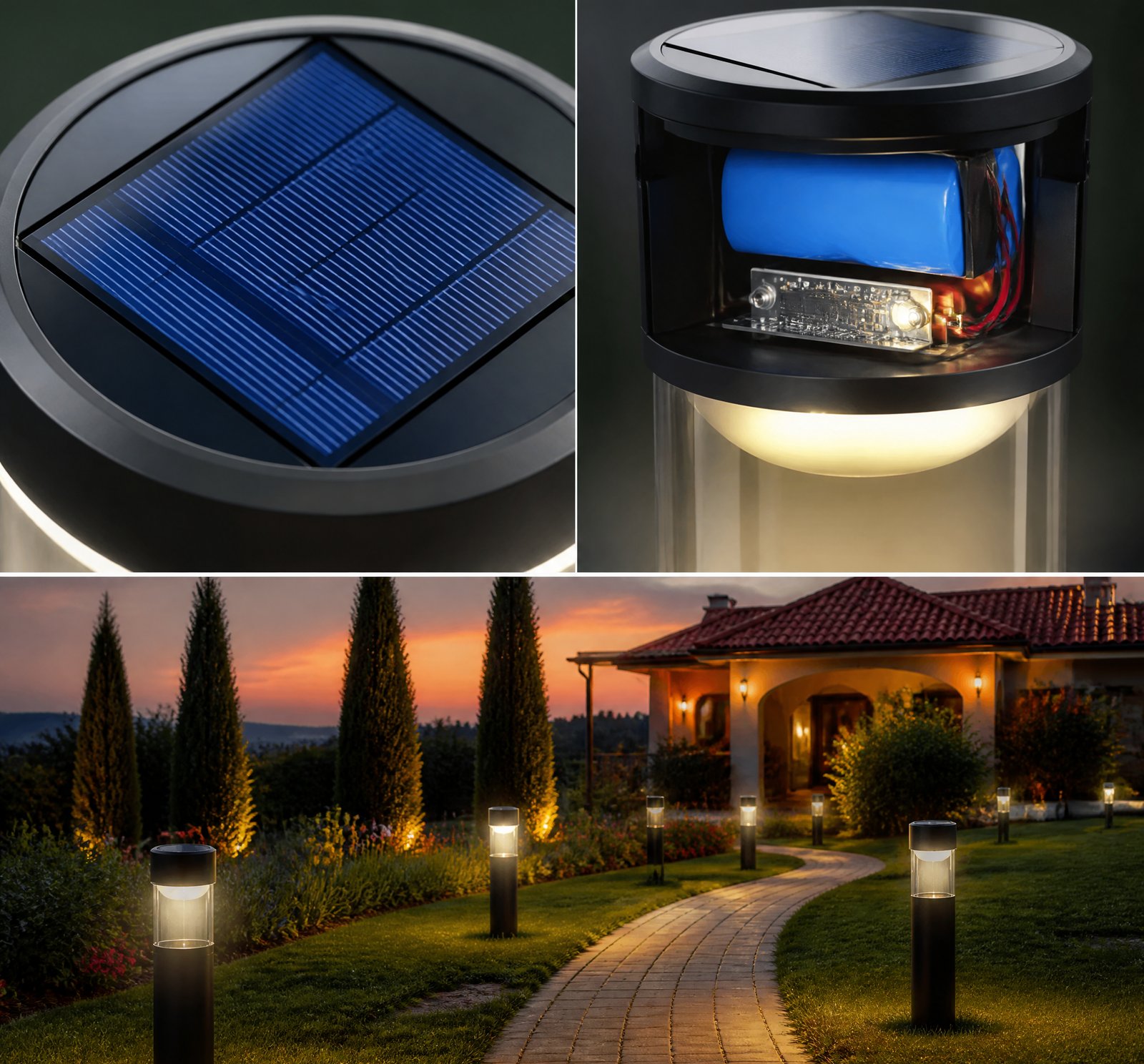
> Quick answer: A polycrystalline-panel + LiFePO4 + PIR solar lamp harvests sunlight during the day, stores energy in a lithium iron phosphate battery, and dispatches power at night via a PIR motion sensor. Efficiency losses occur due to shading [15], temperature effects, and conversion inefficiencies across panels (up to 20% loss), battery charging, and LED conversion [8].
Every evening in Romanian villages and urban gardens, solar lamps glow without drawing from the grid. At the heart of this sustainability shift is a proven system: polycrystalline solar panels, LiFePO4 batteries, and PIR motion sensors working in concert to manage the full energy cycle. But how exactly do they do it—and where do they lose energy?
The Daily Energy Cycle: Harvest, Store, Dispatch
Solar lamps operate on a daily rhythm. During daylight, the polycrystalline panel captures sunlight through the photovoltaic effect, converting photons into direct current (DC) electricity [6]. This power is routed through a charge controller (e.g., LP4060 IC) that regulates voltage and current to prevent overcharging the battery [1,2]. The LiFePO4 battery—a safer, longer-lasting lithium alternative to traditional Li-ion—stores the energy for nighttime use [20]. At dusk or when motion is detected, the PIR sensor triggers the controller to drive the LED load, delivering efficient light with minimal waste [1,2].
Harvesting: Converting Sunlight to Electricity
The solar panel is the system’s first stage. Polycrystalline panels, while less efficient than monocrystalline ones, offer a better cost-to-performance ratio [8]. They typically start at around 90% efficiency, declining to about 80% after ten years [8]. However, real-world performance drops significantly under shading: even 5% shade can cause up to 80% power loss [15]. This makes panel placement critical—avoiding trees, gutters, or shadows from nearby structures is essential for optimal harvest.
| Panel Type | Efficiency Range | Cost Efficiency | Longevity |
|––––|––––––|––––––|––––|
| Polycrystalline | 15–18% [8] | High [8] | 25 years (warranty) |
| Monocrystalline | 20–22% | Lower | 25 years (warranty) |
Storing: Battery Efficiency and Management
The LiFePO4 battery is a key upgrade over older lead-acid or gel electrolyte types [20]. It offers deeper discharge cycles, longer lifespan, and superior thermal stability. However, energy loss still occurs during charging due to heat generation and internal resistance. The charge controller ensures safe charging, protecting against overvoltage and overheating [1,2]. Despite this, battery round-trip efficiency (charging to discharging) typically ranges from 85–90% [24], meaning 10–15% of stored energy is lost as heat.
Dispatching: From Battery to Light
At night, the stored energy powers the LED load via the PIR sensor. LEDs are highly efficient, converting 80–90% of electrical energy into light—far surpassing incandescent bulbs [25]. However, losses occur during DC-to-LED conversion, especially if the controller uses inefficient switching methods. The PIR sensor adds intelligence: it activates the lamp only when motion is detected, reducing runtime and extending battery life. This smart dispatch cuts unnecessary energy use, making systems ideal for outdoor security and pathway lighting.
Efficiency Losses Across Stages
- Harvest: Shading [15], temperature rise (efficiency drops ~0.5% per °C above 25°C), and panel degradation [8]
- Storage: Charge controller inefficiencies (~10% loss), battery self-discharge, and thermal losses [24]
- Dispatch: LED driver losses, wiring resistance, and ambient temperature effects
Practical Applications in Romania
Romanian households and municipalities are adopting solar lamps for off-grid homes, rural roads, and public parks. The Photovoltaic Energy: The Romanian Experience highlights that solar lighting systems can reduce energy costs by up to 70% in remote areas [6]. In urban zones, grid-connected solar lamps help cut peak demand, lowering carbon emissions [3].
Key Takeaways
- Polycrystalline panels deliver strong cost efficiency and 25-year durability [8].
- LiFePO4 batteries improve safety and lifespan vs. traditional lithium or lead-acid [20].
- PIR sensors cut energy use by activating lights only when needed.
- Shading can reduce output by up to 80% [15], making installation planning vital.
- Full system efficiency is typically 50–65% due to cumulative losses [24].
References
- [3] US10563827B2_-_Solar_powered_illumination_system_-_Google_Patents__f82b6692 — patent
source passage
decrease in a number of charging/discharging cycles of the rechargeable battery, which in turn results in longer battery and charge controller lifetime. – the illumination system further has reduced maintenance cost primarily due to the longer lifetime. Landscapes – Engineering & Computer Science (AREA) – General Engineering & Computer Science (AREA) – Life Sciences & Earth Sciences (AREA) – Sustainable Development (AREA) – Power Engineering (AREA) – Non-Portable Lighting Devices Or Systems Thereof (AREA) – Secondary Cells (AREA) Abstract The illumination system includes at least one solar panel, a charge controller, a rechargeable battery, an illumination unit connected to the battery through the controller, and a base frame supporting the solar panel and illumination unit at a top portion thereof, with the battery provided in a bottom portion of the base frame. Description The embodiments herein generally relate to an illumination system and particularly relates to a solar based illumination system with low power usage, standard optical flux and enhanced lifetime. The embodiments herein more particularly relate to an illumination system adapted to work with both solar panels and a main power supply during an off-grid and an on-grid installation respectively. Solar panels are frequently used to recharge batteries during the day that then subsequently are able to power lights at night. Solar panels may serve multiple functions, and, although it is very common for a solar pane
- [6] Photovoltaic Energy_ The Romanian Experience — book
source passage
and how it manages to produce energy using the energy of the sun. We see which are the main components and which are the factors that can compromise its performance. We will see, then, how to size the right system starting from the electricity bill, from the actual consumption and how to mitigate as much as possible the losses due to shading and other inefficiencies . Photovoltaic panels, consisting of the union of several photovoltaic cells, convert the energy of photons into electricity. The process that creates this "energy" is called the photovoltaic effect, the mechanism that, starting from sunlight, induces the "stimulation" of the electrons present in the silicon of which each solar cell is composed. Simplifying to the maximum: when a photon hits the surface of the photovoltaic cell, its energy is transferred to the electrons present on the silicon cell. These electrons are "excited" and begin to flow in the circuit, producing electric current. A solar panel produces energy in Direct Current (DC). It will then be the task of the inverter to convert it into Alternating Current to transport it and use it in our distribution networks. In fact, domestic and industrial buildings are designed for the transport and use of alternating current . The components of a photovoltaic system As many people know, every photovoltaic system consists of at least two basic components: photovoltaic modules, consisting of photovoltaic cells that transform sunlight into electricity, one or mo
- [8] Trends in Photovoltaic Applications — book
source passage
are less complex, more efficient, and cost-effective, mainly with economic incentives (Lima et al., 2017). A Long-Term Evaluation of Energy Generation from Photovoltaic Panels … 189 Figure 1. Variables required for predicting the global solar radiation on tilted panels and the electrical energy produced from the photovoltaic panels. Antonio José Steidle Neto and Daniela de Carvalho Lopes 190 The grid-connected photovoltaic system is composed of a modular panel set, an inverter DC to AC, and an electricity meter. The polycrystalline type of panel was adopted due to its more advantageous benefit-cost ratio compared to the monocrystalline one. The most of manufacturers affirm that the polycrystalline panels are installed with a 25-year warranty, reaching an efficiency of 90% during the first 10 years and 80% during the subsequent 15 years. The electrical energy produced from the photovoltaic system for each municipality was estimated considering the global solar radiation on tilted panels (Figure 1), and the parameter values presented in Table 2. Table 2. Specific parameters of the grid-connected photovoltaic system Parameter Value Reference Quantity of photovoltaic panels 100.0 – Modular area of the photovoltaic panel 1.7 m2 6 Multinational companies Average efficiency of the photovoltaic panel 15.9%* 6 Multinational companies Inverter DC to AC efficiency 90.0% Nacer et al., 2015 Efficiency from cable electricity losses 98.0% Freitas, 2008 * Based on 25 different models of po
- [15] Solar Photovoltaic Energy_ Systems and Design — book
source passage
that is in shade. With solar thermal systems, if 5% of the panel is in shade, you lose around 5% of the power production. Depending on the exact circumstances, even if only 5% of a photovoltaic solar panel is in shade, it is possible to lose 50–80% of power production from your entire solar array. For this reason, it is hugely important that your solar energy system remains out of shade throughout the day. Sometimes this is not possible, and this requires some additional design work in order to keep the effect of shade on your system to a minimum. I cover shade in much more detail in Appendix A, including an explanation of why shade has such a big impact on energy production. For now, it is just important to know that shading can significantly affect the amount of energy you can get from your solar energy system. Solar array power point efficiencies Now we know the theoretical size of our solar panels. However, we have not taken into account the efficiencies of the panels themselves or the efficiencies of the controller or inverter that handles them. Solar panels are rated on their ‘peak power output’. Peak power on a solar panel in bright sunlight is normally generated at between 14 and 20 volts. This voltage can go up and down quite significantly, depending on the amount of sunlight available. This swing in voltage gets much higher if you have multiple solar panels connected together in series – or if you are using a higher-voltage solar panel. It is common for a solar arra
- [20] Solar_lamp_-_Wikipedia__3c516988 — wikipedia
source passage
could cause problems.[6] A battery is usually housed within a metal or plastic case. Inside the case are electrodes including cathodes and anodes where chemical reactions occur. A separator also exists between cathode and anode which stops the electrodes reacting together at the same time as allowing electrical charge to flow freely between the two. Lastly, the collector conducts a charge from the battery to outside.[7] Batteries inside solar lamps usually use gel electrolyte technology with high performance in deep discharging, in order to enable use in extreme ranges of temperature.[citation needed] It may also use lead-acid, nickel metal hydride, nickel cadmium, or lithium. This part of the lamp saves up energy from the solar panel and provides power when needed at night when there is no light energy available. In general, the efficiency of photovoltaic energy conversion is limited for physical reasons. Around 24% of solar radiation of a long wavelength is not absorbed. 33% is heat lost to surroundings, and further losses are of approximately 15-20%. Only 23% is absorbed, which means a battery is a crucial part of solar lamp.[8] This section controls the entire working systems to protect battery charge. It ensures, under any circumstances including extreme weather conditions with large temperature difference, the battery does not overcharge or over discharge and damage the battery even further.[citation needed] This section also includes additional parts such as light cont
- [24] Conference Record of the IEEE Photovoltaic Specialists Conference — book
source passage
daily solar energy incident on the array. riMPPT = daily energy efficiency for the charge controller, the ratio of the daily dc-energy out of the charge controller divided by the daily dc-energy available from the array. (MPPT efficiency) tibat = daily energy efficiency for the battery, the ratio of the daily dc-energy out of the battery divided by the daily dc-energy delivered by the charge controller. tiinv = daily energy efficiency for the inverter, the ratio of the daily ac-energy from the inverter divided by the daily dc-energy provided to the inverter. risYs = overall daily energy efficiency of the system, the ratio of the daily ac-energy to the load divided by the daily dc-energy available from the array. It is important to recognize that the successful application of this testing and analysis procedure required the system to operate continuously for an extended period of time, without exceeding design limits. Otherwise, the daily energy efficiency concept can provide meaningless or unrealistic results. For instance, if the array provided no energy for an entire day, then the daily charge-controller efficiency (timppt) becomes zero. Similarly, if no energy was provided from the charge-controller during the day, but energy was still extracted from the battery, then its energy efficiency (tibat) becomes meaningless. SYSTEM DESIGN AND SIZING The system engineering insight gained from the testing and analysis approach summarized in this paper can improve and simplify the d
- [25] Power Electronics and Motor Drives_ Advances and Applications — book
source passage
can be saved. Such lamps have other advantages, such as longer lamp life, smooth light, and dimming control capability. • CONTROL OF POWER BY ELECTRONIC SWITCHING IS MORE EFFICIENT THAN OLD RHEOSTATIC CONTROL • ROUGHLY 60% TO 65% OF GENERATED ENERGY IS CONSUMED IN ELECTRICAL MACHINES, MAINLY PUMPS AND FANS • VARIABLE-SPEED, FULL-THROTTLE FLOW CONTROL CAN IMPROVE EFFICIENCY BY 30% AT LIGHT LOAD • LIGHT-LOAD REDUCED-FLUX MACHINE OPERATION CAN FURTHER IMPROVE EFFICIENCY • VARIABLE-SPEED AIR CONDITIONERS/HEAT PUMPS CAN SAVE ENERGY BY 30% • 20% OF GENERATED ENERGY IS USED IN LIGHTING • HIGH-FREQUENCY FLUORESCENT LAMPS ARE TWO TO THREE TIMES MORE EFFICIENT THAN INCANDESCENT LAMPS, LED LAMPS HAVE HIGHER EFFICIENCY THAN FLUORESCENT LAMPS FIGURE 1.16 Energy saving with power electronics. Power Electronics and Motor Drives 21 What is renewable energy? It is a kind of energy that never gets depleted or exhausted with usage. It is interesting to note that all of the energy resources in the world originate from the sun. Of course, the earth was originally created from the sun. The earth has abundant resources of renewable energy, which can be classified as hydroelectric, wind, solar (PVand thermal), ocean (wave and thermal), geothermal, and biomass (primary and secondary). All these resources are environ- mentally clean (or green), economical and abundant all over the world. Some of these energy sources may be sporadic and unpredictable in nature. Currently, all these energy resources are
decrease in a number of charging/discharging cycles of the rechargeable battery, which in turn results in longer battery and charge controller lifetime. – the illumination system further has reduced maintenance cost primarily due to the longer lifetime. Landscapes – Engineering & Computer Science (AREA) – General Engineering & Computer Science (AREA) – Life Sciences & Earth Sciences (AREA) – Sustainable Development (AREA) – Power Engineering (AREA) – Non-Portable Lighting Devices Or Systems Thereof (AREA) – Secondary Cells (AREA) Abstract The illumination system includes at least one solar panel, a charge controller, a rechargeable battery, an illumination unit connected to the battery through the controller, and a base frame supporting the solar panel and illumination unit at a top portion thereof, with the battery provided in a bottom portion of the base frame. Description The embodiments herein generally relate to an illumination system and particularly relates to a solar based illumination system with low power usage, standard optical flux and enhanced lifetime. The embodiments herein more particularly relate to an illumination system adapted to work with both solar panels and a main power supply during an off-grid and an on-grid installation respectively. Solar panels are frequently used to recharge batteries during the day that then subsequently are able to power lights at night. Solar panels may serve multiple functions, and, although it is very common for a solar pane
and how it manages to produce energy using the energy of the sun. We see which are the main components and which are the factors that can compromise its performance. We will see, then, how to size the right system starting from the electricity bill, from the actual consumption and how to mitigate as much as possible the losses due to shading and other inefficiencies . Photovoltaic panels, consisting of the union of several photovoltaic cells, convert the energy of photons into electricity. The process that creates this "energy" is called the photovoltaic effect, the mechanism that, starting from sunlight, induces the "stimulation" of the electrons present in the silicon of which each solar cell is composed. Simplifying to the maximum: when a photon hits the surface of the photovoltaic cell, its energy is transferred to the electrons present on the silicon cell. These electrons are "excited" and begin to flow in the circuit, producing electric current. A solar panel produces energy in Direct Current (DC). It will then be the task of the inverter to convert it into Alternating Current to transport it and use it in our distribution networks. In fact, domestic and industrial buildings are designed for the transport and use of alternating current . The components of a photovoltaic system As many people know, every photovoltaic system consists of at least two basic components: photovoltaic modules, consisting of photovoltaic cells that transform sunlight into electricity, one or mo
are less complex, more efficient, and cost-effective, mainly with economic incentives (Lima et al., 2017). A Long-Term Evaluation of Energy Generation from Photovoltaic Panels … 189 Figure 1. Variables required for predicting the global solar radiation on tilted panels and the electrical energy produced from the photovoltaic panels. Antonio José Steidle Neto and Daniela de Carvalho Lopes 190 The grid-connected photovoltaic system is composed of a modular panel set, an inverter DC to AC, and an electricity meter. The polycrystalline type of panel was adopted due to its more advantageous benefit-cost ratio compared to the monocrystalline one. The most of manufacturers affirm that the polycrystalline panels are installed with a 25-year warranty, reaching an efficiency of 90% during the first 10 years and 80% during the subsequent 15 years. The electrical energy produced from the photovoltaic system for each municipality was estimated considering the global solar radiation on tilted panels (Figure 1), and the parameter values presented in Table 2. Table 2. Specific parameters of the grid-connected photovoltaic system Parameter Value Reference Quantity of photovoltaic panels 100.0 – Modular area of the photovoltaic panel 1.7 m2 6 Multinational companies Average efficiency of the photovoltaic panel 15.9%* 6 Multinational companies Inverter DC to AC efficiency 90.0% Nacer et al., 2015 Efficiency from cable electricity losses 98.0% Freitas, 2008 * Based on 25 different models of po
that is in shade. With solar thermal systems, if 5% of the panel is in shade, you lose around 5% of the power production. Depending on the exact circumstances, even if only 5% of a photovoltaic solar panel is in shade, it is possible to lose 50–80% of power production from your entire solar array. For this reason, it is hugely important that your solar energy system remains out of shade throughout the day. Sometimes this is not possible, and this requires some additional design work in order to keep the effect of shade on your system to a minimum. I cover shade in much more detail in Appendix A, including an explanation of why shade has such a big impact on energy production. For now, it is just important to know that shading can significantly affect the amount of energy you can get from your solar energy system. Solar array power point efficiencies Now we know the theoretical size of our solar panels. However, we have not taken into account the efficiencies of the panels themselves or the efficiencies of the controller or inverter that handles them. Solar panels are rated on their ‘peak power output’. Peak power on a solar panel in bright sunlight is normally generated at between 14 and 20 volts. This voltage can go up and down quite significantly, depending on the amount of sunlight available. This swing in voltage gets much higher if you have multiple solar panels connected together in series – or if you are using a higher-voltage solar panel. It is common for a solar arra
could cause problems.[6] A battery is usually housed within a metal or plastic case. Inside the case are electrodes including cathodes and anodes where chemical reactions occur. A separator also exists between cathode and anode which stops the electrodes reacting together at the same time as allowing electrical charge to flow freely between the two. Lastly, the collector conducts a charge from the battery to outside.[7] Batteries inside solar lamps usually use gel electrolyte technology with high performance in deep discharging, in order to enable use in extreme ranges of temperature.[citation needed] It may also use lead-acid, nickel metal hydride, nickel cadmium, or lithium. This part of the lamp saves up energy from the solar panel and provides power when needed at night when there is no light energy available. In general, the efficiency of photovoltaic energy conversion is limited for physical reasons. Around 24% of solar radiation of a long wavelength is not absorbed. 33% is heat lost to surroundings, and further losses are of approximately 15-20%. Only 23% is absorbed, which means a battery is a crucial part of solar lamp.[8] This section controls the entire working systems to protect battery charge. It ensures, under any circumstances including extreme weather conditions with large temperature difference, the battery does not overcharge or over discharge and damage the battery even further.[citation needed] This section also includes additional parts such as light cont
daily solar energy incident on the array. riMPPT = daily energy efficiency for the charge controller, the ratio of the daily dc-energy out of the charge controller divided by the daily dc-energy available from the array. (MPPT efficiency) tibat = daily energy efficiency for the battery, the ratio of the daily dc-energy out of the battery divided by the daily dc-energy delivered by the charge controller. tiinv = daily energy efficiency for the inverter, the ratio of the daily ac-energy from the inverter divided by the daily dc-energy provided to the inverter. risYs = overall daily energy efficiency of the system, the ratio of the daily ac-energy to the load divided by the daily dc-energy available from the array. It is important to recognize that the successful application of this testing and analysis procedure required the system to operate continuously for an extended period of time, without exceeding design limits. Otherwise, the daily energy efficiency concept can provide meaningless or unrealistic results. For instance, if the array provided no energy for an entire day, then the daily charge-controller efficiency (timppt) becomes zero. Similarly, if no energy was provided from the charge-controller during the day, but energy was still extracted from the battery, then its energy efficiency (tibat) becomes meaningless. SYSTEM DESIGN AND SIZING The system engineering insight gained from the testing and analysis approach summarized in this paper can improve and simplify the d
can be saved. Such lamps have other advantages, such as longer lamp life, smooth light, and dimming control capability. • CONTROL OF POWER BY ELECTRONIC SWITCHING IS MORE EFFICIENT THAN OLD RHEOSTATIC CONTROL • ROUGHLY 60% TO 65% OF GENERATED ENERGY IS CONSUMED IN ELECTRICAL MACHINES, MAINLY PUMPS AND FANS • VARIABLE-SPEED, FULL-THROTTLE FLOW CONTROL CAN IMPROVE EFFICIENCY BY 30% AT LIGHT LOAD • LIGHT-LOAD REDUCED-FLUX MACHINE OPERATION CAN FURTHER IMPROVE EFFICIENCY • VARIABLE-SPEED AIR CONDITIONERS/HEAT PUMPS CAN SAVE ENERGY BY 30% • 20% OF GENERATED ENERGY IS USED IN LIGHTING • HIGH-FREQUENCY FLUORESCENT LAMPS ARE TWO TO THREE TIMES MORE EFFICIENT THAN INCANDESCENT LAMPS, LED LAMPS HAVE HIGHER EFFICIENCY THAN FLUORESCENT LAMPS FIGURE 1.16 Energy saving with power electronics. Power Electronics and Motor Drives 21 What is renewable energy? It is a kind of energy that never gets depleted or exhausted with usage. It is interesting to note that all of the energy resources in the world originate from the sun. Of course, the earth was originally created from the sun. The earth has abundant resources of renewable energy, which can be classified as hydroelectric, wind, solar (PVand thermal), ocean (wave and thermal), geothermal, and biomass (primary and secondary). All these resources are environ- mentally clean (or green), economical and abundant all over the world. Some of these energy sources may be sporadic and unpredictable in nature. Currently, all these energy resources are