
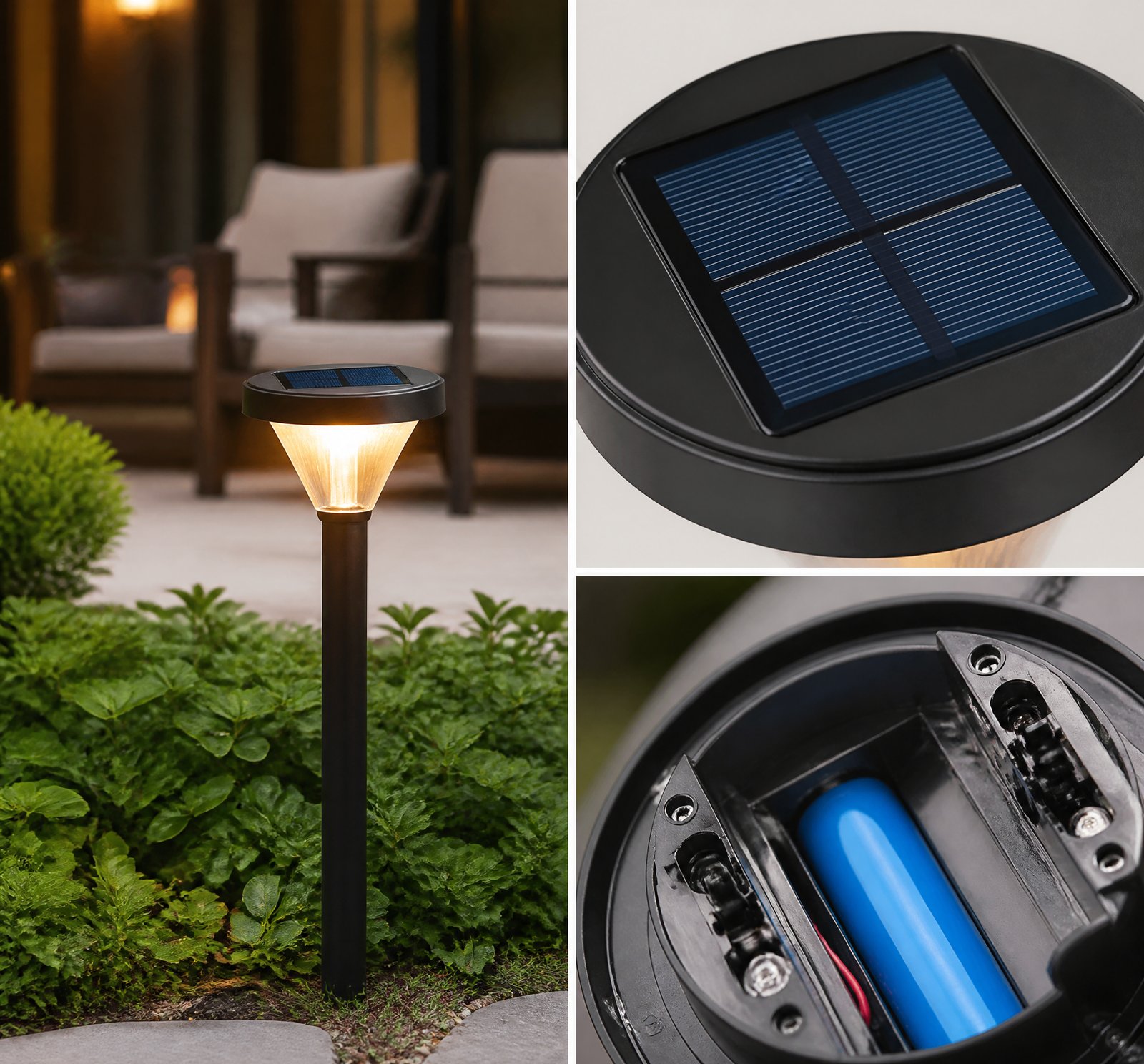
> Quick answer: Solar panels in outdoor lamps lose output over time due to gradual material degradation [1][3], heat-induced performance loss [16], soiling [17], and electrical issues like potential-induced degradation (PID) [6]. Modern panels degrade at less than 0.5% per year, slower than commonly assumed [12].
Solar lamps are a practical solution for lighting outdoor spaces in Romania and beyond. However, as they age, many users notice a decline in their output. This article will explore the primary causes of this phenomenon, backed by research findings.
The Gradual Decline: Material Degradation
Over time, solar panels experience intrinsic material degradation, leading to an estimated annual loss of 0.5% to 1% [5][12][19]. While traditional estimates suggest a 1% decline per year, recent studies show that modern monocrystalline silicon panels manufactured post-2000 degrade at less than 0.4% annually [12]. This means most panels retain about 80% of their original output after 25 years—aligning with manufacturer warranties [14][15].
Light-Induced Degradation (LID)
One of the earliest losses is through light-induced degradation (LID), where solar exposure causes a one-time efficiency drop of 1% to 3% within the first hours of use [1][3]. This occurs due to interactions between sunlight and impurities in crystalline silicon wafers, particularly boron-oxygen complexes [1][3].
Environmental Stressors: Heat and Cold
High temperatures negatively affect panel performance by increasing electrical resistance and reducing voltage output. Thermal cycling from day-night temperature swings can also cause microcracks and delamination [16][20]. Conversely, cold temperatures can improve performance by reducing electrical resistance, although winter conditions like snow accumulation can diminish this benefit [16].
Soiling: Accumulation of Dust and Debris
Soiling—the buildup of dust, pollen, bird droppings, and debris on the panel surface—can drastically reduce output. Even partial coverage can lead to significant losses; 10% coverage can reduce total production by up to 30% [8]. Regular cleaning or rain can help mitigate this issue, though it is more challenging in dry or dusty climates [2][17].
Electrical Degradation Mechanisms
Potential-induced degradation (PID) occurs when voltage differences between the panel’s frame and cells cause current leakage, leading to ion migration—typically sodium ions moving toward the cell or frame depending on grounding [6][7]. This is exacerbated by transformerless inverters, which are ungrounded and increase PID risk [6][7]. While grounding can mitigate PID, it remains a concern in modern installations [6][7].
UV Radiation: A Growing Concern
Recent lab tests have identified strong UV-induced degradation in some modules, though its real-world impact is still under study [21]. This highlights the need for ongoing research into UV protection and materials.
Battery Degradation
While not extensively covered in the literature provided, battery health directly affects overall system performance and lifespan. Regular maintenance can help manage this aspect of solar lamp degradation.
Key Takeaways
- Solar panels degrade at less than 0.5% annually post-2000 [12].
- Light-induced degradation (LID) causes an initial efficiency drop but is not a long-term issue.
- Heat, soiling, and electrical issues like PID significantly impact solar lamp performance.
- Regular cleaning and maintenance can extend lifespan.
Frequently Asked Questions
[
{
„q”: „How much does light-induced degradation (LID) affect solar lamps?”,
„a”: „Light-induced degradation (LID) causes a one-time efficiency drop of 1% to 3% within the first hours of exposure [1][3].”
},
{
„q”: „What role does soiling play in solar lamp performance?”,
„a”: „Soiling can drastically reduce output, with just 10% coverage reducing total production by up to 30%. Regular cleaning is crucial [8][17].”
},
{
„q”: „How do temperature changes affect solar panels?”,
„a”: „High temperatures increase electrical resistance and reduce voltage output. Cold can improve performance but snow accumulation offsets these benefits [16][20].”
}
]
References
- [1] How_long_do_rooftop_residential_solar_panels_last_-_pv_magazine_Global__7bebb092 — authority
source passage
to decline, in some cases significantly. All panels also suffer something called light induced degradation (LID), in which panels lose efficiency within the first hours of being exposed to the sun. LID varies from panel to panel based on the quality of the crystalline silicon wafers, but usually results in a one-time, 1% to 3% loss in efficiency, said testing laboratory PVEL, PV Evolution Labs. Weather conditions The exposure to weather conditions is the main driver in panel degradation. Heat is a key factor in both real-time panel performance and degradation over time. Ambient heat negatively affects the performance and efficiency of electrical components, according to NREL. By checking the manufacturer’s data sheet, a panel’s temperature coefficient can be found, which will demonstrate the panel’s ability to perform in higher temperatures, said SolarCalculator.com. Heat exchange also drives degradation through a process called thermal cycling. When it is warm, materials expand, and when the temperature lowers, they contract. This movement slowly causes microcracks to form in the panel over time, lowering output.The coefficient explains how much efficiency is lost by each degree of Celsius increased above the standard temperature of 25 C. For example, a temperature coefficient of -0.353% means that for every degree Celsius above 25, 0.353% of total production capability is lost. In its annual Module Score Card study, PVEL analyzed 36 operational solar projects in India, and
- [2] Solar_Panel_Maintenance_Everything_You_Need_To_Know__c7394383 — authority
source passage
to decrease, you can monitor it via an app. Lower energy output could be a sign that your panels are obstructed by something, like debris, and cannot generate their typical electricity amount. By integrating a solar panel monitoring system into your setup, you can track how much energy your panels produce on any given day and how much they produce over time. This allows you to see exactly how various external factors affect your panels' performance and how well they're maintaining their efficiency across their life. The monitoring system will also alert you if a panel breaks or malfunctions so that you can repair or replace it. Let's take a closer look at how to make sure your solar panels last as long as possible. How do you maintain solar panels? If your panels are tilted, you’re in luck: rainfall will actually clear away debris that's accumulated on them. However, during the dry season or extended periods without rain, it's important to clean them manually. It is generally recommended that you perform solar panel cleaning between two and four times per year. While that might seem like a lot, the good news is that this doesn’t require much work. All you really need is a leaf blower or a quick spray with a garden hose, and your panels will be clean and in top condition. In winter, you may need to clean your panels after a heavy snowfall. If you're using water to clear the snow away, make sure it's lukewarm. You can also use a squeegee with a long handle. It is important to n
- [3] How_long_do_residential_solar_panels_last_pv_magazine_International__a1e59f16 — authority
source passage
materials in their glass, encapsulation, and diffusion barriers. All panels also suffer something called light-induced degradation (LID), in which panels lose efficiency within the first hours of being exposed to the sun. LID varies from panel to panel based on the quality of the crystalline silicon wafers, but usually results in a one-time, 1-3% loss in efficiency, said testing laboratory PVEL, PV Evolution Labs. Weathering The exposure to weather conditions is the main driver in panel degradation. Heat is a key factor in both real-time panel performance and degradation over time. Ambient heat negatively affects the performance and efficiency of electrical components, according to NREL. By checking the manufacturer’s data sheet, a panel’s temperature coefficient can be found, which will demonstrate the panel’s ability to perform in higher temperatures. The coefficient explains how much real-time efficiency is lost by each degree Celsius increase above the standard temperature of 25 degrees Celsius. For example, a temperature coefficient of -0.353% means that for every degree Celsius above 25, 0.353% of total production capability is lost. Heat exchange drives panel degradation through a process called thermal cycling. When it is warm, materials expand, and when the temperature lowers, they contract. This movement slowly causes microcracks to form in the panel over time, lowering output. In its annual Module Score Card study, PVEL analyzed 36 operational solar projects in Ind
- [5] Unbound_Solar__8_Costly_Solar_Mistakes_to_Avoid_When_You_Design_Your_Solar_Panel_Kit__vox2ZYlGo2I — youtube
source passage
shading, natural efficiency drop, and other things that impact the true output of your system. That's why we recommend that you consult with an experienced solar technician first before investing in your solar system. Here are the following things you should talk about with your solar technician. First, efficiency. Solar panel efficiency drops about 1% every year. It's a good idea to design a little extra headroom to account for the 10 to 20% decrease that happens over the course of 20 years. In most cases, this is an extra panel or two. Second, weather and location. Solar panels are tested in ideal conditions, but in the real world, your system can be exposed to much harsher conditions. High temperatures can actually reduce the amount of energy your panels generate. Your location also dictates how many sun hours you get. The term sun hours doesn't mean how long the sun is in the sky. It refers to the amount of time the sun is in the right position to generate peak energy. Most places get about four to six sun hours per day, and the exact amount influences system sizing. Third, voltage. Your system needs to be designed at the right voltage based on the equipment being used and what it requires. We also account for things like temperature that can affect voltage and system performance. If you don't have the right voltage from your solar panels or battery bank, your system might not perform well, or worse, you could damage your expensive hardware. And finally, battery bank sizi
- [6] What_forces_cause_solar_panel_degradation_and_failure__8652ad31 — magazine
source passage
panels turn on themselves after years in the field, outside products can also contribute to degradation levels. The increased usage of transformerless inverters on U.S. solar projects has raised the threat level of potential induced degradation (PID) of solar panels. PID happens when different components in the same system are at different voltage potentials (such as the frame and the solar cell), which can allow electrical current to leak and modules to lose their peak performance. Often, simply negatively grounding a system removes the concern for PID, but transformerless inverters are ungrounded. When that electrical current leaks, sodium ions in the glass move toward the solar cell or the frame, depending on how the system is grounded. There’s also an issue with the whole industry moving to higher voltages, because higher voltages make that current pull stronger, and sodium ions move more easily over top solar cells, reducing their output. Frameless modules can help reduce the PID possibility (since there’s no metal frame to disrupt voltages). And many module manufacturers take extra steps to ensure modules are PID-free now. It’s important for installers to know what products they’re combining into a full system to know if something besides the panel may contribute to degradation. Cheaper panels and less material Back in 2015, NREL surveyed New York installers and found that many were having the same issues with new solar modules. As module companies were trying to lower
- [7] What_forces_cause_solar_panel_degradation_and_failure__8652ad31 — authority
source passage
panels turn on themselves after years in the field, outside products can also contribute to degradation levels. The increased usage of transformerless inverters on U.S. solar projects has raised the threat level of potential induced degradation (PID) of solar panels. PID happens when different components in the same system are at different voltage potentials (such as the frame and the solar cell), which can allow electrical current to leak and modules to lose their peak performance. Often, simply negatively grounding a system removes the concern for PID, but transformerless inverters are ungrounded. When that electrical current leaks, sodium ions in the glass move toward the solar cell or the frame, depending on how the system is grounded. There’s also an issue with the whole industry moving to higher voltages, because higher voltages make that current pull stronger, and sodium ions move more easily over top solar cells, reducing their output. Frameless modules can help reduce the PID possibility (since there’s no metal frame to disrupt voltages). And many module manufacturers take extra steps to ensure modules are PID-free now. It’s important for installers to know what products they’re combining into a full system to know if something besides the panel may contribute to degradation. Cheaper panels and less material Back in 2015, NREL surveyed New York installers and found that many were having the same issues with new solar modules. As module companies were trying to lower
- [8] Why_do_solar_power_plants_work_inefficiently_-_pv_magazine_Global__212d1863 — authority
source passage
their power plants will produce under ideal conditions. In other words, it is practically impossible to see the figures declared by the cheap producers in reality, while EU-made power plants can achieve even higher production. Even small things can have a big impact However, the efficiency of even two identical solar power plants installed in different locations can differ significantly. Not only due to cloudiness, seasonality, direction or angle of the roof, but also for many other reasons. Our research shows that if even a small area of the solar panel is covered, for example, by falling leaves, dirt, or the shadow of a tree or bush – the overall efficiency of the power plant is significantly reduced. In some cases, even a tenth of the covered area can reduce total production by up to 30%. Therefore, periodic cleaning of solar modules, pruning of surrounding vegetation and similar maintenance play a crucial role. The infographic below shows how the power plant’s efficiency is reduced if leaves fall on one of the panels: Not all problems are noticed and solved so simply. Solar power plants are full of equipment, connectors, and other components that can fail or disconnect unexpectedly. As a result, electricity production can be reduced or even completely stopped. There are many different examples. The information we have gathered shows that a common problem with solar power plants is inventories heating up. They are usually housed in closed cabinets that protect them from ra
- [12] Solar_Panels_May_Last_Longer_Than_You_Think_-_GreenBuildingAdvisor__730f378f — authority
source passage
# Solar Panels May Last Longer Than You Think – GreenBuildingAdvisor Source: Blog/Web URL: https://www.greenbuildingadvisor.com/article/solar-panels-may-last-longer-than-you-think Author: Scott Gibson Date: 2014-05-01 The rule of thumb on the long-term performance of photovoltaic panels is that output will decline by about 1% each year. After 20 years in service, panels should still be able to produce roughly 80% of their rated capacity. But research at the National Renewable Energy Laboratory finds that rate of degradation is probably overstated, according to a post at Engineering.com. Researchers found the output of the most common type of panels made with mono-crystalline silicon fell by less than 0.5% for panels manufactured before 2000 and by less than 0.4% for panels made after that date. The difference is significant: after 20 years of use, panels manufactured today should be producing 92% of their original rated capacity rather than 80%. (To read the results of tests performed by GBA senior editor Martin Holladay on an ancient PV panel, see Testing a Thirty-Year-Old Photovoltaic Module.) Rates vary by climate Researchers found some variation in the degradation rate depending on where the panels were installed, Engineering.com said. In extreme climates, such as areas where panels were subjected to heavy snow or wind loads or high levels of ultraviolet radiation, degradation rates were nearly 1% per year. In moderate climates, rates were as low as 0.2% per year; after 2
- [14] What_forces_cause_solar_panel_degradation_and_failure__8652ad31 — magazine
source passage
# What forces cause solar panel degradation and failure Source: Blog/Web URL: https://www.solarpowerworldonline.com/2017/06/causes-solar-panel-degradation/ Author: Kelly Pickerel Date: 2017-06-05 Although crystalline solar power panels are often sold with 25- to 30-year lifespan guarantees, those 30-year-old modules won’t be performing as well as they did on Day 1. Performance declines as solar cells experience degradation due to unavoidable circumstances like UV exposure and weather cycles. Manufacturers realize this, so solar panels come with a power output or performance warranty that usually guarantees 80% production at 25 years. Panel companies are only comfortable offering this guarantee because of a 2012 NREL study (“Photovoltaic Degradation Rates—An Analytical Review”) that found solar panels degrade about 0.5% to 3% each year, barring any equipment issues. So panels degrade automatically; that’s worked into their performance warranties. There are also outside forces that can contribute to a panel’s degradation and possible failure. We talked with Sarah Kurtz, research fellow at NREL and co-author of that oft-cited 2012 study, on how technology and manufacturing changes, along with installation practices, affect degradation rates. A complex issue According to NREL, modules can fail because of unavoidable elements like thermal cycling, damp heat, humidity freeze and UV exposure. Thermal cycling can cause solder bond failures and cracks in solar cells. Damp heat has bee
- [15] What_forces_cause_solar_panel_degradation_and_failure__8652ad31 — authority
source passage
# What forces cause solar panel degradation and failure Source: Blog/Web URL: https://www.solarpowerworldonline.com/2017/06/causes-solar-panel-degradation/ Author: Kelly Pickerel Date: 2017-06-05 Although crystalline solar power panels are often sold with 25- to 30-year lifespan guarantees, those 30-year-old modules won’t be performing as well as they did on Day 1. Performance declines as solar cells experience degradation due to unavoidable circumstances like UV exposure and weather cycles. Manufacturers realize this, so solar panels come with a power output or performance warranty that usually guarantees 80% production at 25 years. Panel companies are only comfortable offering this guarantee because of a 2012 NREL study (“Photovoltaic Degradation Rates—An Analytical Review”) that found solar panels degrade about 0.5% to 3% each year, barring any equipment issues. So panels degrade automatically; that’s worked into their performance warranties. There are also outside forces that can contribute to a panel’s degradation and possible failure. We talked with Sarah Kurtz, research fellow at NREL and co-author of that oft-cited 2012 study, on how technology and manufacturing changes, along with installation practices, affect degradation rates. A complex issue According to NREL, modules can fail because of unavoidable elements like thermal cycling, damp heat, humidity freeze and UV exposure. Thermal cycling can cause solder bond failures and cracks in solar cells. Damp heat has bee
- [16] Solar_panel_-_Wikipedia__afb0eaf3 — wikipedia
source passage
high temperatures negatively impact efficiency, colder temperatures can improve solar panel performance due to reduced electrical resistance within the cells. However, winter conditions introduce additional challenges such as snow accumulation and reduced daylight hours, which can offset the efficiency benefits of lower temperatures. Solar panels are still capable of generating power in winter, but overall output may be lower due to limited sunlight exposure and potential obstructions.[68] The ability of solar modules to withstand damage by rain, hail, heavy snow load, and cycles of heat and cold varies by manufacturer, although most solar panels on the U.S. market are UL listed, meaning they have gone through testing to withstand hail.[69] Potential-induced degradation (also called PID) is a potential-induced performance degradation in crystalline photovoltaic modules, caused by so-called stray currents.[70] This effect may cause power loss of up to 30%.[71] The power output of a photovoltaic (PV) device decreases over time due to exposure to solar radiation as well as other external conditions. The degradation index, defined as the annual percentage of output power loss, is a key factor in determining the long-term production of a photovoltaic plant. To estimate this degradation, the percentage of decrease associated with each of the electrical parameters is calculated. Individual degradation of a solar panel can negatively influence the performance of a complete string.[72
- [17] Green_Tech_Town__UL-Solar_Solar_Panel_Quality_Check_After_2_Years__C00t_Lgfth0 — youtube
source passage
I should also point out again that there are many solar panel cleaning solution kits online but some can be expensive and in my case this method comes out to be cheaper and easier after cleaning the solar panels I rechecked with my digital multimeter to see how many amps I was producing and as I predicted the pollen does have a tremendous effect on the power the solar panels can produce and while performing this test I received nine point seven amps max next I checked the condition of my solar panels and I found more discoloration on some of my solar cells last year when I contacted the company I bought the solar panels firm which was ul solar regarding this problem you are Solar City if the panel's were not outputting the right amount of power that they should be for their age they would have no problem replacing the solar panel since they do come with a 25 year warranty but I still wanted to see what causes this discoloration so after doing some quick research I found that some say it's a problem with materials or the workmanship when the solar panels are being produced or just caused by moisture from condensation on the metal context to spray it out away from the surrounding cell surfaces and the list of possibilities just went on and on and on so the route calls what the root causes hasn't really been found but one can probably conclude that it has something to do with the workmanship when the solar panels were being produced and all the air was maybe not fully vacuumed o
- [19] Undecided_with_Matt_Ferrell__Why_This_Might_Be_the_Last_Solar_Panel_Youll_Ever_Need__Lglick8bCPc — youtube
source passage
a constant barrage of environmental hazards: hail, snow, dust, and temperature swings. On average, a solar panel loses about 0.5% to 0.8% efficiency per year. So, the goal isn’t just a longer lifespan, but a longer healthspan … making sure panels keep performing at a high level throughout their lifetime. And when a single cell on a panel gets damaged? Replacing it isn’t really an option. This becomes even more of a problem when you look at satellites, probes, and other space-based PV tech. Up there, the sun’s rays are unfiltered by an atmosphere, and let’s face it, sending a repair crew into orbit isn’t exactly practical. To top it off, the durability that makes PVs so tough in the field also makes them hard to recycle. There are folks working on that, and I've made videos on it, but for now, keeping panels in service as long as possible reduces their environmental impact, and makes them a better long-term investment. These challenges inspired the development of the first self-healing PV back in 2010, when MIT Professor Michael Strano took a page straight out of nature’s playbook. Photosynthesizing plants are surprisingly similar to solar panels. They both use sunlight to generate energy, and they’re both vulnerable to the sun’s damaging rays. In plants, the photosynthetic molecules in leaves are constantly being destroyed by sunlight. But here’s the cool part: plants replace those molecules within an hour, keeping their energy production running at full capacity day after da
- [20] How_Does_Weather_Affect_PV_System_Degradation_and_Performance__c64c4d74 — authority
source passage
# How Does Weather Affect PV System Degradation and Performance? – Tech Insights Source: Blog/Web URL: https://eepower.com/tech-insights/how-does-weather-affect-pv-system-degradation-and-performance/ Author: Shannon Cuthrell Date: 2024-02-12 How Does Weather Affect PV System Degradation and Performance? Researchers collected data on an unprecedented sample size of solar systems in the U.S., yielding some interesting findings on extreme weather and long-term degradation. Solar photovoltaic (PV) systems are built to last for decades, but exposure to the elements and minor losses in energy production can accumulate over time. The National Renewable Energy Laboratory (NREL) spent four years analyzing data to shed light on this topic, which lacks an industry-wide consensus due to inconsistent performance metrics and manufacturer-specific system variations. The dataset includes an unprecedented net of 25,000 inverters across nearly 2,500 commercial- and utility-scale projects in 37 states and territories. This covers about 11% of the U.S. solar fleet—or 8 of 72 GW. The mean age of these systems was five years. An electroluminescence image of a person creating cracks in an NREL test solar panel. Image used courtesy of NREL Short-Term Weather Impacts on PV Systems To study the consequences of hail, flooding, wind gusts, lightning, wildfire, and other natural conditions, NREL compared the dataset to a map of extreme weather records compiled by the National Oceanic and Atmospheric Admi
- [21] Uncovering_UV_degradation_risks_in_solar_panels_-_pv_magazine__009c501f — magazine
source passage
# Uncovering UV degradation risks in solar panels – pv magazine Global Source: Blog/Web URL: https://www.pv-magazine.com/2025/08/21/uncovering-uv-degradation-risks-in-solar-panels/ Author: Mark Hutchins Date: 2025-08-21 From pv magazine 6/25 “The Hunt for High Efficiency” Can you give some background on recent industry concerns around ultraviolet-induced degradation in PV modules? For around two and a half years, we have been involved in several projects where larger module buyers benchmark different module types against each other in terms of reliability. In this context, we realized that there was strong UV degradation in lab tests for some modules. This came alongside some other issues like mechanical load or damp heat degradation, but the UV degradation was the most surprising to us, and to others in the industry, including some module manufacturers. To put it simply, the applied UV dose in the test typically corresponds to about one year of exposure in Europe. If this lab degradation appeared in the field, this would mean that the economic viability of many large PV projects could be significantly impaired, just because of the amount of UV-related performance loss. And have you seen these levels of UV degradation start to appear in modules already in the field? This is where another recent finding comes in. We quickly realized that these modules did not show stable behavior after UV testing in the lab. Depending on the storage and light conditions, we sometimes saw very
to decline, in some cases significantly. All panels also suffer something called light induced degradation (LID), in which panels lose efficiency within the first hours of being exposed to the sun. LID varies from panel to panel based on the quality of the crystalline silicon wafers, but usually results in a one-time, 1% to 3% loss in efficiency, said testing laboratory PVEL, PV Evolution Labs. Weather conditions The exposure to weather conditions is the main driver in panel degradation. Heat is a key factor in both real-time panel performance and degradation over time. Ambient heat negatively affects the performance and efficiency of electrical components, according to NREL. By checking the manufacturer’s data sheet, a panel’s temperature coefficient can be found, which will demonstrate the panel’s ability to perform in higher temperatures, said SolarCalculator.com. Heat exchange also drives degradation through a process called thermal cycling. When it is warm, materials expand, and when the temperature lowers, they contract. This movement slowly causes microcracks to form in the panel over time, lowering output.The coefficient explains how much efficiency is lost by each degree of Celsius increased above the standard temperature of 25 C. For example, a temperature coefficient of -0.353% means that for every degree Celsius above 25, 0.353% of total production capability is lost. In its annual Module Score Card study, PVEL analyzed 36 operational solar projects in India, and
to decrease, you can monitor it via an app. Lower energy output could be a sign that your panels are obstructed by something, like debris, and cannot generate their typical electricity amount. By integrating a solar panel monitoring system into your setup, you can track how much energy your panels produce on any given day and how much they produce over time. This allows you to see exactly how various external factors affect your panels' performance and how well they're maintaining their efficiency across their life. The monitoring system will also alert you if a panel breaks or malfunctions so that you can repair or replace it. Let's take a closer look at how to make sure your solar panels last as long as possible. How do you maintain solar panels? If your panels are tilted, you’re in luck: rainfall will actually clear away debris that's accumulated on them. However, during the dry season or extended periods without rain, it's important to clean them manually. It is generally recommended that you perform solar panel cleaning between two and four times per year. While that might seem like a lot, the good news is that this doesn’t require much work. All you really need is a leaf blower or a quick spray with a garden hose, and your panels will be clean and in top condition. In winter, you may need to clean your panels after a heavy snowfall. If you're using water to clear the snow away, make sure it's lukewarm. You can also use a squeegee with a long handle. It is important to n
materials in their glass, encapsulation, and diffusion barriers. All panels also suffer something called light-induced degradation (LID), in which panels lose efficiency within the first hours of being exposed to the sun. LID varies from panel to panel based on the quality of the crystalline silicon wafers, but usually results in a one-time, 1-3% loss in efficiency, said testing laboratory PVEL, PV Evolution Labs. Weathering The exposure to weather conditions is the main driver in panel degradation. Heat is a key factor in both real-time panel performance and degradation over time. Ambient heat negatively affects the performance and efficiency of electrical components, according to NREL. By checking the manufacturer’s data sheet, a panel’s temperature coefficient can be found, which will demonstrate the panel’s ability to perform in higher temperatures. The coefficient explains how much real-time efficiency is lost by each degree Celsius increase above the standard temperature of 25 degrees Celsius. For example, a temperature coefficient of -0.353% means that for every degree Celsius above 25, 0.353% of total production capability is lost. Heat exchange drives panel degradation through a process called thermal cycling. When it is warm, materials expand, and when the temperature lowers, they contract. This movement slowly causes microcracks to form in the panel over time, lowering output. In its annual Module Score Card study, PVEL analyzed 36 operational solar projects in Ind
shading, natural efficiency drop, and other things that impact the true output of your system. That's why we recommend that you consult with an experienced solar technician first before investing in your solar system. Here are the following things you should talk about with your solar technician. First, efficiency. Solar panel efficiency drops about 1% every year. It's a good idea to design a little extra headroom to account for the 10 to 20% decrease that happens over the course of 20 years. In most cases, this is an extra panel or two. Second, weather and location. Solar panels are tested in ideal conditions, but in the real world, your system can be exposed to much harsher conditions. High temperatures can actually reduce the amount of energy your panels generate. Your location also dictates how many sun hours you get. The term sun hours doesn't mean how long the sun is in the sky. It refers to the amount of time the sun is in the right position to generate peak energy. Most places get about four to six sun hours per day, and the exact amount influences system sizing. Third, voltage. Your system needs to be designed at the right voltage based on the equipment being used and what it requires. We also account for things like temperature that can affect voltage and system performance. If you don't have the right voltage from your solar panels or battery bank, your system might not perform well, or worse, you could damage your expensive hardware. And finally, battery bank sizi
panels turn on themselves after years in the field, outside products can also contribute to degradation levels. The increased usage of transformerless inverters on U.S. solar projects has raised the threat level of potential induced degradation (PID) of solar panels. PID happens when different components in the same system are at different voltage potentials (such as the frame and the solar cell), which can allow electrical current to leak and modules to lose their peak performance. Often, simply negatively grounding a system removes the concern for PID, but transformerless inverters are ungrounded. When that electrical current leaks, sodium ions in the glass move toward the solar cell or the frame, depending on how the system is grounded. There’s also an issue with the whole industry moving to higher voltages, because higher voltages make that current pull stronger, and sodium ions move more easily over top solar cells, reducing their output. Frameless modules can help reduce the PID possibility (since there’s no metal frame to disrupt voltages). And many module manufacturers take extra steps to ensure modules are PID-free now. It’s important for installers to know what products they’re combining into a full system to know if something besides the panel may contribute to degradation. Cheaper panels and less material Back in 2015, NREL surveyed New York installers and found that many were having the same issues with new solar modules. As module companies were trying to lower
panels turn on themselves after years in the field, outside products can also contribute to degradation levels. The increased usage of transformerless inverters on U.S. solar projects has raised the threat level of potential induced degradation (PID) of solar panels. PID happens when different components in the same system are at different voltage potentials (such as the frame and the solar cell), which can allow electrical current to leak and modules to lose their peak performance. Often, simply negatively grounding a system removes the concern for PID, but transformerless inverters are ungrounded. When that electrical current leaks, sodium ions in the glass move toward the solar cell or the frame, depending on how the system is grounded. There’s also an issue with the whole industry moving to higher voltages, because higher voltages make that current pull stronger, and sodium ions move more easily over top solar cells, reducing their output. Frameless modules can help reduce the PID possibility (since there’s no metal frame to disrupt voltages). And many module manufacturers take extra steps to ensure modules are PID-free now. It’s important for installers to know what products they’re combining into a full system to know if something besides the panel may contribute to degradation. Cheaper panels and less material Back in 2015, NREL surveyed New York installers and found that many were having the same issues with new solar modules. As module companies were trying to lower
their power plants will produce under ideal conditions. In other words, it is practically impossible to see the figures declared by the cheap producers in reality, while EU-made power plants can achieve even higher production. Even small things can have a big impact However, the efficiency of even two identical solar power plants installed in different locations can differ significantly. Not only due to cloudiness, seasonality, direction or angle of the roof, but also for many other reasons. Our research shows that if even a small area of the solar panel is covered, for example, by falling leaves, dirt, or the shadow of a tree or bush – the overall efficiency of the power plant is significantly reduced. In some cases, even a tenth of the covered area can reduce total production by up to 30%. Therefore, periodic cleaning of solar modules, pruning of surrounding vegetation and similar maintenance play a crucial role. The infographic below shows how the power plant’s efficiency is reduced if leaves fall on one of the panels: Not all problems are noticed and solved so simply. Solar power plants are full of equipment, connectors, and other components that can fail or disconnect unexpectedly. As a result, electricity production can be reduced or even completely stopped. There are many different examples. The information we have gathered shows that a common problem with solar power plants is inventories heating up. They are usually housed in closed cabinets that protect them from ra
# Solar Panels May Last Longer Than You Think – GreenBuildingAdvisor Source: Blog/Web URL: https://www.greenbuildingadvisor.com/article/solar-panels-may-last-longer-than-you-think Author: Scott Gibson Date: 2014-05-01 The rule of thumb on the long-term performance of photovoltaic panels is that output will decline by about 1% each year. After 20 years in service, panels should still be able to produce roughly 80% of their rated capacity. But research at the National Renewable Energy Laboratory finds that rate of degradation is probably overstated, according to a post at Engineering.com. Researchers found the output of the most common type of panels made with mono-crystalline silicon fell by less than 0.5% for panels manufactured before 2000 and by less than 0.4% for panels made after that date. The difference is significant: after 20 years of use, panels manufactured today should be producing 92% of their original rated capacity rather than 80%. (To read the results of tests performed by GBA senior editor Martin Holladay on an ancient PV panel, see Testing a Thirty-Year-Old Photovoltaic Module.) Rates vary by climate Researchers found some variation in the degradation rate depending on where the panels were installed, Engineering.com said. In extreme climates, such as areas where panels were subjected to heavy snow or wind loads or high levels of ultraviolet radiation, degradation rates were nearly 1% per year. In moderate climates, rates were as low as 0.2% per year; after 2
# What forces cause solar panel degradation and failure Source: Blog/Web URL: https://www.solarpowerworldonline.com/2017/06/causes-solar-panel-degradation/ Author: Kelly Pickerel Date: 2017-06-05 Although crystalline solar power panels are often sold with 25- to 30-year lifespan guarantees, those 30-year-old modules won’t be performing as well as they did on Day 1. Performance declines as solar cells experience degradation due to unavoidable circumstances like UV exposure and weather cycles. Manufacturers realize this, so solar panels come with a power output or performance warranty that usually guarantees 80% production at 25 years. Panel companies are only comfortable offering this guarantee because of a 2012 NREL study (“Photovoltaic Degradation Rates—An Analytical Review”) that found solar panels degrade about 0.5% to 3% each year, barring any equipment issues. So panels degrade automatically; that’s worked into their performance warranties. There are also outside forces that can contribute to a panel’s degradation and possible failure. We talked with Sarah Kurtz, research fellow at NREL and co-author of that oft-cited 2012 study, on how technology and manufacturing changes, along with installation practices, affect degradation rates. A complex issue According to NREL, modules can fail because of unavoidable elements like thermal cycling, damp heat, humidity freeze and UV exposure. Thermal cycling can cause solder bond failures and cracks in solar cells. Damp heat has bee
# What forces cause solar panel degradation and failure Source: Blog/Web URL: https://www.solarpowerworldonline.com/2017/06/causes-solar-panel-degradation/ Author: Kelly Pickerel Date: 2017-06-05 Although crystalline solar power panels are often sold with 25- to 30-year lifespan guarantees, those 30-year-old modules won’t be performing as well as they did on Day 1. Performance declines as solar cells experience degradation due to unavoidable circumstances like UV exposure and weather cycles. Manufacturers realize this, so solar panels come with a power output or performance warranty that usually guarantees 80% production at 25 years. Panel companies are only comfortable offering this guarantee because of a 2012 NREL study (“Photovoltaic Degradation Rates—An Analytical Review”) that found solar panels degrade about 0.5% to 3% each year, barring any equipment issues. So panels degrade automatically; that’s worked into their performance warranties. There are also outside forces that can contribute to a panel’s degradation and possible failure. We talked with Sarah Kurtz, research fellow at NREL and co-author of that oft-cited 2012 study, on how technology and manufacturing changes, along with installation practices, affect degradation rates. A complex issue According to NREL, modules can fail because of unavoidable elements like thermal cycling, damp heat, humidity freeze and UV exposure. Thermal cycling can cause solder bond failures and cracks in solar cells. Damp heat has bee
high temperatures negatively impact efficiency, colder temperatures can improve solar panel performance due to reduced electrical resistance within the cells. However, winter conditions introduce additional challenges such as snow accumulation and reduced daylight hours, which can offset the efficiency benefits of lower temperatures. Solar panels are still capable of generating power in winter, but overall output may be lower due to limited sunlight exposure and potential obstructions.[68] The ability of solar modules to withstand damage by rain, hail, heavy snow load, and cycles of heat and cold varies by manufacturer, although most solar panels on the U.S. market are UL listed, meaning they have gone through testing to withstand hail.[69] Potential-induced degradation (also called PID) is a potential-induced performance degradation in crystalline photovoltaic modules, caused by so-called stray currents.[70] This effect may cause power loss of up to 30%.[71] The power output of a photovoltaic (PV) device decreases over time due to exposure to solar radiation as well as other external conditions. The degradation index, defined as the annual percentage of output power loss, is a key factor in determining the long-term production of a photovoltaic plant. To estimate this degradation, the percentage of decrease associated with each of the electrical parameters is calculated. Individual degradation of a solar panel can negatively influence the performance of a complete string.[72
I should also point out again that there are many solar panel cleaning solution kits online but some can be expensive and in my case this method comes out to be cheaper and easier after cleaning the solar panels I rechecked with my digital multimeter to see how many amps I was producing and as I predicted the pollen does have a tremendous effect on the power the solar panels can produce and while performing this test I received nine point seven amps max next I checked the condition of my solar panels and I found more discoloration on some of my solar cells last year when I contacted the company I bought the solar panels firm which was ul solar regarding this problem you are Solar City if the panel's were not outputting the right amount of power that they should be for their age they would have no problem replacing the solar panel since they do come with a 25 year warranty but I still wanted to see what causes this discoloration so after doing some quick research I found that some say it's a problem with materials or the workmanship when the solar panels are being produced or just caused by moisture from condensation on the metal context to spray it out away from the surrounding cell surfaces and the list of possibilities just went on and on and on so the route calls what the root causes hasn't really been found but one can probably conclude that it has something to do with the workmanship when the solar panels were being produced and all the air was maybe not fully vacuumed o
a constant barrage of environmental hazards: hail, snow, dust, and temperature swings. On average, a solar panel loses about 0.5% to 0.8% efficiency per year. So, the goal isn’t just a longer lifespan, but a longer healthspan … making sure panels keep performing at a high level throughout their lifetime. And when a single cell on a panel gets damaged? Replacing it isn’t really an option. This becomes even more of a problem when you look at satellites, probes, and other space-based PV tech. Up there, the sun’s rays are unfiltered by an atmosphere, and let’s face it, sending a repair crew into orbit isn’t exactly practical. To top it off, the durability that makes PVs so tough in the field also makes them hard to recycle. There are folks working on that, and I've made videos on it, but for now, keeping panels in service as long as possible reduces their environmental impact, and makes them a better long-term investment. These challenges inspired the development of the first self-healing PV back in 2010, when MIT Professor Michael Strano took a page straight out of nature’s playbook. Photosynthesizing plants are surprisingly similar to solar panels. They both use sunlight to generate energy, and they’re both vulnerable to the sun’s damaging rays. In plants, the photosynthetic molecules in leaves are constantly being destroyed by sunlight. But here’s the cool part: plants replace those molecules within an hour, keeping their energy production running at full capacity day after da
# How Does Weather Affect PV System Degradation and Performance? – Tech Insights Source: Blog/Web URL: https://eepower.com/tech-insights/how-does-weather-affect-pv-system-degradation-and-performance/ Author: Shannon Cuthrell Date: 2024-02-12 How Does Weather Affect PV System Degradation and Performance? Researchers collected data on an unprecedented sample size of solar systems in the U.S., yielding some interesting findings on extreme weather and long-term degradation. Solar photovoltaic (PV) systems are built to last for decades, but exposure to the elements and minor losses in energy production can accumulate over time. The National Renewable Energy Laboratory (NREL) spent four years analyzing data to shed light on this topic, which lacks an industry-wide consensus due to inconsistent performance metrics and manufacturer-specific system variations. The dataset includes an unprecedented net of 25,000 inverters across nearly 2,500 commercial- and utility-scale projects in 37 states and territories. This covers about 11% of the U.S. solar fleet—or 8 of 72 GW. The mean age of these systems was five years. An electroluminescence image of a person creating cracks in an NREL test solar panel. Image used courtesy of NREL Short-Term Weather Impacts on PV Systems To study the consequences of hail, flooding, wind gusts, lightning, wildfire, and other natural conditions, NREL compared the dataset to a map of extreme weather records compiled by the National Oceanic and Atmospheric Admi
# Uncovering UV degradation risks in solar panels – pv magazine Global Source: Blog/Web URL: https://www.pv-magazine.com/2025/08/21/uncovering-uv-degradation-risks-in-solar-panels/ Author: Mark Hutchins Date: 2025-08-21 From pv magazine 6/25 “The Hunt for High Efficiency” Can you give some background on recent industry concerns around ultraviolet-induced degradation in PV modules? For around two and a half years, we have been involved in several projects where larger module buyers benchmark different module types against each other in terms of reliability. In this context, we realized that there was strong UV degradation in lab tests for some modules. This came alongside some other issues like mechanical load or damp heat degradation, but the UV degradation was the most surprising to us, and to others in the industry, including some module manufacturers. To put it simply, the applied UV dose in the test typically corresponds to about one year of exposure in Europe. If this lab degradation appeared in the field, this would mean that the economic viability of many large PV projects could be significantly impaired, just because of the amount of UV-related performance loss. And have you seen these levels of UV degradation start to appear in modules already in the field? This is where another recent finding comes in. We quickly realized that these modules did not show stable behavior after UV testing in the lab. Depending on the storage and light conditions, we sometimes saw very