
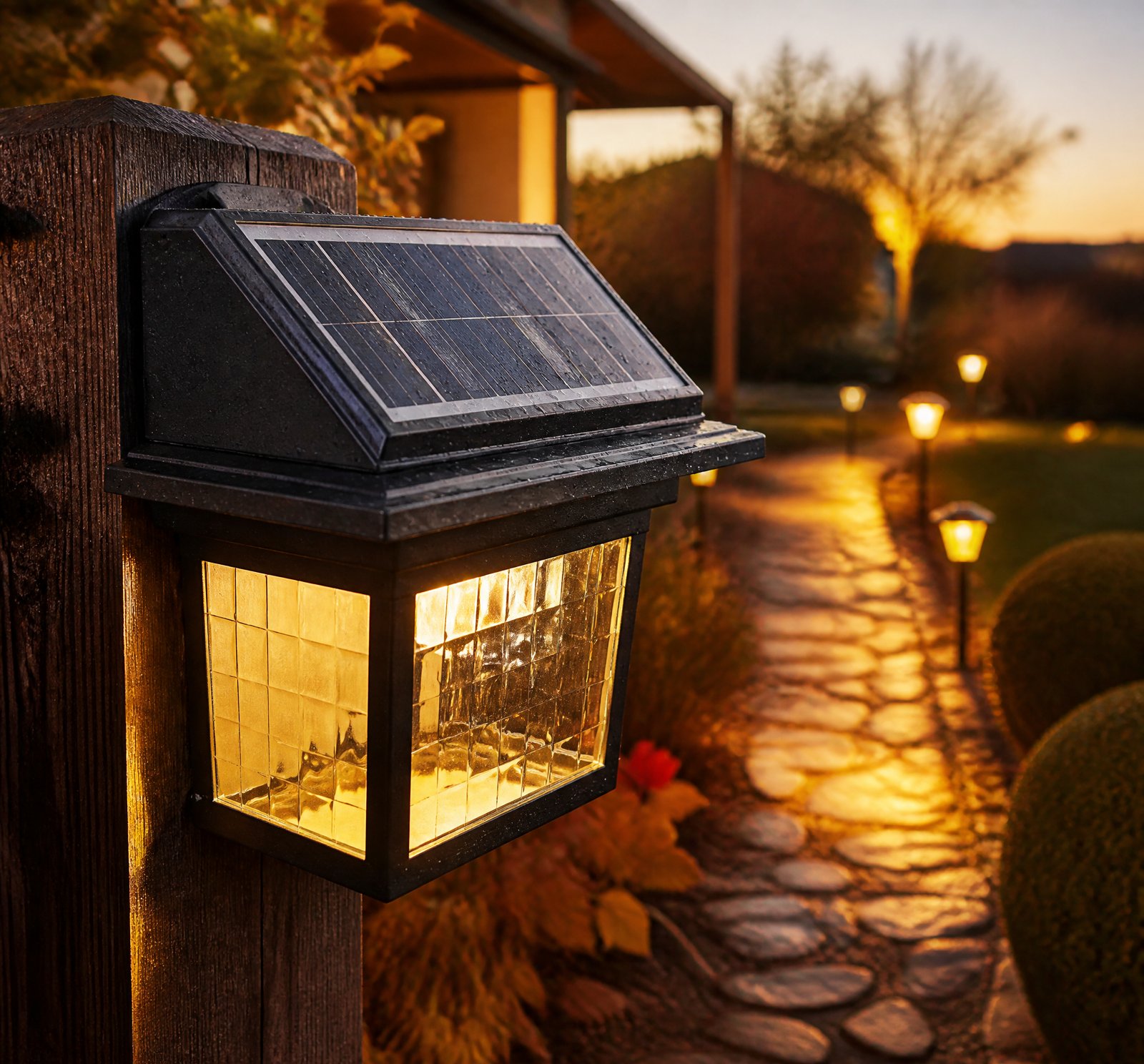
> Quick answer: Driver circuitry is the most common cause of early solar lamp failure, responsible for nearly 60% of catastrophic failures. The Arrhenius equation model predicts that a lower operating temperature extends component lifetime [1].
The quest to find reliable solar lamps in Romania often leads to frustration due to premature failures. Understanding which components are the most likely culprits and how to predict their lifespan can significantly extend your lamp’s operational life. This article delves into the research to provide actionable insights.
Why Driver Circuitry Fails First
The single component most responsible for early failure in solar lamps is the driver circuitry, also known as power supply or electronics [1]. In a dataset of 5,400 outdoor lamps operating over 34 million hours, driver failures caused nearly 60% of catastrophic breakdowns where the lamp stops emitting light. This contrasts sharply with LED failures, which account for only 10% [1].
Temperature and Component Lifespan
The Arrhenius equation model predicts that component lifetime doubles for every 10°C decrease in temperature over a limited range [1]. Both semiconductors and electrolytic capacitors are sensitive to heat and their failure rates increase significantly with rising temperatures. This highlights the importance of thermal management in extending driver lifespan.
Other Common Failure Points
While driver circuitry is the primary issue, other components can also fail, though not as frequently or consistently:
- PV Modules: Glass fractures due to thinner glass and inconsistent tempering processes [10][11][8].
- Electrical Connectors: Vulnerable to moisture ingress and particulate contamination, leading to intermittent operation [21].
Comparison of Failure Frequencies
| Component | Frequency of Failure |
|–––––––|–––––––-|
| Driver Circuitry | Very High |
| PV Modules | Moderate |
| Electrical Connectors | Low |
Surprising Insights from the Data
The data reveal several surprising findings that challenge common assumptions:
- LEDs are not the weakest link: Despite being solid-state and long-lived, LEDs account for only 10% of failures [1].
- Supply chain quality matters: Glass fracture can vary dramatically based on manufacturer quality, even within the same production line [8].
Predictive Specifications
The predictive spec for premature failure is thermal design or operating temperature. While no specific temperature threshold is provided in the sources, a lower operating temperature generally extends component lifespan.
Key Takeaways
- Driver circuitry is responsible for nearly 60% of catastrophic failures.
- The Arrhenius equation model predicts that lifetime doubles with every 10°C decrease in temperature.
- Thermal design is critical but lacks specific standardized tests for consumers to evaluate reliability before purchase.
- LEDs are not the primary cause, challenging common assumptions.
Frequently Asked Questions
[{
„q”: „What causes most premature failures in solar lamps?”,
„a”: „Driver circuitry is responsible for nearly 60% of catastrophic failures [1].”
}, {
„q”: „How does temperature affect component lifespan?”,
„a”: „The Arrhenius equation model predicts that component lifetime doubles with every 10°C decrease in operating temperature [1].”
}, {
„q”: „Are there any specific tests for consumers to evaluate solar lamp reliability?”,
„a”: „There are no standardized MTBF values or tests for consumers, but thermal design is a key factor [25].”
}]
References
- [1] What_Happened_To_The_100000-Hour_LED_Bulbs_-_Hackaday__a70b0bb9 — authority
source passage
might be responsible for failures. The US Department of Energy (DoE)’s solid-state lighting program supports research and development of LED technologies, and their website contains volumes of data on LED lighting systems. Their Lifetime and Reliability Fact Sheet contains data on the failure rate of 5,400 outdoor lamps over 34 million hours of operation. Interestingly, the LEDs themselves account for only 10% of the failures; driver circuitry, on the other hand, was responsible almost 60% of the time. The remainder of failures were due to housing problems, which may not be as applicable for bulbs in indoor use. This data shows that at least for catastrophic failures (where the lamp ceases to emit light), extending lifetime means improving the power supplies. Locate the Weakest Link: Component Lifetime The lifetime of a bulb (or power supply) can be no longer than the lifetime of any of its components. Among the components found inside the bulbs, two stand out as life-limiters: the semiconductors and the electrolytic capacitors. Both of these components suffer from a failure rate that is a strong function of temperature. The typical model for this effect, based on the Arrhenius equation, predicts a doubling of lifetime for each 10 degree Celsius decrease in temperature, at least over a limited range. The two longer-lived bulbs use twice as many packages to carry approximately the same number of LED dice as the GE Basic lamp, decreasing thermal resistance to their respective h
- [8] Understanding_and_preventing_PV_module_glass_fracture__0db3e70f — authority
source passage
# Understanding and preventing PV module glass fracture Source: Blog/Web URL: https://www.vde.com/en/vde-americas/newsroom/pv-module-glass-fracture-byline?trk=public_post_comment-text Author: Date: 2025-09-19 Solar glass fracture is a probabilistic event that occurs based on a combination of internal and external factors, many of which are hiding in plain sight. As an example, module manufacturers have largely continued to treat solar glass as a commodity—meaning it is rarely subject to batch traceability or lot tracking—even though tempering process control becomes more important as modules get bigger, as shown in Figure 6. Meanwhile, forensic analysis has revealed evidence that glass supply chain plays at least some role in the proliferation of low-energy glass fracture. “A developer came to RETC recently with two side-by-side projects,” recounts Kedir. “While both sites used modules from the same manufacturer, the number of cracks exhibited on one site was an order of magnitude higher than the other. Testing modules from the site experiencing glass failure, we found that 75% of samples tested under the design load rating. It turned out that the modules at these side-by-side sites came from two different production lines, each supplied by a different glass manufacturer.” If a change in glass vendor at the point of production can account for an order of magnitude difference in early mortality in the field, why isn’t this variable part of a standard bill of materials (BOM) ve
- [10] Solar_modules_under_pressure_The_growing_risk_of_spontaneous__d1711215 — magazine
source passage
# Solar modules under pressure: The growing risk of spontaneous glass breakage – pv magazine Global Source: Blog/Web URL: https://www.pv-magazine.com/2026/01/15/solar-modules-under-pressure-the-growing-risk-of-spontaneous-glass-breakage/ Author: Alexia Chappond et Gauthier Dambrine; Skyray; Pv Magazine Date: 2026-01-15 Solar modules under pressure: The growing risk of spontaneous glass breakage With the rapid growth of solar photovoltaics, module reliability has become a central issue for the industry. Among the quality problems that have emerged recently, spontaneous glass breakage is attracting increasing attention. Long considered isolated incidents, glass breakages are now becoming more frequent, revealing the limitations of certain industrial choices and the need for heightened vigilance. The rise of solar energy has been accompanied by the constant evolution of technologies and manufacturing processes. To meet global demand and reduce costs, many manufacturers have opted for larger, more powerful, but also lighter modules. A lighter module has the undeniable advantage of reducing the weight on structures, and therefore the costs of the building structure. With glass representing more than half the module’s weight, this quest for lightness has naturally led to the use of increasingly thinner glass. While this development allows for lighter structures and simplifies logistics, it has consequences for the robustness of the modules. Indeed, thinner glass, even if tempered,
- [11] Solar_modules_under_pressure_The_growing_risk_of_spontaneous__d1711215 — authority
source passage
# Solar modules under pressure: The growing risk of spontaneous glass breakage – pv magazine Global Source: Blog/Web URL: https://www.pv-magazine.com/2026/01/15/solar-modules-under-pressure-the-growing-risk-of-spontaneous-glass-breakage/ Author: Alexia Chappond et Gauthier Dambrine; Skyray; Pv Magazine Date: 2026-01-15 Solar modules under pressure: The growing risk of spontaneous glass breakage With the rapid growth of solar photovoltaics, module reliability has become a central issue for the industry. Among the quality problems that have emerged recently, spontaneous glass breakage is attracting increasing attention. Long considered isolated incidents, glass breakages are now becoming more frequent, revealing the limitations of certain industrial choices and the need for heightened vigilance. The rise of solar energy has been accompanied by the constant evolution of technologies and manufacturing processes. To meet global demand and reduce costs, many manufacturers have opted for larger, more powerful, but also lighter modules. A lighter module has the undeniable advantage of reducing the weight on structures, and therefore the costs of the building structure. With glass representing more than half the module’s weight, this quest for lightness has naturally led to the use of increasingly thinner glass. While this development allows for lighter structures and simplifies logistics, it has consequences for the robustness of the modules. Indeed, thinner glass, even if tempered,
- [21] PV_Connectors_Energy__075705d0 — authority
source passage
of some metals to high humidity and other environmental stressors; – Supply-chain pressures that lead to cost-cuts in manufacturing, including materials substitution and reduction; – Prevalence of low-quality replacement connectors that are vulnerable to ingress of moisture /and particulates. A Four-Part Investigation Our research spans these topic areas: Onsite inspections include visual inspections for evidence of cross-mating, separation or loose connections, and signs of heat deformation; and thermal inspection via a handheld long-wave infrared camera. Onsite data collection will include connector type, manufacturer and serial number, if known, location of connector in the array, and site metadata, including module make and model, system age, climate zone, exposure to extreme weather, etc. This task will also include development of a master spreadsheet to ensure thorough and consistent data across multiple sites. Connectors removed from photovoltaic systems as a result of onsite inspections, commercially off-the-shelf connectors and connectors obtained via the project’s mail-in program, will be subjected to materials characterization and forensics analysis. The COTS connectors will represent a statistically significant number of each type, based on such data as market share, unit price, morphology and country of origin, and will provide important data on the variation in quality of connectors being sold in the US. Techno-economic analysis (TEA) data will be collected in p
- [25] Do_We_Need_Solar_Inverter_Reliability_Standards__81655bbf — magazine
source passage
tests, including thermal cycling and HALT testing.” —Mark Goodreau, Solectria Renewables“Inverter manufacturers have their own set of perspectives on reliability, and establishing standards is always a challenge. TMEIC has incorporated reliability standards from IEC for reliability cycling tests and has also established standard factory testing from field experience.” —Ryuta Ray Saka, TMEIC“Reliability can be measured by mean time before failure (MTBF), but more importantly, there is the question of mean time to repair (MTTR). While a component failure is a relatively rare event, if it takes hours or days of downtime to repair, productivity will suffer. Therefore it is advantageous to use a design with as much modularity as possible, allowing repairs to be done rapidly and efficiently.” —Lou Lambruschi, marketing services and E-business manager at Parker Hannifin“Solar Inverters are solid-state power electronic devices. Therefore, there is no need for a specific reliability standard as power electronic industry standards should be adhered to.” —Peter Gerhardinger, VP of Technical Sales, NextronexModule-Level Power Electronics: “It is common practice in telecommunication and military power equipment to meet certain predictions on product life and reliability, better known as mean time before failure (MTBF) estimates. Some form of MTBF could separate the good from the bad and force solar module manufactures to address failures with analysis and constant product improvement.” —M
might be responsible for failures. The US Department of Energy (DoE)’s solid-state lighting program supports research and development of LED technologies, and their website contains volumes of data on LED lighting systems. Their Lifetime and Reliability Fact Sheet contains data on the failure rate of 5,400 outdoor lamps over 34 million hours of operation. Interestingly, the LEDs themselves account for only 10% of the failures; driver circuitry, on the other hand, was responsible almost 60% of the time. The remainder of failures were due to housing problems, which may not be as applicable for bulbs in indoor use. This data shows that at least for catastrophic failures (where the lamp ceases to emit light), extending lifetime means improving the power supplies. Locate the Weakest Link: Component Lifetime The lifetime of a bulb (or power supply) can be no longer than the lifetime of any of its components. Among the components found inside the bulbs, two stand out as life-limiters: the semiconductors and the electrolytic capacitors. Both of these components suffer from a failure rate that is a strong function of temperature. The typical model for this effect, based on the Arrhenius equation, predicts a doubling of lifetime for each 10 degree Celsius decrease in temperature, at least over a limited range. The two longer-lived bulbs use twice as many packages to carry approximately the same number of LED dice as the GE Basic lamp, decreasing thermal resistance to their respective h
# Understanding and preventing PV module glass fracture Source: Blog/Web URL: https://www.vde.com/en/vde-americas/newsroom/pv-module-glass-fracture-byline?trk=public_post_comment-text Author: Date: 2025-09-19 Solar glass fracture is a probabilistic event that occurs based on a combination of internal and external factors, many of which are hiding in plain sight. As an example, module manufacturers have largely continued to treat solar glass as a commodity—meaning it is rarely subject to batch traceability or lot tracking—even though tempering process control becomes more important as modules get bigger, as shown in Figure 6. Meanwhile, forensic analysis has revealed evidence that glass supply chain plays at least some role in the proliferation of low-energy glass fracture. “A developer came to RETC recently with two side-by-side projects,” recounts Kedir. “While both sites used modules from the same manufacturer, the number of cracks exhibited on one site was an order of magnitude higher than the other. Testing modules from the site experiencing glass failure, we found that 75% of samples tested under the design load rating. It turned out that the modules at these side-by-side sites came from two different production lines, each supplied by a different glass manufacturer.” If a change in glass vendor at the point of production can account for an order of magnitude difference in early mortality in the field, why isn’t this variable part of a standard bill of materials (BOM) ve
# Solar modules under pressure: The growing risk of spontaneous glass breakage – pv magazine Global Source: Blog/Web URL: https://www.pv-magazine.com/2026/01/15/solar-modules-under-pressure-the-growing-risk-of-spontaneous-glass-breakage/ Author: Alexia Chappond et Gauthier Dambrine; Skyray; Pv Magazine Date: 2026-01-15 Solar modules under pressure: The growing risk of spontaneous glass breakage With the rapid growth of solar photovoltaics, module reliability has become a central issue for the industry. Among the quality problems that have emerged recently, spontaneous glass breakage is attracting increasing attention. Long considered isolated incidents, glass breakages are now becoming more frequent, revealing the limitations of certain industrial choices and the need for heightened vigilance. The rise of solar energy has been accompanied by the constant evolution of technologies and manufacturing processes. To meet global demand and reduce costs, many manufacturers have opted for larger, more powerful, but also lighter modules. A lighter module has the undeniable advantage of reducing the weight on structures, and therefore the costs of the building structure. With glass representing more than half the module’s weight, this quest for lightness has naturally led to the use of increasingly thinner glass. While this development allows for lighter structures and simplifies logistics, it has consequences for the robustness of the modules. Indeed, thinner glass, even if tempered,
# Solar modules under pressure: The growing risk of spontaneous glass breakage – pv magazine Global Source: Blog/Web URL: https://www.pv-magazine.com/2026/01/15/solar-modules-under-pressure-the-growing-risk-of-spontaneous-glass-breakage/ Author: Alexia Chappond et Gauthier Dambrine; Skyray; Pv Magazine Date: 2026-01-15 Solar modules under pressure: The growing risk of spontaneous glass breakage With the rapid growth of solar photovoltaics, module reliability has become a central issue for the industry. Among the quality problems that have emerged recently, spontaneous glass breakage is attracting increasing attention. Long considered isolated incidents, glass breakages are now becoming more frequent, revealing the limitations of certain industrial choices and the need for heightened vigilance. The rise of solar energy has been accompanied by the constant evolution of technologies and manufacturing processes. To meet global demand and reduce costs, many manufacturers have opted for larger, more powerful, but also lighter modules. A lighter module has the undeniable advantage of reducing the weight on structures, and therefore the costs of the building structure. With glass representing more than half the module’s weight, this quest for lightness has naturally led to the use of increasingly thinner glass. While this development allows for lighter structures and simplifies logistics, it has consequences for the robustness of the modules. Indeed, thinner glass, even if tempered,
of some metals to high humidity and other environmental stressors; – Supply-chain pressures that lead to cost-cuts in manufacturing, including materials substitution and reduction; – Prevalence of low-quality replacement connectors that are vulnerable to ingress of moisture /and particulates. A Four-Part Investigation Our research spans these topic areas: Onsite inspections include visual inspections for evidence of cross-mating, separation or loose connections, and signs of heat deformation; and thermal inspection via a handheld long-wave infrared camera. Onsite data collection will include connector type, manufacturer and serial number, if known, location of connector in the array, and site metadata, including module make and model, system age, climate zone, exposure to extreme weather, etc. This task will also include development of a master spreadsheet to ensure thorough and consistent data across multiple sites. Connectors removed from photovoltaic systems as a result of onsite inspections, commercially off-the-shelf connectors and connectors obtained via the project’s mail-in program, will be subjected to materials characterization and forensics analysis. The COTS connectors will represent a statistically significant number of each type, based on such data as market share, unit price, morphology and country of origin, and will provide important data on the variation in quality of connectors being sold in the US. Techno-economic analysis (TEA) data will be collected in p
tests, including thermal cycling and HALT testing.” —Mark Goodreau, Solectria Renewables“Inverter manufacturers have their own set of perspectives on reliability, and establishing standards is always a challenge. TMEIC has incorporated reliability standards from IEC for reliability cycling tests and has also established standard factory testing from field experience.” —Ryuta Ray Saka, TMEIC“Reliability can be measured by mean time before failure (MTBF), but more importantly, there is the question of mean time to repair (MTTR). While a component failure is a relatively rare event, if it takes hours or days of downtime to repair, productivity will suffer. Therefore it is advantageous to use a design with as much modularity as possible, allowing repairs to be done rapidly and efficiently.” —Lou Lambruschi, marketing services and E-business manager at Parker Hannifin“Solar Inverters are solid-state power electronic devices. Therefore, there is no need for a specific reliability standard as power electronic industry standards should be adhered to.” —Peter Gerhardinger, VP of Technical Sales, NextronexModule-Level Power Electronics: “It is common practice in telecommunication and military power equipment to meet certain predictions on product life and reliability, better known as mean time before failure (MTBF) estimates. Some form of MTBF could separate the good from the bad and force solar module manufactures to address failures with analysis and constant product improvement.” —M