
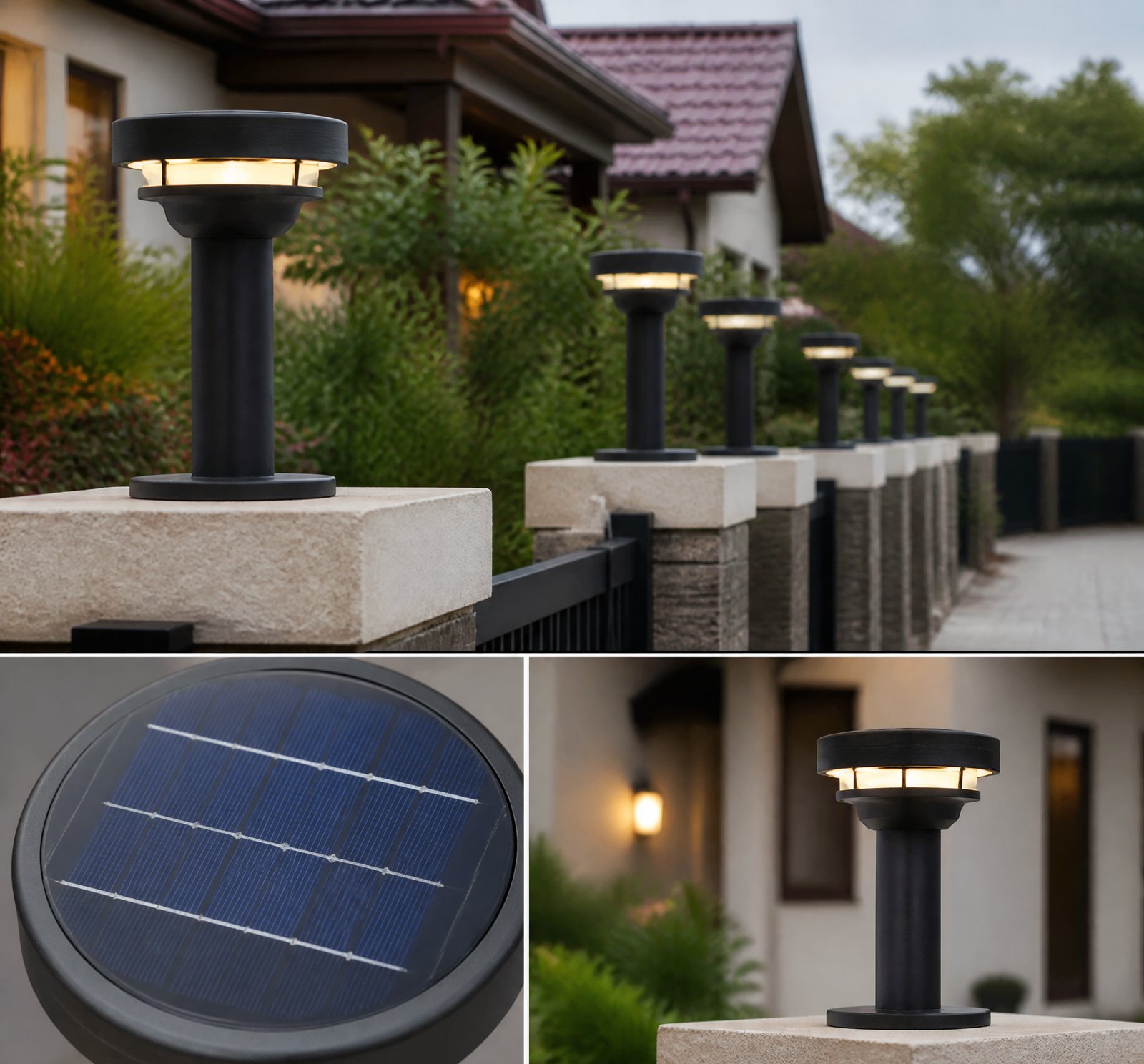
> Quick answer: The functional relationship between beam angle, mounting height, and ground-level illuminance for a 2000-lumen, 6500 K solar lamp is influenced by adjustable features but not quantitatively specified in the sources. Adjustable beam angles allow targeted illumination, while higher mounting heights reduce peak illuminance but increase coverage area [7][13].
Adjusting the beam angle and mounting height of a 2000-lumen, 6500 K solar lamp can significantly impact ground-level illuminance in yards or pathways. However, despite numerous sources discussing design features and general performance characteristics, they do not provide specific quantitative data needed to define this exact relationship.
Understanding the Impact of Beam Angle
Beam angle is a critical factor in determining how light is distributed on the ground. A narrower beam angle focused downward can increase illuminance at a specific point, while a wider beam angle may reduce peak illuminance but improve uniformity across a broader area [13]. The ability to adjust the angle of the lighting unit is a recurring feature across multiple patents and product descriptions. For example:
- Adjustable Holder: US8066399B2 describes an adjustable holder that allows both the lighting unit and photovoltaic panel to be rotated synchronously, directing light toward specific targets like work surfaces or tools [13].
- Pivoting Housing: US9200767B2 details an adjustable solar-charged lamp where the housing can pivot to direct light and adjust orientation for optimal charging [8][16].
These adjustments enable users to fine-tune the lamp’s performance based on their specific needs, providing targeted illumination in yards or along pathways.
The Role of Mounting Height
Mounting height is another variable that influences ground-level illuminance. Higher mounting heights generally reduce peak ground-level illuminance due to the inverse square law but increase coverage area. Conversely, lower mounting heights can increase illuminance at the center while reducing overall coverage [9].
- Adjustable Pole Connection: US8588830B2 mentions a pole-based solar lighting system where the decorative light fixture and its connection to the base are adjustable, allowing for optimal positioning of both the solar panel and LED module [9][12]. This allows users to orient the lamp for maximum efficiency in both energy collection and illumination.
Despite these insights, sources do not specify precise quantitative data on how illuminance varies with height or angle. For example, the drop in illuminance from 2 meters to 4 meters above ground is not quantified [9].
Color Temperature and Efficiency
The 6500 K color temperature is a common daylight setting for LED lamps and does not directly affect ground-level illuminance according to the sources. However, LED efficiency exceeding 200 lumens per watt can improve perceived brightness [22].
- Self-contained Solar Floodlight: A solar floodlight with a 2000-lumen output is weatherproof and equipped with a PIR motion sensor for outdoor use [7]. This lamp can be mounted on walls, fences, or poles using included hardware.
Dual Adjustability in Modern Design
A key design trend highlighted by the sources is the ability to independently aim both the solar panel and LED module. This feature optimizes both energy collection and light distribution, allowing users to fine-tune performance for specific needs [22].
- Solar Film Integration: Designs that integrate solar film as part of the lamp’s structure increase effective surface area for energy collection, enhancing performance even when partially shaded or misaligned with the sun [15].
Key Takeaways
- Adjustable beam angles and mounting heights allow targeted illumination but do not have precise quantitative data.
- Narrower beam angles can increase illuminance at specific points while wider beams improve uniformity across broader areas.
- Higher mounts reduce peak illuminance but increase coverage, while lower mounts increase central illuminance.
Frequently Asked Questions
„`json
[
{
„q”: „How does the mounting height affect ground-level illuminance?”,
„a”: „Higher mounting heights generally reduce peak illuminance due to the inverse square law but increase overall coverage area [9][12].”
},
{
„q”: „Can adjusting the beam angle improve illumination in a specific spot?”,
„a”: „Yes, narrower beam angles focused downward can significantly increase illuminance at specific points while wider beams spread light more uniformly across an area [13].”
},
{
„q”: „What role does LED efficiency play in ground-level illuminance?”,
„a”: „LED efficiency exceeding 200 lumens per watt improves perceived brightness, but the sources do not link this directly to specific beam angle or height interactions [22].”
}
]
„`
References
- [7] Wagan_Tech__Solar_Floodlights_A_complete_look_at_Wagan_Tech_Solar_LED_Floodlights_line__aBVqXfTIt0U — youtube
source passage
optimal angle for the light you can also Slide the lamp head horizontally and vertically next we have the solar plus LED floodlight product line we have four different versions one that outputs 800 lumens 1600 lumens 2 000 lumens and 3 000 lumens these lights are completely self-contained solar powered weatherproof and require no wiring to install and all of them come with energy efficient monocrystall and solar panels on the top that are used to recharge the internal lithium ion battery quickly the internal Lithium-ion batteries allow the lights to have a run time of up to three nights on a single charge the new 2000 and 3000 models come equipped with our alt technology that allows them to have a run time of up to 10 nights alt or adaptive lighting technology uses smart battery optimization during cloudy days or when the battery charge is low to extend run times by decreasing the light output the lights come with tough casings that are ip65 rated waterproof and built to withstand the elements they are also equipped with PIR motion sensors that can detect motion from between 25 to 40 feet away on the back are simple mounting brackets that you can use to mount the lights on any hard surface such as walls fences or even poles mounting hardware is also included for all of our solar flood lights lastly the solar plus LED floodlight 2000 and 3000 Lumen models also come with remote controls that can be used to program the lights to suit your customers needs and that's been our quic
- [8] US9200767B2_-_Adjustable_solar_charged_lamp_-_Google_Patents__e3609d18 — patent
source passage
ray 138 hits the solar collector 106 at an angle of intersection 140 close to ninety degrees, in other words, so that the ray 138 is perpendicular to the solar collector 106 . – the adjustable nature of the solar-charged lamp 100 allows the housing 102 to be adjusted relative to the hanger assembly 200 . – the frictional force imparted by the yoke 202 on the housing 102 permits the angle of intersection 140 to be maintained. – the orientation of the entire adjustable solar-charged lamp 100 may be adjusted through the course of one day's charging; however, the adjustment is greatly simplified by being able to adjust the angle of intersection 140 by pivoting the housing 102 about the pivot axis 116 . – the housing 102 can be adjusted to direct light emitted from the light emitting device 126 toward a target 142 . – This target 142 may be a work surface, a book, a kitchen utensil, or any of an infinite number of tools and objects with which humans interface daily. This ability to selectively direct and aim the light greatly reduces the quantity of light required to perform tasks. – the lamp 100 is placed in a location where a light source, such as the sun 108 , can project light onto the solar collector 106 . – a light source such as the sun 108 – Light received by the solar collector 106 is converted into electricity and stored in the battery. – the lamp 100 can be moved to a dark location, such as a windowless room in a dwelling, and activated to illuminate the room. – energy
- [9] US8588830B2_-_Wireless_autonomous_solar-powered_outdoor_lighting__6d9bbfe3 — patent
source passage
As illustrated in FIGS. 13-16 , this coverage of the pole will expose the panel 14 to the suns rays generally from sunrise to sunset, in order to maximize solar-power generation. – the panel 14 preferably covers 1 ⁇ 2-3 ⁇ 4 of the length of the pole, extending from its upper edge 20 at a location near the top of the pole to its lower edge 22 several feet above the base 24 supporting the pole. It is preferred that the lower edge 22 be high enough from the ground or street level that passers-by or vandals cannot easily reach the panel 14 to cut, pry off, or otherwise damage the panel. – connection of the pole 12 to the base 24 may be done in various ways, each typically being adjustable so that, at the time of installation, the pole may be turned to orient the panel 14 optimally to catch sunlight through the day. – the adjustable connection shown in FIGS. 1 and 3 to best advantage, includes a pole base flange 26 having multiple, curved slots 28 through which bolts extend, so that the bolts may be tightened to secure the pole to the base 24 after the pole is rotated to the desired orientation. – the connection of the decorative light fixture ( 50 , discussed below), may also be adjustable, so that, given any orientation of the pole, the decorative light fixture may be secured/tightened to point in the desired direction, for example, over a street or sidewalk. – the main, or only, light-producing unit of the preferred street light 10 is a light-emitting diode (LED) fixture at or
- [12] US20100029268A1_-_Wireless_autonomous_solar-powered_outdoor__58410db8 — patent
source passage
of the circumference (preferably at least 225 degrees and more preferably about 270 degrees) of the pole in order to be directly exposed to sunlight all through the daylight hours. As illustrated in FIGS. 13-16 , this coverage of the pole will expose the panel 14 to the suns rays generally from sunrise to sunset, in order to maximize solar-power generation. – the panel 14 preferably covers 1 ⁇ 2-3 ⁇ 4 of the length of the pole, extending from its upper edge 20 at a location near the top of the pole to its lower edge 22 several feet above the base 24 supporting the pole. It is preferred that the lower edge 22 be high enough from the ground or street level that passers-by or vandals cannot easily reach the panel 14 to cut, pry off, or otherwise damage the panel. – connection of the pole 12 to the base 24 may be done in various ways, each typically being adjustable so that, at the time of installation, the pole may be turned to orient the panel 14 optimally to catch sunlight through the day. – the adjustable connection shown in FIGS. 1 and 3 to best advantage, includes a pole base flange 26 having multiple, curved slots 28 through which bolts extend, so that the bolts may be tightened to secure the pole to the base 24 after the pole is rotated to the desired orientation. – the connection of the decorative light fixture ( 50 , discussed below), may also be adjustable, so that, given any orientation of the pole, the decorative light fixture may be secured/tightened to point in the
- [13] US8066399B2_-_Solar_energy_street_lamp_structure_with_adjustable__82d93d1a — patent
source passage
solar energy street lamp structure is simplified and therefore incurs relatively low costs; 2. Now that the solar energy street lamp structure is simplified, it is relatively easy to place the center of gravity of the solar energy street lamp structure at the center of the entire structure so as to provide increased resistance to typhoons and external shocks; 3. The angle-adjustable holder of the solar energy street lamp structure allows the at least one photovoltaic panel to adjust according to an incident angle of sunlight so as to generate electric power at enhanced efficiency; and 4. As the at least one lighting unit and the at least one photovoltaic panel can dissipate heat via each other, heat dissipation is carried out at increased efficiency. A detailed description of further features and advantages of the present invention is given below so that a person skilled in the art is enabled to understand and implement the technical contents of the present invention and readily comprehend the objectives and advantages thereof by reviewing the teachings disclosed herein and the appended claims in conjunction with the accompanying drawings, wherein: Referring to FIG. 1A and FIG. 1B , a solar energy street lamp structure 100 with an adjustable angle according to an embodiment of the present invention includes a lamp holder 10, at least one lighting unit 20, at least one photovoltaic panel 30, an electric power storage portion 40, and an actuation portion 50. As shown in FIG. 1A
- [15] DE102015015970A1_-_Device_system_of_a_solar_lamp_-_Google_Patents__48d32ece — patent
source passage
1. The PV used here must be exposed at an angle of about 0-30 ° to the sun and to the south to generate good power output. 2. As a result, the PV is limited to the top of a lamp and thus the area size is limited. 3. Solar lamps are usually not optimally positioned by the user to the sun, as their primary purpose is the illumination of a particular area. The PV modules are thus often in partial shade or completely absonnig. The necessary requirements according to Die in diesem Patent verwendet PV hat bei nicht optimaler Exposition einen verhältnismäßig guten Ertrag, das Problem der zufälligen Exposition einer Solarlampe wird damit gelöst. Durch die gleichzeitige Verwendung der Solarfolie als Lampenschirm und Solargenerator steht erheblich mehr Fläche zur Verfügung, was zu einem vergleichsweise deutlich hören Energieertrag führt.The PV used in this patent has a relatively good yield in non-optimal exposure, solving the problem of accidental exposure of a solar lamp. By the simultaneous use of the solar film as a lampshade and solar generator is considerably more area available, resulting in a comparatively clearly hear energy yield. Welchem technischen Problem hat sich der Anmelder gestelltWhat technical problem has the applicant faced? Eine Solarlampe soll hell und lange leuchten können. Dafür benötigt sie einen entsprechend hohen solaren Energieertrag. Die Funktion und Form einer Lampe beschränken jedoch die mögliche Größe einer integrierten PV. Durch die Wahl einer anderen P
- [16] US9200767B2_-_Adjustable_solar_charged_lamp_-_Google_Patents__e3609d18 — patent
source passage
to the hanger assembly to allow for maximum exposure to a light source, such as the sun. – FIG. 1 is an isometric view of one embodiment of an adjustable solar charged lamp. – FIG. 2 is an exploded isometric view of the lamp. – FIG. 3 is a front elevation view of the lamp. – FIG. 4 is a top plan view of the lamp. – FIG. 5 is a side elevation view of the lamp. – FIGS. 6 a and 6 b are a first and second cross-sectional view of a housing and a yoke cooperating to enable the housing to pivot relative to a hanger assembly. – FIG. 7 is a right elevation view of the lamp shown adjusted to enable charging from the sun. – FIG. 8 is a front elevation view of the lamp shown with the housing adjusted to direct light on a target. – FIG. 9 is another exploded isometric view of the lamp. – the problem of repeatedly illuminating a dark location is solved by providing a solar-charged lamp, configured to resemble a traditional incandescent light bulb and to produce light equivalent to a traditional incandescent light bulb. – the lamp has an electronics assembly adjustably supported by a hanger assembly such that the entire lamp is repositionable to track with the sun in order to maximize the recharging of the battery. – the lamp 100 includes a housing 102 , having an exterior and an interior, and a lens 104 . – the lens 104 is substantially the shape of a traditional incandescent light bulb. – Positioned on the housing 102 is at least one solar collector 106 configured to receive photons and t
- [22] 6_Trends_In_Solar_Area_Lighting_-_EdisonReport__f721a99c — magazine
source passage
# 6 Trends In Solar Area Lighting Source: Blog/Web URL: https://edisonreport.com/2020/08/18/6-trends-in-solar-area-lighting/ Author: Randy Reid Date: 2020-08-18 Emeryville, CA | August 18, 2020 Distributors, contractors, and specifiers have to keep up with many changes in lighting technology. One of the growing outdoor lighting categories is solar area lights. The global solar lighting market is projected to more than double to $10.8 billion USD by 2024, up from $5.2 billion USD in 2019, a compound annual growth rate (CAGR) of 15.6%, according to the research firm Markets and Markets. Here are six trends in solar area luminaires to be aware of: – Independently aim-able solar panels and LED modules. This allows optimization of solar collection as well as directing light where it is most needed. Placing the solar panel on an angle, equal to the local latitude, will maximize solar energy collection, year-round (https://www.soltechlighting.com/blog/solar-panel-optimization/ ). Angling the solar panel also allows rain, wind, and gravity to naturally clean the solar panel surface. – Increased light output. LED fixture efficacy can now exceed 200 lpW, for some models. This LED efficiency is combining with dramatically improving solar panel and battery power+efficiency, so that some solar area lights can now achieve 9,000+ lumens for a 50W floodlight fixture. – Increased LED run times. The same combination of dramatic efficiency improvements for the LEDs, solar panels, and battery te
optimal angle for the light you can also Slide the lamp head horizontally and vertically next we have the solar plus LED floodlight product line we have four different versions one that outputs 800 lumens 1600 lumens 2 000 lumens and 3 000 lumens these lights are completely self-contained solar powered weatherproof and require no wiring to install and all of them come with energy efficient monocrystall and solar panels on the top that are used to recharge the internal lithium ion battery quickly the internal Lithium-ion batteries allow the lights to have a run time of up to three nights on a single charge the new 2000 and 3000 models come equipped with our alt technology that allows them to have a run time of up to 10 nights alt or adaptive lighting technology uses smart battery optimization during cloudy days or when the battery charge is low to extend run times by decreasing the light output the lights come with tough casings that are ip65 rated waterproof and built to withstand the elements they are also equipped with PIR motion sensors that can detect motion from between 25 to 40 feet away on the back are simple mounting brackets that you can use to mount the lights on any hard surface such as walls fences or even poles mounting hardware is also included for all of our solar flood lights lastly the solar plus LED floodlight 2000 and 3000 Lumen models also come with remote controls that can be used to program the lights to suit your customers needs and that's been our quic
ray 138 hits the solar collector 106 at an angle of intersection 140 close to ninety degrees, in other words, so that the ray 138 is perpendicular to the solar collector 106 . – the adjustable nature of the solar-charged lamp 100 allows the housing 102 to be adjusted relative to the hanger assembly 200 . – the frictional force imparted by the yoke 202 on the housing 102 permits the angle of intersection 140 to be maintained. – the orientation of the entire adjustable solar-charged lamp 100 may be adjusted through the course of one day's charging; however, the adjustment is greatly simplified by being able to adjust the angle of intersection 140 by pivoting the housing 102 about the pivot axis 116 . – the housing 102 can be adjusted to direct light emitted from the light emitting device 126 toward a target 142 . – This target 142 may be a work surface, a book, a kitchen utensil, or any of an infinite number of tools and objects with which humans interface daily. This ability to selectively direct and aim the light greatly reduces the quantity of light required to perform tasks. – the lamp 100 is placed in a location where a light source, such as the sun 108 , can project light onto the solar collector 106 . – a light source such as the sun 108 – Light received by the solar collector 106 is converted into electricity and stored in the battery. – the lamp 100 can be moved to a dark location, such as a windowless room in a dwelling, and activated to illuminate the room. – energy
As illustrated in FIGS. 13-16 , this coverage of the pole will expose the panel 14 to the suns rays generally from sunrise to sunset, in order to maximize solar-power generation. – the panel 14 preferably covers 1 ⁇ 2-3 ⁇ 4 of the length of the pole, extending from its upper edge 20 at a location near the top of the pole to its lower edge 22 several feet above the base 24 supporting the pole. It is preferred that the lower edge 22 be high enough from the ground or street level that passers-by or vandals cannot easily reach the panel 14 to cut, pry off, or otherwise damage the panel. – connection of the pole 12 to the base 24 may be done in various ways, each typically being adjustable so that, at the time of installation, the pole may be turned to orient the panel 14 optimally to catch sunlight through the day. – the adjustable connection shown in FIGS. 1 and 3 to best advantage, includes a pole base flange 26 having multiple, curved slots 28 through which bolts extend, so that the bolts may be tightened to secure the pole to the base 24 after the pole is rotated to the desired orientation. – the connection of the decorative light fixture ( 50 , discussed below), may also be adjustable, so that, given any orientation of the pole, the decorative light fixture may be secured/tightened to point in the desired direction, for example, over a street or sidewalk. – the main, or only, light-producing unit of the preferred street light 10 is a light-emitting diode (LED) fixture at or
of the circumference (preferably at least 225 degrees and more preferably about 270 degrees) of the pole in order to be directly exposed to sunlight all through the daylight hours. As illustrated in FIGS. 13-16 , this coverage of the pole will expose the panel 14 to the suns rays generally from sunrise to sunset, in order to maximize solar-power generation. – the panel 14 preferably covers 1 ⁇ 2-3 ⁇ 4 of the length of the pole, extending from its upper edge 20 at a location near the top of the pole to its lower edge 22 several feet above the base 24 supporting the pole. It is preferred that the lower edge 22 be high enough from the ground or street level that passers-by or vandals cannot easily reach the panel 14 to cut, pry off, or otherwise damage the panel. – connection of the pole 12 to the base 24 may be done in various ways, each typically being adjustable so that, at the time of installation, the pole may be turned to orient the panel 14 optimally to catch sunlight through the day. – the adjustable connection shown in FIGS. 1 and 3 to best advantage, includes a pole base flange 26 having multiple, curved slots 28 through which bolts extend, so that the bolts may be tightened to secure the pole to the base 24 after the pole is rotated to the desired orientation. – the connection of the decorative light fixture ( 50 , discussed below), may also be adjustable, so that, given any orientation of the pole, the decorative light fixture may be secured/tightened to point in the
solar energy street lamp structure is simplified and therefore incurs relatively low costs; 2. Now that the solar energy street lamp structure is simplified, it is relatively easy to place the center of gravity of the solar energy street lamp structure at the center of the entire structure so as to provide increased resistance to typhoons and external shocks; 3. The angle-adjustable holder of the solar energy street lamp structure allows the at least one photovoltaic panel to adjust according to an incident angle of sunlight so as to generate electric power at enhanced efficiency; and 4. As the at least one lighting unit and the at least one photovoltaic panel can dissipate heat via each other, heat dissipation is carried out at increased efficiency. A detailed description of further features and advantages of the present invention is given below so that a person skilled in the art is enabled to understand and implement the technical contents of the present invention and readily comprehend the objectives and advantages thereof by reviewing the teachings disclosed herein and the appended claims in conjunction with the accompanying drawings, wherein: Referring to FIG. 1A and FIG. 1B , a solar energy street lamp structure 100 with an adjustable angle according to an embodiment of the present invention includes a lamp holder 10, at least one lighting unit 20, at least one photovoltaic panel 30, an electric power storage portion 40, and an actuation portion 50. As shown in FIG. 1A
1. The PV used here must be exposed at an angle of about 0-30 ° to the sun and to the south to generate good power output. 2. As a result, the PV is limited to the top of a lamp and thus the area size is limited. 3. Solar lamps are usually not optimally positioned by the user to the sun, as their primary purpose is the illumination of a particular area. The PV modules are thus often in partial shade or completely absonnig. The necessary requirements according to Die in diesem Patent verwendet PV hat bei nicht optimaler Exposition einen verhältnismäßig guten Ertrag, das Problem der zufälligen Exposition einer Solarlampe wird damit gelöst. Durch die gleichzeitige Verwendung der Solarfolie als Lampenschirm und Solargenerator steht erheblich mehr Fläche zur Verfügung, was zu einem vergleichsweise deutlich hören Energieertrag führt.The PV used in this patent has a relatively good yield in non-optimal exposure, solving the problem of accidental exposure of a solar lamp. By the simultaneous use of the solar film as a lampshade and solar generator is considerably more area available, resulting in a comparatively clearly hear energy yield. Welchem technischen Problem hat sich der Anmelder gestelltWhat technical problem has the applicant faced? Eine Solarlampe soll hell und lange leuchten können. Dafür benötigt sie einen entsprechend hohen solaren Energieertrag. Die Funktion und Form einer Lampe beschränken jedoch die mögliche Größe einer integrierten PV. Durch die Wahl einer anderen P
to the hanger assembly to allow for maximum exposure to a light source, such as the sun. – FIG. 1 is an isometric view of one embodiment of an adjustable solar charged lamp. – FIG. 2 is an exploded isometric view of the lamp. – FIG. 3 is a front elevation view of the lamp. – FIG. 4 is a top plan view of the lamp. – FIG. 5 is a side elevation view of the lamp. – FIGS. 6 a and 6 b are a first and second cross-sectional view of a housing and a yoke cooperating to enable the housing to pivot relative to a hanger assembly. – FIG. 7 is a right elevation view of the lamp shown adjusted to enable charging from the sun. – FIG. 8 is a front elevation view of the lamp shown with the housing adjusted to direct light on a target. – FIG. 9 is another exploded isometric view of the lamp. – the problem of repeatedly illuminating a dark location is solved by providing a solar-charged lamp, configured to resemble a traditional incandescent light bulb and to produce light equivalent to a traditional incandescent light bulb. – the lamp has an electronics assembly adjustably supported by a hanger assembly such that the entire lamp is repositionable to track with the sun in order to maximize the recharging of the battery. – the lamp 100 includes a housing 102 , having an exterior and an interior, and a lens 104 . – the lens 104 is substantially the shape of a traditional incandescent light bulb. – Positioned on the housing 102 is at least one solar collector 106 configured to receive photons and t
# 6 Trends In Solar Area Lighting Source: Blog/Web URL: https://edisonreport.com/2020/08/18/6-trends-in-solar-area-lighting/ Author: Randy Reid Date: 2020-08-18 Emeryville, CA | August 18, 2020 Distributors, contractors, and specifiers have to keep up with many changes in lighting technology. One of the growing outdoor lighting categories is solar area lights. The global solar lighting market is projected to more than double to $10.8 billion USD by 2024, up from $5.2 billion USD in 2019, a compound annual growth rate (CAGR) of 15.6%, according to the research firm Markets and Markets. Here are six trends in solar area luminaires to be aware of: – Independently aim-able solar panels and LED modules. This allows optimization of solar collection as well as directing light where it is most needed. Placing the solar panel on an angle, equal to the local latitude, will maximize solar energy collection, year-round (https://www.soltechlighting.com/blog/solar-panel-optimization/ ). Angling the solar panel also allows rain, wind, and gravity to naturally clean the solar panel surface. – Increased light output. LED fixture efficacy can now exceed 200 lpW, for some models. This LED efficiency is combining with dramatically improving solar panel and battery power+efficiency, so that some solar area lights can now achieve 9,000+ lumens for a 50W floodlight fixture. – Increased LED run times. The same combination of dramatic efficiency improvements for the LEDs, solar panels, and battery te