
> Quick answer: The Seebeck effect is not a primary mechanism in polycrystalline silicon solar panels but can contribute under specific thermal non-uniformities [2]. The typical open-circuit voltage temperature coefficient for these panels is around 2 mV/°C, indicating how much the voltage decreases per degree Celsius increase [24][7].
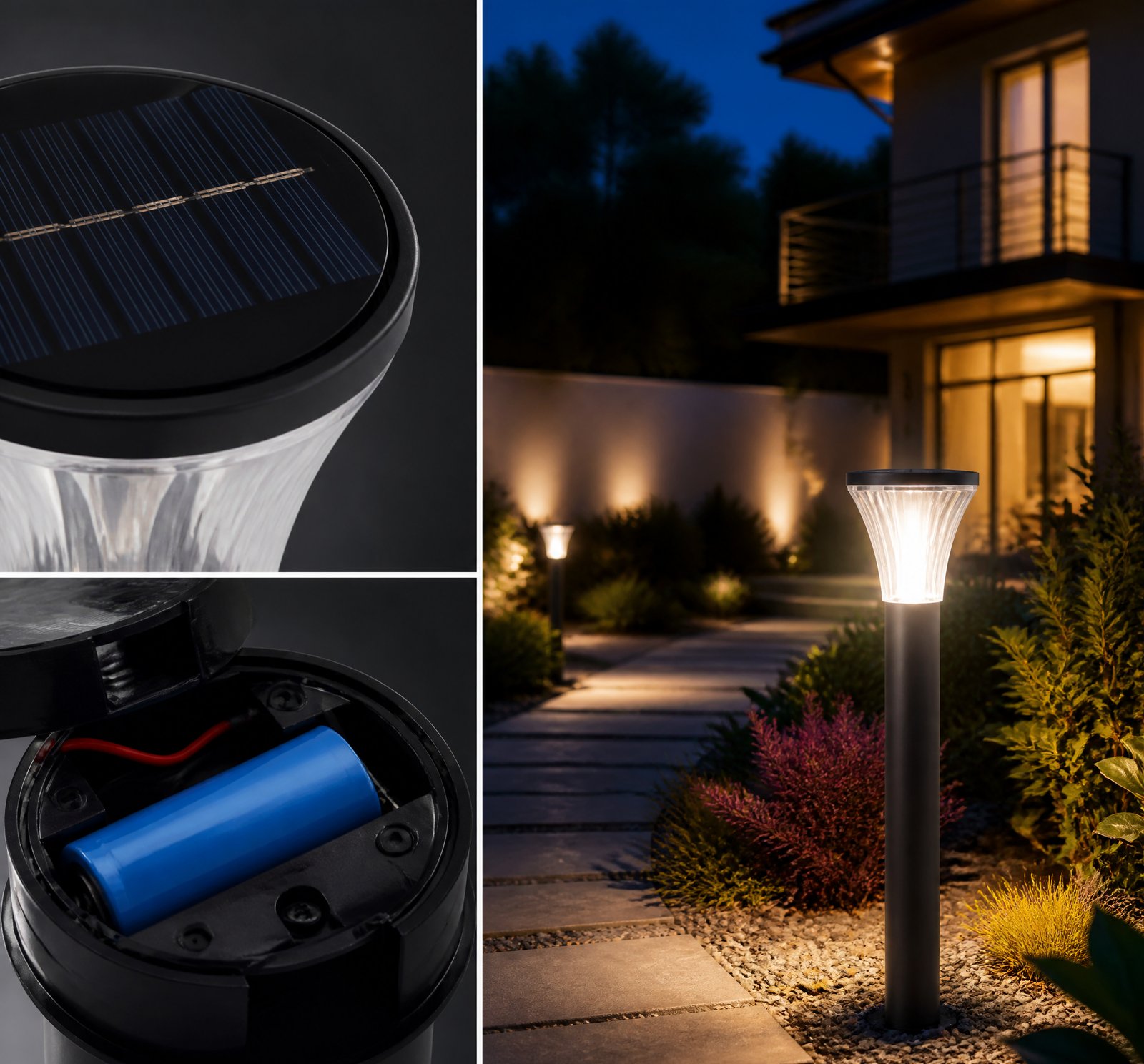
The Seebeck effect, a thermoelectric phenomenon where a temperature gradient across a material generates a voltage, plays a minor role in solar lamps but can still affect their performance under certain conditions. This article explores its impact on polycrystalline panels and the typical open-circuit voltage temperature coefficient.
The Role of the Seebeck Effect in Solar Panels
The Seebeck effect is not the main mechanism driving energy conversion in standard polycrystalline silicon solar panels [2]. Instead, the photovoltaic effect—where photons excite electron-hole pairs in a semiconductor—is the dominant process. However, under specific thermal non-uniformities such as localized heating from sunlight, temperature gradients can arise across the panel’s surface or between its layers [2][4].
These gradients shift electron energy levels differently in hot and cold regions, generating a small voltage due to differential carrier distribution [2]. Despite this theoretical possibility, this contribution is typically negligible compared to the photovoltaic output, especially in well-designed panels with uniform illumination and thermal management [3][9].
Temperature Dependence of Solar Panel Performance
The temperature dependence of solar panel performance is primarily driven by changes in the semiconductor’s bandgap. As the temperature increases, the bandgap narrows, increasing intrinsic carrier concentration and reducing the open-circuit voltage (VOC) [20][22]. This relationship is a critical performance metric for solar panels.
Typical Open-Circuit Voltage Temperature Coefficient
The typical open-circuit voltage temperature coefficient for polycrystalline silicon panels is around 2 mV/°C, indicating how much the voltage decreases per degree Celsius increase [24][7]. Some sources indicate that VOC decreases by about 2.3 mV/°C for silicon-based cells, aligning with the general range of 2–2.5 mV/°C [20][24].
This coefficient is derived from the exponential dependence of the saturation current (I₀) on temperature, which increases with temperature and thus reduces VOC [20]. It is important to note that this value can vary slightly depending on the specific material and cell design.
Thermoelectric Generators vs. Solar Panels
While the Seebeck effect is theoretically possible in solar panels due to temperature gradients, it is not typically harnessed or measured as a primary output mechanism. Instead, thermoelectric generators (TEGs) are engineered specifically for this purpose, using materials with high Seebeck coefficients [8]. For example, the Micropelt TGP-651 has a Seebeck coefficient of 60 mV/K.
In contrast, temperature gradients across a solar panel are generally too small and non-uniform to generate meaningful voltage via the Seebeck effect under normal conditions. Panels can reach temperatures up to about 20°C above ambient air in hot climates like deserts [9], but this heating is usually uniform across the surface, minimizing large thermal gradients.
Efficiency Loss Due to Heat
One key insight from the research is that while heat can generate electricity via the Seebeck effect, it primarily degrades performance by reducing voltage more than it increases current. The temperature coefficient of VOC—typically around 2 mV/°C—is a well-established metric used by manufacturers to rate panel performance under varying thermal conditions [24][7].
This coefficient is not derived from the Seebeck effect but from the semiconductor physics of the p–n junction and the temperature dependence of carrier concentration [20]. The primary concern in solar panel design is minimizing temperature rise to preserve efficiency, rather than exploiting it for thermoelectric gain.
Key Takeaways
- The Seebeck effect is a minor phenomenon in polycrystalline silicon solar panels.
- The typical open-circuit voltage temperature coefficient for these panels is around 2 mV/°C [24][7].
- Heat primarily degrades performance by reducing VOC rather than generating useful voltage via the Seebeck effect.
References
- [2] Photovoltaic_effect_-_Wikipedia__9ed0785d — wikipedia
source passage
an electromotive force and an electric current, and thus some of the light energy is converted into electric energy. The photovoltaic effect can also occur when two photons are absorbed simultaneously in a process called two-photon photovoltaic effect. In addition to the direct photovoltaic excitation of free electrons, an electric current can also arise through the Seebeck effect. When a conductive or semiconductive material is heated by absorption of electromagnetic radiation, the heating can lead to increased temperature gradients in the semiconductor material or differentials between materials. These thermal differences in turn may generate a voltage because the electron energy levels are shifted differently in different areas, creating a potential difference between those areas which in turn create an electric current. The relative contributions of the photovoltaic effect versus the Seebeck effect depend on many characteristics of the constituent materials.[citation needed] All above effects generate direct current, the first demonstration of the alternating current photovoltaic effect (AC PV) was done by Dr. Haiyang Zou and Prof. Zhong Lin Wang at the Georgia Institute of Technology in 2017. The AC PV effect is the generation of alternating current (AC) in the nonequilibrium states when the light periodically shines at the junction or interface of material.[5] The AC PV effect is based on the capacitive model that the current strongly depends on the frequency of the cho
- [3] Solar_Photovoltaic_Performance_and_Efficiency_Basics__974f2aa6 — authority
source passage
heat. – Temperature—Solar cells generally work best at low temperatures. Higher temperatures cause the semiconductor properties to shift, resulting in a slight increase in current, but a much larger decrease in voltage. Extreme increases in temperature can also damage the cell and other module materials, leading to shorter operating lifetimes. Since much of the sunlight shining on cells becomes heat, proper thermal management improves both efficiency and lifetime. – Reflection—A cell's efficiency can be increased by minimizing the amount of light reflected away from the cell's surface. For example, untreated silicon reflects more than 30% of incident light. Anti-reflection coatings and textured surfaces help decrease reflection. A high-efficiency cell will appear dark blue or black. Determining Conversion Efficiency Researchers measure the performance of a PV device to predict the power the cell will produce. Electrical power is the product of current and voltage. Current-voltage relationships measure the electrical characteristics of PV devices. If a certain "load" resistance is connected to the two terminals of a cell or module, the current and voltage being produced will adjust according to Ohm's law (the current through a conductor between two points is directly proportional to the potential difference across the two points). Efficiencies are obtained by exposing the cell to a constant, standard level of light while maintaining a constant cell temperature, and measuring t
- [4] Photovoltaics_-_Wikipedia__8efc2b01 — wikipedia
source passage
TPV systems generally work at lower temperatures than solar cells, their efficiencies tend to be low. Offsetting this through the use of multi-junction cells based on non-silicon materials is common, but generally very expensive. This currently limits TPV to niche roles like spacecraft power and waste heat collection from larger systems like steam turbines. Photovoltaic-Thermoelectric Generator (PV-TEG) hybrid system is a type of hybrid PV cell that pairs a photovoltaic (PV) cell with a thermoelectric generator (TEG).[148] TEGs rely on the Seebeck effect, a phenomenon that occurs when a junction of two conducting materials experience a temperature difference thereby, inducing an electromotive force.[149] The resulting voltage is directly proportional to the temperature difference. During the process of converting light into electricity, heat dissipates, making PV cells less efficient at high temperatures and reducing their lifespan.[149] By integrating a TEG into the system, heat is facilitated away from the PV cell and converts it into electricity, thereby improving its efficiency and longevity.[150] The thermoelectric figure of merit ZT, determines the efficiency of converting heat into electricity as well as the ability to cool.[151] Optimizing parameters such as electrical conductivity (σ), Seebeck coefficient (S), thermal conductivity (κ) are of interest to maximize efficiencies. Common thermoelectric materials typically have a ZT value of about 1, corresponding to an ef
- [7] Photovoltaic_effect_-_Wikipedia__9ed0785d — wikipedia
source passage
cells under varying conditions of G and T date back several decades ago.1-4 In general, it is known that VOC shows a significant inverse correlation with T, whereas for ISC that correlation is direct, but weaker, so that this increment does not compensate for the decrease of VOC. As a consequence, Pmax reduces when T increases. This correlation between the output power of a solar cell and its junction working temperature depends on the semiconductor material,2 and it is due to the influence of T on the concentration, lifetime, and mobility of the intrinsic carriers, that is, electrons and holes, inside the PV cell. The temperature sensitivity is usually described by some temperature coefficients, each one expressing the derivative of the parameter it refers to with respect to the junction temperature. The values of these parameters can be found in any PV module data sheet; they are the following: – β Coefficient of variation of VOC with respect to T, given by ∂VOC/∂T. – α Coefficient of variation of ISC with respect to T, given by ∂ISC/∂T. – δ Coefficient of variation of Pmax with respect to T, given by ∂Pmax/∂T. Techniques for estimating these coefficients from experimental data can be found in the literature.[6] Few studies analyse the variation of the series resistance with respect to the cell or module temperature. This dependency is studied by suitably processing the current–voltage curve. The temperature coefficient of the series resistance is estimated by using the sin
- [8] Five_Building_Blocks_of_Self-Powered_Wireless_Sensor_Nodes__8f190e48 — magazine
source passage
• Life Time • Operating Temperature • Seebeck Coefficient Of these, the Seebeck coefficient is the most important parameter. It is directly responsible for the level of output voltage per degree of temperature gradient. For example, a TEG we have experience with is the Micropelt TGP-651. It has a Seebeck coefficient of 60 mV/K and yields up to 1.68 V per watt of thermal input. The matched output power of a TEG depends on the characteristics of the thermal path between the heat source (hot side) and the ambient (cold side). The TEG has a heat sink on the cold side to dissipate heat and create the temperature gradient. The size of the heat sink greatly impacts the TEG’s performance, especially for open circuit voltage’s relative performance and TEG’s matched-power output. A look at the datasheet of the TGP-651 shows that one can expect matched power output of anywhere between approximately 1.3 mW to 1.7 mW at a DT of 50°C, which is not uncommon in factories where hot liquid or gases are flowing through pipes. In our experience, a power output of 1.3 mW is more than sufficient to run a well-designed sensor node. Vibration Energy Piezo-electric harvesters convert mechanical vibrations into alternating current (AC) energy. The AC signal can then be rectified to DC and used as a power source. The element is usually mounted in cantilever fashion on the vibrating source. Further, the vibrational natural frequency of the element must be tuned to the vibrational frequency of the source
- [9] How_hot_do_solar_panels_get_and_how_does_it_affect_my_system__3483098b — authority
source passage
are absorbing the sun’s heat, and because they are built to be tough, high temperatures will not degrade them. Are solar panels hot to the touch? Yes, solar panels are hot to the touch. Generally speaking, solar panels are 36 degrees Fahrenheit warmer than the ambient external air temperature. When solar panels get hot, the operating cell temperature is what increases and reduces the ability for panels to generate electricity. Because the panels are a dark color, they are hotter than the external temperature because dark colors, like black, absorb more heat. For example, the ambient temperature in the desert can reach 113 degrees Fahrenheit, meaning solar panels in this climate can reach 149 degrees Fahrenheit. The physical panel and metal racking that secure them in place are definitely not meant to be touched on a particularly hot day. What is the ‘temperature coefficient’? The temperature coefficient is the percentage decrease in energy production for each increase in degree Celsius over 25, or 77 degrees Fahrenheit. A low temperature coefficient is best. The reduction in output is minimal, only about .5%, so you will probably not notice your solar panels performing any worse. For reference, the temperature coefficient from major solar panel manufacturers’ data sheets is below. For example, let’s say you have the Sunpower module and the solar cell temperature is measured at 45 degrees C. That’s 20 degrees C above STC. To find how much the power output will decrease, you mu
- [20] Effect_of_Temperature_-_PVEducationorg__62755497 — authority
source passage
temperature dependencies of the other parameters can be neglected, gives; where B' is a temperature independent constant. A constant, γ, is used instead of the number 3 to incorporate the possible temperature dependencies of the other material parameters. For silicon solar cells near room temperature, I0 approximately doubles for every 10 °C increase in temperature. VOC The impact of I0 on the open-circuit voltage can be calculated by substituting the equation for I0 into the equation for Voc as shown below; where EG0 = qVG0. Assuming that dVoc/dT does not depend on dIsc/dT, dVoc/dT can be found as; The above equation shows that the temperature sensitivity of a solar cell depends on the open-circuit voltage of the solar cell, with higher voltage solar cells being less affected by temperature. For silicon, EG0 is 1.2, and using γ as 3 gives a reduction in the open-circuit voltage of about 2.2 mV/°C; An alternate approach to determining VOC with temperature is from the variation of ni with temperature. We have seen that: $$V_{OC}=\frac{n k T}{q} \ln \left(\frac{I_{L}}{I_{0}}+1\right)$$ IL has very small change with temperature when compared to I0 so changes in IL can be ignored. Further, changes in ni with temperature dominate the changes in I0. We can define a constant, A that includes recombination parameters that do not change with temperature so that at a temperature of T1: $$I_0 = A n_i^2, and$$ $$V_{OC1}=\frac{k T_1}{q} \ln \left(\frac{I_{L}}{A n_i^2}\right)$$ $$A = \frac
- [22] Effect_of_Temperature_-_PVEducationorg__62755497 — authority
source passage
# Effect of Temperature Source: Blog/Web URL: https://www.pveducation.org/pvcdrom/solar-cell-operation/effect-of-temperature Author: A B Sproul; Green; M A Date: 2010-10-08 Like all other semiconductor devices, solar cells are sensitive to temperature. Increases in temperature reduce the bandgap of a semiconductor, thereby effecting most of the semiconductor material parameters. The decrease in the band gap of a semiconductor with increasing temperature can be viewed as increasing the energy of the electrons in the material. Lower energy is therefore needed to break the bond. In the bond model of a semiconductor bandgap, a reduction in the bond energy also reduces the bandgap. Therefore increasing the temperature reduces the bandgap. In a solar cell, the parameter most affected by an increase in temperature is the open-circuit voltage. The impact of increasing temperature is shown in the figure below. The open-circuit voltage decreases with temperature because of the temperature dependence of I0. The equation for I0 from one side of a p-n junction is given by; where: q is the electronic charge given in the constants page; A is the area; D is the diffusivity of the minority carrier given for silicon as a function of doping in the Silicon Material Parameters page; L is the minority carrier diffusion length; ND is the doping; and ni is the intrinsic carrier concentration given for silicon in the Silicon Material Parameters page. In the above equation, many of the parameters have
- [24] Solar_Battery_Charger_-_Power_Systems_Design__f519218e — magazine
source passage
and a parallel resistor represent respectively the voltage loss and the leakage current of the cell. The diode D characterises the non linear behavior of the cell and the dependency of its performance on ambient temperature. The typical voltage to current (V-I) and voltage to power (V-P) characteristic of a PV cell is shown in figure 3. The open circuit voltage (Voc) is about 0.6V for a crystalline solar cell and it is relatively independent of the solar irradiation. The current produced by the cell depends on the irradiation, ambient temperature, surface area of the cell, and the voltage at which it is operating. The maximum power point (MPP) is the point at which the solar cell current (Imp) and voltage (Vmp), produces the maximum power. At MPP of the curve, the voltage is about 80% of the Voc. A PV module is realised by a series of cells called strings. Each string is protected by a bypass diode that prevents damage through overheating if one or more cells are shaded or defective. These strings are connected in series or parallel to get respectively higher voltage or higher current out of the panel. In ideal conditions, with uniform irradiation and temperature among the panels, the V-I and V-P characteristics of a module are similar to that of a cell, except for their different scale factor. Several factors influence the output performance of a photovoltaic module: cell material, sunlight intensity, cell temperature, load resistance and irradiation mismatch. Because all ce
an electromotive force and an electric current, and thus some of the light energy is converted into electric energy. The photovoltaic effect can also occur when two photons are absorbed simultaneously in a process called two-photon photovoltaic effect. In addition to the direct photovoltaic excitation of free electrons, an electric current can also arise through the Seebeck effect. When a conductive or semiconductive material is heated by absorption of electromagnetic radiation, the heating can lead to increased temperature gradients in the semiconductor material or differentials between materials. These thermal differences in turn may generate a voltage because the electron energy levels are shifted differently in different areas, creating a potential difference between those areas which in turn create an electric current. The relative contributions of the photovoltaic effect versus the Seebeck effect depend on many characteristics of the constituent materials.[citation needed] All above effects generate direct current, the first demonstration of the alternating current photovoltaic effect (AC PV) was done by Dr. Haiyang Zou and Prof. Zhong Lin Wang at the Georgia Institute of Technology in 2017. The AC PV effect is the generation of alternating current (AC) in the nonequilibrium states when the light periodically shines at the junction or interface of material.[5] The AC PV effect is based on the capacitive model that the current strongly depends on the frequency of the cho
heat. – Temperature—Solar cells generally work best at low temperatures. Higher temperatures cause the semiconductor properties to shift, resulting in a slight increase in current, but a much larger decrease in voltage. Extreme increases in temperature can also damage the cell and other module materials, leading to shorter operating lifetimes. Since much of the sunlight shining on cells becomes heat, proper thermal management improves both efficiency and lifetime. – Reflection—A cell's efficiency can be increased by minimizing the amount of light reflected away from the cell's surface. For example, untreated silicon reflects more than 30% of incident light. Anti-reflection coatings and textured surfaces help decrease reflection. A high-efficiency cell will appear dark blue or black. Determining Conversion Efficiency Researchers measure the performance of a PV device to predict the power the cell will produce. Electrical power is the product of current and voltage. Current-voltage relationships measure the electrical characteristics of PV devices. If a certain "load" resistance is connected to the two terminals of a cell or module, the current and voltage being produced will adjust according to Ohm's law (the current through a conductor between two points is directly proportional to the potential difference across the two points). Efficiencies are obtained by exposing the cell to a constant, standard level of light while maintaining a constant cell temperature, and measuring t
TPV systems generally work at lower temperatures than solar cells, their efficiencies tend to be low. Offsetting this through the use of multi-junction cells based on non-silicon materials is common, but generally very expensive. This currently limits TPV to niche roles like spacecraft power and waste heat collection from larger systems like steam turbines. Photovoltaic-Thermoelectric Generator (PV-TEG) hybrid system is a type of hybrid PV cell that pairs a photovoltaic (PV) cell with a thermoelectric generator (TEG).[148] TEGs rely on the Seebeck effect, a phenomenon that occurs when a junction of two conducting materials experience a temperature difference thereby, inducing an electromotive force.[149] The resulting voltage is directly proportional to the temperature difference. During the process of converting light into electricity, heat dissipates, making PV cells less efficient at high temperatures and reducing their lifespan.[149] By integrating a TEG into the system, heat is facilitated away from the PV cell and converts it into electricity, thereby improving its efficiency and longevity.[150] The thermoelectric figure of merit ZT, determines the efficiency of converting heat into electricity as well as the ability to cool.[151] Optimizing parameters such as electrical conductivity (σ), Seebeck coefficient (S), thermal conductivity (κ) are of interest to maximize efficiencies. Common thermoelectric materials typically have a ZT value of about 1, corresponding to an ef
cells under varying conditions of G and T date back several decades ago.1-4 In general, it is known that VOC shows a significant inverse correlation with T, whereas for ISC that correlation is direct, but weaker, so that this increment does not compensate for the decrease of VOC. As a consequence, Pmax reduces when T increases. This correlation between the output power of a solar cell and its junction working temperature depends on the semiconductor material,2 and it is due to the influence of T on the concentration, lifetime, and mobility of the intrinsic carriers, that is, electrons and holes, inside the PV cell. The temperature sensitivity is usually described by some temperature coefficients, each one expressing the derivative of the parameter it refers to with respect to the junction temperature. The values of these parameters can be found in any PV module data sheet; they are the following: – β Coefficient of variation of VOC with respect to T, given by ∂VOC/∂T. – α Coefficient of variation of ISC with respect to T, given by ∂ISC/∂T. – δ Coefficient of variation of Pmax with respect to T, given by ∂Pmax/∂T. Techniques for estimating these coefficients from experimental data can be found in the literature.[6] Few studies analyse the variation of the series resistance with respect to the cell or module temperature. This dependency is studied by suitably processing the current–voltage curve. The temperature coefficient of the series resistance is estimated by using the sin
• Life Time • Operating Temperature • Seebeck Coefficient Of these, the Seebeck coefficient is the most important parameter. It is directly responsible for the level of output voltage per degree of temperature gradient. For example, a TEG we have experience with is the Micropelt TGP-651. It has a Seebeck coefficient of 60 mV/K and yields up to 1.68 V per watt of thermal input. The matched output power of a TEG depends on the characteristics of the thermal path between the heat source (hot side) and the ambient (cold side). The TEG has a heat sink on the cold side to dissipate heat and create the temperature gradient. The size of the heat sink greatly impacts the TEG’s performance, especially for open circuit voltage’s relative performance and TEG’s matched-power output. A look at the datasheet of the TGP-651 shows that one can expect matched power output of anywhere between approximately 1.3 mW to 1.7 mW at a DT of 50°C, which is not uncommon in factories where hot liquid or gases are flowing through pipes. In our experience, a power output of 1.3 mW is more than sufficient to run a well-designed sensor node. Vibration Energy Piezo-electric harvesters convert mechanical vibrations into alternating current (AC) energy. The AC signal can then be rectified to DC and used as a power source. The element is usually mounted in cantilever fashion on the vibrating source. Further, the vibrational natural frequency of the element must be tuned to the vibrational frequency of the source
are absorbing the sun’s heat, and because they are built to be tough, high temperatures will not degrade them. Are solar panels hot to the touch? Yes, solar panels are hot to the touch. Generally speaking, solar panels are 36 degrees Fahrenheit warmer than the ambient external air temperature. When solar panels get hot, the operating cell temperature is what increases and reduces the ability for panels to generate electricity. Because the panels are a dark color, they are hotter than the external temperature because dark colors, like black, absorb more heat. For example, the ambient temperature in the desert can reach 113 degrees Fahrenheit, meaning solar panels in this climate can reach 149 degrees Fahrenheit. The physical panel and metal racking that secure them in place are definitely not meant to be touched on a particularly hot day. What is the ‘temperature coefficient’? The temperature coefficient is the percentage decrease in energy production for each increase in degree Celsius over 25, or 77 degrees Fahrenheit. A low temperature coefficient is best. The reduction in output is minimal, only about .5%, so you will probably not notice your solar panels performing any worse. For reference, the temperature coefficient from major solar panel manufacturers’ data sheets is below. For example, let’s say you have the Sunpower module and the solar cell temperature is measured at 45 degrees C. That’s 20 degrees C above STC. To find how much the power output will decrease, you mu
temperature dependencies of the other parameters can be neglected, gives; where B' is a temperature independent constant. A constant, γ, is used instead of the number 3 to incorporate the possible temperature dependencies of the other material parameters. For silicon solar cells near room temperature, I0 approximately doubles for every 10 °C increase in temperature. VOC The impact of I0 on the open-circuit voltage can be calculated by substituting the equation for I0 into the equation for Voc as shown below; where EG0 = qVG0. Assuming that dVoc/dT does not depend on dIsc/dT, dVoc/dT can be found as; The above equation shows that the temperature sensitivity of a solar cell depends on the open-circuit voltage of the solar cell, with higher voltage solar cells being less affected by temperature. For silicon, EG0 is 1.2, and using γ as 3 gives a reduction in the open-circuit voltage of about 2.2 mV/°C; An alternate approach to determining VOC with temperature is from the variation of ni with temperature. We have seen that: $$V_{OC}=\frac{n k T}{q} \ln \left(\frac{I_{L}}{I_{0}}+1\right)$$ IL has very small change with temperature when compared to I0 so changes in IL can be ignored. Further, changes in ni with temperature dominate the changes in I0. We can define a constant, A that includes recombination parameters that do not change with temperature so that at a temperature of T1: $$I_0 = A n_i^2, and$$ $$V_{OC1}=\frac{k T_1}{q} \ln \left(\frac{I_{L}}{A n_i^2}\right)$$ $$A = \frac
# Effect of Temperature Source: Blog/Web URL: https://www.pveducation.org/pvcdrom/solar-cell-operation/effect-of-temperature Author: A B Sproul; Green; M A Date: 2010-10-08 Like all other semiconductor devices, solar cells are sensitive to temperature. Increases in temperature reduce the bandgap of a semiconductor, thereby effecting most of the semiconductor material parameters. The decrease in the band gap of a semiconductor with increasing temperature can be viewed as increasing the energy of the electrons in the material. Lower energy is therefore needed to break the bond. In the bond model of a semiconductor bandgap, a reduction in the bond energy also reduces the bandgap. Therefore increasing the temperature reduces the bandgap. In a solar cell, the parameter most affected by an increase in temperature is the open-circuit voltage. The impact of increasing temperature is shown in the figure below. The open-circuit voltage decreases with temperature because of the temperature dependence of I0. The equation for I0 from one side of a p-n junction is given by; where: q is the electronic charge given in the constants page; A is the area; D is the diffusivity of the minority carrier given for silicon as a function of doping in the Silicon Material Parameters page; L is the minority carrier diffusion length; ND is the doping; and ni is the intrinsic carrier concentration given for silicon in the Silicon Material Parameters page. In the above equation, many of the parameters have
and a parallel resistor represent respectively the voltage loss and the leakage current of the cell. The diode D characterises the non linear behavior of the cell and the dependency of its performance on ambient temperature. The typical voltage to current (V-I) and voltage to power (V-P) characteristic of a PV cell is shown in figure 3. The open circuit voltage (Voc) is about 0.6V for a crystalline solar cell and it is relatively independent of the solar irradiation. The current produced by the cell depends on the irradiation, ambient temperature, surface area of the cell, and the voltage at which it is operating. The maximum power point (MPP) is the point at which the solar cell current (Imp) and voltage (Vmp), produces the maximum power. At MPP of the curve, the voltage is about 80% of the Voc. A PV module is realised by a series of cells called strings. Each string is protected by a bypass diode that prevents damage through overheating if one or more cells are shaded or defective. These strings are connected in series or parallel to get respectively higher voltage or higher current out of the panel. In ideal conditions, with uniform irradiation and temperature among the panels, the V-I and V-P characteristics of a module are similar to that of a cell, except for their different scale factor. Several factors influence the output performance of a photovoltaic module: cell material, sunlight intensity, cell temperature, load resistance and irradiation mismatch. Because all ce