> Quick answer: An IP65 rating certifies complete protection against dust ingress and low-pressure water jets. It ensures the device can withstand water projected from any direction without harmful ingress [1][4]. However, it does not indicate resistance to snow load or standing water [1][4].
Understanding an IP65 rating is crucial for anyone looking to purchase solar lamps in Romania or elsewhere. This article delves into what the rating certifies and where its limitations lie.
What Does an IP65 Rating Certify?
An IP65 rating guarantees complete protection against dust ingress, meaning no particles can interfere with internal components [1][4]. The second digit „5” specifies that the device is protected from low-pressure water jets from any direction without harmful effects on the lamp’s functionality [1][4][16].
Dust Ingress Protection
The first digit ‘6’ in an IP65 rating indicates that the solar lamp is completely dust-tight. This ensures that no particles can enter and affect the internal workings of the device, making it ideal for outdoor use where dust and debris are common [1][4].
Water Jet Resistance
The second digit ‘5’ means the lamp can withstand water jets from any direction without harmful ingress. While this is effective against rain and wind-driven water, it does not guarantee protection against prolonged exposure to standing water or heavy snow loads [1][4][16].
IP Ratings and Mechanical Durability
While IP65 provides robust environmental sealing, it does not ensure mechanical durability under specific conditions like snow load.
Snow Load and Standing Water
The sources do not directly link IP ratings to mechanical load resistance. Instead, they highlight that solar panels are tested for mechanical loading using standards such as IEC 61215 [21]. This test includes a static load of 5,400 Pa to simulate the weight of snow and wind forces [21][17].
#### Comparison Table: IP Ratings vs. Mechanical Durability
| IP Rating | Protection Type |
|–––––|––––––––––––|
| IP65 | Dust tight, low-pressure water jets |
| IEC 61215 | Mechanical load testing (snow/wind) |
Inhomogeneous Mechanical Loading Test (IML)
The IML test simulates non-uniform snow loads by applying uneven weights to the lower portion of a tilted panel. This assesses its ability to withstand real-world stress patterns like those caused by heavy snow accumulation [17][21].
IP Ratings and Long-Term Environmental Exposure
Another critical aspect is how long-term environmental exposure affects an IP65-rated enclosure.
Material Degradation Over Time
While the rating ensures initial protection, it does not address material degradation over years of exposure to elements like freeze-thaw cycles [13]. The sources do not specify whether plastics or metals used in these enclosures can maintain their sealing effectiveness through such extremes [13].
Key Takeaways
- An IP65 rating guarantees dust-tightness and protection against low-pressure water jets.
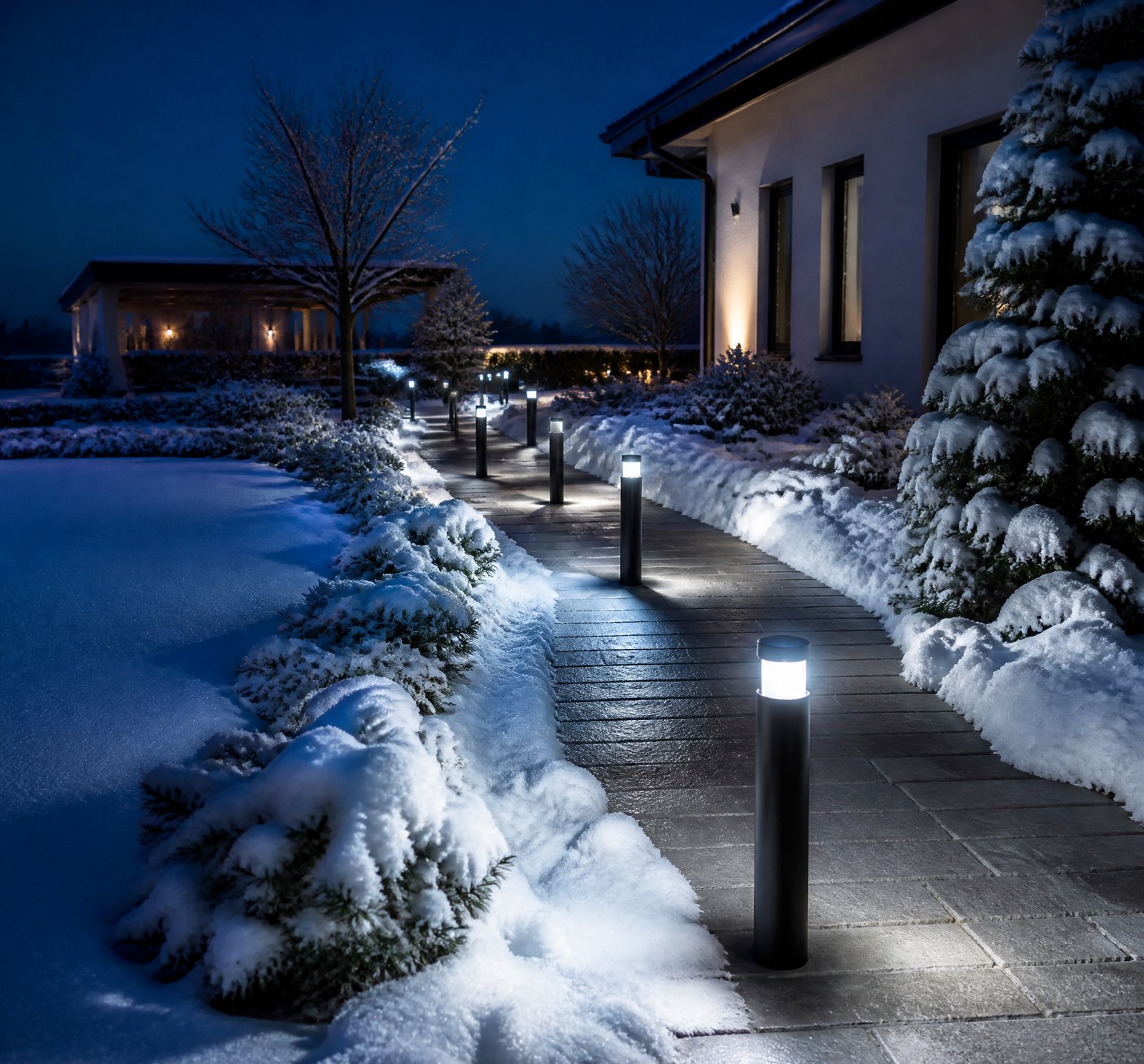
- It does not ensure resistance to snow load or standing water.
- Separate mechanical durability tests are required for assessing real-world stress conditions.
Frequently Asked Questions
[{„q”: „Does an IP65-rated solar lamp protect against heavy rain?”, „a”: „Yes, an IP65 rating ensures protection from low-pressure water jets, which covers heavy rain. However, it does not cover prolonged exposure to standing water [1][4].”},
{„q”: „Can I rely on the IP65 rating for winter conditions in Romania?”, „a”: „While IP65 provides dust and water jet resistance, additional testing is needed for snow load and freeze-thaw cycles [21][13].”},
{„q”: „What tests are conducted to ensure mechanical durability?”, „a”: „Tests like IEC 61215 and Inhomogeneous Mechanical Loading (IML) assess the ability to withstand real-world forces such as heavy snow accumulation [21][17].” }]
References
- [1] IP_Rating_Panasonic_Connect__46a09e83 — authority
source passage
# IP Rating Source: Blog/Web URL: https://eu.connect.panasonic.com/gb/en/products/toughbook/ip-rating Author: Date: 2026-01-01 Breadcrumb What is IP Rating? IP Rating stands for Ingress Protection Rating. A standardized code that defines the level of protection a device offers against the intrusion of solid particles and liquids. What is IP Rating (Ingress Protection)? An IP rating, or Ingress Protection rating, defines the level of defense a device offers against solids like dust and liquids such as water. This international standard (IEC 60529) helps users understand how well equipment performs in challenging environments. How to read an IP rating? The rating typically appears as IP followed by two digits. The first digit indicates protection against solids (like dust and sand), while the second digit refers to resistance against liquids (water= rain, jets, immersion). For example, IP67 means a device that is completely dust-tight and can withstand submersion in water up to 1 meter for 30 minutes. IP68 offers even higher water resistance. TOUGHBOOK IP Ratings at a Glance In rugged computing, IP ratings are critical. They ensure devices can operate reliably in field conditions, from construction sites to emergency response scenarios. Our TOUGHBOOK lineup includes a range of IP-rated models built to perform where others can’t: • TOUGHBOOK 40 – IP66: sealed against dust, powerful water jets • TOUGHBOOK 33 & G2 – IP65: dust-tight, protected against water jets • TOUGHBOOK 55 – I
- [4] IP_code_-_Wikipedia__b712a7e1 — wikipedia
source passage
the experts preparing the original standards are likely retired or deceased.[5] This table shows what each digit or part of the IP code represents.[6] The first digit indicates the level of protection the enclosure provides against access to hazardous parts (e.g., electrical conductors, moving parts) and the ingress of solid foreign objects.[7] The second digit indicates the level of protection that the enclosure provides against harmful ingress of water.[3] The ratings for water ingress are not cumulative beyond IPX6. A device compliant with IPX7 (covering water immersion) is not necessarily compliant with IPX5 or IPX6 (covering exposure to water jets). A device that meets both tests is indicated by listing both tests separated by a slash, e.g. IPX5/IPX7. Standard IP testing is performed using fresh water; protection against other fluids, such as salt water, oils, or solvents, is not guaranteed by the rating and requires specific chemical resistance testing. (All tests with the letter "K" are defined by ISO 20653 (replacing DIN 40050-9) and are not found in IEC 60529, except for IPx9, which is the same as the IP69K water test.) For the protection of equipment specific to: The letter K is specified in ISO 20653 (replacing DIN 40050-9) and not in IEC 60529. DIN 40050-9 extended the newer IEC 60529 rating system with an IP69K rating for high-pressure, high-temperature wash-down applications.[10] Enclosures conforming with ISO 20653:2013 must be both dust-tight (IP6X) and able t
- [13] Landscape_and_Outdoor_Luminaire_Lighting_ULLighting_Performance_Testin__f858e2e3 — authority
source passage
supplied by a remote power unit or an integrated PV module, present no risk of electric shock injury they are subject to a far more abbreviated evaluation than their line voltage counterparts. Services to evaluate compliance to UL and CSA lighting standards We offer a full range of outdoor lighting testing and certification services, for both safety and performance, through our worldwide network of laboratories and engineering facilities. Line voltage luminaires Line voltage luminaires are evaluated for compliance to UL 1598, the Standard for Safety of Luminaires, including the applicable wet location requirements. These requirements are fully harmonized with the Canadian standard CSA C22.2 No. 250.0. Every UL certification project will provide for installation approval in both the U.S. and Canada. For enclosures made of polymeric material, additional evaluations are needed to assess their ability to retain integrity after exposure to ultraviolet light and very low temperatures. Additionally, many of these products are evaluated for ingress protection (IP) so they may be able to obtain an applicable IP rating per EN 60529, signifying the product’s ability to withstand penetration from moisture and dust. Low-voltage lighting certification Low voltage lighting can be evaluated as a complete system or as separate low voltage luminaires and power units. Over the past two decades, and increasingly with the expansion of LED technology, manufacturers have more commonly focused on ei
- [16] Lithium Ion Rechargeable Batteries — book
source passage
60 °C for a dwell time of 16 hours, also employing a ramp rate of 2000 ft./minute. Passing criteria: No deformation in the casing and leakage of electrolyte. Degradation of capacity and performance must be within acceptable limits. Causing internal short circuits and potential thermal runaway. 3–5 Dust test Per IEC standard 60,529‐IP6X: The dust test involves an 8‐hour duration, with dust continuously blown into the chamber, followed by a minimum settlement period of 2 hours to ensure complete settling before opening the chamber. During the test, the units undergo a 2‐hour orientation period in the four worst‐case orientations, which are more prone to dust leakage. The dust used for the test should either be Arizona dust or talcum powder with particles smaller than 75 μm. Approximately 2 kg of dust per cubic meter of the chamber volume is recommended, with the relative humidity maintained below 30% if the chamber has humidity control capabilities. Passing criteria: Must maintain electrical performance, mechanical integrity, safety features, reliability, sealing effectiveness, and functional operation in dusty environments. 3–5 Liquid ingress test The liquid ingress test, as per IEC standard 60529, categorizes levels of protection against liquid ingress. IPX2 denotes suitability for indoor applications, IPX4 for both indoor and outdoor use, and IPX6 for outdoor applications. IPX7 and above signify complete protection against liquid ingress. The test involves checking the unit'
- [17] What_are_the_mechanical_loading_tests_for_solar_panels__ec529d80 — magazine
source passage
pitched residential installations, TUV Rheinland has created the IML test, which is sometimes referred to as non-uniform snow load test. The test begins with 240 hours of Humidity Freeze (HF 10) test on the module, to simulate the freezing conditions. Then a carefully designed set of weights are placed on top of the test module installed at 37° angle. The majority of the weights are located near the bottom frame, with lesser weights toward the top of the module. The result is an uneven distribution of weights spread across the bottom two-thirds of the test module, that simulate the enormous load exerted by settled snow around the eaves, shown in Figure 2. WINAICO’s standard module has successfully passed the 6,000 Pa IML test with less than 5% power degradation. A closer inspection of the force diagram shows the 6,000 Pa IML force is the vector sum of a 4,792 Pa perpendicular force (FP) and a 3,611 Pa horizontal force (FH). The horizontal force FH directly pushes against the weakest points of the frame, as a pile of snow, pulled down by gravitational force, would. By adding a 1.5 safety factor, WINAICO is certified to withstand 4,000 Pa of non-uniform snow load, a pressure that simulates around 50 cm of settled snow on a pitched roof. Dynamic Mechanical Loading (DML) to simulate the effects of typhoons One area constantly overlooked by the traditional solar markets like Europe, is the effects of strong wind on solar modules due to lack of typhoons and other wind related natur
- [21] What_are_the_mechanical_loading_tests_for_solar_panels__ec529d80 — magazine
source passage
# What are the mechanical loading tests for solar panels? Source: Blog/Web URL: https://www.solarpowerworldonline.com/2016/07/mechanical-loading-tests-solar-panels/ Author: Kelly Pickerel Date: 2016-07-05 A white paper provided by WINAICO‘s Tony Chang, Marketing Deputy Manager The maturing solar industry is beginning to realize solar energy is a 20- to 25-year investment, and solar module reliability is as important as, if not more important than, the power output. Therefore, quality solar manufacturers are integrating reliability testing into the design process, and they use the test results to fine tune module quality during mass production. One aspect of module reliability is strength against external forces, usually in the forms of human handling, snow and wind. In order to characterize such external forces, quality labs have devised Mechanical Loading (ML), Inhomogeneous Mechanical Loading (IML) and Dynamic Mechanical Loading (DML) tests. Mechanical Loading (ML) tests as a general test of module strength ML tests have long been hailed as the de-facto tests for evaluating the mechanical strength of solar modules, especially with IEC 61215 having included the 5,400 Pa requirement for passing the standard. An ML test mounts a solar module flat on a standard mounting system, with 5,400 Pa of weight force placed on top to put stress on the solar module, shown in Figure 1. For a standard 60-cell module, this is equivalent to 916 kg of load on top of a single module. Pictures a
# IP Rating Source: Blog/Web URL: https://eu.connect.panasonic.com/gb/en/products/toughbook/ip-rating Author: Date: 2026-01-01 Breadcrumb What is IP Rating? IP Rating stands for Ingress Protection Rating. A standardized code that defines the level of protection a device offers against the intrusion of solid particles and liquids. What is IP Rating (Ingress Protection)? An IP rating, or Ingress Protection rating, defines the level of defense a device offers against solids like dust and liquids such as water. This international standard (IEC 60529) helps users understand how well equipment performs in challenging environments. How to read an IP rating? The rating typically appears as IP followed by two digits. The first digit indicates protection against solids (like dust and sand), while the second digit refers to resistance against liquids (water= rain, jets, immersion). For example, IP67 means a device that is completely dust-tight and can withstand submersion in water up to 1 meter for 30 minutes. IP68 offers even higher water resistance. TOUGHBOOK IP Ratings at a Glance In rugged computing, IP ratings are critical. They ensure devices can operate reliably in field conditions, from construction sites to emergency response scenarios. Our TOUGHBOOK lineup includes a range of IP-rated models built to perform where others can’t: • TOUGHBOOK 40 – IP66: sealed against dust, powerful water jets • TOUGHBOOK 33 & G2 – IP65: dust-tight, protected against water jets • TOUGHBOOK 55 – I
the experts preparing the original standards are likely retired or deceased.[5] This table shows what each digit or part of the IP code represents.[6] The first digit indicates the level of protection the enclosure provides against access to hazardous parts (e.g., electrical conductors, moving parts) and the ingress of solid foreign objects.[7] The second digit indicates the level of protection that the enclosure provides against harmful ingress of water.[3] The ratings for water ingress are not cumulative beyond IPX6. A device compliant with IPX7 (covering water immersion) is not necessarily compliant with IPX5 or IPX6 (covering exposure to water jets). A device that meets both tests is indicated by listing both tests separated by a slash, e.g. IPX5/IPX7. Standard IP testing is performed using fresh water; protection against other fluids, such as salt water, oils, or solvents, is not guaranteed by the rating and requires specific chemical resistance testing. (All tests with the letter "K" are defined by ISO 20653 (replacing DIN 40050-9) and are not found in IEC 60529, except for IPx9, which is the same as the IP69K water test.) For the protection of equipment specific to: The letter K is specified in ISO 20653 (replacing DIN 40050-9) and not in IEC 60529. DIN 40050-9 extended the newer IEC 60529 rating system with an IP69K rating for high-pressure, high-temperature wash-down applications.[10] Enclosures conforming with ISO 20653:2013 must be both dust-tight (IP6X) and able t
supplied by a remote power unit or an integrated PV module, present no risk of electric shock injury they are subject to a far more abbreviated evaluation than their line voltage counterparts. Services to evaluate compliance to UL and CSA lighting standards We offer a full range of outdoor lighting testing and certification services, for both safety and performance, through our worldwide network of laboratories and engineering facilities. Line voltage luminaires Line voltage luminaires are evaluated for compliance to UL 1598, the Standard for Safety of Luminaires, including the applicable wet location requirements. These requirements are fully harmonized with the Canadian standard CSA C22.2 No. 250.0. Every UL certification project will provide for installation approval in both the U.S. and Canada. For enclosures made of polymeric material, additional evaluations are needed to assess their ability to retain integrity after exposure to ultraviolet light and very low temperatures. Additionally, many of these products are evaluated for ingress protection (IP) so they may be able to obtain an applicable IP rating per EN 60529, signifying the product’s ability to withstand penetration from moisture and dust. Low-voltage lighting certification Low voltage lighting can be evaluated as a complete system or as separate low voltage luminaires and power units. Over the past two decades, and increasingly with the expansion of LED technology, manufacturers have more commonly focused on ei
60 °C for a dwell time of 16 hours, also employing a ramp rate of 2000 ft./minute. Passing criteria: No deformation in the casing and leakage of electrolyte. Degradation of capacity and performance must be within acceptable limits. Causing internal short circuits and potential thermal runaway. 3–5 Dust test Per IEC standard 60,529‐IP6X: The dust test involves an 8‐hour duration, with dust continuously blown into the chamber, followed by a minimum settlement period of 2 hours to ensure complete settling before opening the chamber. During the test, the units undergo a 2‐hour orientation period in the four worst‐case orientations, which are more prone to dust leakage. The dust used for the test should either be Arizona dust or talcum powder with particles smaller than 75 μm. Approximately 2 kg of dust per cubic meter of the chamber volume is recommended, with the relative humidity maintained below 30% if the chamber has humidity control capabilities. Passing criteria: Must maintain electrical performance, mechanical integrity, safety features, reliability, sealing effectiveness, and functional operation in dusty environments. 3–5 Liquid ingress test The liquid ingress test, as per IEC standard 60529, categorizes levels of protection against liquid ingress. IPX2 denotes suitability for indoor applications, IPX4 for both indoor and outdoor use, and IPX6 for outdoor applications. IPX7 and above signify complete protection against liquid ingress. The test involves checking the unit'
pitched residential installations, TUV Rheinland has created the IML test, which is sometimes referred to as non-uniform snow load test. The test begins with 240 hours of Humidity Freeze (HF 10) test on the module, to simulate the freezing conditions. Then a carefully designed set of weights are placed on top of the test module installed at 37° angle. The majority of the weights are located near the bottom frame, with lesser weights toward the top of the module. The result is an uneven distribution of weights spread across the bottom two-thirds of the test module, that simulate the enormous load exerted by settled snow around the eaves, shown in Figure 2. WINAICO’s standard module has successfully passed the 6,000 Pa IML test with less than 5% power degradation. A closer inspection of the force diagram shows the 6,000 Pa IML force is the vector sum of a 4,792 Pa perpendicular force (FP) and a 3,611 Pa horizontal force (FH). The horizontal force FH directly pushes against the weakest points of the frame, as a pile of snow, pulled down by gravitational force, would. By adding a 1.5 safety factor, WINAICO is certified to withstand 4,000 Pa of non-uniform snow load, a pressure that simulates around 50 cm of settled snow on a pitched roof. Dynamic Mechanical Loading (DML) to simulate the effects of typhoons One area constantly overlooked by the traditional solar markets like Europe, is the effects of strong wind on solar modules due to lack of typhoons and other wind related natur
# What are the mechanical loading tests for solar panels? Source: Blog/Web URL: https://www.solarpowerworldonline.com/2016/07/mechanical-loading-tests-solar-panels/ Author: Kelly Pickerel Date: 2016-07-05 A white paper provided by WINAICO‘s Tony Chang, Marketing Deputy Manager The maturing solar industry is beginning to realize solar energy is a 20- to 25-year investment, and solar module reliability is as important as, if not more important than, the power output. Therefore, quality solar manufacturers are integrating reliability testing into the design process, and they use the test results to fine tune module quality during mass production. One aspect of module reliability is strength against external forces, usually in the forms of human handling, snow and wind. In order to characterize such external forces, quality labs have devised Mechanical Loading (ML), Inhomogeneous Mechanical Loading (IML) and Dynamic Mechanical Loading (DML) tests. Mechanical Loading (ML) tests as a general test of module strength ML tests have long been hailed as the de-facto tests for evaluating the mechanical strength of solar modules, especially with IEC 61215 having included the 5,400 Pa requirement for passing the standard. An ML test mounts a solar module flat on a standard mounting system, with 5,400 Pa of weight force placed on top to put stress on the solar module, shown in Figure 1. For a standard 60-cell module, this is equivalent to 916 kg of load on top of a single module. Pictures a