
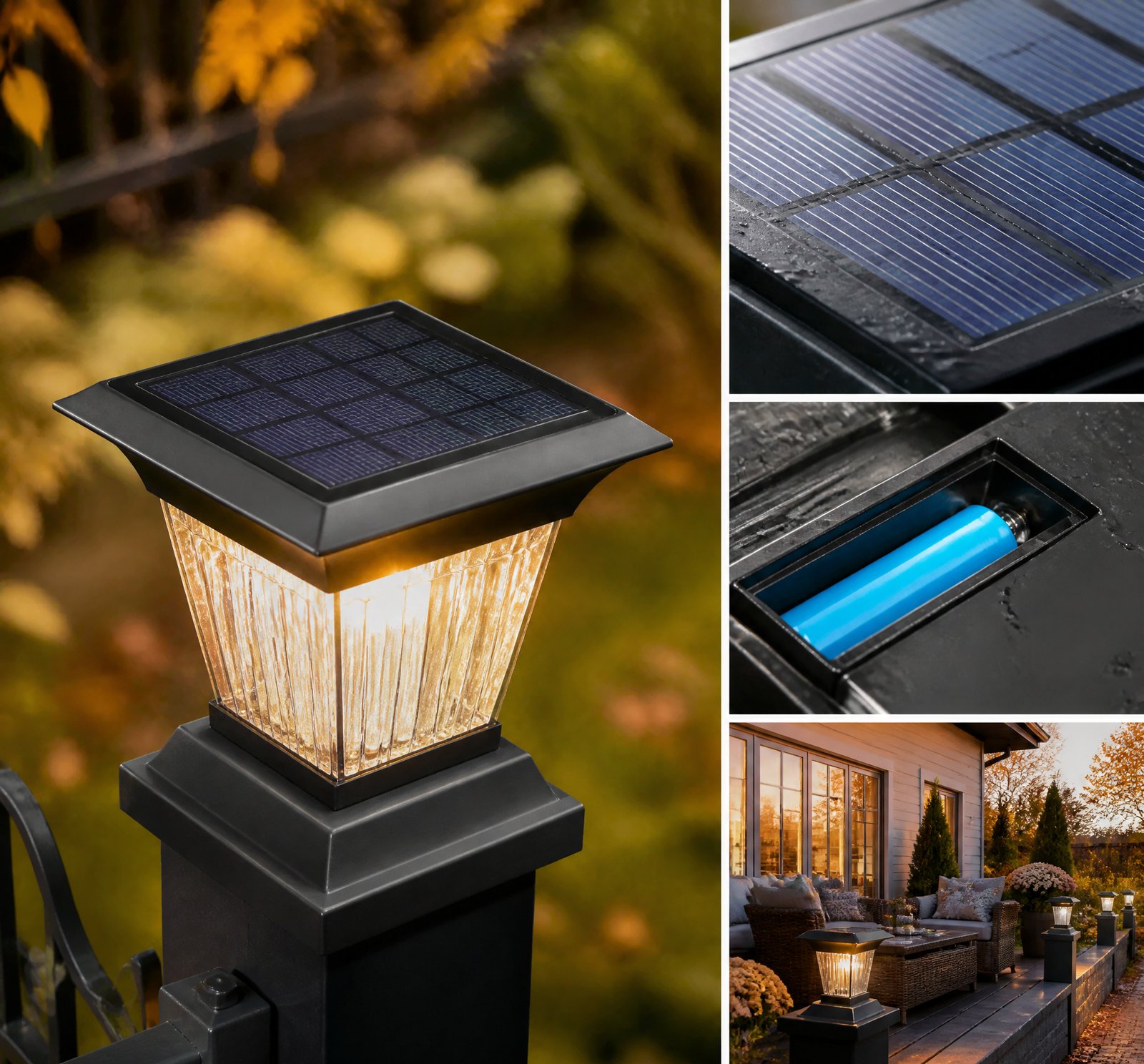
> Quick answer: In long-term field studies, the battery most frequently fails first in outdoor solar lights within 2 years due to poor quality and temperature extremes [13]. The driver follows closely as a failure point, often failing within 2 years due to moisture ingress and design flaws [3].
In central-European climates, which component of solar lamps is the weakest link? Long-term field studies reveal some surprising insights into battery life and system reliability. This article delves into the specific components that fail first under these conditions, providing actionable insights for users in Romania and beyond.
Battery Failure: The Primary Weak Link
The most frequent point of failure in outdoor solar lights is the battery, particularly within just two years [13]. Low-quality or poorly managed batteries, such as lead-acid types or recycled lithium cells with low cycle life (typically 300–500 full charge cycles), are especially vulnerable. These batteries fail to perform adequately below 10°C or above 50°C, common in central-European winters and summers [13]. Even high-capacity LiFePO4 batteries can suffer permanent damage if the battery management system (BMS) is absent, leading to cell imbalance [13].
Driver Failure: The Silent Killer
The driver (controller) ranks second as a frequent failure point. According to a US Department of Energy study, drivers contribute to nearly 60% of catastrophic failures in LED lighting systems [3]. This high rate is often due to poor waterproofing and inadequate circuit design, leading to moisture damage and short circuits—especially in low-cost models [12]. A failed driver can waste up to 40% of the energy generated by the solar panel, causing battery starvation even when sunlight is available [6].
Housing Durability: The Weather’s Worst Enemy
The housing is another significant failure point. In coastal or industrial environments, salt air accelerates corrosion in iron or regular steel bodies [2]. Rust can create holes, allowing rainwater to penetrate and damage internal components like the battery and circuitry [2]. Low-quality plastic housings also crack under prolonged UV exposure and thermal cycling [18][24], leading to structural failures due to seasonal temperature swings and exposure to rain and snow.
Solar Panel Reliability: High Durability, Low Failure Rate
In contrast, solar panels are more resilient. While they do degrade over time due to light-induced degradation (LID) and thermal cycling, their failure rate is low [18][24]. A study found a median failure rate of only 5 panels per 10,000 annually, with system downtime rarely attributed to panel failure [15][19].
LED Longevity: The Most Reliable Component
LEDs account for less than 10% of failures in outdoor lighting systems and have a typical lifespan rated at 50,000 hours or more [3][17]. Their semiconductor nature makes them less prone to degradation [3], although heat can affect their performance.
Sensor Reliability: A Common Weakness
The sensor is also a frequent point of failure, particularly in low-cost models with limited detection range and poor waterproofing. These sensors can fail within months when exposed to moisture, causing lights to remain on during the day or not activate at night [12].
Key Takeaways
- Batteries are the primary weak link, failing within 2 years due to poor quality and temperature extremes.
- Drivers contribute significantly to failures due to moisture damage and inadequate design.
- Housings can fail due to corrosion and cracking from UV exposure and thermal cycling.
References
- [2] Solar_Street_Light_From_Germany__Why_Solar_Street_Lighting_Fails_in_Storms_Structural_Integrity_for_EPC_Projects__yvEyflD92L4 — youtube
source passage
# Why Solar Street Lighting Fails in Storms? (Structural Integrity for EPC Projects) Source: YouTube — Solar Street Light From Germany URL: https://www.youtube.com/watch?v=yvEyflD92L4 Video ID: yvEyflD92L4 Transcript: generated The long-term durability of a solar street lighting project doesn't depend only on the battery. It also depends on how strong and stable the structure is. Often, lights collapse during powerful storms or the body corrodes within just a few months due to salty air. This puts your entire investment at serious risk. Why do such mechanical failures occur? In today's technical discussion, we'll explore the real secrets behind the durability of solar street lighting systems. In coastal or industrial areas, salt in the air causes iron or regular steel bodies to oxidize quickly and develop rust. Once holes form in the structure, rainwater can directly reach the battery and circuitry, rendering the entire system unusable. On the other hand, low-quality plastic bodies tend to crack under excessive sunlight. Once this kind of damage begins, it becomes nearly impossible to repair and significantly increases the overall project cost. When lights are installed on tall poles, wind pressure or wind load increases significantly. If the bracket or overall mechanical design isn't properly engineered, even winds of 100 km/h can cause the light to detach from the pole and fall. This is not only a financial loss, but also a serious safety hazard. We need to understand why m
- [3] What_Happened_To_The_100000-Hour_LED_Bulbs_-_Hackaday__a70b0bb9 — authority
source passage
might be responsible for failures. The US Department of Energy (DoE)’s solid-state lighting program supports research and development of LED technologies, and their website contains volumes of data on LED lighting systems. Their Lifetime and Reliability Fact Sheet contains data on the failure rate of 5,400 outdoor lamps over 34 million hours of operation. Interestingly, the LEDs themselves account for only 10% of the failures; driver circuitry, on the other hand, was responsible almost 60% of the time. The remainder of failures were due to housing problems, which may not be as applicable for bulbs in indoor use. This data shows that at least for catastrophic failures (where the lamp ceases to emit light), extending lifetime means improving the power supplies. Locate the Weakest Link: Component Lifetime The lifetime of a bulb (or power supply) can be no longer than the lifetime of any of its components. Among the components found inside the bulbs, two stand out as life-limiters: the semiconductors and the electrolytic capacitors. Both of these components suffer from a failure rate that is a strong function of temperature. The typical model for this effect, based on the Arrhenius equation, predicts a doubling of lifetime for each 10 degree Celsius decrease in temperature, at least over a limited range. The two longer-lived bulbs use twice as many packages to carry approximately the same number of LED dice as the GE Basic lamp, decreasing thermal resistance to their respective h
- [6] Solar_Street_Light_From_Germany__Why_Solar_Street_Lights_Fail_in_Winter_Ultimate_Technical_Guide_for_B2B_Projects__Ua7I1YwH3DU — youtube
source passage
# Why Solar Street Lights Fail in Winter? (Ultimate Technical Guide for B2B Projects) Source: YouTube — Solar Street Light From Germany URL: https://www.youtube.com/watch?v=Ua7I1YwH3DU Video ID: Ua7I1YwH3DU Transcript: generated You've invested thousands of dollars in a large-scale solar project, but just 3 months later, the streets are dark by midnight. No light, no security. This isn't just a technical glitch, it's a total project failure and a massive financial loss for your company. Why does the battery fail to charge even with expensive systems? Today, we reveal the silent killer, the technical reasons behind charging failure and how to stop it forever. The biggest culprit is the use of polycrystalline panels. With an efficiency of only 17%, they are a disaster for B2B projects. On cloudy days or during winter, these panels fail to generate the minimum voltage required to trigger the charging process. This leads to battery starvation. When a battery stays partially charged for weeks, internal chemical layers build up, causing permanent damage. This is exactly why your lights shut off in the middle of the night. Even if the panel generates some power, an outdated PWM controller wastes 40% of it. It's like trying to fill a bucket with a massive hole in the bottom. Enough energy never reaches the battery. This leaves the streets dark, increasing the risk of accidents and crime. In a professional B2B environment, these small technical mistakes can destroy your company's enti
- [12] Solar_Street_Light_From_Germany__Why_Solar_Street_Lights_Fail_at_Night_Technical_Audit_Solutions__hEoajAjj8HI — youtube
source passage
# Why Solar Street Lights Fail at Night (Technical Audit & Solutions) Source: YouTube — Solar Street Light From Germany URL: https://www.youtube.com/watch?v=hEoajAjj8HI Video ID: hEoajAjj8HI Transcript: generated A dark road where solar street lights have been installed for safety. When a pedestrian walks under the light, it is supposed to brighten, but it doesn't. This is not just a mechanical fault. It is a major safety risk at night and a failure of the project. Why doesn't the motion sensor work? Today, we will dive deep into this technical problem. Most low-cost solar lights use low-quality passive infrared sensors. Their detection range is very limited. When the temperature is too high or the light is installed at a greater height, these sensors often fail to detect human presence. As a result, the core objective of the project is compromised. In business-to-business projects, this kind of sensor failure can lead to significant maintenance costs. The biggest issue is poor waterproofing. If the sensor is not properly sealed, rainwater or moisture can enter and damage the sensor's internal circuit. As a result, the light may stay on all day or not turn on at all. Many low-cost lights with an IP65 rating fail to effectively block moisture, causing the sensor to become faulty within just a few months. Dell has solved this problem with its all-in-one intelligent lighting system. Our system features a high-response motion sensor that can accurately detect movement from height
- [13] Solar_Street_Light_From_Germany__The_Science_of_Solar_Battery_Failure_How_to_Achieve_a_12_Year_Lifespan__lu_n9o8-I80 — youtube
source passage
# The Science of Solar Battery Failure: How to Achieve a 12 Year Lifespan Source: YouTube — Solar Street Light From Germany URL: https://www.youtube.com/watch?v=lu_n9o8-I80 Video ID: lu_n9o8-I80 Transcript: generated The success of a solar street light project largely depends on its battery. However, statistics show that 80% of projects suffer battery failure within just 2 years. Why do solar batteries lose their ability to hold charge so quickly? Today, we will analyze the deep technical reasons behind battery failure and explore how a proper design can solve this problem for good. Most low-cost solar lights use lead-acid batteries or recycled lithium cells. These have a very low cycle life, typically only 300 to 500 full charge cycles. As a result, the batteries often swell or become completely dead even before reaching 2 years of use. This creates a significant financial risk, especially for large-scale B2B projects. Batteries are most heavily affected by temperature. Below 10°C or above 50°C, standard lithium batteries struggle to charge properly. In extreme desert heat or polar cold conditions, these batteries can suffer permanent damage. As a result, the maintenance cost of the entire project increases significantly. A battery pack consists of multiple individual cells. Without a smart BMS, battery management system, the voltage between these cells becomes unbalanced. This imbalance can lead to overcharging or even short circuits. Without a robust management system, it
- [15] How_long_do_residential_solar_panels_last_pv_magazine_International__a1e59f16 — authority
source passage
study found a median failure rate of 5 panels out of 10,000 annually. Panel failure has improved markedly over time, as it was found that systems installed between 1980 and 2000 demonstrated a failure rate double the post-2000 group. (Read: “Top solar panel brands in performance, reliability and quality“) System downtime is rarely attributed to panel failure. In fact, a study by kWh Analytics found that 80% of all solar plant downtime is a result of failing inverters, the device that converts the panel’s DC current to usable AC. pv magazine will analyze inverter performance in the next installment of this series.
- [17] Philips_Radii_auto-linkable_solar_lights_light_up_your_outdoor_space__f26786e0 — authority
source passage
leading to corrosion or rust. In addition, with a long lifespan of up to 50,000 hours and a five-year warranty period, they will light up your outdoor space with reliable solar lighting for a long time.
- [18] How_long_do_rooftop_residential_solar_panels_last_-_pv_magazine_Global__7bebb092 — authority
source passage
to decline, in some cases significantly. All panels also suffer something called light induced degradation (LID), in which panels lose efficiency within the first hours of being exposed to the sun. LID varies from panel to panel based on the quality of the crystalline silicon wafers, but usually results in a one-time, 1% to 3% loss in efficiency, said testing laboratory PVEL, PV Evolution Labs. Weather conditions The exposure to weather conditions is the main driver in panel degradation. Heat is a key factor in both real-time panel performance and degradation over time. Ambient heat negatively affects the performance and efficiency of electrical components, according to NREL. By checking the manufacturer’s data sheet, a panel’s temperature coefficient can be found, which will demonstrate the panel’s ability to perform in higher temperatures, said SolarCalculator.com. Heat exchange also drives degradation through a process called thermal cycling. When it is warm, materials expand, and when the temperature lowers, they contract. This movement slowly causes microcracks to form in the panel over time, lowering output.The coefficient explains how much efficiency is lost by each degree of Celsius increased above the standard temperature of 25 C. For example, a temperature coefficient of -0.353% means that for every degree Celsius above 25, 0.353% of total production capability is lost. In its annual Module Score Card study, PVEL analyzed 36 operational solar projects in India, and
- [19] How_long_do_rooftop_residential_solar_panels_last_-_pv_magazine_Global__7bebb092 — authority
source passage
panels out of 10,000 annually. Panel failure has improved markedly over time, as it was found that system installed between 1980 and 2000 demonstrated a failure rate double the post-2000 group. System downtime is rarely attributed to panel failure. In fact, a study by kWh Analytics found that 80% of all solar plant downtime is a result of failing inverters, the device that converts the panel’s DC current to usable AC. pv magazine will analyze inverter performance in the next installment of this series.
- [24] How_long_do_residential_solar_panels_last_pv_magazine_International__a1e59f16 — authority
source passage
materials in their glass, encapsulation, and diffusion barriers. All panels also suffer something called light-induced degradation (LID), in which panels lose efficiency within the first hours of being exposed to the sun. LID varies from panel to panel based on the quality of the crystalline silicon wafers, but usually results in a one-time, 1-3% loss in efficiency, said testing laboratory PVEL, PV Evolution Labs. Weathering The exposure to weather conditions is the main driver in panel degradation. Heat is a key factor in both real-time panel performance and degradation over time. Ambient heat negatively affects the performance and efficiency of electrical components, according to NREL. By checking the manufacturer’s data sheet, a panel’s temperature coefficient can be found, which will demonstrate the panel’s ability to perform in higher temperatures. The coefficient explains how much real-time efficiency is lost by each degree Celsius increase above the standard temperature of 25 degrees Celsius. For example, a temperature coefficient of -0.353% means that for every degree Celsius above 25, 0.353% of total production capability is lost. Heat exchange drives panel degradation through a process called thermal cycling. When it is warm, materials expand, and when the temperature lowers, they contract. This movement slowly causes microcracks to form in the panel over time, lowering output. In its annual Module Score Card study, PVEL analyzed 36 operational solar projects in Ind
# Why Solar Street Lighting Fails in Storms? (Structural Integrity for EPC Projects) Source: YouTube — Solar Street Light From Germany URL: https://www.youtube.com/watch?v=yvEyflD92L4 Video ID: yvEyflD92L4 Transcript: generated The long-term durability of a solar street lighting project doesn't depend only on the battery. It also depends on how strong and stable the structure is. Often, lights collapse during powerful storms or the body corrodes within just a few months due to salty air. This puts your entire investment at serious risk. Why do such mechanical failures occur? In today's technical discussion, we'll explore the real secrets behind the durability of solar street lighting systems. In coastal or industrial areas, salt in the air causes iron or regular steel bodies to oxidize quickly and develop rust. Once holes form in the structure, rainwater can directly reach the battery and circuitry, rendering the entire system unusable. On the other hand, low-quality plastic bodies tend to crack under excessive sunlight. Once this kind of damage begins, it becomes nearly impossible to repair and significantly increases the overall project cost. When lights are installed on tall poles, wind pressure or wind load increases significantly. If the bracket or overall mechanical design isn't properly engineered, even winds of 100 km/h can cause the light to detach from the pole and fall. This is not only a financial loss, but also a serious safety hazard. We need to understand why m
might be responsible for failures. The US Department of Energy (DoE)’s solid-state lighting program supports research and development of LED technologies, and their website contains volumes of data on LED lighting systems. Their Lifetime and Reliability Fact Sheet contains data on the failure rate of 5,400 outdoor lamps over 34 million hours of operation. Interestingly, the LEDs themselves account for only 10% of the failures; driver circuitry, on the other hand, was responsible almost 60% of the time. The remainder of failures were due to housing problems, which may not be as applicable for bulbs in indoor use. This data shows that at least for catastrophic failures (where the lamp ceases to emit light), extending lifetime means improving the power supplies. Locate the Weakest Link: Component Lifetime The lifetime of a bulb (or power supply) can be no longer than the lifetime of any of its components. Among the components found inside the bulbs, two stand out as life-limiters: the semiconductors and the electrolytic capacitors. Both of these components suffer from a failure rate that is a strong function of temperature. The typical model for this effect, based on the Arrhenius equation, predicts a doubling of lifetime for each 10 degree Celsius decrease in temperature, at least over a limited range. The two longer-lived bulbs use twice as many packages to carry approximately the same number of LED dice as the GE Basic lamp, decreasing thermal resistance to their respective h
# Why Solar Street Lights Fail in Winter? (Ultimate Technical Guide for B2B Projects) Source: YouTube — Solar Street Light From Germany URL: https://www.youtube.com/watch?v=Ua7I1YwH3DU Video ID: Ua7I1YwH3DU Transcript: generated You've invested thousands of dollars in a large-scale solar project, but just 3 months later, the streets are dark by midnight. No light, no security. This isn't just a technical glitch, it's a total project failure and a massive financial loss for your company. Why does the battery fail to charge even with expensive systems? Today, we reveal the silent killer, the technical reasons behind charging failure and how to stop it forever. The biggest culprit is the use of polycrystalline panels. With an efficiency of only 17%, they are a disaster for B2B projects. On cloudy days or during winter, these panels fail to generate the minimum voltage required to trigger the charging process. This leads to battery starvation. When a battery stays partially charged for weeks, internal chemical layers build up, causing permanent damage. This is exactly why your lights shut off in the middle of the night. Even if the panel generates some power, an outdated PWM controller wastes 40% of it. It's like trying to fill a bucket with a massive hole in the bottom. Enough energy never reaches the battery. This leaves the streets dark, increasing the risk of accidents and crime. In a professional B2B environment, these small technical mistakes can destroy your company's enti
# Why Solar Street Lights Fail at Night (Technical Audit & Solutions) Source: YouTube — Solar Street Light From Germany URL: https://www.youtube.com/watch?v=hEoajAjj8HI Video ID: hEoajAjj8HI Transcript: generated A dark road where solar street lights have been installed for safety. When a pedestrian walks under the light, it is supposed to brighten, but it doesn't. This is not just a mechanical fault. It is a major safety risk at night and a failure of the project. Why doesn't the motion sensor work? Today, we will dive deep into this technical problem. Most low-cost solar lights use low-quality passive infrared sensors. Their detection range is very limited. When the temperature is too high or the light is installed at a greater height, these sensors often fail to detect human presence. As a result, the core objective of the project is compromised. In business-to-business projects, this kind of sensor failure can lead to significant maintenance costs. The biggest issue is poor waterproofing. If the sensor is not properly sealed, rainwater or moisture can enter and damage the sensor's internal circuit. As a result, the light may stay on all day or not turn on at all. Many low-cost lights with an IP65 rating fail to effectively block moisture, causing the sensor to become faulty within just a few months. Dell has solved this problem with its all-in-one intelligent lighting system. Our system features a high-response motion sensor that can accurately detect movement from height
# The Science of Solar Battery Failure: How to Achieve a 12 Year Lifespan Source: YouTube — Solar Street Light From Germany URL: https://www.youtube.com/watch?v=lu_n9o8-I80 Video ID: lu_n9o8-I80 Transcript: generated The success of a solar street light project largely depends on its battery. However, statistics show that 80% of projects suffer battery failure within just 2 years. Why do solar batteries lose their ability to hold charge so quickly? Today, we will analyze the deep technical reasons behind battery failure and explore how a proper design can solve this problem for good. Most low-cost solar lights use lead-acid batteries or recycled lithium cells. These have a very low cycle life, typically only 300 to 500 full charge cycles. As a result, the batteries often swell or become completely dead even before reaching 2 years of use. This creates a significant financial risk, especially for large-scale B2B projects. Batteries are most heavily affected by temperature. Below 10°C or above 50°C, standard lithium batteries struggle to charge properly. In extreme desert heat or polar cold conditions, these batteries can suffer permanent damage. As a result, the maintenance cost of the entire project increases significantly. A battery pack consists of multiple individual cells. Without a smart BMS, battery management system, the voltage between these cells becomes unbalanced. This imbalance can lead to overcharging or even short circuits. Without a robust management system, it
study found a median failure rate of 5 panels out of 10,000 annually. Panel failure has improved markedly over time, as it was found that systems installed between 1980 and 2000 demonstrated a failure rate double the post-2000 group. (Read: “Top solar panel brands in performance, reliability and quality“) System downtime is rarely attributed to panel failure. In fact, a study by kWh Analytics found that 80% of all solar plant downtime is a result of failing inverters, the device that converts the panel’s DC current to usable AC. pv magazine will analyze inverter performance in the next installment of this series.
leading to corrosion or rust. In addition, with a long lifespan of up to 50,000 hours and a five-year warranty period, they will light up your outdoor space with reliable solar lighting for a long time.
to decline, in some cases significantly. All panels also suffer something called light induced degradation (LID), in which panels lose efficiency within the first hours of being exposed to the sun. LID varies from panel to panel based on the quality of the crystalline silicon wafers, but usually results in a one-time, 1% to 3% loss in efficiency, said testing laboratory PVEL, PV Evolution Labs. Weather conditions The exposure to weather conditions is the main driver in panel degradation. Heat is a key factor in both real-time panel performance and degradation over time. Ambient heat negatively affects the performance and efficiency of electrical components, according to NREL. By checking the manufacturer’s data sheet, a panel’s temperature coefficient can be found, which will demonstrate the panel’s ability to perform in higher temperatures, said SolarCalculator.com. Heat exchange also drives degradation through a process called thermal cycling. When it is warm, materials expand, and when the temperature lowers, they contract. This movement slowly causes microcracks to form in the panel over time, lowering output.The coefficient explains how much efficiency is lost by each degree of Celsius increased above the standard temperature of 25 C. For example, a temperature coefficient of -0.353% means that for every degree Celsius above 25, 0.353% of total production capability is lost. In its annual Module Score Card study, PVEL analyzed 36 operational solar projects in India, and
panels out of 10,000 annually. Panel failure has improved markedly over time, as it was found that system installed between 1980 and 2000 demonstrated a failure rate double the post-2000 group. System downtime is rarely attributed to panel failure. In fact, a study by kWh Analytics found that 80% of all solar plant downtime is a result of failing inverters, the device that converts the panel’s DC current to usable AC. pv magazine will analyze inverter performance in the next installment of this series.
materials in their glass, encapsulation, and diffusion barriers. All panels also suffer something called light-induced degradation (LID), in which panels lose efficiency within the first hours of being exposed to the sun. LID varies from panel to panel based on the quality of the crystalline silicon wafers, but usually results in a one-time, 1-3% loss in efficiency, said testing laboratory PVEL, PV Evolution Labs. Weathering The exposure to weather conditions is the main driver in panel degradation. Heat is a key factor in both real-time panel performance and degradation over time. Ambient heat negatively affects the performance and efficiency of electrical components, according to NREL. By checking the manufacturer’s data sheet, a panel’s temperature coefficient can be found, which will demonstrate the panel’s ability to perform in higher temperatures. The coefficient explains how much real-time efficiency is lost by each degree Celsius increase above the standard temperature of 25 degrees Celsius. For example, a temperature coefficient of -0.353% means that for every degree Celsius above 25, 0.353% of total production capability is lost. Heat exchange drives panel degradation through a process called thermal cycling. When it is warm, materials expand, and when the temperature lowers, they contract. This movement slowly causes microcracks to form in the panel over time, lowering output. In its annual Module Score Card study, PVEL analyzed 36 operational solar projects in Ind