
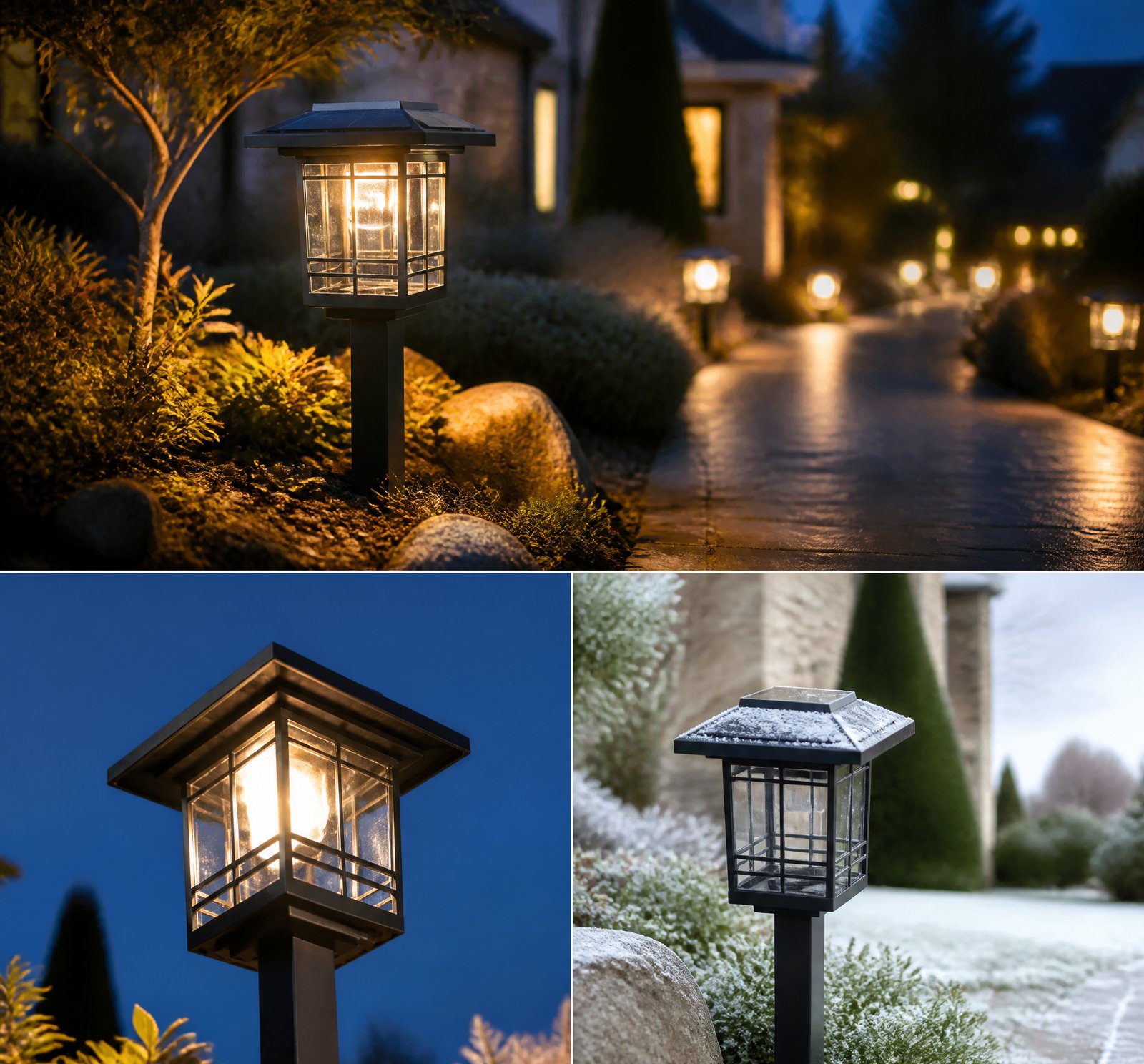
> Quick answer: The amount of light reaching the ground from a given lumen output is influenced by human visual sensitivity, luminaire design, distance to the surface, and environmental factors like motion sensors and battery performance [1][8].
To understand how much light solar lamps project onto the ground in Romania, we must delve into the physical principles that govern this process. This article explores the intricate relationship between lumen output, spectral composition, fixture design, and practical operational considerations.
The Photometric Relationship: Luminous Flux, Intensity, and Illuminance
The amount of light reaching the ground is not just a function of lumen output but also involves human visual perception. Lumens quantify perceived brightness based on the eye’s sensitivity to different wavelengths, with green light at 555 nm offering peak efficiency [1][4][5]. For example, one watt of 555 nm green light yields 683 lumens, while infrared and ultraviolet radiation yield zero lumens due to their invisibility to humans [4][5].
Illuminance (lux) measures the amount of light falling on a surface. The inverse square law implies that illuminance decreases with distance from the source, and sunlight at Earth’s surface can reach up to 100,000 lux [8]. Therefore, even solar lamps with high lumen outputs may produce low lux levels if the light is spread over large areas or emitted from a distant point.
Spectral Composition: Trade-offs Between Brightness and Color Quality
The spectral content of the light plays a critical role in perceived brightness. While monochromatic green light (555 nm) offers optimal luminous efficacy, white light sources must include multiple wavelengths to appear natural, reducing overall efficiency [1][5]. For instance, a 60-watt incandescent bulb and a 15-watt compact fluorescent can both produce 900 lumens because the fluorescent emits more of the wavelengths to which the eye is sensitive [4].
Luminaire Design: Directing Light Effectively
The design of solar lamp fixtures significantly influences how much light reaches the ground. Patent designs include lampshades that prevent internal light absorption and promote outward emission, ensuring maximum illumination efficiency [2][25]. Proper distribution—from focused to diffuse—is key to effective lighting. For example, a semitransparent hemisphere shade can help direct or diffuse light more effectively [2].
Environmental Factors: Dynamic Control Systems
Solar lamps often incorporate motion sensors and dimming algorithms to regulate energy use, turning on at full brightness at dusk and adjusting output based on activity levels [7][16]. Battery capacity also affects performance; systems may dim LEDs when battery levels fall below a threshold, impacting the consistent delivery of lumen outputs [16].
Sensor Accuracy: Measuring Light Correctly
Lux sensors measure illuminance and are calibrated to human visual sensitivity. CCT sensors measure color but not total intensity, highlighting that accurate measurement requires accounting for visibility weights across different wavelengths [5][11]. Flux measurements must be standardized under specific conditions to be meaningful.
Key Takeaways
- Human Visual Sensitivity: Lumens quantify perceived brightness based on the eye’s spectral sensitivity.
- Fixture Design Matters: Proper design directs light effectively, reducing losses from absorption and internal reflection.
- Dynamic Controls Enhance Efficiency: Motion sensors and dimming algorithms optimize energy use while maintaining adequate illumination.
Frequently Asked Questions
„`json
[
{
„q”: „Does a higher lumen output always mean more brightness?”,
„a”: „Not necessarily. The same radiant power in different wavelengths produces vastly different lumens; green light (555 nm) is most efficient [4][5].”
},
{
„q”: „How does distance affect the lux level on the ground?”,
„a”: „Illuminance decreases with distance from the source, following the inverse square law. Sunlight at Earth’s surface can reach up to 100,000 lux [8].”
},
{
„q”: „What role do motion sensors play in solar lamp performance?”,
„a”: „Motion sensors and dimming algorithms regulate energy use, turning on full brightness at dusk and adjusting output based on activity levels [7][16].”
}
]
„`
References
- [1] Diodes_-_Education_-_DigiKey_TechForum_-_An_Electronic_Component__e6dec931 — authority
source passage
that humans find useful. Measurements are typically quoted based on a photopic (color perception at normal light levels) vision model, in which the theoretical maximum is 683 lumens per watt. That maximum applies at the peak of the human spectral sensitivity curve around 555nm (green) so theoretical maximums for light sources with broader spectral content (e.g. “white” light) will be lower. Luminous flux , measured in units of lumens , is a measure of perceived optical power. Because human vision is not uniformly sensitive to all wavelengths, the usual all-purpose unit for measuring power (the watt ) doesn’t serve well in situations where providing illumination is the goal; one watt of red light does not provide the same illumination benefit as one watt of green light, for example. The luminous flux concept works around this limitation by weighting the spectral content of a light source according to a standard luminosity function, which describes the variation of human vision sensitivity as a function of wavelength. The various flux attributes used to describe LEDs communicate the amount of optical power produced by a device. These figures are directly dependent on the forward current applied to the LED when the measurement was made and somewhat less directly (though strongly) on the temperature of the device. Accordingly, the listed flux values are applicable at the also-listed test current and temperature. The photo below illustrates the difference in illumination benefit d
- [2] US4816970A_-_Solar_powered_light_-_Google_Patents__3a220bcd — patent
source passage
majority of the light rays are prevented from passing through the interior surface of the lampshade 16 during an illumination of the light bulb, while substantially all of the light rays are permitted to pass through the exterior surface of the lampshade so as to come into contact with the solar panels 18. With respect to the manner of usage and operation of the present invention, the same should be apparent from the above description. Accordingly, no further discussion regarding the manner of usage and operation of the invention will be provided. With respect to the above description then, it is to realized that the optimum dimensional relationships for the parts of the invention, to include variations in size, materials, shape, form, function and manner of operation, assembly and use, are deemed readily apparent and obvious to one skilled in the art, and all equivalent relationships to those illustrated in the drawings and described in the specification are intended to be encompassed by the present invention. Therefore, the foregoing is considered as illustrative only of the principles of the invention. Further, since numerous modifications and changes will readily occur to those skilled in the art, it is not desired to limit the invention to the exact construction and operation shown and described, and accordingly, all suitable modifications and equivalents may be resorted to, falling within the scope of the invention. Claims (9) 1. A new and improved solar powered lamp co
- [4] Photometry_optics_-_Wikipedia__217b5bfa — wikipedia
source passage
900 lumens, as does the package of the 15 watt compact fluorescent. The lumen is defined as amount of light given into one steradian by a point source of one candela strength; while the candela, a base SI unit, is defined as the luminous intensity of a source of monochromatic radiation, of frequency 540 terahertz, and a radiant intensity of 1/683 watts per steradian. (540 THz corresponds to about 555 nanometres, the wavelength, in the green, to which the human eye is most sensitive. The number 1/683 was chosen to make the candela about equal to the standard candle, the unit which it superseded). Combining these definitions, we see that 1/683 watt of 555 nanometre green light provides one lumen. The relation between watts and lumens is not just a simple scaling factor. We know this already, because the 60 watt incandescent bulb and the 15 watt compact fluorescent can both provide 900 lumens. The definition tells us that 1 watt of pure green 555 nm light is "worth" 683 lumens. It does not say anything about other wavelengths. Because lumens are photometric units, their relationship to watts depends on the wavelength according to how visible the wavelength is. Infrared and ultraviolet radiation, for example, are invisible and do not count. One watt of infrared radiation (which is where most of the radiation from an incandescent bulb falls) is worth zero lumens. Within the visible spectrum, wavelengths of light are weighted according to a function called the "photopic spectral lu
- [5] Lux_-_Wikipedia__79e6a9ae — wikipedia
source passage
system is more sensitive to some wavelengths than others, and accordingly every wavelength is given a different weight. The weighting factor is known as the luminosity function. The lux is one lumen per square metre (lm/m2), and the corresponding radiometric unit, which measures irradiance, is the watt per square metre (W/m2). There is no single conversion factor between lux and W/m2; there is a different conversion factor for every wavelength, and it is not possible to make a conversion unless one knows the spectral composition of the light. The peak of the luminosity function is at 555 nm (green); the eye's image-forming visual system is more sensitive to light of this wavelength than any other. For monochromatic light of this wavelength, the amount of illuminance for a given amount of irradiance is maximum: 683.002 lx per 1 W/m2; the irradiance needed to make 1 lx at this wavelength is about 1.464 mW/m2. Other wavelengths of visible light produce fewer lux per watt-per-meter-squared. The luminosity function falls to zero for wavelengths outside the visible spectrum. For a light source with mixed wavelengths, the number of lumens per watt can be calculated by means of the luminosity function. In order to appear reasonably "white", a light source cannot consist solely of the green light to which the eye's image-forming visual photoreceptors are most sensitive, but must include a generous mixture of red and blue wavelengths, to which they are much less sensitive. This means t
- [7] WO2010057138A2_-_Energy-efficient_solar-powered_outdoor_lighting__593d23e6 — patent
source passage
so that the solar collector is generally vertical; providing a lighting fixture connected to the pole and comprising multiple light emitting diodes (LEDs); providing at least one battery operatively connected to the solar collector panel and the LEDs; providing at least one motion sensor on said pole; actively controlling energy delivery from said at least one battery to said LEDs, by turning on, dimming and turning off said LEDs according to at least one mode of operation, said at least one mode of operation comprising a normal operation mode comprising turning said LEDs on at dusk to full brightness for a first predetermined amount of time, and, after said first predetermined amount of time, dimming said LEDs to a first fraction of said full brightness, until said at least one motion sensor detects a motion event near said pole and then increasing energy delivery to said LEDs for a second predetermined amount of time starting when said at least one motion sensor no longer detects said motion event, followed by reducing energy delivery to said LEDs to dim said LEDs, so that the LEDs are dimmed to less than full brightness in between motion events. The methods may include actively controlling energy delivery from said at least one battery to said LEDs by increasing energy delivery to said LEDs for a third predetermined amount of time before dawn so that said LEDs remain at full brightness until dawn. The methods may include dimming said LEDs when said at least one battery fal
- [8] Our_Best_Lamps_Still_Cant_Equal_the_Luminosity_of_-_IEEE_Spectrum__c5a4e3cc — authority
source passage
# Our Best Lamps Still Can’t Equal the Luminosity of the Sun Source: Blog/Web URL: https://spectrum.ieee.org/our-best-lamps-still-cant-equal-the-luminosity-of-the-sun Author: Vaclav Smil Date: 2019-03-27 Illustration: Greg Mably You can roughly track the advance of civilization by the state of its lighting—above all, its power, cost, and luminous efficacy. That last element refers to the ability of a light source to produce a meaningful response in the eye, and it is the total luminous flux (in lumens) divided by the rated power (in watts). The luminous efficacy of direct sunlight rises with the solar altitude, going from 70 to 105 lumens per watt, and for diffuse skylight it ranges from 110 to 130 lm/W, for an overall global mean rate of around 105 lm/W. Under photopic conditions (that is, under bright light, when the retina’s rods are saturated and only the color-sensitive cones discriminate among wavelengths) the luminous efficacy of visible light peaks at 683 lm/W at a wavelength of 555 nanometers. That’s in the green part of the spectrum—the color that seems, at any given level of power, to be the brightest. For millennia, our sources of artificial light lagged three orders of magnitude behind this theoretical peak. Candles had a luminous efficacy of just 0.2 to 0.3 lm/W, coal gas lights did five or six times as well, and the carbon filaments of Edison’s early bulbs hardly did better than that. By 1898 Carl Auer von Welsbach introduced the first metal filament, and his o
- [11] WO2018093819A1_-_Cct_tuning_daylighting_system_-_Google_Patents__ac7f4997 — patent
source passage
luminosity of the light increases or decreases, as long as the CCT of the light being measured does not change. – a lux sensor generates an output signal in which the voltage varies as a function of the luminosity of the light being measured. – a lux sensor measuring light having a specific luminosity will generate an output signal having the same voltage regardless of whether the CCT of the light increases or decreases, as long as the luminosity of the light of the light being measured does not change. – a CCT sensor and a lux sensor may, at some level, measure the intensity of light – an important distinction between a CCT sensor and a lux sensor is that the output of a CCT sensor represents the CCT of the measured light and does not represent the actual overall intensity of the light. – the CCT tuning lighting system 100 includes one or more color-tunable light sources 102, at least one color-tunable light source controller 104, and one or more luminosity (lux) sensors 8. – the inventors of the present disclosure have discovered that the luminosity of natural light 3 may be correlated to the CCT of the natural light 3. – the color-tunable light source controller 104 is configured to receive one or more signals from one or more lux sensors 8 that are representative of a luminous flux of natural light 3, determine a CCT of the natural light 3 based on, at least in part, the determined luminous flux of the natural light 3, and generate an output signal based, at least in part
- [16] US20120020060A1_-_Energy-efficient_solar-powered_-_Google_Patents__619c8cff — patent
source passage
and comprising multiple light emitting diodes (LEDs); providing at least one battery operatively connected to the solar collector panel and the LEDs; providing at least one motion sensor on said pole; actively controlling energy delivery from said at least one battery to said LEDs, by turning on, dimming and turning off said LEDs according to at least one mode of operation, said at least one mode of operation comprising a normal operation mode comprising turning said LEDs on at dusk to full brightness for a first predetermined amount of time, and, after said first predetermined amount of time, dimming said LEDs to a first fraction of said full brightness, until said at least one motion sensor detects a motion event near said pole and then increasing energy delivery to said LEDs for a second predetermined amount of time starting when said at least one motion sensor no longer detects said motion event, followed by reducing energy delivery to said LEDs to dim said LEDs, so that the LEDs are dimmed to less than full brightness in between motion events. The methods may include actively controlling energy delivery from said at least one battery to said LEDs by increasing energy delivery to said LEDs for a third predetermined amount of time before dawn so that said LEDs remain at full brightness until dawn. The methods may include dimming said LEDs when said at least one battery falls to a battery voltage in the range of 1-2 volts above a minimum safe battery voltage, said minimum s
- [25] CN202469837U_-_LED_light_emitting_diode_lighting_lamp__92765e29 — patent
source passage
storage battery; the switches are connected with the circuit board; the edge outline of the semitransparent lampshade is in a square shape matched with the front surface of the square lamp housing; and the middle part of the semitransparent lampshade protrudes outwards to form a hemisphere shape. The LED lighting lamp has the advantages that the structure is novel, the carrying is easy and the removability is high, and the solar energy is utilized reasonably and efficiently, so the generalizability of the LED lighting lamp is high. Description Technical field The utility model relates to a kind of LED illuminating lamp, particularly relates to a kind of LED illuminating lamp that can utilize solar energy. Background technology Under the situation that electric power resource is generally in short supply at present, many places, will be used so the product of solar energy aspect more and more highlights its effect because power network can not cover, and resident's life is thrown light on to affect widely.And present LED illuminating lamp utilize aspect the solar energy not overripened; Its structure is single; General LED illuminating lamp can only be by solar powered or can only be by mains-supplied; And these LED lamps are fixed on mostly that position is used even its solar components and light fixture all can not be split, thereby cause solar components not accept sunshine substantially, utilize solar energy; The state that short of electricity can't be used often appears
that humans find useful. Measurements are typically quoted based on a photopic (color perception at normal light levels) vision model, in which the theoretical maximum is 683 lumens per watt. That maximum applies at the peak of the human spectral sensitivity curve around 555nm (green) so theoretical maximums for light sources with broader spectral content (e.g. “white” light) will be lower. Luminous flux , measured in units of lumens , is a measure of perceived optical power. Because human vision is not uniformly sensitive to all wavelengths, the usual all-purpose unit for measuring power (the watt ) doesn’t serve well in situations where providing illumination is the goal; one watt of red light does not provide the same illumination benefit as one watt of green light, for example. The luminous flux concept works around this limitation by weighting the spectral content of a light source according to a standard luminosity function, which describes the variation of human vision sensitivity as a function of wavelength. The various flux attributes used to describe LEDs communicate the amount of optical power produced by a device. These figures are directly dependent on the forward current applied to the LED when the measurement was made and somewhat less directly (though strongly) on the temperature of the device. Accordingly, the listed flux values are applicable at the also-listed test current and temperature. The photo below illustrates the difference in illumination benefit d
majority of the light rays are prevented from passing through the interior surface of the lampshade 16 during an illumination of the light bulb, while substantially all of the light rays are permitted to pass through the exterior surface of the lampshade so as to come into contact with the solar panels 18. With respect to the manner of usage and operation of the present invention, the same should be apparent from the above description. Accordingly, no further discussion regarding the manner of usage and operation of the invention will be provided. With respect to the above description then, it is to realized that the optimum dimensional relationships for the parts of the invention, to include variations in size, materials, shape, form, function and manner of operation, assembly and use, are deemed readily apparent and obvious to one skilled in the art, and all equivalent relationships to those illustrated in the drawings and described in the specification are intended to be encompassed by the present invention. Therefore, the foregoing is considered as illustrative only of the principles of the invention. Further, since numerous modifications and changes will readily occur to those skilled in the art, it is not desired to limit the invention to the exact construction and operation shown and described, and accordingly, all suitable modifications and equivalents may be resorted to, falling within the scope of the invention. Claims (9) 1. A new and improved solar powered lamp co
900 lumens, as does the package of the 15 watt compact fluorescent. The lumen is defined as amount of light given into one steradian by a point source of one candela strength; while the candela, a base SI unit, is defined as the luminous intensity of a source of monochromatic radiation, of frequency 540 terahertz, and a radiant intensity of 1/683 watts per steradian. (540 THz corresponds to about 555 nanometres, the wavelength, in the green, to which the human eye is most sensitive. The number 1/683 was chosen to make the candela about equal to the standard candle, the unit which it superseded). Combining these definitions, we see that 1/683 watt of 555 nanometre green light provides one lumen. The relation between watts and lumens is not just a simple scaling factor. We know this already, because the 60 watt incandescent bulb and the 15 watt compact fluorescent can both provide 900 lumens. The definition tells us that 1 watt of pure green 555 nm light is "worth" 683 lumens. It does not say anything about other wavelengths. Because lumens are photometric units, their relationship to watts depends on the wavelength according to how visible the wavelength is. Infrared and ultraviolet radiation, for example, are invisible and do not count. One watt of infrared radiation (which is where most of the radiation from an incandescent bulb falls) is worth zero lumens. Within the visible spectrum, wavelengths of light are weighted according to a function called the "photopic spectral lu
system is more sensitive to some wavelengths than others, and accordingly every wavelength is given a different weight. The weighting factor is known as the luminosity function. The lux is one lumen per square metre (lm/m2), and the corresponding radiometric unit, which measures irradiance, is the watt per square metre (W/m2). There is no single conversion factor between lux and W/m2; there is a different conversion factor for every wavelength, and it is not possible to make a conversion unless one knows the spectral composition of the light. The peak of the luminosity function is at 555 nm (green); the eye's image-forming visual system is more sensitive to light of this wavelength than any other. For monochromatic light of this wavelength, the amount of illuminance for a given amount of irradiance is maximum: 683.002 lx per 1 W/m2; the irradiance needed to make 1 lx at this wavelength is about 1.464 mW/m2. Other wavelengths of visible light produce fewer lux per watt-per-meter-squared. The luminosity function falls to zero for wavelengths outside the visible spectrum. For a light source with mixed wavelengths, the number of lumens per watt can be calculated by means of the luminosity function. In order to appear reasonably "white", a light source cannot consist solely of the green light to which the eye's image-forming visual photoreceptors are most sensitive, but must include a generous mixture of red and blue wavelengths, to which they are much less sensitive. This means t
so that the solar collector is generally vertical; providing a lighting fixture connected to the pole and comprising multiple light emitting diodes (LEDs); providing at least one battery operatively connected to the solar collector panel and the LEDs; providing at least one motion sensor on said pole; actively controlling energy delivery from said at least one battery to said LEDs, by turning on, dimming and turning off said LEDs according to at least one mode of operation, said at least one mode of operation comprising a normal operation mode comprising turning said LEDs on at dusk to full brightness for a first predetermined amount of time, and, after said first predetermined amount of time, dimming said LEDs to a first fraction of said full brightness, until said at least one motion sensor detects a motion event near said pole and then increasing energy delivery to said LEDs for a second predetermined amount of time starting when said at least one motion sensor no longer detects said motion event, followed by reducing energy delivery to said LEDs to dim said LEDs, so that the LEDs are dimmed to less than full brightness in between motion events. The methods may include actively controlling energy delivery from said at least one battery to said LEDs by increasing energy delivery to said LEDs for a third predetermined amount of time before dawn so that said LEDs remain at full brightness until dawn. The methods may include dimming said LEDs when said at least one battery fal
# Our Best Lamps Still Can’t Equal the Luminosity of the Sun Source: Blog/Web URL: https://spectrum.ieee.org/our-best-lamps-still-cant-equal-the-luminosity-of-the-sun Author: Vaclav Smil Date: 2019-03-27 Illustration: Greg Mably You can roughly track the advance of civilization by the state of its lighting—above all, its power, cost, and luminous efficacy. That last element refers to the ability of a light source to produce a meaningful response in the eye, and it is the total luminous flux (in lumens) divided by the rated power (in watts). The luminous efficacy of direct sunlight rises with the solar altitude, going from 70 to 105 lumens per watt, and for diffuse skylight it ranges from 110 to 130 lm/W, for an overall global mean rate of around 105 lm/W. Under photopic conditions (that is, under bright light, when the retina’s rods are saturated and only the color-sensitive cones discriminate among wavelengths) the luminous efficacy of visible light peaks at 683 lm/W at a wavelength of 555 nanometers. That’s in the green part of the spectrum—the color that seems, at any given level of power, to be the brightest. For millennia, our sources of artificial light lagged three orders of magnitude behind this theoretical peak. Candles had a luminous efficacy of just 0.2 to 0.3 lm/W, coal gas lights did five or six times as well, and the carbon filaments of Edison’s early bulbs hardly did better than that. By 1898 Carl Auer von Welsbach introduced the first metal filament, and his o
luminosity of the light increases or decreases, as long as the CCT of the light being measured does not change. – a lux sensor generates an output signal in which the voltage varies as a function of the luminosity of the light being measured. – a lux sensor measuring light having a specific luminosity will generate an output signal having the same voltage regardless of whether the CCT of the light increases or decreases, as long as the luminosity of the light of the light being measured does not change. – a CCT sensor and a lux sensor may, at some level, measure the intensity of light – an important distinction between a CCT sensor and a lux sensor is that the output of a CCT sensor represents the CCT of the measured light and does not represent the actual overall intensity of the light. – the CCT tuning lighting system 100 includes one or more color-tunable light sources 102, at least one color-tunable light source controller 104, and one or more luminosity (lux) sensors 8. – the inventors of the present disclosure have discovered that the luminosity of natural light 3 may be correlated to the CCT of the natural light 3. – the color-tunable light source controller 104 is configured to receive one or more signals from one or more lux sensors 8 that are representative of a luminous flux of natural light 3, determine a CCT of the natural light 3 based on, at least in part, the determined luminous flux of the natural light 3, and generate an output signal based, at least in part
and comprising multiple light emitting diodes (LEDs); providing at least one battery operatively connected to the solar collector panel and the LEDs; providing at least one motion sensor on said pole; actively controlling energy delivery from said at least one battery to said LEDs, by turning on, dimming and turning off said LEDs according to at least one mode of operation, said at least one mode of operation comprising a normal operation mode comprising turning said LEDs on at dusk to full brightness for a first predetermined amount of time, and, after said first predetermined amount of time, dimming said LEDs to a first fraction of said full brightness, until said at least one motion sensor detects a motion event near said pole and then increasing energy delivery to said LEDs for a second predetermined amount of time starting when said at least one motion sensor no longer detects said motion event, followed by reducing energy delivery to said LEDs to dim said LEDs, so that the LEDs are dimmed to less than full brightness in between motion events. The methods may include actively controlling energy delivery from said at least one battery to said LEDs by increasing energy delivery to said LEDs for a third predetermined amount of time before dawn so that said LEDs remain at full brightness until dawn. The methods may include dimming said LEDs when said at least one battery falls to a battery voltage in the range of 1-2 volts above a minimum safe battery voltage, said minimum s
storage battery; the switches are connected with the circuit board; the edge outline of the semitransparent lampshade is in a square shape matched with the front surface of the square lamp housing; and the middle part of the semitransparent lampshade protrudes outwards to form a hemisphere shape. The LED lighting lamp has the advantages that the structure is novel, the carrying is easy and the removability is high, and the solar energy is utilized reasonably and efficiently, so the generalizability of the LED lighting lamp is high. Description Technical field The utility model relates to a kind of LED illuminating lamp, particularly relates to a kind of LED illuminating lamp that can utilize solar energy. Background technology Under the situation that electric power resource is generally in short supply at present, many places, will be used so the product of solar energy aspect more and more highlights its effect because power network can not cover, and resident's life is thrown light on to affect widely.And present LED illuminating lamp utilize aspect the solar energy not overripened; Its structure is single; General LED illuminating lamp can only be by solar powered or can only be by mains-supplied; And these LED lamps are fixed on mostly that position is used even its solar components and light fixture all can not be split, thereby cause solar components not accept sunshine substantially, utilize solar energy; The state that short of electricity can't be used often appears