
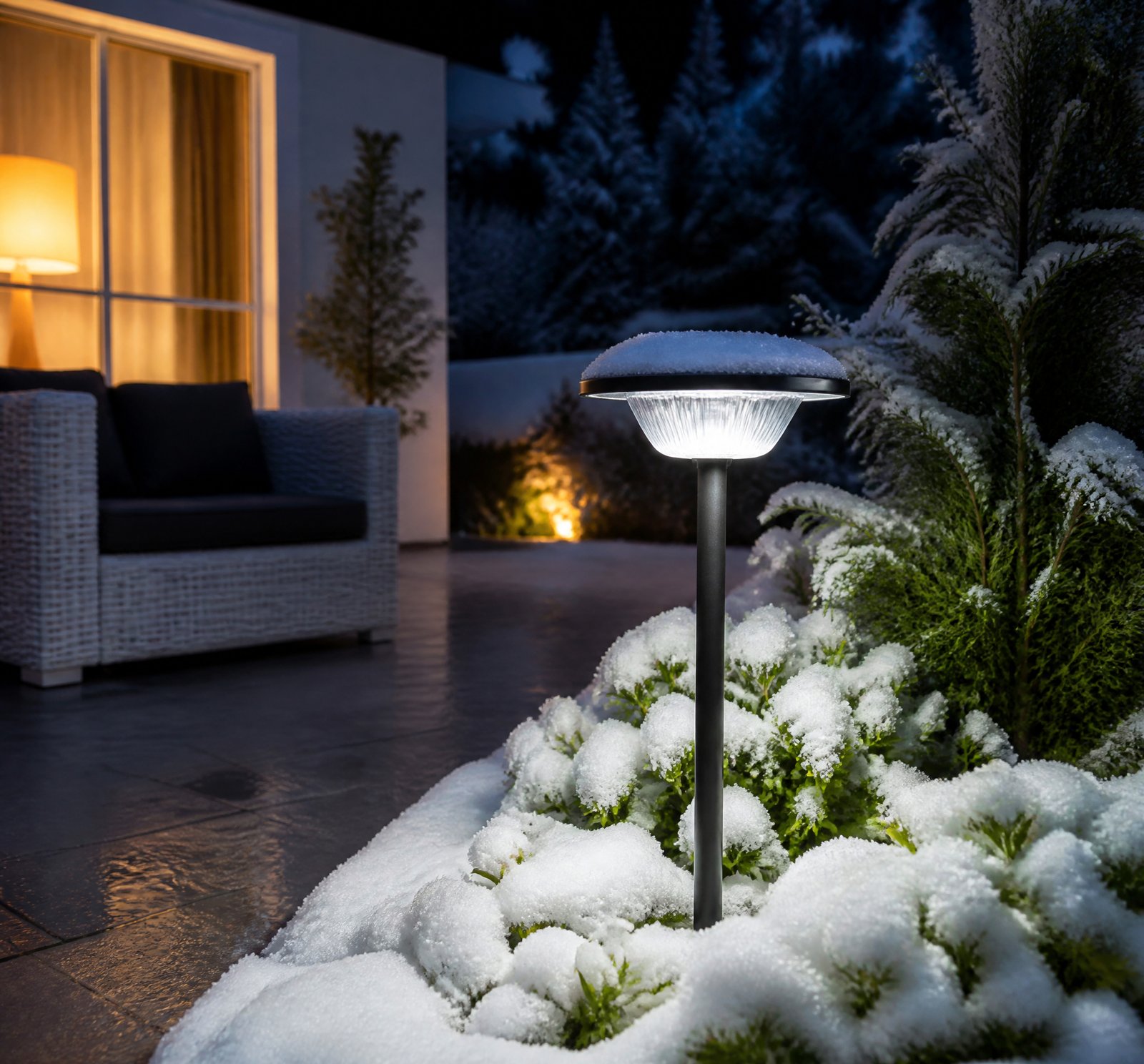
> Quick answer: To extend the reliable operation of solar lamps through Romania’s coldest months, prioritize snow removal from panels, store batteries indoors during winter to preserve capacity, and ensure south-facing orientation—these practices are more effective than relying on passive resilience [1][3][4][5][6].
Winter in Romania can be brutal for solar lamp enthusiasts. Short days and heavy snowfall can severely impact the performance of your outdoor lighting system. However, by following these evidence-based maintenance strategies, you can ensure that your solar lamps keep shining brightly throughout even the harshest winter months.
Snow Removal: Clearing the Path to Sunlight
Snow removal is critical for maintaining the functionality of your solar panels [10]. While bifacial panels can capture reflected light from snow-covered ground [10], standard monofacial panels need direct sunlight, which means any accumulation must be cleared promptly. Studies show that systems maintained at a battery voltage above 11 volts through two months of overcast skies suggest that even partial exposure to sunlight is essential for sustaining operation [1][3][4][12].
Battery Storage: Protecting Your Power Source
Battery storage is another crucial aspect of winter maintenance. Cold temperatures can reduce battery capacity by about 10% for every 15–20°F below 80°F [13]. To prevent this, store batteries indoors at room temperature during the winter months to maintain their effective capacity and extend their lifespan [5][6][7].
Angle Adjustment: Optimizing Sunlight Capture
While not directly discussed in the research, optimal angle adjustment can enhance sunlight capture. In Romania’s Northern Hemisphere location, facing solar panels south maximizes sunlight exposure [22]. This ensures that even under prolonged overcast conditions, systems maintain minimum voltage above 11 volts [1][3][4][12].
Dimming Protocols: Extending Operational Life
Surprisingly, adaptive dimming protocols can extend the operational life of your solar lamps. Systems observed to produce about 20% of normal output on cloudy days suggest that even in harsh winter conditions, some sunlight reaching the panel is enough to power lights at a dimmed level [25]. This dynamic control allows systems to survive prolonged low-light periods without battery replacement.
Key Takeaways
- Clear snow from panels promptly for optimal performance.
- Store batteries indoors during winter to maintain capacity and lifespan.
- Ensure south-facing orientation for maximum sunlight capture.
- Use adaptive dimming protocols to extend operational life in cloudy conditions.
FAQ Section
#### Q: How often should I remove snow from my solar panel?
A: Snow removal is crucial, but the frequency depends on accumulation. It’s best to clear panels promptly after a significant snowfall to ensure uninterrupted energy generation [10].
#### Q: What are the implications of battery type in cold weather conditions?
A: Battery types vary in their performance under cold conditions. Lithium-ion batteries generally perform better than NiCd batteries, retaining more capacity even at lower temperatures [16][17].
#### Q: Can solar lamps operate effectively during prolonged overcast days?
A: Yes, systems can maintain operation with about 20% of normal output on cloudy days, enough to power lights dimmed for a few hours. Adaptive dimming protocols improve performance in low-light conditions [25].
References
- [1] US20120020060A1_-_Energy-efficient_solar-powered_-_Google_Patents__619c8cff — patent
source passage
of successful operation of the outdoor lighting was accomplished, without any tie to or contribution of energy from the electrical grid, without any replacement of the batteries, and without any energy input into the batterys or any part of the lighting system except from the amorphous PV cell material on each pole. – FIG. 50 one may see long periods of days and weeks of sky cover (measured in hours during the day, defined as “cloudy” or “overcast” as judged from the local weather report), but the system maintained minimum battery voltage above the important benchmark of approximately 11 volts all through the roughly two month winter period, except for the “waving tree limb” incident in December, described above. – FIGS. 51A and B which represent a different test, of a set of poles operating over about 2.5 winter months (the graph being split roughly in two), multiple poles operating independent of each other and autonomously (not tied to the grid) all performed continuously at or above 11 volts throughout the winter, despite long stretches of little or no sunshine per day. – a solar-powered outdoor lighting system comprising: a flexible photovoltaic solar collector panel curved at least 180 degrees around a generally cylindrical light pole and attached to the light pole so that the panel is generally vertical; a lighting fixture connected to the pole and comprising multiple light emitting diodes (LEDs); at least one battery operatively connected to the solar collector panel
- [3] US20120020060A1_-_Energy-efficient_solar-powered_-_Google_Patents__619c8cff — patent
source passage
accomplished, without any tie to or contribution of energy from the electrical grid, without any replacement of the batteries, and without any energy input into the batterys or any part of the lighting system except from the amorphous PV cell material on each pole. – In FIG. 50 , one may see long periods of days and weeks of sky cover (measured in hours during the day, defined as “cloudy” or “overcast” as judged from the local weather report), but the system maintained minimum battery voltage above the important benchmark of approximately 11 volts all through the roughly two month winter period, except for the “waving tree limb” incident in December, described above. InFIGS. 51A and B, which represent a different test, of a set of poles operating over about 2.5 winter months (the graph being split roughly in two), multiple poles operating independent of each other and autonomously (not tied to the grid) all performed continuously at or above 11 volts throughout the winter, despite long stretches of little or no sunshine per day. Even during the dark days of January, only a few of the poles came near to dropping to 11 volts, at which increased dimming action per the energy-savings mode E6 kept the poles operating successfully, at least at dimmed condition, during the crucual periods after dusk and before dawn, and upon motion being sensed. Up an increase in sunshine late in January, the batteries all rebounded to a range of 12-12.5 volts. – Preferred embodiments may therefore
- [4] WO2010057138A2_-_Energy-efficient_solar-powered_outdoor_lighting__593d23e6 — patent
source passage
to or contribution of energy from the electrical grid, without any replacement of the batteries, and without any energy input into the batterys or any part of the lighting system except from the amorphous PV cell material on each pole. [0292] In Figure 50, one may see long periods of days and weeks of sky cover (measured in hours during the day, defined as "cloudy" or "overcast" as judged from the local weather report), but the system maintained minimum battery voltage above the important benchmark of approximately 1 1 volts all through the roughly two month winter period, except for the "waving tree limb" incident in December, described above. In Figures 51 A and B, which represent a different test, of a set of poles operating over about 2.5 winter months (the graph being split roughly in two), multiple poles operating independent of each other and autonomously (not tied to the grid) all performed continuously at or above 1 1 volts throughout the winter, despite long stretches of little or no sunshine per day. Even during the dark days of January, only a few of the poles came near to dropping to 1 1 volts, at which increased dimming action per the energy-savings mode E6 kept the poles operating successfully, at least at dimmed condition, during the crucual periods after dusk and before dawn, and upon motion being sensed. Up an increase in sunshine late in January, the batteries all rebounded to a range of 12 — 12.5 volts. [0294] Preferred embodiments may therefore be describ
- [5] 7_Best_Solar_Outdoor_Lights_of_2026_Lab-Tested_and_Reviewed__49a0dfe8 — blog
source passage
off the battery even on the dreariest of days. Also consider models with an on/off switch—that way, you can turn off the lights when you don’t need them and conserve battery charge. What’s the best place to store solar lights in the winter, when there’s less sun to power them? Generally, battery-powered devices perform best when stored at room temperature. This would mean keeping them indoors during cold weather. That’s inconvenient—but at least you’ll avoid hitting them with a shovel, plow, or snow blower when they’re safely packed away. How CR Tests Solar Outdoor Lights At our Yonkers, N.Y., facility, we mount samples of each light on a mobile cart and park it outdoors for roughly five hours every day. We test on both sunny and cloudy days. Next, our testers bring each light indoors. We note when the lights go out and score them on how long they stay on. The total times can differ from day to day, depending on sun, cloud, and rain conditions, but the best models always outperform the worst, whether powered during a day with a lot of sun or very little. For scoring, we use the two brightest days from our testing. In addition, we size up ease of use by evaluating how easy each light is to mount and adjust. We also note which models have certain key features—like a switch to turn lights on and off, or the ability to charge them with a separate power cord if the sun isn’t out. Finally, we leave out samples of each light to expose them to rain and heat, noting whether any fixtur
- [6] 7_Best_Solar_Outdoor_Lights_of_2026_Lab-Tested_and_Reviewed__49a0dfe8 — authority
source passage
off the battery even on the dreariest of days. Also consider models with an on/off switch—that way, you can turn off the lights when you don’t need them and conserve battery charge. What’s the best place to store solar lights in the winter, when there’s less sun to power them? Generally, battery-powered devices perform best when stored at room temperature. This would mean keeping them indoors during cold weather. That’s inconvenient—but at least you’ll avoid hitting them with a shovel, plow, or snow blower when they’re safely packed away. How CR Tests Solar Outdoor Lights At our Yonkers, N.Y., facility, we mount samples of each light on a mobile cart and park it outdoors for roughly five hours every day. We test on both sunny and cloudy days. Next, our testers bring each light indoors. We note when the lights go out and score them on how long they stay on. The total times can differ from day to day, depending on sun, cloud, and rain conditions, but the best models always outperform the worst, whether powered during a day with a lot of sun or very little. For scoring, we use the two brightest days from our testing. In addition, we size up ease of use by evaluating how easy each light is to mount and adjust. We also note which models have certain key features—like a switch to turn lights on and off, or the ability to charge them with a separate power cord if the sun isn’t out. Finally, we leave out samples of each light to expose them to rain and heat, noting whether any fixtur
- [7] Best_Solar_Lights_for_2026_Tried_and_Tested_-_The_English_Home__445faf4d — blog
source passage
can withstand summer showers, they often won’t be completely waterproof. If you want something you can leave out year-round, look out for those that have a higher IP rating, which have a better chance of withstanding snow, wind and heavy rain – an IP65 rating or higher means they’ll be robust enough to withstand more extreme weather conditions. Caring for solar lights Our experts suggest storing your solar lights away during the darker, winter months to protect them from harsh winter frosts. It’s also recommended that you regularly clean the solar panel to ensure it works at optimum capacity. Do solar lights charge on cloudy days? Even on cloudy days, solar lights can still absorb enough daylight to charge, though their performance may be reduced compared to bright, sunny conditions. Thanks to advances in solar technology, many modern solar lights are designed to work efficiently in low light, ensuring your garden still enjoys a gentle glow even when the sun hides behind the clouds. For the best results, place your lights in the brightest available spot to maximise their charging potential throughout the day. Should garden solar lights be left out in the winter? Garden solar lights are built to withstand the changing seasons, including winter. Most models are made from weather-resistant materials that protect against rain, frost, and cold temperatures. However, to keep them in top condition, it’s a good idea to clean the solar panels regularly and, if possible, store the batt
- [10] Bifacial_solar_modules_shine_in_snowy_-_pv_magazine_Global__308ec4a1 — authority
source passage
# Bifacial solar modules shine in snowy environments – pv magazine Global Source: Blog/Web URL: https://www.pv-magazine.com/2022/05/23/bifacial-solar-modules-shine-in-snowy-environments/ Author: Anne Fischer Date: 2022-05-23 From pv magazine USA As solar costs have dropped, it now makes economic sense to implement them even in the deep north, yet there is concern about the effects of snow on energy generation. While solar panels operate best in colder temperatures, panels covered in snow will generate less energy, known as snow loss. A study conducted at Western University in Ontario, Canada, shows how to beat snow losses using solar energy systems. The difference between bifacial and monofacial modules is that bifacial modules absorb light from the front and back, while monofacial only collect sunlight on the front. The study analyzed snow losses on these two types of systems using hourly data including energy, solar irradiation and albedo, the measure of the diffuse reflection of solar radiation. The researchers found by using bifacial solar modules instead of trading monofacial, snow losses could be cut from double digits to just 2% on an annual basis. The bifacial solar installation had a 19% gain largely from the reflection of the snow compared to the traditional monofacial systems. The study was conducted at a pair of solar arrays that used both monofacial and bifacial modules, and data was generated in both summer and winter to determine snow loss. A camera was aimed a
- [12] WO2010057138A2_-_Energy-efficient_solar-powered_outdoor_lighting__593d23e6 — patent
source passage
a different test, of a set of poles operating over about 2.5 winter months (the graph being split roughly in two), multiple poles operating independent of each other and autonomously (not tied to the grid) all performed continuously at or above 1 1 volts throughout the winter, despite long stretches of little or no sunshine per day. – a solar- powered outdoor lighting system comprising: a flexible photovoltaic solar collector panel curved at least 180 degrees around a generally cylindrical light pole and attached to the light pole so that the panel is generally vertical; a lighting fixture connected to the pole and comprising multiple light emitting diodes (LEDs); at least one battery operatively connected to the solar collector panel and the LEDs; an active controller system comprising a maximum power point tracking charge controller adapted to charge said at least one battery, and a load controller adapted for management of energy delivery to said LEDs, wherein said management of energy delivery is adapted to turn on, turn off, dim and brighten said LEDs; at least one motion sensor connected to said pole and operatively connected to said load controller; wherein said load controller is adapted, in response to said motion sensor sensing motion near the pole when the LEDs are in a dimmed state, to increase power to said LEDs to brighten said LEDs at least while said motion is detected. – LEDs light emitting diodes – Said active controller may be adapted to dim said LEDs when
- [13] How_to_prepare_your_solar_battery_bank_for_winter__398bf836 — authority
source passage
# How to prepare your solar battery bank for winter Source: Blog/Web URL: https://www.solarpowerworldonline.com/2016/11/prepare-solar-battery-bank-ready-winter/ Author: SPW Date: 2016-11-22 By John Connell, vice president of Crown Battery Manufacturing’s SLI Products Group Winter weather can drastically cut battery capacity and lifespan—but it doesn’t have to. Proper storage, depth of discharge and maintenance will help prepare any battery bank for winter and maximize lifespan and capacity. Storing batteries provides protection from cold temperatures Most batteries are rated at 77°F, and their ideal operating temperature is between 50°F and 85°F. Batteries lose about 10% of their capacity for every 15°F to 20°F below 80°F. Their internal chemistries slow down, resistance increases and capacity and charge acceptance drop. This reduced capacity is temporary. However, it can present a problem because most renewable energy systems have the shortest days (i.e. lowest solar production) and highest loads during the winter, when capacity is lower. Common battery storage solutions such as tin shelters, refrigerators or homemade boxes offer little protection from cold winter temperatures. And during the summer, temperatures in such enclosed spaces can exceed 140°F—hot enough to greatly accelerate battery deterioration. A better approach is storing batteries in a well-insulated space with sufficient thermal mass and protection from direct sunlight. AGM and other no- or low-maintenance b
- [16] Outdoor_Solar_Lighting_Department_of_Energy__bbe3fc64 — blog
source passage
# Outdoor Solar Lighting Source: Blog/Web URL: https://www.energy.gov/energysaver/outdoor-solar-lighting Author: Date: 2012-07-29 Outdoor solar lights are easy to install and virtually maintenance free. Best of all, using them won't increase your electric bill. Popular home uses for outdoor solar lighting include pathway light sets, wall-mounted lamps, freestanding lamp posts, and security lights. Outdoor solar lighting systems use solar cells, which convert sunlight into electricity. The electricity is stored in batteries for use at night. Manufacturers most commonly use nickel cadmium, sealed lead acid, and lead acid batteries. Outdoor solar lighting systems work well in most areas of the United States. However, it is important to consider geographic and site-specific variables when choosing a product. A solar lighting system will work well only as long as the solar cells receive the manufacturer's recommended hours of sunlight. The "nightly run time" listings on most outdoor solar lighting systems are based on specific sunlight conditions. Outdoor solar lights located in places that receive less sunlight than the solar cells need will operate for fewer hours per night than expected. Nightly run times may also vary depending on how clear the sky is on any given day. Operating times in the winter months may vary as much as 30%–50% unless the solar lighting system has been sized specifically for winter operation. If the solar cells are shaded by landscape features (such as tr
- [17] Outdoor_Solar_Lighting_-_Department_of_Energy__bbe3fc64 — authority
source passage
# Outdoor Solar Lighting Source: Blog/Web URL: https://www.energy.gov/energysaver/outdoor-solar-lighting Author: Date: 2012-07-29 Outdoor solar lights are easy to install and virtually maintenance free. Best of all, using them won't increase your electric bill. Popular home uses for outdoor solar lighting include pathway light sets, wall-mounted lamps, freestanding lamp posts, and security lights. Outdoor solar lighting systems use solar cells, which convert sunlight into electricity. The electricity is stored in batteries for use at night. Manufacturers most commonly use nickel cadmium, sealed lead acid, and lead acid batteries. Outdoor solar lighting systems work well in most areas of the United States. However, it is important to consider geographic and site-specific variables when choosing a product. A solar lighting system will work well only as long as the solar cells receive the manufacturer's recommended hours of sunlight. The "nightly run time" listings on most outdoor solar lighting systems are based on specific sunlight conditions. Outdoor solar lights located in places that receive less sunlight than the solar cells need will operate for fewer hours per night than expected. Nightly run times may also vary depending on how clear the sky is on any given day. Operating times in the winter months may vary as much as 30%–50% unless the solar lighting system has been sized specifically for winter operation. If the solar cells are shaded by landscape features (such as tr
- [22] 12_Best_Solar_Lamp_Posts_Top_Rated_Lamps_to_Buy__191c85e0 — blog
source passage
higher elevation than surrounding structures. Solar panels will continue to function even if the light is deflected or partially covered by clouds. The rain helps your solar panels run more efficiently by wiping away dust and debris. First, make sure your solar panel is in a sunny location. The brighter it is, the more power it generates and the longer it will keep your lights on. Second, angle your solar lights so that they face south. It will provide them with direct sunlight and allow them to charge more quickly. The brightest solar lights are task lights or spotlights, and the greatest ones may produce brightness comparable to a 40-watt incandescent bulb. That is still not as bright as a standard outdoor spotlight, so in areas where you need powerful, direct light, double or triple up. Solar lights turn off automatically during the day since they convert light into energy to store in batteries. This energy is used to power the light at night. While solar lights require little to no maintenance, they require thorough cleaning to maintain efficacy during their lives. Solar street lights are the sustainable solution for extensive lighting, lowering carbon emissions and environmental impact while increasing community safety and satisfaction. Yes, even on cloudy days, solar lights charge. Although the battery does not charge as quickly, small efficient solar panels can still provide electricity when it is partly cloudy or overcast. In most cases, you do not need to manually tu
- [25] US20120020060A1_-_Energy-efficient_solar-powered_-_Google_Patents__619c8cff — patent
source passage
maximizing (focusing on) the winter performance in the preferred embodiments, every possible bit of solar energy is “squeezed out” and also conserved during operation over the winter nights, to keep the system operational over the winter. Even on the cloudiest day, the preferred embodiments of the invention produce about 20% of the normal (sunny day). This allows the system to always have some energy available, even if it can only turn the light on (at a lower dimmed down state) for a couple of hours at the beginning of the night. In testing, such dimmed-down operation being possible for only a couple of hours has only happened once, in Houston, Tex. testing, when a pole reached the lowest energy mode, but said lowest energy mode was due to “false motion” events. A tree with a light source behind it was shining towards the motion detector, and the wind blowing the tree was interpreted as motion (the IR detector saw the heat from the light & therefore the motion). To avoid such events, programming was changed to ignore continuous motion and treat it as an error/alert condition to be ignored after a certain period of time. “Continuous” in this context may be set by the manufacturer, for example, and preferably means in the range of motion at least every two minutes for a set time period in the range of 30-minutes. Aiming the motion detectors down, so that motion above about 10 feet high would be ignored, has also been found to be effective, so that human and vehicular traffic i
of successful operation of the outdoor lighting was accomplished, without any tie to or contribution of energy from the electrical grid, without any replacement of the batteries, and without any energy input into the batterys or any part of the lighting system except from the amorphous PV cell material on each pole. – FIG. 50 one may see long periods of days and weeks of sky cover (measured in hours during the day, defined as “cloudy” or “overcast” as judged from the local weather report), but the system maintained minimum battery voltage above the important benchmark of approximately 11 volts all through the roughly two month winter period, except for the “waving tree limb” incident in December, described above. – FIGS. 51A and B which represent a different test, of a set of poles operating over about 2.5 winter months (the graph being split roughly in two), multiple poles operating independent of each other and autonomously (not tied to the grid) all performed continuously at or above 11 volts throughout the winter, despite long stretches of little or no sunshine per day. – a solar-powered outdoor lighting system comprising: a flexible photovoltaic solar collector panel curved at least 180 degrees around a generally cylindrical light pole and attached to the light pole so that the panel is generally vertical; a lighting fixture connected to the pole and comprising multiple light emitting diodes (LEDs); at least one battery operatively connected to the solar collector panel
accomplished, without any tie to or contribution of energy from the electrical grid, without any replacement of the batteries, and without any energy input into the batterys or any part of the lighting system except from the amorphous PV cell material on each pole. – In FIG. 50 , one may see long periods of days and weeks of sky cover (measured in hours during the day, defined as “cloudy” or “overcast” as judged from the local weather report), but the system maintained minimum battery voltage above the important benchmark of approximately 11 volts all through the roughly two month winter period, except for the “waving tree limb” incident in December, described above. InFIGS. 51A and B, which represent a different test, of a set of poles operating over about 2.5 winter months (the graph being split roughly in two), multiple poles operating independent of each other and autonomously (not tied to the grid) all performed continuously at or above 11 volts throughout the winter, despite long stretches of little or no sunshine per day. Even during the dark days of January, only a few of the poles came near to dropping to 11 volts, at which increased dimming action per the energy-savings mode E6 kept the poles operating successfully, at least at dimmed condition, during the crucual periods after dusk and before dawn, and upon motion being sensed. Up an increase in sunshine late in January, the batteries all rebounded to a range of 12-12.5 volts. – Preferred embodiments may therefore
to or contribution of energy from the electrical grid, without any replacement of the batteries, and without any energy input into the batterys or any part of the lighting system except from the amorphous PV cell material on each pole. [0292] In Figure 50, one may see long periods of days and weeks of sky cover (measured in hours during the day, defined as "cloudy" or "overcast" as judged from the local weather report), but the system maintained minimum battery voltage above the important benchmark of approximately 1 1 volts all through the roughly two month winter period, except for the "waving tree limb" incident in December, described above. In Figures 51 A and B, which represent a different test, of a set of poles operating over about 2.5 winter months (the graph being split roughly in two), multiple poles operating independent of each other and autonomously (not tied to the grid) all performed continuously at or above 1 1 volts throughout the winter, despite long stretches of little or no sunshine per day. Even during the dark days of January, only a few of the poles came near to dropping to 1 1 volts, at which increased dimming action per the energy-savings mode E6 kept the poles operating successfully, at least at dimmed condition, during the crucual periods after dusk and before dawn, and upon motion being sensed. Up an increase in sunshine late in January, the batteries all rebounded to a range of 12 — 12.5 volts. [0294] Preferred embodiments may therefore be describ
off the battery even on the dreariest of days. Also consider models with an on/off switch—that way, you can turn off the lights when you don’t need them and conserve battery charge. What’s the best place to store solar lights in the winter, when there’s less sun to power them? Generally, battery-powered devices perform best when stored at room temperature. This would mean keeping them indoors during cold weather. That’s inconvenient—but at least you’ll avoid hitting them with a shovel, plow, or snow blower when they’re safely packed away. How CR Tests Solar Outdoor Lights At our Yonkers, N.Y., facility, we mount samples of each light on a mobile cart and park it outdoors for roughly five hours every day. We test on both sunny and cloudy days. Next, our testers bring each light indoors. We note when the lights go out and score them on how long they stay on. The total times can differ from day to day, depending on sun, cloud, and rain conditions, but the best models always outperform the worst, whether powered during a day with a lot of sun or very little. For scoring, we use the two brightest days from our testing. In addition, we size up ease of use by evaluating how easy each light is to mount and adjust. We also note which models have certain key features—like a switch to turn lights on and off, or the ability to charge them with a separate power cord if the sun isn’t out. Finally, we leave out samples of each light to expose them to rain and heat, noting whether any fixtur
off the battery even on the dreariest of days. Also consider models with an on/off switch—that way, you can turn off the lights when you don’t need them and conserve battery charge. What’s the best place to store solar lights in the winter, when there’s less sun to power them? Generally, battery-powered devices perform best when stored at room temperature. This would mean keeping them indoors during cold weather. That’s inconvenient—but at least you’ll avoid hitting them with a shovel, plow, or snow blower when they’re safely packed away. How CR Tests Solar Outdoor Lights At our Yonkers, N.Y., facility, we mount samples of each light on a mobile cart and park it outdoors for roughly five hours every day. We test on both sunny and cloudy days. Next, our testers bring each light indoors. We note when the lights go out and score them on how long they stay on. The total times can differ from day to day, depending on sun, cloud, and rain conditions, but the best models always outperform the worst, whether powered during a day with a lot of sun or very little. For scoring, we use the two brightest days from our testing. In addition, we size up ease of use by evaluating how easy each light is to mount and adjust. We also note which models have certain key features—like a switch to turn lights on and off, or the ability to charge them with a separate power cord if the sun isn’t out. Finally, we leave out samples of each light to expose them to rain and heat, noting whether any fixtur
can withstand summer showers, they often won’t be completely waterproof. If you want something you can leave out year-round, look out for those that have a higher IP rating, which have a better chance of withstanding snow, wind and heavy rain – an IP65 rating or higher means they’ll be robust enough to withstand more extreme weather conditions. Caring for solar lights Our experts suggest storing your solar lights away during the darker, winter months to protect them from harsh winter frosts. It’s also recommended that you regularly clean the solar panel to ensure it works at optimum capacity. Do solar lights charge on cloudy days? Even on cloudy days, solar lights can still absorb enough daylight to charge, though their performance may be reduced compared to bright, sunny conditions. Thanks to advances in solar technology, many modern solar lights are designed to work efficiently in low light, ensuring your garden still enjoys a gentle glow even when the sun hides behind the clouds. For the best results, place your lights in the brightest available spot to maximise their charging potential throughout the day. Should garden solar lights be left out in the winter? Garden solar lights are built to withstand the changing seasons, including winter. Most models are made from weather-resistant materials that protect against rain, frost, and cold temperatures. However, to keep them in top condition, it’s a good idea to clean the solar panels regularly and, if possible, store the batt
# Bifacial solar modules shine in snowy environments – pv magazine Global Source: Blog/Web URL: https://www.pv-magazine.com/2022/05/23/bifacial-solar-modules-shine-in-snowy-environments/ Author: Anne Fischer Date: 2022-05-23 From pv magazine USA As solar costs have dropped, it now makes economic sense to implement them even in the deep north, yet there is concern about the effects of snow on energy generation. While solar panels operate best in colder temperatures, panels covered in snow will generate less energy, known as snow loss. A study conducted at Western University in Ontario, Canada, shows how to beat snow losses using solar energy systems. The difference between bifacial and monofacial modules is that bifacial modules absorb light from the front and back, while monofacial only collect sunlight on the front. The study analyzed snow losses on these two types of systems using hourly data including energy, solar irradiation and albedo, the measure of the diffuse reflection of solar radiation. The researchers found by using bifacial solar modules instead of trading monofacial, snow losses could be cut from double digits to just 2% on an annual basis. The bifacial solar installation had a 19% gain largely from the reflection of the snow compared to the traditional monofacial systems. The study was conducted at a pair of solar arrays that used both monofacial and bifacial modules, and data was generated in both summer and winter to determine snow loss. A camera was aimed a
a different test, of a set of poles operating over about 2.5 winter months (the graph being split roughly in two), multiple poles operating independent of each other and autonomously (not tied to the grid) all performed continuously at or above 1 1 volts throughout the winter, despite long stretches of little or no sunshine per day. – a solar- powered outdoor lighting system comprising: a flexible photovoltaic solar collector panel curved at least 180 degrees around a generally cylindrical light pole and attached to the light pole so that the panel is generally vertical; a lighting fixture connected to the pole and comprising multiple light emitting diodes (LEDs); at least one battery operatively connected to the solar collector panel and the LEDs; an active controller system comprising a maximum power point tracking charge controller adapted to charge said at least one battery, and a load controller adapted for management of energy delivery to said LEDs, wherein said management of energy delivery is adapted to turn on, turn off, dim and brighten said LEDs; at least one motion sensor connected to said pole and operatively connected to said load controller; wherein said load controller is adapted, in response to said motion sensor sensing motion near the pole when the LEDs are in a dimmed state, to increase power to said LEDs to brighten said LEDs at least while said motion is detected. – LEDs light emitting diodes – Said active controller may be adapted to dim said LEDs when
# How to prepare your solar battery bank for winter Source: Blog/Web URL: https://www.solarpowerworldonline.com/2016/11/prepare-solar-battery-bank-ready-winter/ Author: SPW Date: 2016-11-22 By John Connell, vice president of Crown Battery Manufacturing’s SLI Products Group Winter weather can drastically cut battery capacity and lifespan—but it doesn’t have to. Proper storage, depth of discharge and maintenance will help prepare any battery bank for winter and maximize lifespan and capacity. Storing batteries provides protection from cold temperatures Most batteries are rated at 77°F, and their ideal operating temperature is between 50°F and 85°F. Batteries lose about 10% of their capacity for every 15°F to 20°F below 80°F. Their internal chemistries slow down, resistance increases and capacity and charge acceptance drop. This reduced capacity is temporary. However, it can present a problem because most renewable energy systems have the shortest days (i.e. lowest solar production) and highest loads during the winter, when capacity is lower. Common battery storage solutions such as tin shelters, refrigerators or homemade boxes offer little protection from cold winter temperatures. And during the summer, temperatures in such enclosed spaces can exceed 140°F—hot enough to greatly accelerate battery deterioration. A better approach is storing batteries in a well-insulated space with sufficient thermal mass and protection from direct sunlight. AGM and other no- or low-maintenance b
# Outdoor Solar Lighting Source: Blog/Web URL: https://www.energy.gov/energysaver/outdoor-solar-lighting Author: Date: 2012-07-29 Outdoor solar lights are easy to install and virtually maintenance free. Best of all, using them won't increase your electric bill. Popular home uses for outdoor solar lighting include pathway light sets, wall-mounted lamps, freestanding lamp posts, and security lights. Outdoor solar lighting systems use solar cells, which convert sunlight into electricity. The electricity is stored in batteries for use at night. Manufacturers most commonly use nickel cadmium, sealed lead acid, and lead acid batteries. Outdoor solar lighting systems work well in most areas of the United States. However, it is important to consider geographic and site-specific variables when choosing a product. A solar lighting system will work well only as long as the solar cells receive the manufacturer's recommended hours of sunlight. The "nightly run time" listings on most outdoor solar lighting systems are based on specific sunlight conditions. Outdoor solar lights located in places that receive less sunlight than the solar cells need will operate for fewer hours per night than expected. Nightly run times may also vary depending on how clear the sky is on any given day. Operating times in the winter months may vary as much as 30%–50% unless the solar lighting system has been sized specifically for winter operation. If the solar cells are shaded by landscape features (such as tr
# Outdoor Solar Lighting Source: Blog/Web URL: https://www.energy.gov/energysaver/outdoor-solar-lighting Author: Date: 2012-07-29 Outdoor solar lights are easy to install and virtually maintenance free. Best of all, using them won't increase your electric bill. Popular home uses for outdoor solar lighting include pathway light sets, wall-mounted lamps, freestanding lamp posts, and security lights. Outdoor solar lighting systems use solar cells, which convert sunlight into electricity. The electricity is stored in batteries for use at night. Manufacturers most commonly use nickel cadmium, sealed lead acid, and lead acid batteries. Outdoor solar lighting systems work well in most areas of the United States. However, it is important to consider geographic and site-specific variables when choosing a product. A solar lighting system will work well only as long as the solar cells receive the manufacturer's recommended hours of sunlight. The "nightly run time" listings on most outdoor solar lighting systems are based on specific sunlight conditions. Outdoor solar lights located in places that receive less sunlight than the solar cells need will operate for fewer hours per night than expected. Nightly run times may also vary depending on how clear the sky is on any given day. Operating times in the winter months may vary as much as 30%–50% unless the solar lighting system has been sized specifically for winter operation. If the solar cells are shaded by landscape features (such as tr
higher elevation than surrounding structures. Solar panels will continue to function even if the light is deflected or partially covered by clouds. The rain helps your solar panels run more efficiently by wiping away dust and debris. First, make sure your solar panel is in a sunny location. The brighter it is, the more power it generates and the longer it will keep your lights on. Second, angle your solar lights so that they face south. It will provide them with direct sunlight and allow them to charge more quickly. The brightest solar lights are task lights or spotlights, and the greatest ones may produce brightness comparable to a 40-watt incandescent bulb. That is still not as bright as a standard outdoor spotlight, so in areas where you need powerful, direct light, double or triple up. Solar lights turn off automatically during the day since they convert light into energy to store in batteries. This energy is used to power the light at night. While solar lights require little to no maintenance, they require thorough cleaning to maintain efficacy during their lives. Solar street lights are the sustainable solution for extensive lighting, lowering carbon emissions and environmental impact while increasing community safety and satisfaction. Yes, even on cloudy days, solar lights charge. Although the battery does not charge as quickly, small efficient solar panels can still provide electricity when it is partly cloudy or overcast. In most cases, you do not need to manually tu
maximizing (focusing on) the winter performance in the preferred embodiments, every possible bit of solar energy is “squeezed out” and also conserved during operation over the winter nights, to keep the system operational over the winter. Even on the cloudiest day, the preferred embodiments of the invention produce about 20% of the normal (sunny day). This allows the system to always have some energy available, even if it can only turn the light on (at a lower dimmed down state) for a couple of hours at the beginning of the night. In testing, such dimmed-down operation being possible for only a couple of hours has only happened once, in Houston, Tex. testing, when a pole reached the lowest energy mode, but said lowest energy mode was due to “false motion” events. A tree with a light source behind it was shining towards the motion detector, and the wind blowing the tree was interpreted as motion (the IR detector saw the heat from the light & therefore the motion). To avoid such events, programming was changed to ignore continuous motion and treat it as an error/alert condition to be ignored after a certain period of time. “Continuous” in this context may be set by the manufacturer, for example, and preferably means in the range of motion at least every two minutes for a set time period in the range of 30-minutes. Aiming the motion detectors down, so that motion above about 10 feet high would be ignored, has also been found to be effective, so that human and vehicular traffic i