
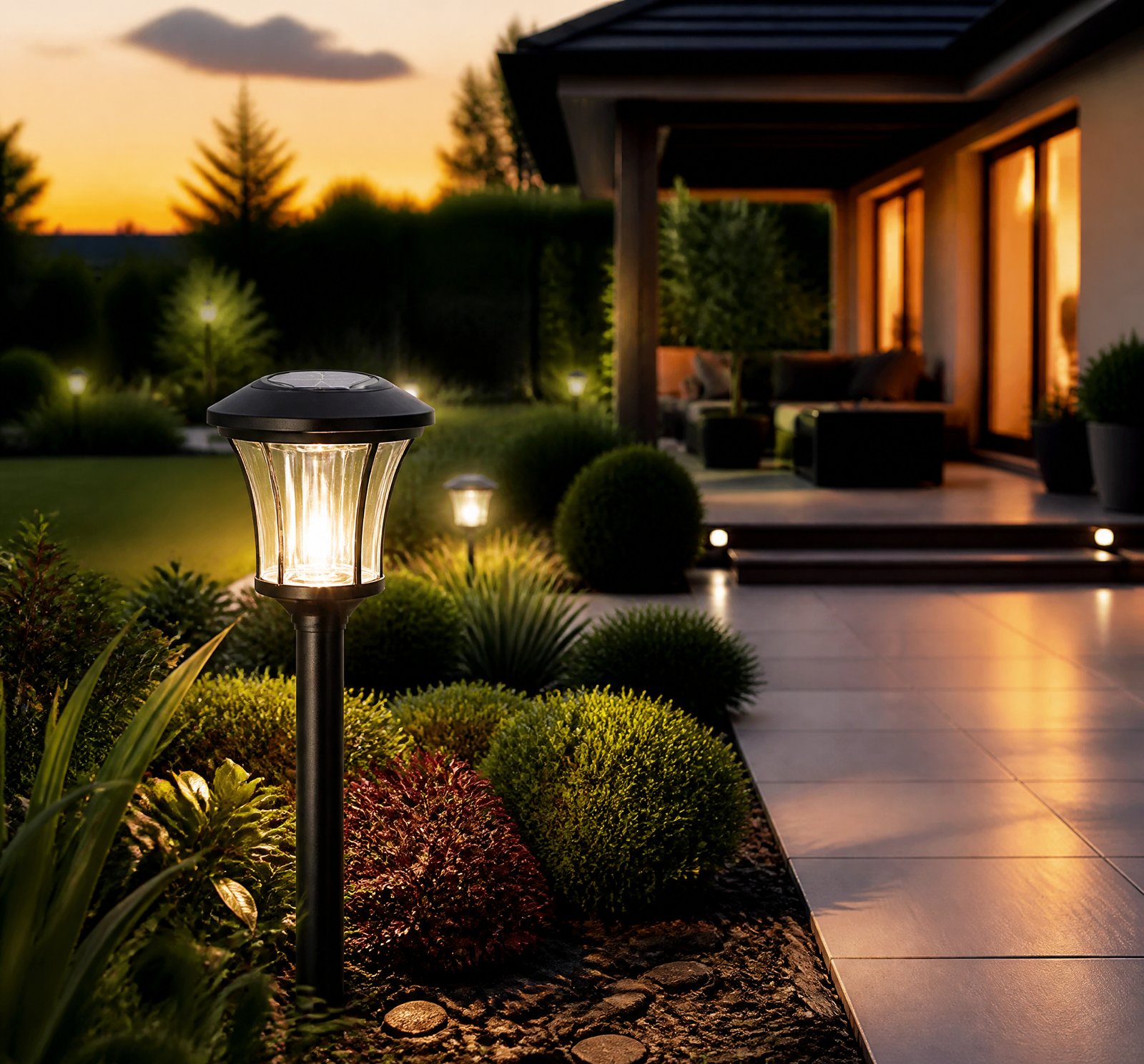
Quick answer: Lămpile solare de calitate din România mențin autonomia completă noaptea la o insolație solară minimă de aproximativ 3,5–4,5 kWh/m²/zi. În perioada iernii, în special în jurul solstițiului de iarnă, pot exista 40–60 de zile pe an cu insolație sub acest prag, punând presiune pe baterii și dimensiunea panoului [2][19].
În România, unde insolația variază semnificativ între sezoane, întrebarea dacă lămpile solare pot funcționa autonom noaptea în toate condițiile este esențială pentru alegerea unui sistem fiabil. Deși sursele nu oferă un prag exact în Wh/m² pe zi pentru funcționarea plenară în toate condițiile de iarnă, studiile indică că un sistem trebuie proiectat pentru a funcționa chiar și la niveluri reduse de insolație, mai ales în perioada critică de 6 săptămâni înainte și după solstițiul de iarnă [2]. Această perioadă este cea mai dificilă datorită nopților lungi și insolației minime, care pun presiune asupra capacității bateriei [2].
În ceea ce privește valorile reale, insolația medie anuală în România se estimează între 3,5 și 4,5 kWh/m²/zi, valori care se încadrează în categoria globală a țărilor cu producție solară medie peste 3,5 kWh/kWp [11]. Aceste cifre sugerează că, în medie, un panou solar poate genera suficientă energie pentru a alimenta o lămpă solară pe o noapte completă. Totuși, o medie anuală nu reflectă condițiile extreme de iarnă, când izolarea, cerul înnorat și lungimea nopților reduc semnificativ generarea energetică.
Un sistem de iluminat stradal cu trei zile de autonomie necesită un panou PV de 160 W și o baterie de 1,5 kWh [18], ceea ce arată că dimensiunea panoului și a bateriei este direct legată de durata de funcționare în condiții de insolație redusă [19]. În România, pentru a asigura autonomia chiar și în timpul iernii, este esențial să se proiecteze un sistem cu o capacitate suplimentară față de medie, luând în calcul și degradarea anuală a panourilor, care scade cu aproximativ 1% pe an [25]. După 20 de ani, producția poate scădea cu 10–20% [25], deci trebuie proiectat cu rezervă.
Chiar și în zilele înnorite sau ploioase, panourile solare produc energie datorită luminii difuzate [14]. Aceasta contrazice ideea că sistemul se oprește complet în condiții nefavorabile, indicând că un sistem bine proiectat poate funcționa într-o gamă mai largă de condiții decât se crede în mod obișnuit [14]. De asemenea, inovații precum foliile solare ca capac pentru panou pot crește eficiența chiar și în condiții neoptimale [17].
Consumul unei lămpi solare este estimat între 84 și 206 Wh pe noapte [9], deci un panou trebuie să genereze cel puțin această cantitate într-o zi, chiar și în condiții de insolație redusă. Dacă un panou de calitate poate genera cel puțin 206 Wh într-o zi, sistemul poate funcționa, dar nu este garantat în iarna severă fără o baterie suficient de mare și un management eficient al energiei.
Concluzii cheie
- Lămpile solare de calitate în România pot menține autonomia noaptea la o insolație minimă de 3,5–4,5 kWh/m²/zi [11].
- În perioada iernii, pot exista 40–60 de zile pe an cu insolație sub acest prag, în special în jurul solstițiului de iarnă [2].
- Dimensiunea panoului și a bateriei trebuie proiectată pentru a funcționa în condiții de insolație minimă, cu rezervă pentru degradare [25].
- Panourile solare produc energie și în zilele înnorite, datorită luminii difuzate [14].
- Sistemele cu BMS, baterii LiFePO4 și senzori inteligenti (PIR, crepuscular) sunt cele mai eficiente în condiții extreme [2].
Întrebări frecvente
Care este pragul minim de insolație solară pentru funcționarea unei lămpi solare în România?
Un sistem de calitate funcționează la o insolație minimă de 3,5–4,5 kWh/m²/zi, dar în iarna severă poate scădea sub acest nivel [11][19].
Câte zile pe an în România au insolație sub pragul necesar pentru autonomie?
În perioada iernii, în jurul solstițiului de iarnă, pot exista 40–60 de zile cu insolație insuficientă pentru încărcare completă [2].
Poate un panou solar genera energie în zilele înnorite?
Da, chiar și în condiții de cer înnorat, panourile produc energie datorită luminii difuzate [14].
References
- [2] Lighting Live Annual Conference 2025 Speaker Spotlight Peter — magazine
source passage
and is accessible to all. It was intended to maximise the economic effectiveness of solar panel arrays for electricity generation on houses, to optimise battery storage systems for domestic demand. It can also be used to calculate the effectiveness of stand-alone systems such as a solar-powered streetlight. The system relies on calculated solar irradiance figures throughout the year, collated for most of the western world and as PDE have collected their own data over many years, we can confirm the validity of the data within the obvious norms of high – and low-pressure systems that pass over our Island. From this data input, it is then possible with some accuracy to confirm whether a proposed solar lighting system will actually work. Further, what is the maximum wattage and duty cycle the luminaire can be run at in the various seasons? The winter period of 6 weeks before and after the December solstice might appear to be the riskiest, but seasonal storms in the spring can have a significant effect on the climb out of the darkest months when the double whammy of maximum length of winter nights and minimum direct sunlight have stretched the battery capacity to its limits, and in many cases beyond. Lighting Live Annual Conference takes place 18th – 19th June 2025 Attend the Annuahttps://lightinglive.org.uk/2025annualconference/l Gala Thank you to our Event Partner: Street Lighting Supplies & Co. Ltd Thank you to our Headline Sponsors: Charles Endirect | Orange Tek | Urbis Schréd
- [9] WO2010057138A2 – Energy-efficient solar-powered outdoor lighting — patent
source passage
over the next minute. – the light dims back up to 100% 30 minutes pre-dawn and remains on until the photocell shuts the light off. – Photocell turns the light on at 100% at dusk & remains on for 2 hours, at which time the light dims down to 12.5% power (50% of Dp) over the next minute. The light remains at the dimmed down light level state until the motion sensor is activated, at which time the light is brought back up to 80% for 4 minutes. The light then dims back down to 12.5% power over the next minute. The light dims back up to 100% 0.5 hr. predawn and remains on until the photocell shuts the light off. – a minimum Ah threshold will be set to eliminate noise that could create false counts on the Ah Min and Ah Hours readings. – the following numbered list comprises requests in firmware to facilitate testing and diagnosing problems. It is assumed that that there is a test tool available that allows communication with the control board and to pass along test and diagnostic parameters, as well as receiving responses/output from the control board. – Nightly energy consumption for the Inovus VisiaTM 100 luninaire is from 84 watt-hours to 206 watt-hours. – the main function of the Load Shedding System is to maintain power to the most important loads as energy conservation modes are incorporated. – the preferred solar collector is an amorphous, rather than a crystalline material, and, while it is fairly low in efficiency compared to many recently-developed photovoltaic cell mater
- [11] Solar Photovoltaic Power Potential by Country – World Bank Group — authority
source passage
Atlantic islands. High-potential countries tend to have low seasonality in solar photovoltaic output, meaning that the resource is relatively constant between different months of the year. In total, 86% of the global population lives in 150 countries where the difference between the maximum and the minimum output between different seasons is below a factor of two, and average daily output is above 3.5 kWh/kWp. Alongside solar resource, the potential for growth in the solar industry is determined by electricity needs; supportive or restrictive policies; costs and payback time; weather-related risks; stability of electricity grids; predictability of solar power supply; interconnection of grids enabling transmission and distribution; and other technical, social, and economic factors. Hence solar PV may still be economically attractive in countries with relatively low solar resource potential due to the prevalence of high electricity prices, or a high daytime peak load from industry or air conditioning. This report aims to provide findings for high-level comparisons between countries and regions on their solar energy potential and is intended to raise awareness, stimulate investment interest, and inform public debate. Many less-developed countries—in terms of the human development index, reliability of electricity supply, and access to electricity—tend to have very high practical solar photovoltaic potential, so far untapped. In Ethiopia just 0.005% of the country’s land area cou
- [14] Undecided with Matt Ferrell Are We Getting Scammed with Solar BD7aCkLwR7U — youtube
source passage
a light source. If you have a bare light bulb shining on an object, the light rays are moving in a straight line from the source when they hit an object. These relatively parallel light rays will cast a very harsh/sharp shadow on the ground. Think about standing outside on a sunny day and looking at your own shadow. However, if you put a thin layer of diffusion between the light source and yourself, those light rays get refracted and diffused. They’re no longer all in parallel to each other when they hit an object. They’re bouncing around and coming at the object from many directions at once. The result is a much softer edged shadow. This is what’s happening to solar panels on overcast days. Yes, the light hitting the panel isn’t as strong, but you can actually get a more consistent, lower level power generation over the course of the day because of that diffused light. You can absolutely see the difference in my energy production on sunny days versus overcast or rainy days, but there’s still electricity getting generated … albeit a very small amount. Just look at my data between March 24th and March 30th. It should be pretty clear which days were overcast or had outright dark gray skies with lots of rain. March 27th was very overcast as a storm was starting to move in and we still produced 43kWh vs. our usual 80kWh on a truly sunny day. March 28th was a very gloomy, rainy day and we still produced about 14kWh. This would be a problem if I was offgrid, but I’m not. The days w
- [17] DE102015015970A1 – Device system of a solar lamp – Google Patents — patent
source passage
1. The PV used here must be exposed at an angle of about 0-30 ° to the sun and to the south to generate good power output. 2. As a result, the PV is limited to the top of a lamp and thus the area size is limited. 3. Solar lamps are usually not optimally positioned by the user to the sun, as their primary purpose is the illumination of a particular area. The PV modules are thus often in partial shade or completely absonnig. The necessary requirements according to Die in diesem Patent verwendet PV hat bei nicht optimaler Exposition einen verhältnismäßig guten Ertrag, das Problem der zufälligen Exposition einer Solarlampe wird damit gelöst. Durch die gleichzeitige Verwendung der Solarfolie als Lampenschirm und Solargenerator steht erheblich mehr Fläche zur Verfügung, was zu einem vergleichsweise deutlich hören Energieertrag führt.The PV used in this patent has a relatively good yield in non-optimal exposure, solving the problem of accidental exposure of a solar lamp. By the simultaneous use of the solar film as a lampshade and solar generator is considerably more area available, resulting in a comparatively clearly hear energy yield. Welchem technischen Problem hat sich der Anmelder gestelltWhat technical problem has the applicant faced? Eine Solarlampe soll hell und lange leuchten können. Dafür benötigt sie einen entsprechend hohen solaren Energieertrag. Die Funktion und Form einer Lampe beschränken jedoch die mögliche Größe einer integrierten PV. Durch die Wahl einer anderen P
- [18] Best practices for solar street lighting systems Buildings — authority
source passage
with three nights' autonomy in Sydney will need approximately a 160W PV panel and 1.5kWh battery. Moving closer to the equator, the PV panel and battery size requirement will decrease due to the consistent availability of solar energy year-round. Moving away from the equator, the panel size and battery requirements will increase. Nevertheless, the road ahead for the solar street lighting industry is rocky. Technological challenges result in gray areas from a compliance perspective. The design process is detailed and complex; for simplicity, we will touch on the best practices for solar lighting system design, reliability, compliance, and maintainability. Best practices begin with data In Australia, government-employed engineers or consulting engineering firms hired by the agency typically oversee public projects, while consulting firms design private projects. Independent lighting contractors might step in to design the lighting layout, but not the overall electrical and lighting system. To develop a solar street lighting system with optimal solar energy harvesting and use of stored electrical energy to maintain light levels and avoid noncompliance infractions**, the project team must design a balanced autonomous system based on several factors: the geographical location of the intended installation, a detailed historical study of solar irradiance in the area, and a compliant light level calculation. Designers can research solar irradiance data from the National Solar Radiati
- [19] US9037443B1 – Systems and methods for solar – Google Patents — patent
source passage
values for Phoenix, Ariz. are 5.08 Peak Sun-hours and 4.01 Peak Sun-hours, respectively, while the average and minimum insolation values for Bowdon, N. Dak. are 2.17 Peak Sun-hours and 1.73 Peak Sun-hours, respectively. For a load of 10 Watts operating at 12 Volts DC for 24 hours/day, the following Premium, Standard, and Economy solutions are obtained: The present invention may be embodied as an automated design system tool for generating a power equipment proposal for a particular location, comprised of an insolation database with insolation values associated with a plurality of geographic data points, a load database associating appropriate power equipment with load requirements including duty cycles for the equipment, and a processing system which takes into account the periods of poor weather and corresponding low insolation to generate a power equipment proposal. The power equipment proposal will thus typically include three solutions based upon the required level of system reliability or up time as defined below. The economy level design is for non-essential loads that can tolerate periodic outages based on seasonal weather changes which result in low levels of insolation. The standard level design uses average insolation or weather patterns and is for loads that can tolerate occasional and/or rare outages based on extreme and unusual weather changes. The premium level design uses worst case insolation or weather patterns over at least 20 years of data and is for critic
- [25] Unbound Solar 8 Costly Solar Mistakes to Avoid When You Design Your Solar Panel Kit vox2ZYlGo2I — youtube
source passage
shading, natural efficiency drop, and other things that impact the true output of your system. That's why we recommend that you consult with an experienced solar technician first before investing in your solar system. Here are the following things you should talk about with your solar technician. First, efficiency. Solar panel efficiency drops about 1% every year. It's a good idea to design a little extra headroom to account for the 10 to 20% decrease that happens over the course of 20 years. In most cases, this is an extra panel or two. Second, weather and location. Solar panels are tested in ideal conditions, but in the real world, your system can be exposed to much harsher conditions. High temperatures can actually reduce the amount of energy your panels generate. Your location also dictates how many sun hours you get. The term sun hours doesn't mean how long the sun is in the sky. It refers to the amount of time the sun is in the right position to generate peak energy. Most places get about four to six sun hours per day, and the exact amount influences system sizing. Third, voltage. Your system needs to be designed at the right voltage based on the equipment being used and what it requires. We also account for things like temperature that can affect voltage and system performance. If you don't have the right voltage from your solar panels or battery bank, your system might not perform well, or worse, you could damage your expensive hardware. And finally, battery bank sizi
and is accessible to all. It was intended to maximise the economic effectiveness of solar panel arrays for electricity generation on houses, to optimise battery storage systems for domestic demand. It can also be used to calculate the effectiveness of stand-alone systems such as a solar-powered streetlight. The system relies on calculated solar irradiance figures throughout the year, collated for most of the western world and as PDE have collected their own data over many years, we can confirm the validity of the data within the obvious norms of high – and low-pressure systems that pass over our Island. From this data input, it is then possible with some accuracy to confirm whether a proposed solar lighting system will actually work. Further, what is the maximum wattage and duty cycle the luminaire can be run at in the various seasons? The winter period of 6 weeks before and after the December solstice might appear to be the riskiest, but seasonal storms in the spring can have a significant effect on the climb out of the darkest months when the double whammy of maximum length of winter nights and minimum direct sunlight have stretched the battery capacity to its limits, and in many cases beyond. Lighting Live Annual Conference takes place 18th – 19th June 2025 Attend the Annuahttps://lightinglive.org.uk/2025annualconference/l Gala Thank you to our Event Partner: Street Lighting Supplies & Co. Ltd Thank you to our Headline Sponsors: Charles Endirect | Orange Tek | Urbis Schréd
over the next minute. – the light dims back up to 100% 30 minutes pre-dawn and remains on until the photocell shuts the light off. – Photocell turns the light on at 100% at dusk & remains on for 2 hours, at which time the light dims down to 12.5% power (50% of Dp) over the next minute. The light remains at the dimmed down light level state until the motion sensor is activated, at which time the light is brought back up to 80% for 4 minutes. The light then dims back down to 12.5% power over the next minute. The light dims back up to 100% 0.5 hr. predawn and remains on until the photocell shuts the light off. – a minimum Ah threshold will be set to eliminate noise that could create false counts on the Ah Min and Ah Hours readings. – the following numbered list comprises requests in firmware to facilitate testing and diagnosing problems. It is assumed that that there is a test tool available that allows communication with the control board and to pass along test and diagnostic parameters, as well as receiving responses/output from the control board. – Nightly energy consumption for the Inovus VisiaTM 100 luninaire is from 84 watt-hours to 206 watt-hours. – the main function of the Load Shedding System is to maintain power to the most important loads as energy conservation modes are incorporated. – the preferred solar collector is an amorphous, rather than a crystalline material, and, while it is fairly low in efficiency compared to many recently-developed photovoltaic cell mater
Atlantic islands. High-potential countries tend to have low seasonality in solar photovoltaic output, meaning that the resource is relatively constant between different months of the year. In total, 86% of the global population lives in 150 countries where the difference between the maximum and the minimum output between different seasons is below a factor of two, and average daily output is above 3.5 kWh/kWp. Alongside solar resource, the potential for growth in the solar industry is determined by electricity needs; supportive or restrictive policies; costs and payback time; weather-related risks; stability of electricity grids; predictability of solar power supply; interconnection of grids enabling transmission and distribution; and other technical, social, and economic factors. Hence solar PV may still be economically attractive in countries with relatively low solar resource potential due to the prevalence of high electricity prices, or a high daytime peak load from industry or air conditioning. This report aims to provide findings for high-level comparisons between countries and regions on their solar energy potential and is intended to raise awareness, stimulate investment interest, and inform public debate. Many less-developed countries—in terms of the human development index, reliability of electricity supply, and access to electricity—tend to have very high practical solar photovoltaic potential, so far untapped. In Ethiopia just 0.005% of the country’s land area cou
a light source. If you have a bare light bulb shining on an object, the light rays are moving in a straight line from the source when they hit an object. These relatively parallel light rays will cast a very harsh/sharp shadow on the ground. Think about standing outside on a sunny day and looking at your own shadow. However, if you put a thin layer of diffusion between the light source and yourself, those light rays get refracted and diffused. They’re no longer all in parallel to each other when they hit an object. They’re bouncing around and coming at the object from many directions at once. The result is a much softer edged shadow. This is what’s happening to solar panels on overcast days. Yes, the light hitting the panel isn’t as strong, but you can actually get a more consistent, lower level power generation over the course of the day because of that diffused light. You can absolutely see the difference in my energy production on sunny days versus overcast or rainy days, but there’s still electricity getting generated … albeit a very small amount. Just look at my data between March 24th and March 30th. It should be pretty clear which days were overcast or had outright dark gray skies with lots of rain. March 27th was very overcast as a storm was starting to move in and we still produced 43kWh vs. our usual 80kWh on a truly sunny day. March 28th was a very gloomy, rainy day and we still produced about 14kWh. This would be a problem if I was offgrid, but I’m not. The days w
1. The PV used here must be exposed at an angle of about 0-30 ° to the sun and to the south to generate good power output. 2. As a result, the PV is limited to the top of a lamp and thus the area size is limited. 3. Solar lamps are usually not optimally positioned by the user to the sun, as their primary purpose is the illumination of a particular area. The PV modules are thus often in partial shade or completely absonnig. The necessary requirements according to Die in diesem Patent verwendet PV hat bei nicht optimaler Exposition einen verhältnismäßig guten Ertrag, das Problem der zufälligen Exposition einer Solarlampe wird damit gelöst. Durch die gleichzeitige Verwendung der Solarfolie als Lampenschirm und Solargenerator steht erheblich mehr Fläche zur Verfügung, was zu einem vergleichsweise deutlich hören Energieertrag führt.The PV used in this patent has a relatively good yield in non-optimal exposure, solving the problem of accidental exposure of a solar lamp. By the simultaneous use of the solar film as a lampshade and solar generator is considerably more area available, resulting in a comparatively clearly hear energy yield. Welchem technischen Problem hat sich der Anmelder gestelltWhat technical problem has the applicant faced? Eine Solarlampe soll hell und lange leuchten können. Dafür benötigt sie einen entsprechend hohen solaren Energieertrag. Die Funktion und Form einer Lampe beschränken jedoch die mögliche Größe einer integrierten PV. Durch die Wahl einer anderen P
with three nights' autonomy in Sydney will need approximately a 160W PV panel and 1.5kWh battery. Moving closer to the equator, the PV panel and battery size requirement will decrease due to the consistent availability of solar energy year-round. Moving away from the equator, the panel size and battery requirements will increase. Nevertheless, the road ahead for the solar street lighting industry is rocky. Technological challenges result in gray areas from a compliance perspective. The design process is detailed and complex; for simplicity, we will touch on the best practices for solar lighting system design, reliability, compliance, and maintainability. Best practices begin with data In Australia, government-employed engineers or consulting engineering firms hired by the agency typically oversee public projects, while consulting firms design private projects. Independent lighting contractors might step in to design the lighting layout, but not the overall electrical and lighting system. To develop a solar street lighting system with optimal solar energy harvesting and use of stored electrical energy to maintain light levels and avoid noncompliance infractions**, the project team must design a balanced autonomous system based on several factors: the geographical location of the intended installation, a detailed historical study of solar irradiance in the area, and a compliant light level calculation. Designers can research solar irradiance data from the National Solar Radiati
values for Phoenix, Ariz. are 5.08 Peak Sun-hours and 4.01 Peak Sun-hours, respectively, while the average and minimum insolation values for Bowdon, N. Dak. are 2.17 Peak Sun-hours and 1.73 Peak Sun-hours, respectively. For a load of 10 Watts operating at 12 Volts DC for 24 hours/day, the following Premium, Standard, and Economy solutions are obtained: The present invention may be embodied as an automated design system tool for generating a power equipment proposal for a particular location, comprised of an insolation database with insolation values associated with a plurality of geographic data points, a load database associating appropriate power equipment with load requirements including duty cycles for the equipment, and a processing system which takes into account the periods of poor weather and corresponding low insolation to generate a power equipment proposal. The power equipment proposal will thus typically include three solutions based upon the required level of system reliability or up time as defined below. The economy level design is for non-essential loads that can tolerate periodic outages based on seasonal weather changes which result in low levels of insolation. The standard level design uses average insolation or weather patterns and is for loads that can tolerate occasional and/or rare outages based on extreme and unusual weather changes. The premium level design uses worst case insolation or weather patterns over at least 20 years of data and is for critic
shading, natural efficiency drop, and other things that impact the true output of your system. That's why we recommend that you consult with an experienced solar technician first before investing in your solar system. Here are the following things you should talk about with your solar technician. First, efficiency. Solar panel efficiency drops about 1% every year. It's a good idea to design a little extra headroom to account for the 10 to 20% decrease that happens over the course of 20 years. In most cases, this is an extra panel or two. Second, weather and location. Solar panels are tested in ideal conditions, but in the real world, your system can be exposed to much harsher conditions. High temperatures can actually reduce the amount of energy your panels generate. Your location also dictates how many sun hours you get. The term sun hours doesn't mean how long the sun is in the sky. It refers to the amount of time the sun is in the right position to generate peak energy. Most places get about four to six sun hours per day, and the exact amount influences system sizing. Third, voltage. Your system needs to be designed at the right voltage based on the equipment being used and what it requires. We also account for things like temperature that can affect voltage and system performance. If you don't have the right voltage from your solar panels or battery bank, your system might not perform well, or worse, you could damage your expensive hardware. And finally, battery bank sizi