
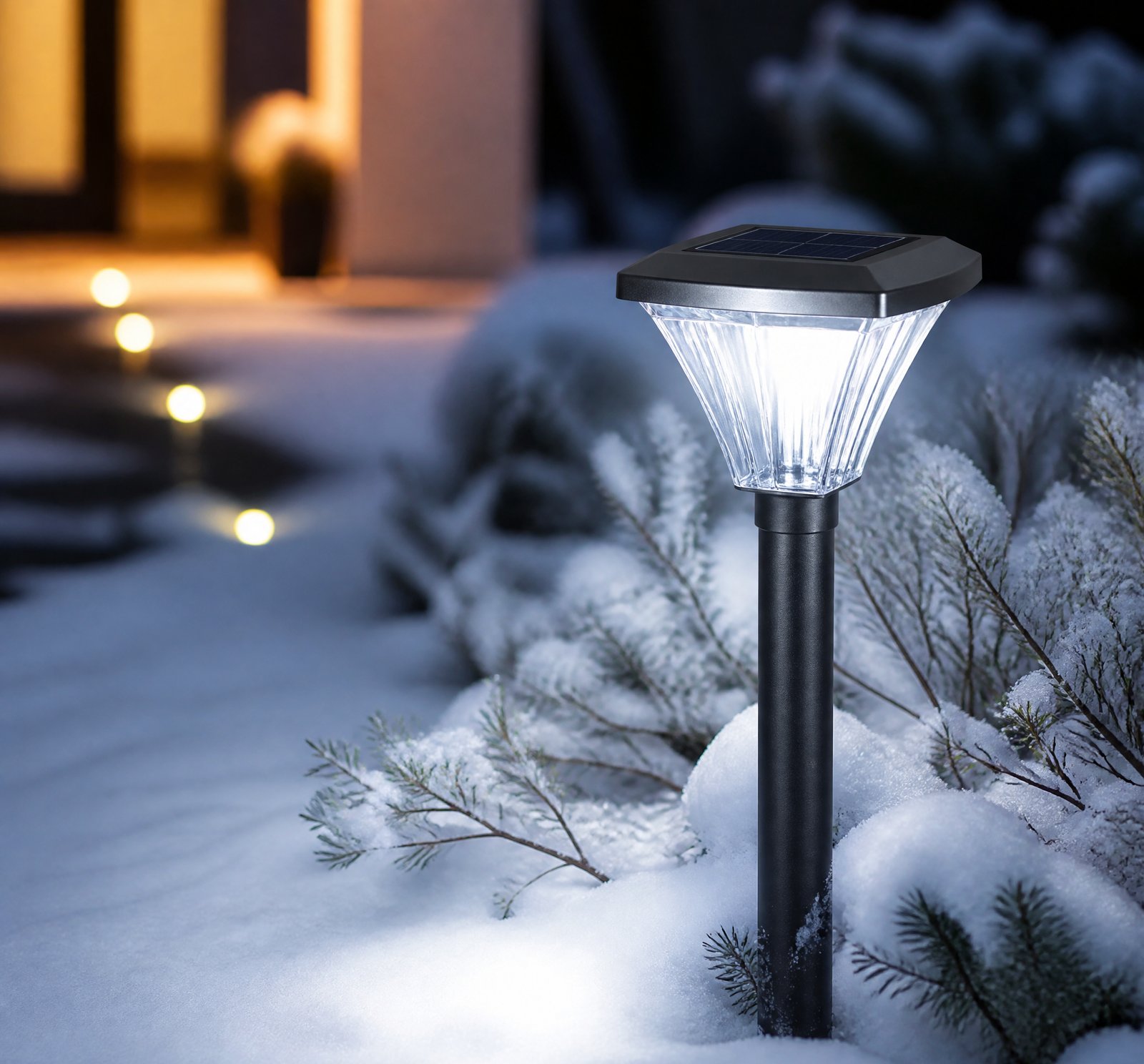
> Quick answer: Solar lamp firmware prioritizes both security and battery conservation through a dynamic framework that adjusts to real-time conditions, historical solar production, and time-based scheduling. This ensures high visibility at dusk and during motion events while minimizing energy use during low-activity periods.
In mixed-mode operation—combining dim background lighting with motion-triggered brightness—solar lamp control firmware in Romania uses an adaptive algorithm to balance security and battery conservation over a sequence of winter nights [18][25]. This approach ensures that the lamps remain effective while conserving energy.
Time-Scheduled Brightness Phases
The core strategy begins with high-brightness illumination at dusk, followed by a transition to a dimmed background state. For example, one system operates at full brightness for two hours after dusk before dimming to 25% [18][25], while another uses a similar pattern but with a 10-minute window of full brightness triggered by motion detection [2][18]. This initial high output ensures strong visibility during peak activity times, aligning with security needs.
Battery Conservation Mechanisms
Battery voltage is the primary input for determining energy conservation priorities. As battery voltage drops, the firmware adjusts to conserve power, even beyond the standard dimming profile [3][18][25]. During winter, when solar insolation is low and battery reserves are strained, the system may enter a „lowest energy mode” if voltage falls too low, reducing light output to minimal levels [5].
Motion-Boosted Brightness
The motion-boost function increases power delivery to brighten the light to 50%–80% of full brightness when motion is detected during the dimmed phase [9][12][20]. After motion ceases, the light dims back down over a set period (e.g., one minute) [18][25].
Adaptive Responses
The firmware uses battery voltage, historical solar production in amp-hours (Ah), and time-of-night to determine the appropriate energy mode [3][25]. If the previous day’s solar harvest was below average, the system adjusts its energy mode for the following night to conserve more aggressively [3][25].
Peripheral Load Management
The firmware manages peripheral loads such as wireless radios and security sensors. In low-energy states, non-essential peripherals are turned off to preserve power for lighting [13][17]. This ensures that essential functions remain powered, maintaining system integrity [19].
Intelligent Adjustments Based on Conditions
A key insight from the research is that the most effective energy conservation occurs through adaptive responses to real-time conditions rather than fixed dimming schedules. For instance, during a low-solar day, the system may dim more aggressively even if the night is otherwise uneventful [3][25].
Handling Conflicting Signals
While motion detection triggers brightening responses, the exact duration or intensity under low-voltage conditions remains unspecified [18]. The research does not clarify how firmware dynamically adjusts motion-boost duration or brightness based on remaining battery capacity.
| Condition | Action |
|––––|–––|
| Low Battery Voltage | Dim aggressively and enter lowest energy mode if necessary [5][3] |
| Motion Detected | Brighten to 50%–80% of full brightness for 1 minute [9][20] |
| Post-Dusk Phase | Full brightness for two hours, then dim to 25% [18] |
Key Takeaways
- Solar lamp firmware uses adaptive algorithms to balance security lighting and battery conservation.
- Real-time battery voltage is a critical input for adjusting energy modes.
- Motion detection triggers brightening but with intelligent duration controls.
Frequently Asked Questions
[
{„q”: „How does the solar lamp’s control system handle low-solar days during winter?”, „a”: „During winter, when solar insolation is low, the firmware adjusts more aggressively to conserve power. The system may dim more and enter a lower energy mode if necessary [3][25].”},
{„q”: „What happens if motion is detected while the battery voltage is critically low?”, „a”: „The firmware still triggers brightening responses when motion is detected, even under low-voltage conditions, though details on duration or intensity are not fully specified [18].”},
{„q”: „Can users override the adaptive logic to favor security over conservation?”, „a”: „While some systems allow remote programming via wireless control boards, specific user-defined settings for overriding adaptive logic are not detailed in the sources [4][6]„}
]
References
- [2] US20120020060A1_-_Energy-efficient_solar-powered_-_Google_Patents__619c8cff — patent
source passage
and comprising multiple light emitting diodes (LEDs); providing at least one battery operatively connected to the solar collector panel and the LEDs; providing at least one motion sensor on said pole; actively controlling energy delivery from said at least one battery to said LEDs, by turning on, dimming and turning off said LEDs according to at least one mode of operation, said at least one mode of operation comprising a normal operation mode comprising turning said LEDs on at dusk to full brightness for a first predetermined amount of time, and, after said first predetermined amount of time, dimming said LEDs to a first fraction of said full brightness, until said at least one motion sensor detects a motion event near said pole and then increasing energy delivery to said LEDs for a second predetermined amount of time starting when said at least one motion sensor no longer detects said motion event, followed by reducing energy delivery to said LEDs to dim said LEDs, so that the LEDs are dimmed to less than full brightness in between motion events. The methods may include actively controlling energy delivery from said at least one battery to said LEDs by increasing energy delivery to said LEDs for a third predetermined amount of time before dawn so that said LEDs remain at full brightness until dawn. The methods may include dimming said LEDs when said at least one battery falls to a battery voltage in the range of 1-2 volts above a minimum safe battery voltage, said minimum s
- [3] US20120020060A1_-_Energy-efficient_solar-powered_-_Google_Patents__619c8cff — patent
source passage
to 100% for 10 minutes after the last-detected motion. It then dims back down to the lower setting over one minute. Towards dawn, the light will brighten back up to full brightness approximately 30 minutes (factory preset) prior to dawn. When the photocell threshold for dawn is crossed, the light will turn off. – FIG. 47 portrays examples of how system conditions can be utilized to determine the appropriate energy modes based on current states to modify power delivered, to the light or other loads, beyond or instead of the “normal” changes over time shown in FIG. 46 . – the voltage of the batteries (on the right of the figure) is one indicator of how much energy is available in the battery storage. As the battery voltage drops, the energy mode is adjusted so that energy can be conserved. – the Ah decision block is referring to the solar production (in Amp-Hours, Ah) from the previous day. This Ah information is also an indicator of whether or not energy needs to be conserved. On any given day, if the energy produced is less than normal, then the energy mode is adjusted to conserve energy, over and above the adjustments shown in FIG. 46 , preferably during the following night. – Modes E1 through E6 Energy Savings Modes are available (modes E1 through E6), and selection of the modes is determined by the measuring the battery voltage at the end of the day. – modes E1 and E2 the light is still brought up to full brightness initially & then dimmed down to less than 25% brightness
- [4] US20120020060A1_-_Energy-efficient_solar-powered_-_Google_Patents__619c8cff — patent
source passage
– Additional features may be added, for example, dimming capability to reduce the light output after the first hour. Such a dimming capability, for example, may allow the light to have a much higher lumen output when it first turns on & then dims it down as the night progresses and less light is needed. Another option is to include a motion sensor over-ride that will immediately turn the light back up to full brightness when motion is detected near the pole, for example, motion of a person, a bicycle, or a vehicle. Both of these features allow the light to be “tuned” to the specific application requirements and to conserve as much energy as possible. This will allow the energy storage pack to be as small as possible to reduce costs and to reduce the size and weight of the fixture. See, particularly, the section entitled “Active Control for Energy-Efficient Lighting” later in this document. – The additional feature of having a wireless control board, for example as described earlier in this document, allows the settings on the light to be changed remotely and allows for the fixture system performance to be monitored remotely. For example, the power company may check to see how each of the lights are performing and confirm that the light is running off of battery power for the full amount of time required for the peak loading period. The owner of the light may check the status of all system features, the battery health, and whether any maintenance items need attention, for exam
- [5] US20120020060A1_-_Energy-efficient_solar-powered_-_Google_Patents__619c8cff — patent
source passage
maximizing (focusing on) the winter performance in the preferred embodiments, every possible bit of solar energy is “squeezed out” and also conserved during operation over the winter nights, to keep the system operational over the winter. Even on the cloudiest day, the preferred embodiments of the invention produce about 20% of the normal (sunny day). This allows the system to always have some energy available, even if it can only turn the light on (at a lower dimmed down state) for a couple of hours at the beginning of the night. In testing, such dimmed-down operation being possible for only a couple of hours has only happened once, in Houston, Tex. testing, when a pole reached the lowest energy mode, but said lowest energy mode was due to “false motion” events. A tree with a light source behind it was shining towards the motion detector, and the wind blowing the tree was interpreted as motion (the IR detector saw the heat from the light & therefore the motion). To avoid such events, programming was changed to ignore continuous motion and treat it as an error/alert condition to be ignored after a certain period of time. “Continuous” in this context may be set by the manufacturer, for example, and preferably means in the range of motion at least every two minutes for a set time period in the range of 30-minutes. Aiming the motion detectors down, so that motion above about 10 feet high would be ignored, has also been found to be effective, so that human and vehicular traffic i
- [6] WO2010057138A2_-_Energy-efficient_solar-powered_outdoor_lighting__593d23e6 — patent
source passage
after the first hour. – dimming capability may allow the light to have a much higher lumen output when it first turns on & then dims it down as the night progresses and less light is needed. – Another option is to include a motion sensor over-ride that will immediately turn the light back up to full brightness when motion is detected near the pole, for example, motion of a person, a bicycle, or a vehicle. Both of these features allow the light to be “tuned " to the specific application requirements and to conserve as much energy as possible. This will allow the energy storage pack to be as small as possible to reduce costs and to reduce the size and weight of the fixture. See, particularly, the section entitled "Active Control for Energy-Efficient Lighting” later in this document. – the additional feature of having a wireless control board allows the settings on the light to be changed remotely and allows for the fixture system performance to be monitored remotely. – the power company may check to see how each of the lights are performing and confirm that the light is running off of battery power for the full amount of time required for the peak loading period. – the owner of the light may check the status of all system features, the battery health, and whether any maintenance items need attention, for example, LEDs that need to be replaced and battery chargers that are not working properly, etc.. – Solar powered light poles and/or specially-adapted LED light fixtures as desc
- [9] WO2010057138A2_-_Energy-efficient_solar-powered_outdoor_lighting__593d23e6 — patent
source passage
mode of operation includes at least one energy-saving mode comprising turning said LEDs on at dusk to a second fraction of full brightness for said first predetermined amount of time, and then dimming said LEDs to a further-reduced third fraction of full brightness, until said at least one motion sensor detects a motion event near said pole and then increasing energy delivery to said LEDs for said second predetermined amount of time to said second fraction of full brightness, and, when said at least one motion sensor no longer detects said motion event, reducing energy delivery to said LEDs to dim said LEDs again to said third fraction of full brightness, so that the LEDs are dimmed to said third fraction of full brightness in between motion events. 27. A method as in Claim 26, wherein said second fraction of foil brightness is in the range of 50% – 80% of foil brightness, and said third fraction is 7.5% – 25% of foil brightness. 28. A method as in Claim 26, comprising brightening said LEDs to said third fraction of full brightness for a third predetermined amount of time before dawn. Priority Applications (4) Applications Claiming Priority (4) Related Parent Applications (1) Related Child Applications (3) Publications (2) Family ID=42170788 Family Applications (1) Country Status (2) Cited By (28) Family Cites Families (9) – 2009 – 2009-11-16 WO PCT/US2009/064659 patent/WO2010057138A2/en not_active Ceased – 2009-11-16 EP EP09826938.4A patent/EP2356371A4/en not_active Withdraw
- [12] US20120020060A1_-_Energy-efficient_solar-powered_-_Google_Patents__619c8cff — patent
source passage
down to 25% or less brightness down after a predetermined amount of time and throughout the nighttime except for times during the nighttime when said at least one motion sensor senses motion near said pole. Or, said active controller system may be adapted to turn on said LEDs at dusk at a reduced brightness in the range of 50%-80% of full brightness, to dim the LEDs down to less than 25% brightness after a predetermined amount of time throughout the nighttime except for times during the nighttime when said at least one motion sensor senses motion near said pole. Or, said active controller (or said load controller) may be adapted, in response to said motion sensor sensing motion near the pole when the LEDs are in a dimmed state, to increase power to said LEDs to brighten said LEDs to 50-80% of full brightness while said motion is detected. Or, said active controller system may be adapted to turn on said LEDs at dusk at a reduced brightness in the range of 50-80% of full brightness, and then dim the LEDs down to a range of 7.5%-25% of full brightness after a predetermined amount of time and throughout the nighttime except for times when said at least one motion sensor sensed motion near said pole. The lighting system may also comprise peripheral devices on said pole powered by said at least one battery, and wherein said active controller system is adapted to shed loads connected to the battery by turning off said peripheral devices to conserve battery energy. Said active contro
- [13] WO2010057138A2_-_Energy-efficient_solar-powered_outdoor_lighting__593d23e6 — patent
source passage
lighting and/or to peripherals in order to protect the battery pack and to ultimately protect the entire lighting system. – this active control is crucial to maintaining operability of the system and preventing damage to 1he batteries, over long cloudy or winter days. – this active control is crucial to managing the synergistic relationship between the lighting pole/array, wherein the grid may rely on the pole/array for energy inverted directly onto the grid in real time when demand matches generation (e.g., afternoon air conditioning peak matches afternoon generation peak), or for battery-stored energy at other times, but wherein the pole/array may rely on the grid for energy input during the darkest months of the winter. – the energy management algorithms such as Nl, El, E2, etc. modes described later in this document, as a function of battery voltage may be relatively simple for a single load (for example, LED lighting). However, for each added load, the algorithms become more complex. With a transport layer load (wireless radios) plus myriad other peripherals (video, security gate, emergency call box, etc.), the energy management algorithms' scope includes the management of a prioritized list of "loads" that can be toggled on/off or reduced in functionality/consumption as a function of battery voltage, and, in grid-connected embodiments, may also include algorithms for drawing energy from the grid through the battery charger to refill. – the preferred apparatus comprises
- [17] WO2010057138A2_-_Energy-efficient_solar-powered_outdoor_lighting__593d23e6 — patent
source passage
then dim the LEDs down to a range of 7.5% – 25 % of full brightness after a predetermined amount of time and throughout the nighttime except for times when said at least one motion sensor sensed motion near said pole. – the lighting system may also comprise peripheral devices on said pole powered by said at least one battery, and wherein said active controller system is adapted to shed loads connected to the battery by turning off said peripheral devices to conserve battery energy. – Said active controller system may be adapted to brighten said LEDs in response to said at least one motion detector only when said motion is below about 10 feet from the ground and only when said motion is not continuous. – the preferred embodiments of the invention may be methods of controlling an outdoor lighting system, for example, comprising: providing a flexible solar collector panel curved at least 180 degrees around a generally cylindrical light pole so that the solar collector is generally vertical; providing a lighting fixture connected to the pole and comprising multiple light emitting diodes (LEDs); providing at least one battery operatively connected to the solar collector panel and the LEDs; providing at least one motion sensor on said pole; actively controlling energy delivery from said at least one battery to said LEDs, by turning on, dimming and turning off said LEDs according to at least one mode of operation, said at least one mode of operation comprising a normal operation mod
- [18] WO2010057138A2_-_Energy-efficient_solar-powered_outdoor_lighting__593d23e6 — patent
source passage
initially coated with dielectric grease to prevent oxidation and corrosion of the metal contacts. All main power lines (from solar collector to charge controller & from charge controller to load and batteries) are fused (5 amps). – the photocell turns on the light at 100% (factory preset) normal power. It stays at 100% for two hours (factory preset) then dims down to 25% brightness (factory preset) for the balance of the night w/ motion sensor over-ride. If motion is detected it immediately brightens up to 100% for 10 minutes after the last-detected motion. It then dims back down to the lower setting over one minute. Towards dawn, the light will brighten back up to full brightness approximately 30 minutes (factory preset) prior to dawn. When the photocell threshold for dawn is crossed, the light will turn off. – Figure 47 portrays examples of how system conditions can be utilized to determine the appropriate energy modes based on current states to modify power delivered, to the light or other loads, beyond or instead of the "normal" changes over time shown in Figure 46. – the voltage of the batteries (on the right of the figure) is one indicator of how much energy is available in the battery storage. As the battery voltage drops, the energy mode is adjusted so that energy can be conserved. – the Ah decision block is referring to the solar production (in Amp-Hours, Ah) from the previous day. This Ah information is also an indicator of whether or not energy needs to be conserve
- [19] US20170055324A1_-_Apparatus_retrofit_kit_and_-_Google_Patents__f5522dda — patent
source passage
source. – the at least one controller can include an actual or estimated amount of power required to run the control system in determining an amount of power required, and can select the illumination adjustment or dimming schedule accordingly. In such implementations, it may be advisable to select a less aggressive illumination adjustment or dimming schedule than might otherwise be selected, to ensure that there is always sufficient power to power the control system. – the at least one controller can select the illumination adjustment or dimming schedule further based at least in part on at least one specified condition of illumination to be placed on operation of the luminaire during the dusk-to-dawn cycle. For instance, selection of the illumination adjustment or dimming schedule can be further based at least in part on at least one specified duration of a maximum illumination by the luminaire for a set period of time with respect to a solar event during the dusk-to-dawn cycle inclusive of a dusk event and a dawn event. – the at least one controller executes the selected illumination adjustment or dimming schedule. – the at least one controller can execute instructions that cause the at least one controller to control the light source(s) of one or more luminaires according to conditions and/or parameters specified in the selected illumination adjustment or dimming schedule. – the at least one controller may cause an illumination level or intensity level, or even color tempe
- [20] WO2010057138A2_-_Energy-efficient_solar-powered_outdoor_lighting__593d23e6 — patent
source passage
at said dusk, and then dim the LEDs down to 25% or less brightness down after a predetermined amount of time and throughout the nighttime except for times during the nighttime when said at least one motion sensor senses motion near said pole. Or, said active controller system may be adapted to turn on said LEDs at dusk at a reduced brightness in the range of 50%- 80% of full brightness, to dim the LEDs down to less than 25% brightness after a predetermined amount of time throughout the nighttime except for times during the nighttime when said at least one motion sensor senses motion near said pole. Or, said active controller (or said load controller) may be adapted, in response to said motion sensor sensing motion near the pole when the LEDs are in a dimmed state, to increase power to said LEDs to brighten said LEDs to 50 – 80% of full brightness while said motion is detected. Or, said active controller system may be adapted to turn on said LEDs at dusk at a reduced brightness in the range of 50 – 80% of full brightness, and then dim the LEDs down to a range of 7.5% – 25 % of full brightness after a predetermined amount of time and throughout the nighttime except for times when said at least one motion sensor sensed motion near said pole. The lighting system may also comprise peripheral devices on said pole powered by said at least one battery, and wherein said active controller system is adapted to shed loads connected to the battery by turning off said peripheral devices to
- [25] US20120020060A1_-_Energy-efficient_solar-powered_-_Google_Patents__619c8cff — patent
source passage
end of the day, as it starts to get dark, the photocell turns on the light at 100% (factory preset) normal power. It stays at 100% for two hours (factory preset) then dims down to 25% brightness (factory preset) for the balance of the night w/ motion sensor over-ride. If motion is detected it immediately brightens up to 100% for 10 minutes after the last-detected motion. It then dims back down to the lower setting over one minute. Towards dawn, the light will brighten back up to full brightness approximately 30 minutes (factory preset) prior to dawn. When the photocell threshold for dawn is crossed, the light will turn off. – FIG. 47 portrays examples of how system conditions can be utilized to determine the appropriate energy modes based on current states to modify power delivered, to the light or other loads, beyond or instead of the “normal” changes over time shown inFIG. 46 . For example, the voltage of the batteries (on the right of the figure) is one indicator of how much energy is available in the battery storage. As the battery voltage drops, the energy mode is adjusted so that energy can be conserved. On the left of the figure, the Ah decision block is referring to the solar production (in Amp-Hours, Ah) from the previous day. This Ah information is also an indicator of whether or not energy needs to be conserved. On any given day, if the energy produced is less than normal, then the energy mode is adjusted to conserve energy, over and above the adjustments shown inF
and comprising multiple light emitting diodes (LEDs); providing at least one battery operatively connected to the solar collector panel and the LEDs; providing at least one motion sensor on said pole; actively controlling energy delivery from said at least one battery to said LEDs, by turning on, dimming and turning off said LEDs according to at least one mode of operation, said at least one mode of operation comprising a normal operation mode comprising turning said LEDs on at dusk to full brightness for a first predetermined amount of time, and, after said first predetermined amount of time, dimming said LEDs to a first fraction of said full brightness, until said at least one motion sensor detects a motion event near said pole and then increasing energy delivery to said LEDs for a second predetermined amount of time starting when said at least one motion sensor no longer detects said motion event, followed by reducing energy delivery to said LEDs to dim said LEDs, so that the LEDs are dimmed to less than full brightness in between motion events. The methods may include actively controlling energy delivery from said at least one battery to said LEDs by increasing energy delivery to said LEDs for a third predetermined amount of time before dawn so that said LEDs remain at full brightness until dawn. The methods may include dimming said LEDs when said at least one battery falls to a battery voltage in the range of 1-2 volts above a minimum safe battery voltage, said minimum s
to 100% for 10 minutes after the last-detected motion. It then dims back down to the lower setting over one minute. Towards dawn, the light will brighten back up to full brightness approximately 30 minutes (factory preset) prior to dawn. When the photocell threshold for dawn is crossed, the light will turn off. – FIG. 47 portrays examples of how system conditions can be utilized to determine the appropriate energy modes based on current states to modify power delivered, to the light or other loads, beyond or instead of the “normal” changes over time shown in FIG. 46 . – the voltage of the batteries (on the right of the figure) is one indicator of how much energy is available in the battery storage. As the battery voltage drops, the energy mode is adjusted so that energy can be conserved. – the Ah decision block is referring to the solar production (in Amp-Hours, Ah) from the previous day. This Ah information is also an indicator of whether or not energy needs to be conserved. On any given day, if the energy produced is less than normal, then the energy mode is adjusted to conserve energy, over and above the adjustments shown in FIG. 46 , preferably during the following night. – Modes E1 through E6 Energy Savings Modes are available (modes E1 through E6), and selection of the modes is determined by the measuring the battery voltage at the end of the day. – modes E1 and E2 the light is still brought up to full brightness initially & then dimmed down to less than 25% brightness
– Additional features may be added, for example, dimming capability to reduce the light output after the first hour. Such a dimming capability, for example, may allow the light to have a much higher lumen output when it first turns on & then dims it down as the night progresses and less light is needed. Another option is to include a motion sensor over-ride that will immediately turn the light back up to full brightness when motion is detected near the pole, for example, motion of a person, a bicycle, or a vehicle. Both of these features allow the light to be “tuned” to the specific application requirements and to conserve as much energy as possible. This will allow the energy storage pack to be as small as possible to reduce costs and to reduce the size and weight of the fixture. See, particularly, the section entitled “Active Control for Energy-Efficient Lighting” later in this document. – The additional feature of having a wireless control board, for example as described earlier in this document, allows the settings on the light to be changed remotely and allows for the fixture system performance to be monitored remotely. For example, the power company may check to see how each of the lights are performing and confirm that the light is running off of battery power for the full amount of time required for the peak loading period. The owner of the light may check the status of all system features, the battery health, and whether any maintenance items need attention, for exam
maximizing (focusing on) the winter performance in the preferred embodiments, every possible bit of solar energy is “squeezed out” and also conserved during operation over the winter nights, to keep the system operational over the winter. Even on the cloudiest day, the preferred embodiments of the invention produce about 20% of the normal (sunny day). This allows the system to always have some energy available, even if it can only turn the light on (at a lower dimmed down state) for a couple of hours at the beginning of the night. In testing, such dimmed-down operation being possible for only a couple of hours has only happened once, in Houston, Tex. testing, when a pole reached the lowest energy mode, but said lowest energy mode was due to “false motion” events. A tree with a light source behind it was shining towards the motion detector, and the wind blowing the tree was interpreted as motion (the IR detector saw the heat from the light & therefore the motion). To avoid such events, programming was changed to ignore continuous motion and treat it as an error/alert condition to be ignored after a certain period of time. “Continuous” in this context may be set by the manufacturer, for example, and preferably means in the range of motion at least every two minutes for a set time period in the range of 30-minutes. Aiming the motion detectors down, so that motion above about 10 feet high would be ignored, has also been found to be effective, so that human and vehicular traffic i
after the first hour. – dimming capability may allow the light to have a much higher lumen output when it first turns on & then dims it down as the night progresses and less light is needed. – Another option is to include a motion sensor over-ride that will immediately turn the light back up to full brightness when motion is detected near the pole, for example, motion of a person, a bicycle, or a vehicle. Both of these features allow the light to be “tuned " to the specific application requirements and to conserve as much energy as possible. This will allow the energy storage pack to be as small as possible to reduce costs and to reduce the size and weight of the fixture. See, particularly, the section entitled "Active Control for Energy-Efficient Lighting” later in this document. – the additional feature of having a wireless control board allows the settings on the light to be changed remotely and allows for the fixture system performance to be monitored remotely. – the power company may check to see how each of the lights are performing and confirm that the light is running off of battery power for the full amount of time required for the peak loading period. – the owner of the light may check the status of all system features, the battery health, and whether any maintenance items need attention, for example, LEDs that need to be replaced and battery chargers that are not working properly, etc.. – Solar powered light poles and/or specially-adapted LED light fixtures as desc
mode of operation includes at least one energy-saving mode comprising turning said LEDs on at dusk to a second fraction of full brightness for said first predetermined amount of time, and then dimming said LEDs to a further-reduced third fraction of full brightness, until said at least one motion sensor detects a motion event near said pole and then increasing energy delivery to said LEDs for said second predetermined amount of time to said second fraction of full brightness, and, when said at least one motion sensor no longer detects said motion event, reducing energy delivery to said LEDs to dim said LEDs again to said third fraction of full brightness, so that the LEDs are dimmed to said third fraction of full brightness in between motion events. 27. A method as in Claim 26, wherein said second fraction of foil brightness is in the range of 50% – 80% of foil brightness, and said third fraction is 7.5% – 25% of foil brightness. 28. A method as in Claim 26, comprising brightening said LEDs to said third fraction of full brightness for a third predetermined amount of time before dawn. Priority Applications (4) Applications Claiming Priority (4) Related Parent Applications (1) Related Child Applications (3) Publications (2) Family ID=42170788 Family Applications (1) Country Status (2) Cited By (28) Family Cites Families (9) – 2009 – 2009-11-16 WO PCT/US2009/064659 patent/WO2010057138A2/en not_active Ceased – 2009-11-16 EP EP09826938.4A patent/EP2356371A4/en not_active Withdraw
down to 25% or less brightness down after a predetermined amount of time and throughout the nighttime except for times during the nighttime when said at least one motion sensor senses motion near said pole. Or, said active controller system may be adapted to turn on said LEDs at dusk at a reduced brightness in the range of 50%-80% of full brightness, to dim the LEDs down to less than 25% brightness after a predetermined amount of time throughout the nighttime except for times during the nighttime when said at least one motion sensor senses motion near said pole. Or, said active controller (or said load controller) may be adapted, in response to said motion sensor sensing motion near the pole when the LEDs are in a dimmed state, to increase power to said LEDs to brighten said LEDs to 50-80% of full brightness while said motion is detected. Or, said active controller system may be adapted to turn on said LEDs at dusk at a reduced brightness in the range of 50-80% of full brightness, and then dim the LEDs down to a range of 7.5%-25% of full brightness after a predetermined amount of time and throughout the nighttime except for times when said at least one motion sensor sensed motion near said pole. The lighting system may also comprise peripheral devices on said pole powered by said at least one battery, and wherein said active controller system is adapted to shed loads connected to the battery by turning off said peripheral devices to conserve battery energy. Said active contro
lighting and/or to peripherals in order to protect the battery pack and to ultimately protect the entire lighting system. – this active control is crucial to maintaining operability of the system and preventing damage to 1he batteries, over long cloudy or winter days. – this active control is crucial to managing the synergistic relationship between the lighting pole/array, wherein the grid may rely on the pole/array for energy inverted directly onto the grid in real time when demand matches generation (e.g., afternoon air conditioning peak matches afternoon generation peak), or for battery-stored energy at other times, but wherein the pole/array may rely on the grid for energy input during the darkest months of the winter. – the energy management algorithms such as Nl, El, E2, etc. modes described later in this document, as a function of battery voltage may be relatively simple for a single load (for example, LED lighting). However, for each added load, the algorithms become more complex. With a transport layer load (wireless radios) plus myriad other peripherals (video, security gate, emergency call box, etc.), the energy management algorithms' scope includes the management of a prioritized list of "loads" that can be toggled on/off or reduced in functionality/consumption as a function of battery voltage, and, in grid-connected embodiments, may also include algorithms for drawing energy from the grid through the battery charger to refill. – the preferred apparatus comprises
then dim the LEDs down to a range of 7.5% – 25 % of full brightness after a predetermined amount of time and throughout the nighttime except for times when said at least one motion sensor sensed motion near said pole. – the lighting system may also comprise peripheral devices on said pole powered by said at least one battery, and wherein said active controller system is adapted to shed loads connected to the battery by turning off said peripheral devices to conserve battery energy. – Said active controller system may be adapted to brighten said LEDs in response to said at least one motion detector only when said motion is below about 10 feet from the ground and only when said motion is not continuous. – the preferred embodiments of the invention may be methods of controlling an outdoor lighting system, for example, comprising: providing a flexible solar collector panel curved at least 180 degrees around a generally cylindrical light pole so that the solar collector is generally vertical; providing a lighting fixture connected to the pole and comprising multiple light emitting diodes (LEDs); providing at least one battery operatively connected to the solar collector panel and the LEDs; providing at least one motion sensor on said pole; actively controlling energy delivery from said at least one battery to said LEDs, by turning on, dimming and turning off said LEDs according to at least one mode of operation, said at least one mode of operation comprising a normal operation mod
initially coated with dielectric grease to prevent oxidation and corrosion of the metal contacts. All main power lines (from solar collector to charge controller & from charge controller to load and batteries) are fused (5 amps). – the photocell turns on the light at 100% (factory preset) normal power. It stays at 100% for two hours (factory preset) then dims down to 25% brightness (factory preset) for the balance of the night w/ motion sensor over-ride. If motion is detected it immediately brightens up to 100% for 10 minutes after the last-detected motion. It then dims back down to the lower setting over one minute. Towards dawn, the light will brighten back up to full brightness approximately 30 minutes (factory preset) prior to dawn. When the photocell threshold for dawn is crossed, the light will turn off. – Figure 47 portrays examples of how system conditions can be utilized to determine the appropriate energy modes based on current states to modify power delivered, to the light or other loads, beyond or instead of the "normal" changes over time shown in Figure 46. – the voltage of the batteries (on the right of the figure) is one indicator of how much energy is available in the battery storage. As the battery voltage drops, the energy mode is adjusted so that energy can be conserved. – the Ah decision block is referring to the solar production (in Amp-Hours, Ah) from the previous day. This Ah information is also an indicator of whether or not energy needs to be conserve
source. – the at least one controller can include an actual or estimated amount of power required to run the control system in determining an amount of power required, and can select the illumination adjustment or dimming schedule accordingly. In such implementations, it may be advisable to select a less aggressive illumination adjustment or dimming schedule than might otherwise be selected, to ensure that there is always sufficient power to power the control system. – the at least one controller can select the illumination adjustment or dimming schedule further based at least in part on at least one specified condition of illumination to be placed on operation of the luminaire during the dusk-to-dawn cycle. For instance, selection of the illumination adjustment or dimming schedule can be further based at least in part on at least one specified duration of a maximum illumination by the luminaire for a set period of time with respect to a solar event during the dusk-to-dawn cycle inclusive of a dusk event and a dawn event. – the at least one controller executes the selected illumination adjustment or dimming schedule. – the at least one controller can execute instructions that cause the at least one controller to control the light source(s) of one or more luminaires according to conditions and/or parameters specified in the selected illumination adjustment or dimming schedule. – the at least one controller may cause an illumination level or intensity level, or even color tempe
at said dusk, and then dim the LEDs down to 25% or less brightness down after a predetermined amount of time and throughout the nighttime except for times during the nighttime when said at least one motion sensor senses motion near said pole. Or, said active controller system may be adapted to turn on said LEDs at dusk at a reduced brightness in the range of 50%- 80% of full brightness, to dim the LEDs down to less than 25% brightness after a predetermined amount of time throughout the nighttime except for times during the nighttime when said at least one motion sensor senses motion near said pole. Or, said active controller (or said load controller) may be adapted, in response to said motion sensor sensing motion near the pole when the LEDs are in a dimmed state, to increase power to said LEDs to brighten said LEDs to 50 – 80% of full brightness while said motion is detected. Or, said active controller system may be adapted to turn on said LEDs at dusk at a reduced brightness in the range of 50 – 80% of full brightness, and then dim the LEDs down to a range of 7.5% – 25 % of full brightness after a predetermined amount of time and throughout the nighttime except for times when said at least one motion sensor sensed motion near said pole. The lighting system may also comprise peripheral devices on said pole powered by said at least one battery, and wherein said active controller system is adapted to shed loads connected to the battery by turning off said peripheral devices to
end of the day, as it starts to get dark, the photocell turns on the light at 100% (factory preset) normal power. It stays at 100% for two hours (factory preset) then dims down to 25% brightness (factory preset) for the balance of the night w/ motion sensor over-ride. If motion is detected it immediately brightens up to 100% for 10 minutes after the last-detected motion. It then dims back down to the lower setting over one minute. Towards dawn, the light will brighten back up to full brightness approximately 30 minutes (factory preset) prior to dawn. When the photocell threshold for dawn is crossed, the light will turn off. – FIG. 47 portrays examples of how system conditions can be utilized to determine the appropriate energy modes based on current states to modify power delivered, to the light or other loads, beyond or instead of the “normal” changes over time shown inFIG. 46 . For example, the voltage of the batteries (on the right of the figure) is one indicator of how much energy is available in the battery storage. As the battery voltage drops, the energy mode is adjusted so that energy can be conserved. On the left of the figure, the Ah decision block is referring to the solar production (in Amp-Hours, Ah) from the previous day. This Ah information is also an indicator of whether or not energy needs to be conserved. On any given day, if the energy produced is less than normal, then the energy mode is adjusted to conserve energy, over and above the adjustments shown inF