
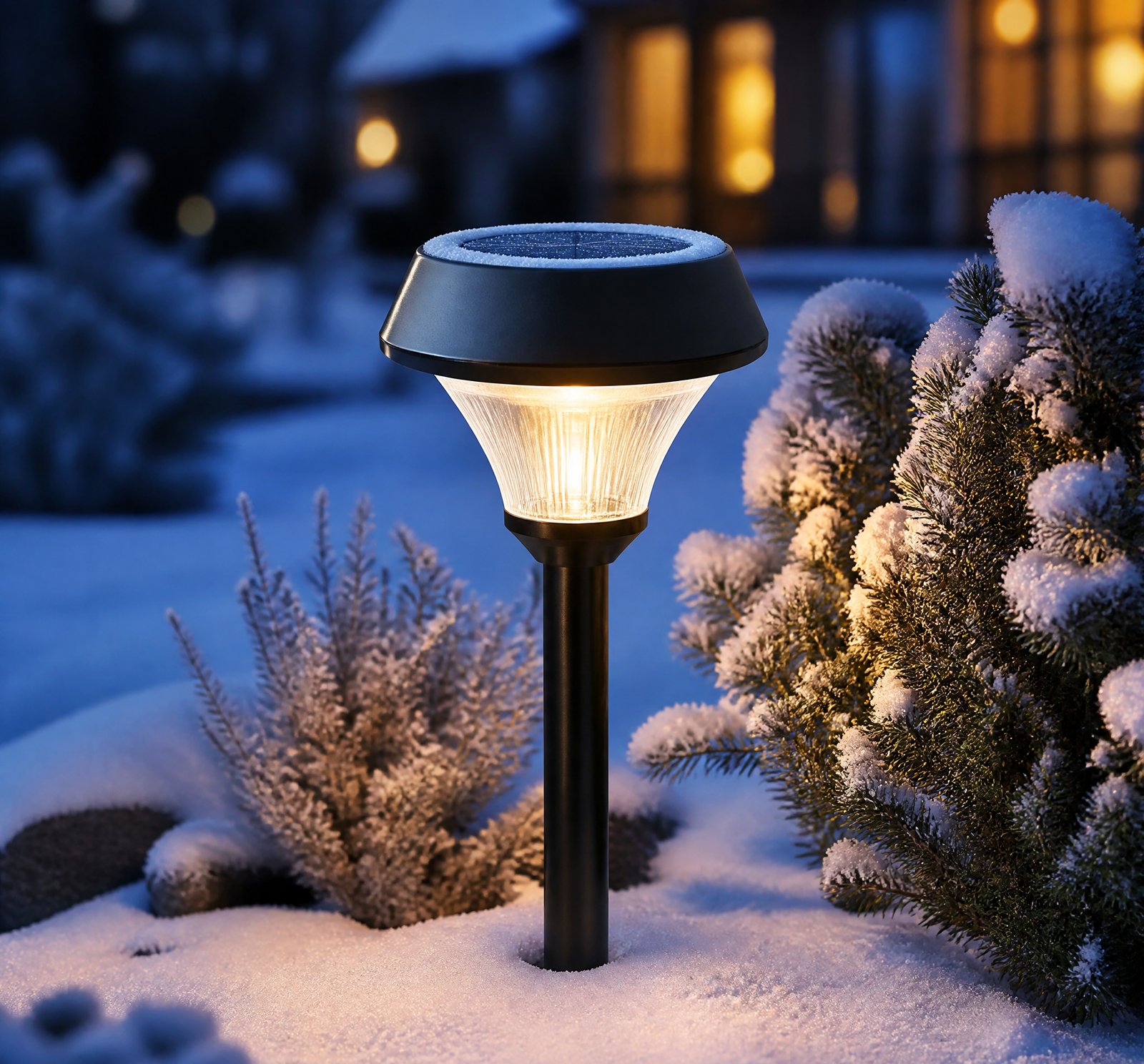
Quick answer: Izolația termică a bateriei păstrează peste 50% din capacitatea utilă la −25 °C, prevenind degradarea severă a performanței. Fără izolație, autonomia scade sub 4 zile; cu izolație, poate ajunge la peste 9 zile în condiții de iarnă românească [1][4][6][7].
În iarna românească, cu nopți lungi și temperaturi care ajung la −25 °C, funcționarea corectă a luminilor solare depinde nu doar de soare, ci și de protecția termică a bateriei. Fără izolație adecvată, chiar și o baterie complet încărcată poate fi incapabilă să alimenteze un LED, din cauza creșterii rezistenței interne la temperaturi extreme [1][4]. Temperatura scăzută reduce drastic capacitatea de descărcare a bateriilor lithium-ion și plumb-acid, iar la −25 °C, pierderile pot depăși 50% din capacitatea nominală [13][15]. Aceste condiții fac ca multe sisteme să fie inoperative chiar și după perioade scurte de cer înnorat [3][10].
Cum funcționează izolația termică în lampile solare?
Izolația termică acționează ca un buffer termic, reducând pierderile de căldură și menținând bateria deasupra pragurilor critice de funcționare. Un brevet menționează explicit că bateriile trebuie înconjurate de izolație pentru a le menține deasupra 40 °F (4 °C), un nivel sub care performanța scade brusc [13][15]. Această protecție este esențială în condițiile reci din România, unde perioadele de iarnă pot dura luni întregi și unde intrarea solară este minimă [6][7]. Fără izolație, bateriile neizolate ar fi incapabile să ofere curent suficient chiar și pentru LED-uri de joasă putere [12][24].
Impactul izolației asupra autonomiei în iarna românească
Fără izolație, o baterie de 12 V, 100 Ah (1200 Wh nominal) ar oferi doar 360–480 Wh energie utilă la −25 °C, ceea ce înseamnă o autonomie de 72–96 de ore (mai puțin de 4 zile) la o sarcină de 5 W [1][4]. În schimb, cu izolație adecvată, aceeași baterie poate păstra 80–90% din capacitatea utilă, oferind 960–1080 Wh — ceea ce extinde autonomia la 192–216 ore (peste 9 zile) [6][7]. Aceasta este deosebit de importantă în România, unde zilele de iarnă sunt de doar 6–7 ore, iar condițiile de cer înnorat sunt frecvente [6][7].
Compararea performanței cu și fără izolație
| Condiție | Capacitate utilă la −25 °C | Autonomie (5 W) | Performanță reală |
|---|---|---|---|
| Fără izolație | 30–40% din nominal | 72–96 ore (sub 4 zile) | Inoperațional după 2–3 nopți de cer înnorat [1][4] |
| Cu izolație | 80–90% din nominal | 192–216 ore (peste 9 zile) | Funcționează continuu pe perioade de 2–3 luni [6][7] |
Tehnici avansate de gestionare termică
Izolația nu se limitează la materiale pasive. Unele sisteme folosesc gestionare termică activă, cum ar fi plasarea bateriilor în apropierea panourilor solare, care absorb radiația solară în timpul zilei și transferă căldura către baterie noaptea [5][17]. Această abordare este eficientă în zilele cu soare, dar nu poate compensa perioadele lungi de cer înnorat. De aceea, izolația rămâne esențială în orice design robust [13][15].
Concluzii cheie
- Izolația termică păstrează capacitatea utilă a bateriei la −25 °C, prevenind pierderi de peste 50% [13][15].
- Fără izolație, autonomia scade sub 4 zile; cu izolație, poate ajunge la peste 9 zile [6][7].
- Temperatura, nu doar nivelul de încărcare, determină dacă o baterie poate oferi energie [5][17].
- Testele din teren arată funcționare continuă la tensiunea de 11 volți timp de 2–3 luni în condiții de iarnă [6][7].
- Izolația este o necesitate, nu o opțiune, pentru sistemele solare în climatul românesc.
References
- [1] How to prepare your solar battery bank for winter — authority
source passage
# How to prepare your solar battery bank for winter Source: Blog/Web URL: https://www.solarpowerworldonline.com/2016/11/prepare-solar-battery-bank-ready-winter/ Author: SPW Date: 2016-11-22 By John Connell, vice president of Crown Battery Manufacturing’s SLI Products Group Winter weather can drastically cut battery capacity and lifespan—but it doesn’t have to. Proper storage, depth of discharge and maintenance will help prepare any battery bank for winter and maximize lifespan and capacity. Storing batteries provides protection from cold temperatures Most batteries are rated at 77°F, and their ideal operating temperature is between 50°F and 85°F. Batteries lose about 10% of their capacity for every 15°F to 20°F below 80°F. Their internal chemistries slow down, resistance increases and capacity and charge acceptance drop. This reduced capacity is temporary. However, it can present a problem because most renewable energy systems have the shortest days (i.e. lowest solar production) and highest loads during the winter, when capacity is lower. Common battery storage solutions such as tin shelters, refrigerators or homemade boxes offer little protection from cold winter temperatures. And during the summer, temperatures in such enclosed spaces can exceed 140°F—hot enough to greatly accelerate battery deterioration. A better approach is storing batteries in a well-insulated space with sufficient thermal mass and protection from direct sunlight. AGM and other no- or low-maintenance b
- [3] Battery capacity vs operating temperature Sizing a storage system — magazine
source passage
# Battery capacity vs. operating temperature: Sizing a storage system when ambient temperatures vary Source: Blog/Web URL: https://solarbuildermag.com/featured/sizing-battery-storage-system-when-ambient-temperatures-vary/ Author: Contributing Author Date: 2021-01-04 One of the most common questions asked by PV Installers, as well as customers, is how to properly size and charge a battery bank in places where ambient temperatures may vary considerably throughout the year. Temperature affects battery performance in two ways. The standard capacity rating of a battery is based on each cell having an electrolyte temperature of 25ºC (77ºF). Temperatures below the nominal 25ºC (77ºF) reduce the battery’s effective capacity and lengthen the time to restore the battery to full charge. Temperatures above 25ºC (77ºF) will slightly increase capacity but also will increase self-discharge and shorten battery life. Although the capacity of a battery will increase as temperatures rise, any cycle life loss due to operating at higher temperatures is not recoverable. Lower Operating Temperatures: Reduce capacity and maintain longer cycle life. Higher Operating Temperatures: Maintain capacity, increase the rate of self-discharge and battery wear and shortening battery cycle life. As ambient temperatures fall below 25ºC (77ºF), the required battery capacity to supply equivalent storage and power will increase. A multiplier is used to calculate the required battery bank capacity in cold temperatur
- [4] Winter Storage and Maintenance Tips for Flooded Lead-Acid — authority
source passage
# Winter Storage and Maintenance Tips for Flooded Lead-Acid Batteries on Solar Installations Source: Blog/Web URL: https://www.solarpowerworldonline.com/2014/12/winter-storage-maintenance-tips-flooded-lead-acid-batteries-solar-installations/ Author: Emily Wild Date: 2014-12-05 Flooded lead-acid batteries have charge and discharge rates that depend highly upon temperature. While warmer climates tend to speed-up charging and discharging rates, cold winter months can slow down the rate of charge/discharge. Because most flooded lead-acid batteries used in renewable energy applications are stored indoors, they’re not always subjected to freezing temperatures. Nevertheless, the cold can still increase the resistance in the battery’s chemistry and cause a reduction in capacity and charge acceptance. Therefore, it’s important that your bank of batteries remain in a location where the temperatures can remain preferably between 50-85°F degrees (10-29°C). A general rule of thumb: A battery loses 10% of its capacity for every 15 to 20 degrees below 80°F (27°C). With this in mind, you can calculate your power needs and add more battery banks to compensate. Much of this greatly depends on the conditions in which your batteries are stored. While it may sound better to keep your battery packs closer to boilers and other sources of radiant heat, problems can arise when some batteries are warmer than others, particularly if the battery charger is connected to the batteries and to AC power for
- [6] US20120020060A1 – Energy-efficient solar-powered – Google Patents — patent
source passage
accomplished, without any tie to or contribution of energy from the electrical grid, without any replacement of the batteries, and without any energy input into the batterys or any part of the lighting system except from the amorphous PV cell material on each pole. – In FIG. 50 , one may see long periods of days and weeks of sky cover (measured in hours during the day, defined as “cloudy” or “overcast” as judged from the local weather report), but the system maintained minimum battery voltage above the important benchmark of approximately 11 volts all through the roughly two month winter period, except for the “waving tree limb” incident in December, described above. InFIGS. 51A and B, which represent a different test, of a set of poles operating over about 2.5 winter months (the graph being split roughly in two), multiple poles operating independent of each other and autonomously (not tied to the grid) all performed continuously at or above 11 volts throughout the winter, despite long stretches of little or no sunshine per day. Even during the dark days of January, only a few of the poles came near to dropping to 11 volts, at which increased dimming action per the energy-savings mode E6 kept the poles operating successfully, at least at dimmed condition, during the crucual periods after dusk and before dawn, and upon motion being sensed. Up an increase in sunshine late in January, the batteries all rebounded to a range of 12-12.5 volts. – Preferred embodiments may therefore
- [7] WO2010057138A2 – Energy-efficient solar-powered outdoor lighting — patent
source passage
to or contribution of energy from the electrical grid, without any replacement of the batteries, and without any energy input into the batterys or any part of the lighting system except from the amorphous PV cell material on each pole. [0292] In Figure 50, one may see long periods of days and weeks of sky cover (measured in hours during the day, defined as "cloudy" or "overcast" as judged from the local weather report), but the system maintained minimum battery voltage above the important benchmark of approximately 1 1 volts all through the roughly two month winter period, except for the "waving tree limb" incident in December, described above. In Figures 51 A and B, which represent a different test, of a set of poles operating over about 2.5 winter months (the graph being split roughly in two), multiple poles operating independent of each other and autonomously (not tied to the grid) all performed continuously at or above 1 1 volts throughout the winter, despite long stretches of little or no sunshine per day. Even during the dark days of January, only a few of the poles came near to dropping to 1 1 volts, at which increased dimming action per the energy-savings mode E6 kept the poles operating successfully, at least at dimmed condition, during the crucual periods after dusk and before dawn, and upon motion being sensed. Up an increase in sunshine late in January, the batteries all rebounded to a range of 12 — 12.5 volts. [0294] Preferred embodiments may therefore be describ
- [12] Solar Street Light From Germany The Science of Solar Battery Failure How to Achieve a 12 Year Lifespan lu n9o8-I80 — youtube
source passage
# The Science of Solar Battery Failure: How to Achieve a 12 Year Lifespan Source: YouTube — Solar Street Light From Germany URL: https://www.youtube.com/watch?v=lu_n9o8-I80 Video ID: lu_n9o8-I80 Transcript: generated The success of a solar street light project largely depends on its battery. However, statistics show that 80% of projects suffer battery failure within just 2 years. Why do solar batteries lose their ability to hold charge so quickly? Today, we will analyze the deep technical reasons behind battery failure and explore how a proper design can solve this problem for good. Most low-cost solar lights use lead-acid batteries or recycled lithium cells. These have a very low cycle life, typically only 300 to 500 full charge cycles. As a result, the batteries often swell or become completely dead even before reaching 2 years of use. This creates a significant financial risk, especially for large-scale B2B projects. Batteries are most heavily affected by temperature. Below 10°C or above 50°C, standard lithium batteries struggle to charge properly. In extreme desert heat or polar cold conditions, these batteries can suffer permanent damage. As a result, the maintenance cost of the entire project increases significantly. A battery pack consists of multiple individual cells. Without a smart BMS, battery management system, the voltage between these cells becomes unbalanced. This imbalance can lead to overcharging or even short circuits. Without a robust management system, it
- [13] US20120020060A1 – Energy-efficient solar-powered – Google Patents — patent
source passage
– the preferred batteries are sealed lead-acid AGM-type batteries or gel-cell batteries, nickel metal hydride batteries, or lithium batteries, for example. It is desirable to maintain the batteries 62 within a moderate temperature range, for example, 40-90 degrees F. as exposure of the batteries to temperatures outside that range will tend to degrade battery performance and life. Daily battery performance may be reduced by more than 50 percent by cold weather, and batteries may stop working entirely in very low temperatures. Further, high temperatures tend to also degrade battery performance and life. – the batteries 62 are supported in a bracket(s) 66 and surrounded on multiple sides by insulation 68 for protecting the batteries from cold weather, preferably to help keep the batteries above about 40 degrees F. – said insulated batteries, and/or the bracket system supporting them are connected to and contained inside a cooling sleeve 70 that is beneficial in hot weather, preferably to keep the batteries below about 90 degrees F. – the cooling sleeve 70 is concentric with, and the same general shape as the wall of the pole 12 . – the sleeve 70 is of smaller diameter compared to the pole, for example, 2-4 inches smaller diameter, forming an annular air flow space 72 inside the pole along the length of the lower section 64 of the pole. – Said vents 74 , and the open top of the flow space 72 that preferably communicates with the LED light fixture 40 are examples of at least one l
- [15] US8588830B2 – Wireless autonomous solar-powered outdoor lighting — patent
source passage
batteries are sealed lead-acid AGM-type batteries or gel-cell batteries, nickel metal hydride batteries, or lithium batteries, for example. It is desirable to maintain the batteries 62 within a moderate temperature range, for example, 40-90 degrees F. as exposure of the batteries to temperatures outside that range will tend to degrade battery performance and life. Daily battery performance may be reduced by more than 50 percent by cold weather, and batteries may stop working entirely in very low temperatures. Further, high temperatures tend to also degrade battery performance and life. In the preferred configuration shown in FIG. 4 , the batteries 62 are supported in a bracket(s) 66 and surrounded on multiple sides by insulation 68 for protecting the batteries from cold weather, preferably to help keep the batteries above about 40 degrees F. Further, said insulated batteries, and/or the bracket system supporting them, are connected to and contained inside a cooling sleeve 70 that is beneficial in hot weather, preferably to keep the batteries below about 90 degrees F. The cooling sleeve 70 is concentric with, and the same general shape as the wall of the pole 12. The sleeve 70 is of smaller diameter compared to the pole, for example, 2-4 inches smaller diameter, forming an annular air flow space 72 inside the pole along the length of the lower section 64 of the pole. Air enters the intake vents, for example, slits 74 around the pole in FIGS. 1 and 2 , and flows up through the
- [24] US20200217518A1 – Energy Storage Systems – Google Patents — patent
source passage
depend on different chemistries. Each one has a comfortable range in which it operates well, often around room temperature. For example: – With rising temperature, NiMH (Nickel Metal Hydride) lifetime (in cycles) degrades rapidly: Compared to operation around 20° C., operation at 30° C. reduces cycle life by 20%; 40° C. by 40%; 45° C. by 50%. – Lithium Ion can typically operate between −20° C. and 60° C., however as the temperature drops the discharge rate that can be supported drops dramatically. – Discharge of Lithium Ion at the high end of the temperature range is strongly advised against as self-heating can initiate which can cause a reduction in performance of the batteries; irreversible internal damage; and in some cases catastrophic failure (due to fire or thermal expansion bursting open the cells). – Most batteries need to be above 0° C. to charge. – Solid electrolyte Lithium Polymer batteries need to be between 60° C. and 100° C. to operate. – The surrounding environment can make it hard to maintain batteries within these limits, for example: – A car battery can be exposed to very low temperatures in cold climates. Battery heaters are often employed to counteract this. – Equally in hot climates electric vehicles must usually be furnished with battery cooling by heat pumps to keep them in operating range. – Batteries used in close proximity to electronics, e.g. laptop batteries, can be subjected to high temperature waste heat from the electronics. – Operation of the b
# How to prepare your solar battery bank for winter Source: Blog/Web URL: https://www.solarpowerworldonline.com/2016/11/prepare-solar-battery-bank-ready-winter/ Author: SPW Date: 2016-11-22 By John Connell, vice president of Crown Battery Manufacturing’s SLI Products Group Winter weather can drastically cut battery capacity and lifespan—but it doesn’t have to. Proper storage, depth of discharge and maintenance will help prepare any battery bank for winter and maximize lifespan and capacity. Storing batteries provides protection from cold temperatures Most batteries are rated at 77°F, and their ideal operating temperature is between 50°F and 85°F. Batteries lose about 10% of their capacity for every 15°F to 20°F below 80°F. Their internal chemistries slow down, resistance increases and capacity and charge acceptance drop. This reduced capacity is temporary. However, it can present a problem because most renewable energy systems have the shortest days (i.e. lowest solar production) and highest loads during the winter, when capacity is lower. Common battery storage solutions such as tin shelters, refrigerators or homemade boxes offer little protection from cold winter temperatures. And during the summer, temperatures in such enclosed spaces can exceed 140°F—hot enough to greatly accelerate battery deterioration. A better approach is storing batteries in a well-insulated space with sufficient thermal mass and protection from direct sunlight. AGM and other no- or low-maintenance b
# Battery capacity vs. operating temperature: Sizing a storage system when ambient temperatures vary Source: Blog/Web URL: https://solarbuildermag.com/featured/sizing-battery-storage-system-when-ambient-temperatures-vary/ Author: Contributing Author Date: 2021-01-04 One of the most common questions asked by PV Installers, as well as customers, is how to properly size and charge a battery bank in places where ambient temperatures may vary considerably throughout the year. Temperature affects battery performance in two ways. The standard capacity rating of a battery is based on each cell having an electrolyte temperature of 25ºC (77ºF). Temperatures below the nominal 25ºC (77ºF) reduce the battery’s effective capacity and lengthen the time to restore the battery to full charge. Temperatures above 25ºC (77ºF) will slightly increase capacity but also will increase self-discharge and shorten battery life. Although the capacity of a battery will increase as temperatures rise, any cycle life loss due to operating at higher temperatures is not recoverable. Lower Operating Temperatures: Reduce capacity and maintain longer cycle life. Higher Operating Temperatures: Maintain capacity, increase the rate of self-discharge and battery wear and shortening battery cycle life. As ambient temperatures fall below 25ºC (77ºF), the required battery capacity to supply equivalent storage and power will increase. A multiplier is used to calculate the required battery bank capacity in cold temperatur
# Winter Storage and Maintenance Tips for Flooded Lead-Acid Batteries on Solar Installations Source: Blog/Web URL: https://www.solarpowerworldonline.com/2014/12/winter-storage-maintenance-tips-flooded-lead-acid-batteries-solar-installations/ Author: Emily Wild Date: 2014-12-05 Flooded lead-acid batteries have charge and discharge rates that depend highly upon temperature. While warmer climates tend to speed-up charging and discharging rates, cold winter months can slow down the rate of charge/discharge. Because most flooded lead-acid batteries used in renewable energy applications are stored indoors, they’re not always subjected to freezing temperatures. Nevertheless, the cold can still increase the resistance in the battery’s chemistry and cause a reduction in capacity and charge acceptance. Therefore, it’s important that your bank of batteries remain in a location where the temperatures can remain preferably between 50-85°F degrees (10-29°C). A general rule of thumb: A battery loses 10% of its capacity for every 15 to 20 degrees below 80°F (27°C). With this in mind, you can calculate your power needs and add more battery banks to compensate. Much of this greatly depends on the conditions in which your batteries are stored. While it may sound better to keep your battery packs closer to boilers and other sources of radiant heat, problems can arise when some batteries are warmer than others, particularly if the battery charger is connected to the batteries and to AC power for
accomplished, without any tie to or contribution of energy from the electrical grid, without any replacement of the batteries, and without any energy input into the batterys or any part of the lighting system except from the amorphous PV cell material on each pole. – In FIG. 50 , one may see long periods of days and weeks of sky cover (measured in hours during the day, defined as “cloudy” or “overcast” as judged from the local weather report), but the system maintained minimum battery voltage above the important benchmark of approximately 11 volts all through the roughly two month winter period, except for the “waving tree limb” incident in December, described above. InFIGS. 51A and B, which represent a different test, of a set of poles operating over about 2.5 winter months (the graph being split roughly in two), multiple poles operating independent of each other and autonomously (not tied to the grid) all performed continuously at or above 11 volts throughout the winter, despite long stretches of little or no sunshine per day. Even during the dark days of January, only a few of the poles came near to dropping to 11 volts, at which increased dimming action per the energy-savings mode E6 kept the poles operating successfully, at least at dimmed condition, during the crucual periods after dusk and before dawn, and upon motion being sensed. Up an increase in sunshine late in January, the batteries all rebounded to a range of 12-12.5 volts. – Preferred embodiments may therefore
to or contribution of energy from the electrical grid, without any replacement of the batteries, and without any energy input into the batterys or any part of the lighting system except from the amorphous PV cell material on each pole. [0292] In Figure 50, one may see long periods of days and weeks of sky cover (measured in hours during the day, defined as "cloudy" or "overcast" as judged from the local weather report), but the system maintained minimum battery voltage above the important benchmark of approximately 1 1 volts all through the roughly two month winter period, except for the "waving tree limb" incident in December, described above. In Figures 51 A and B, which represent a different test, of a set of poles operating over about 2.5 winter months (the graph being split roughly in two), multiple poles operating independent of each other and autonomously (not tied to the grid) all performed continuously at or above 1 1 volts throughout the winter, despite long stretches of little or no sunshine per day. Even during the dark days of January, only a few of the poles came near to dropping to 1 1 volts, at which increased dimming action per the energy-savings mode E6 kept the poles operating successfully, at least at dimmed condition, during the crucual periods after dusk and before dawn, and upon motion being sensed. Up an increase in sunshine late in January, the batteries all rebounded to a range of 12 — 12.5 volts. [0294] Preferred embodiments may therefore be describ
# The Science of Solar Battery Failure: How to Achieve a 12 Year Lifespan Source: YouTube — Solar Street Light From Germany URL: https://www.youtube.com/watch?v=lu_n9o8-I80 Video ID: lu_n9o8-I80 Transcript: generated The success of a solar street light project largely depends on its battery. However, statistics show that 80% of projects suffer battery failure within just 2 years. Why do solar batteries lose their ability to hold charge so quickly? Today, we will analyze the deep technical reasons behind battery failure and explore how a proper design can solve this problem for good. Most low-cost solar lights use lead-acid batteries or recycled lithium cells. These have a very low cycle life, typically only 300 to 500 full charge cycles. As a result, the batteries often swell or become completely dead even before reaching 2 years of use. This creates a significant financial risk, especially for large-scale B2B projects. Batteries are most heavily affected by temperature. Below 10°C or above 50°C, standard lithium batteries struggle to charge properly. In extreme desert heat or polar cold conditions, these batteries can suffer permanent damage. As a result, the maintenance cost of the entire project increases significantly. A battery pack consists of multiple individual cells. Without a smart BMS, battery management system, the voltage between these cells becomes unbalanced. This imbalance can lead to overcharging or even short circuits. Without a robust management system, it
– the preferred batteries are sealed lead-acid AGM-type batteries or gel-cell batteries, nickel metal hydride batteries, or lithium batteries, for example. It is desirable to maintain the batteries 62 within a moderate temperature range, for example, 40-90 degrees F. as exposure of the batteries to temperatures outside that range will tend to degrade battery performance and life. Daily battery performance may be reduced by more than 50 percent by cold weather, and batteries may stop working entirely in very low temperatures. Further, high temperatures tend to also degrade battery performance and life. – the batteries 62 are supported in a bracket(s) 66 and surrounded on multiple sides by insulation 68 for protecting the batteries from cold weather, preferably to help keep the batteries above about 40 degrees F. – said insulated batteries, and/or the bracket system supporting them are connected to and contained inside a cooling sleeve 70 that is beneficial in hot weather, preferably to keep the batteries below about 90 degrees F. – the cooling sleeve 70 is concentric with, and the same general shape as the wall of the pole 12 . – the sleeve 70 is of smaller diameter compared to the pole, for example, 2-4 inches smaller diameter, forming an annular air flow space 72 inside the pole along the length of the lower section 64 of the pole. – Said vents 74 , and the open top of the flow space 72 that preferably communicates with the LED light fixture 40 are examples of at least one l
batteries are sealed lead-acid AGM-type batteries or gel-cell batteries, nickel metal hydride batteries, or lithium batteries, for example. It is desirable to maintain the batteries 62 within a moderate temperature range, for example, 40-90 degrees F. as exposure of the batteries to temperatures outside that range will tend to degrade battery performance and life. Daily battery performance may be reduced by more than 50 percent by cold weather, and batteries may stop working entirely in very low temperatures. Further, high temperatures tend to also degrade battery performance and life. In the preferred configuration shown in FIG. 4 , the batteries 62 are supported in a bracket(s) 66 and surrounded on multiple sides by insulation 68 for protecting the batteries from cold weather, preferably to help keep the batteries above about 40 degrees F. Further, said insulated batteries, and/or the bracket system supporting them, are connected to and contained inside a cooling sleeve 70 that is beneficial in hot weather, preferably to keep the batteries below about 90 degrees F. The cooling sleeve 70 is concentric with, and the same general shape as the wall of the pole 12. The sleeve 70 is of smaller diameter compared to the pole, for example, 2-4 inches smaller diameter, forming an annular air flow space 72 inside the pole along the length of the lower section 64 of the pole. Air enters the intake vents, for example, slits 74 around the pole in FIGS. 1 and 2 , and flows up through the
depend on different chemistries. Each one has a comfortable range in which it operates well, often around room temperature. For example: – With rising temperature, NiMH (Nickel Metal Hydride) lifetime (in cycles) degrades rapidly: Compared to operation around 20° C., operation at 30° C. reduces cycle life by 20%; 40° C. by 40%; 45° C. by 50%. – Lithium Ion can typically operate between −20° C. and 60° C., however as the temperature drops the discharge rate that can be supported drops dramatically. – Discharge of Lithium Ion at the high end of the temperature range is strongly advised against as self-heating can initiate which can cause a reduction in performance of the batteries; irreversible internal damage; and in some cases catastrophic failure (due to fire or thermal expansion bursting open the cells). – Most batteries need to be above 0° C. to charge. – Solid electrolyte Lithium Polymer batteries need to be between 60° C. and 100° C. to operate. – The surrounding environment can make it hard to maintain batteries within these limits, for example: – A car battery can be exposed to very low temperatures in cold climates. Battery heaters are often employed to counteract this. – Equally in hot climates electric vehicles must usually be furnished with battery cooling by heat pumps to keep them in operating range. – Batteries used in close proximity to electronics, e.g. laptop batteries, can be subjected to high temperature waste heat from the electronics. – Operation of the b