
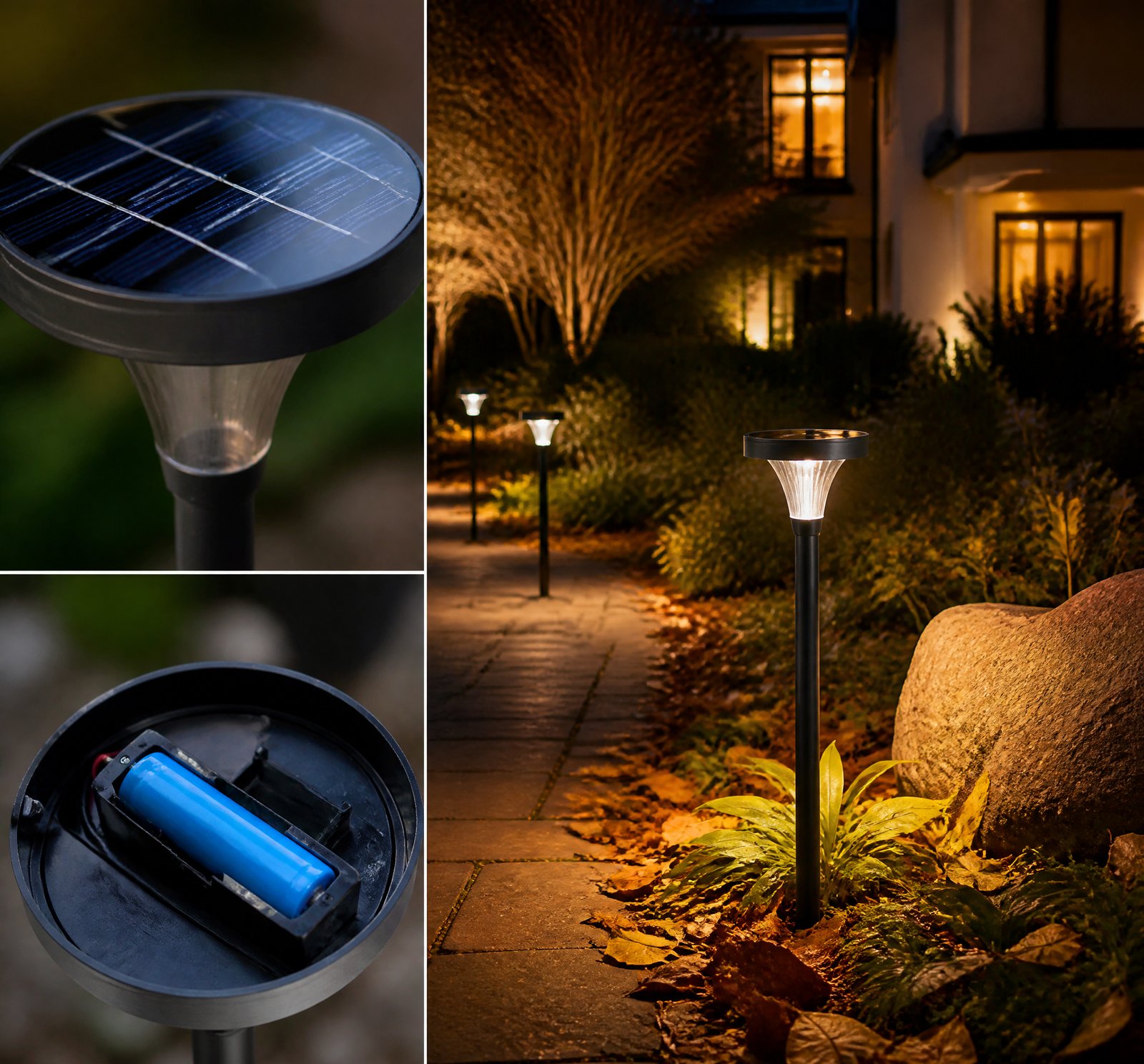
Quick answer: Bateriile își pierd capacitatea în frig din cauza reacțiilor chimice încetinite. Bateriile LiFePO4 sunt mai puțin afectate decât cele cu plumb-acid datorită compoziției chimice stabile, oferind o eficiență mai bună în condiții de temperatură scăzută, inclusiv sub 0°C [2], [3], [7], [8], [16].
Instalarea unor faruri solare pentru curte, grădină sau intrare de casă este o soluție economică, durabilă și ecologică. Totuși, în România, unde iernile pot fi extreme, performanța acestor dispozitive depinde în mare măsură de tipul de baterie utilizat. O întrebare frecventă este: „De ce bateriile solare nu funcționează bine în timpul iernii?” Răspunsul nu este doar o problemă de lumină, ci de fizică și chimie, mai precis de comportamentul bateriilor la temperaturi scăzute.
Cum afectează frigul performanța bateriilor solare?
Temperaturile scăzute încetinesc reacțiile chimice și fizice din interiorul bateriilor, ceea ce duce la o capacitate redusă de stocare a energiei [2], [3], [7], [8], [16]. Acest efect este valabil atât pentru bateriile cu plumb-acid, cât și pentru cele litiu-ion (LiFePO4), dar impactul este semnificativ diferit între cele două tipuri. În condiții sub 0°C, bateriile cu plumb-acid pierd semnificativ din capacitatea lor de stocare [20], [24], datorită faptului că electrolitul lor, bazat pe apă, poate îngheța, iar rezistența internă crește, reducând eficiența încărcării și descărcării [20], [24].
Baterii LiFePO4 vs. baterii cu plumb-acid: care rezistă mai bine la frig?
Bateriile LiFePO4 (litiu-fosfat de fier) sunt mai puțin afectate de temperaturile scăzute datorită compoziției chimice unice și stabile [18]. În contrast cu cele cu plumb-acid, care conțin acid sulfuric și plumb — materiale sensibile la îngheț — LiFePO4 nu conțin substanțe inflamabile și nu se degradează rapid în frig [18]. Această rezistență este esențială în România, unde temperaturile iunii pot scădea sub 0°C pe durata nopților lungi.
| Tip baterie | Sensibilitate la frig | Capacitate în frig | Durată de viață | Siguranță |
|---|---|---|---|---|
| Plumb-acid | Foarte mare [20], [24] | Redusă sub 0°C [20], [24] | 3–5 ani | Medie [18] |
| LiFePO4 | Mică [18] | Mai bună păstrată [7], [16] | 7–10 ani [18] | MARE [18] |
Deși LiFePO4 nu sunt imune la efectele temperaturilor extreme, sunt considerate mult mai rezistente decât cele cu plumb-acid [7], [16]. Ele oferă o durată de viață mai lungă și un timp de descărcare mai bun, ceea ce este crucial pentru sistemele solare care trebuie să funcționeze toată noaptea, chiar și în lunile de iarnă [18].
Cum să maximizăm eficiența bateriilor în iarnă?
Pentru a preveni pierderile de capacitate în timpul iernii, este recomandat să păstrezi bateria la o temperatură constantă, evitând fluctuațiile extreme [4], [20]. În plus, utilizarea unui sistem de management al bateriei (BMS) este esențial, deoarece monitorizează încărcarea, descărcarea și temperaturile interne, prevenind deteriorarea și extinzând durata de viață a sistemului [4], [20].
Concluzii cheie
- Bateriile LiFePO4 sunt mai puțin afectate de frig datorită compoziției chimice stabile [18].
- Capacitatea lor de stocare este mai bine păstrată sub 0°C comparativ cu cele cu plumb-acid [20], [24].
- Au o durată de viață mai lungă și sunt mai sigure datorită naturii neinflamabile [18].
- Un BMS și temperatură stabilă pot maximiza performanța în condiții de iarnă [4], [20].
- Pentru România, LiFePO4 sunt alegerea optimă pentru faruri solare exterioare.
Întrebări frecvente
Putem folosi baterii solare cu plumb-acid în iarnă?
Da, dar eficiența lor scade semnificativ sub 0°C [20], [24]. Electrolitul poate îngheța, iar rezistența internă crește, reducând capacitatea de stocare.
De ce bateriile LiFePO4 sunt mai bune în frig?
Datorită compoziției chimice stabile și absenței acidului sulfuric [18]. Nu îngheață ușor și mențin mai bine capacitatea în temperaturi scăzute [7], [16].
Este necesar un sistem BMS pentru bateriile solare?
Da, un BMS monitorizează temperaturile și starea bateriei, prevenind deteriorarea și extinzând durata de viață [4], [20]. Este esențial pentru performanța în condiții extreme.
References
- [2] Solar Street Light From Germany The Science of Solar Battery Failure How to Achieve a 12 Year Lifespan lu n9o8-I80 — youtube
source passage
# The Science of Solar Battery Failure: How to Achieve a 12 Year Lifespan Source: YouTube — Solar Street Light From Germany URL: https://www.youtube.com/watch?v=lu_n9o8-I80 Video ID: lu_n9o8-I80 Transcript: generated The success of a solar street light project largely depends on its battery. However, statistics show that 80% of projects suffer battery failure within just 2 years. Why do solar batteries lose their ability to hold charge so quickly? Today, we will analyze the deep technical reasons behind battery failure and explore how a proper design can solve this problem for good. Most low-cost solar lights use lead-acid batteries or recycled lithium cells. These have a very low cycle life, typically only 300 to 500 full charge cycles. As a result, the batteries often swell or become completely dead even before reaching 2 years of use. This creates a significant financial risk, especially for large-scale B2B projects. Batteries are most heavily affected by temperature. Below 10°C or above 50°C, standard lithium batteries struggle to charge properly. In extreme desert heat or polar cold conditions, these batteries can suffer permanent damage. As a result, the maintenance cost of the entire project increases significantly. A battery pack consists of multiple individual cells. Without a smart BMS, battery management system, the voltage between these cells becomes unbalanced. This imbalance can lead to overcharging or even short circuits. Without a robust management system, it
- [3] US5367442A – Self-contained solar powered lamp – Google Patents — patent
source passage
specified by the manufacturer. At temperatures higher than the operating temperature, the charge acceptance capabilities of the electrical storage device decrease substantially. This is undesirable because sunlight to power the solar cell array is available only during a relatively short period of time each day. The current level generated by the solar cell array when in excess of the charge acceptance of the electrical storage device causes it to overheat and sustain damage, thereby causing the overall performance of the solar powered lamp to deteriorate. In one approach to overcome this problem, the electrical storage device may be arranged remote from the solar cell array. Although this prevents the electrical storage device from absorbing heat generated by the solar cell array, thus, maintaining the operating temperature at a normal level in hot weather, it is not satisfactory during cold weather because the electrical storage device is unable to provide current sufficient to illuminate the bulb at temperatures below its operating temperature. The electrical storage device is therefore typically placed in heat transfer proximity to the solar cell array so that heat absorbed by the solar cell array on a sunny day helps elevate the temperature of the power source to its normal operating temperature even if the ambient temperature is low. Moreover, existing solar lighting devices are configured in a manner which does not provide for the flow of air through the lamp. This fur
- [4] Solar Electricity — book
source passage
periods when the sun or wind and sun (in hybrid systems) are not as readily available. In sunnier locations, like Colorado, Wyoming, and Utah, battery banks in off-grid applications are often sized to meet the need for electricity for three days. Longer reserve periods—five days or more—may be required in other areas, for example, the cloudier Midwest, Northeast, and Southeastern states and much of Canada. As noted in Chapter 5, backup fossil-fuel generators are often included in off-grid systems. Backup generators can reduce the size of the battery bank. For more details on wiring and sizing battery banks for off-grid systems, you may want to check out the second edition of my book, Power from the Sun. Bear in mind that because batteries are expensive, it’s a good idea to make your home as efficient as possible to reduce the size of your battery bank. Battery Maintenance, Safety, and Proper Installation Battery care and maintenance are vital to the long-term success of battery-based renewable energy systems. Proper installation and maintenance increase the service life of a battery. Longer service life results in lower operating costs over the long haul and cheaper electricity. Keep Them Warm Batteries like to be kept warm. In fact, batteries like to “live” in the temperature range that most human beings find comfortable. For optimal function, lead-acid batteries should be kept at around 75°to 80°F (24° to 27°C). In this range, they’ll accept and deliver tons more electricit
- [7] Unbound Solar Do lithium batteries work in extreme temperatures DIY Solar FAQs Gxe3icl2UA4 — youtube
source passage
# Do lithium batteries work in extreme temperatures? | DIY Solar FAQs Source: YouTube — Unbound Solar URL: https://www.youtube.com/watch?v=Gxe3icl2UA4 Video ID: Gxe3icl2UA4 Transcript: generated so let's look at like the worst case scenario let's say the power goes up there's a bad storm during the winter I don't know if it's going to be charging to the full capacity because usually in winter months we're getting less Sun hours really the key thing here is that cold cold temperatures are really bad for for Batteries lithium batteries well so what would be the solution like if someone had to walk away from this conversation about batteries and be careful of WEA think about it as as a design factor if you know that your batteries are going to be in a cold environment know that you don't have the full rated capacity to pull out of them at this temperature I can only pull 70% out of these batteries of what they're rated for I'll have add an extra 30% onto the capacity if I plan to use it in those conditions you know when people in those kind of conditions like we were just at a house over by schu's um place and we get the extreme hot and we get the extreme cold we're thinking about like oh we want to put the battery outside but then it's south facing side of the the home where the sun is just pounding on that especially when it's 105 110° so we want to make sure it's in the shape if it is going to be outside youve probably got to put it into some kind of like little insulation bo
- [8] Recurrent Data Clarifies EV Range Loss In Cold Conditions — authority
source passage
range loss occurs for a few reasons. The two main contributing factors are chemical and mechanical. Chemical and physical reactions in the battery occur more slowly in cold temperatures. which inhibit chemical reactions and act as resistance that slows down the physical processes. This reduces the EV’s available power. The primary reason EVs lose range in the winter is due to cabin heating to keep the driver and passengers warm. An EV has a much more efficient motor which does not generate nearly as much heat as an internal combustion engine. The heaters that keep the car warm generally draw energy from the high voltage battery, reducing how much capacity is left for driving. Although other organizations have studied the effect of cold weather on range, including AAA, they are often completed in laboratory settings or with a small vehicle sample. The Recurrent research project includes a much larger data set under real world driving conditions. Some electric car drivers worry that the lower performance of their cars in winter will be permanent, but Recurrent says any range loss from winter weather is temporary and causes no long term detriment to the battery. As the weather warms, a car’s expected range on a full charge should return to normal. EV owners who connect to the Recurrent platform can track that over time. Tips For Avoiding Winter Range Loss It takes more energy to warm up a cold car than a warm one. Therefore, EV drivers will want to warm up their cars while they
- [16] altE Store Do lithium batteries work in extreme temperatures DIY Solar FAQs RoSrpkxfIag — youtube
source passage
# Do lithium batteries work in extreme temperatures? DIY Solar FAQs Source: YouTube — altE Store URL: https://www.youtube.com/watch?v=RoSrpkxfIag Video ID: RoSrpkxfIag Transcript: generated so let's look at like the worst case scenario let's say the power goes up there's a bad storm during the winter I don't know if it's going to be charging to the full capacity because usually in winter months we're getting less Sun hours really the key thing here is that cold cold temperatures are really bad for for Batteries lithium batteries well so what would be the solution like if someone had to walk away from this conversation about batteries and be careful of WEA think about it as as a design factor if you know that your batteries are going to be in a cold environment know that you don't have the full rated capacity to pull out of them at this temperature I can only pull 70% out of these batteries of what they're rated for I'll have add an extra 30% onto the capacity if I plan to use it in those conditions you know when people in those kind of conditions like we were just at a house over by schu's um place and we get the extreme hot and we get the extreme cold we're thinking about like oh we want to put the battery outside but then it's south facing side of the the home where the sun is just pounding on that especially when it's 105 110° so we want to make sure it's in the shape if it is going to be outside youve probably got to put it into some kind of like little insulation box or
- [18] Offgrid solution Using discarded smartphone batteries to light up rura — magazine
source passage
# Offgrid solution: Using discarded smartphone batteries to light up rural homes – pv magazine Global Source: Blog/Web URL: https://www.pv-magazine.com/2016/04/20/offgrid-solution-using-discarded-smartphone-batteries-to-light-up-rural-homes_100024222/ Author: Pv Magazine Date: 2016-04-20 Offgrid solution: Using discarded smartphone batteries to light up rural homes Researchers at Kyung Hee University in Seoul, Korea, have come up with a model for recycling unspent lithium ion batteries from discarded smartphones into energy storage units for solar-powered LED lamps, Phys.org writes. With an average consumer lifetime of just around three years, discarded smartphones are generating massive amounts of e-waste and also squandering potentially useful lithium ion batteries, which can last for about five years, according to the science and technology news website. The plan by Kyung Hee University researchers would not only cut down on environmental but also provide storage for rural communities. Boucar Diouf, a professor in the Department of Information Display at the university outlined the recycling and repurposing program this week in the Journal of Renewable and Sustainable Energy. The program would consist of five steps: battery collection, testing and selection, system manufacturing, commercialization and installation. Diouf adds that the candle and kerosene lamps used by homes in many rural communities are harmful, inefficient and more expensive than a small solar home lighti
- [20] Winter Storage and Maintenance Tips for Flooded Lead-Acid — authority
source passage
# Winter Storage and Maintenance Tips for Flooded Lead-Acid Batteries on Solar Installations Source: Blog/Web URL: https://www.solarpowerworldonline.com/2014/12/winter-storage-maintenance-tips-flooded-lead-acid-batteries-solar-installations/ Author: Emily Wild Date: 2014-12-05 Flooded lead-acid batteries have charge and discharge rates that depend highly upon temperature. While warmer climates tend to speed-up charging and discharging rates, cold winter months can slow down the rate of charge/discharge. Because most flooded lead-acid batteries used in renewable energy applications are stored indoors, they’re not always subjected to freezing temperatures. Nevertheless, the cold can still increase the resistance in the battery’s chemistry and cause a reduction in capacity and charge acceptance. Therefore, it’s important that your bank of batteries remain in a location where the temperatures can remain preferably between 50-85°F degrees (10-29°C). A general rule of thumb: A battery loses 10% of its capacity for every 15 to 20 degrees below 80°F (27°C). With this in mind, you can calculate your power needs and add more battery banks to compensate. Much of this greatly depends on the conditions in which your batteries are stored. While it may sound better to keep your battery packs closer to boilers and other sources of radiant heat, problems can arise when some batteries are warmer than others, particularly if the battery charger is connected to the batteries and to AC power for
- [24] Practical Photovoltaics Electricity from Solar Cells — book
source passage
will make the reserve proportionately larger. Doubling the number of storage batteries will more than double the capacity. One factor which greatly reduces available storage capacity is cold weather. Figure 3.8 shows battery capacity at different tem¬ peratures. At temperatures below freezing the capacity drops off sharply. (This is one reason why cars are hard to start in the winter.) Also, a battery can freeze in the winter unless it is well- charged, since the electrolyte in a discharged battery is essen¬ tially water. So it is best, when possible, to store batteries in a place that will not get too cold. Self-Discharge Finally, batteries will slowly discharge while standing. Figure 3.9 shows how this discharge rate varies with the temperature and the composition of the plates. Most automobile batteries have lead-antimony plates, but the new low-maintenance sealed bat- o -r—-,-1-1-(- 0 1 3 10 20 100 OISCHARGE RATE (HOURS) FIGURE 3.7—Available lead-acid battery capacity as a function of discharge rate. T~ 500 l PERCENT RATED CAPACITY BATTERIES AND OTHER STORAGE SYSTEMS 53 CELL TEMPERATURE FIGURE 3.8—Lead-acid battery capacity as a function of temperature. FIGURE 3.9—Lead-acid battery self-discharge rate. 54 PRACTICAL PHOTO VOLT AICS teries normally use lead-calcium plates. As the curve clearly shows, at room temperature lead-calcium grids have a negligible self¬ discharge rate while the older lead-antimony grid batteries can lose their entire charge in a couple of weeks of
# The Science of Solar Battery Failure: How to Achieve a 12 Year Lifespan Source: YouTube — Solar Street Light From Germany URL: https://www.youtube.com/watch?v=lu_n9o8-I80 Video ID: lu_n9o8-I80 Transcript: generated The success of a solar street light project largely depends on its battery. However, statistics show that 80% of projects suffer battery failure within just 2 years. Why do solar batteries lose their ability to hold charge so quickly? Today, we will analyze the deep technical reasons behind battery failure and explore how a proper design can solve this problem for good. Most low-cost solar lights use lead-acid batteries or recycled lithium cells. These have a very low cycle life, typically only 300 to 500 full charge cycles. As a result, the batteries often swell or become completely dead even before reaching 2 years of use. This creates a significant financial risk, especially for large-scale B2B projects. Batteries are most heavily affected by temperature. Below 10°C or above 50°C, standard lithium batteries struggle to charge properly. In extreme desert heat or polar cold conditions, these batteries can suffer permanent damage. As a result, the maintenance cost of the entire project increases significantly. A battery pack consists of multiple individual cells. Without a smart BMS, battery management system, the voltage between these cells becomes unbalanced. This imbalance can lead to overcharging or even short circuits. Without a robust management system, it
specified by the manufacturer. At temperatures higher than the operating temperature, the charge acceptance capabilities of the electrical storage device decrease substantially. This is undesirable because sunlight to power the solar cell array is available only during a relatively short period of time each day. The current level generated by the solar cell array when in excess of the charge acceptance of the electrical storage device causes it to overheat and sustain damage, thereby causing the overall performance of the solar powered lamp to deteriorate. In one approach to overcome this problem, the electrical storage device may be arranged remote from the solar cell array. Although this prevents the electrical storage device from absorbing heat generated by the solar cell array, thus, maintaining the operating temperature at a normal level in hot weather, it is not satisfactory during cold weather because the electrical storage device is unable to provide current sufficient to illuminate the bulb at temperatures below its operating temperature. The electrical storage device is therefore typically placed in heat transfer proximity to the solar cell array so that heat absorbed by the solar cell array on a sunny day helps elevate the temperature of the power source to its normal operating temperature even if the ambient temperature is low. Moreover, existing solar lighting devices are configured in a manner which does not provide for the flow of air through the lamp. This fur
periods when the sun or wind and sun (in hybrid systems) are not as readily available. In sunnier locations, like Colorado, Wyoming, and Utah, battery banks in off-grid applications are often sized to meet the need for electricity for three days. Longer reserve periods—five days or more—may be required in other areas, for example, the cloudier Midwest, Northeast, and Southeastern states and much of Canada. As noted in Chapter 5, backup fossil-fuel generators are often included in off-grid systems. Backup generators can reduce the size of the battery bank. For more details on wiring and sizing battery banks for off-grid systems, you may want to check out the second edition of my book, Power from the Sun. Bear in mind that because batteries are expensive, it’s a good idea to make your home as efficient as possible to reduce the size of your battery bank. Battery Maintenance, Safety, and Proper Installation Battery care and maintenance are vital to the long-term success of battery-based renewable energy systems. Proper installation and maintenance increase the service life of a battery. Longer service life results in lower operating costs over the long haul and cheaper electricity. Keep Them Warm Batteries like to be kept warm. In fact, batteries like to “live” in the temperature range that most human beings find comfortable. For optimal function, lead-acid batteries should be kept at around 75°to 80°F (24° to 27°C). In this range, they’ll accept and deliver tons more electricit
# Do lithium batteries work in extreme temperatures? | DIY Solar FAQs Source: YouTube — Unbound Solar URL: https://www.youtube.com/watch?v=Gxe3icl2UA4 Video ID: Gxe3icl2UA4 Transcript: generated so let's look at like the worst case scenario let's say the power goes up there's a bad storm during the winter I don't know if it's going to be charging to the full capacity because usually in winter months we're getting less Sun hours really the key thing here is that cold cold temperatures are really bad for for Batteries lithium batteries well so what would be the solution like if someone had to walk away from this conversation about batteries and be careful of WEA think about it as as a design factor if you know that your batteries are going to be in a cold environment know that you don't have the full rated capacity to pull out of them at this temperature I can only pull 70% out of these batteries of what they're rated for I'll have add an extra 30% onto the capacity if I plan to use it in those conditions you know when people in those kind of conditions like we were just at a house over by schu's um place and we get the extreme hot and we get the extreme cold we're thinking about like oh we want to put the battery outside but then it's south facing side of the the home where the sun is just pounding on that especially when it's 105 110° so we want to make sure it's in the shape if it is going to be outside youve probably got to put it into some kind of like little insulation bo
range loss occurs for a few reasons. The two main contributing factors are chemical and mechanical. Chemical and physical reactions in the battery occur more slowly in cold temperatures. which inhibit chemical reactions and act as resistance that slows down the physical processes. This reduces the EV’s available power. The primary reason EVs lose range in the winter is due to cabin heating to keep the driver and passengers warm. An EV has a much more efficient motor which does not generate nearly as much heat as an internal combustion engine. The heaters that keep the car warm generally draw energy from the high voltage battery, reducing how much capacity is left for driving. Although other organizations have studied the effect of cold weather on range, including AAA, they are often completed in laboratory settings or with a small vehicle sample. The Recurrent research project includes a much larger data set under real world driving conditions. Some electric car drivers worry that the lower performance of their cars in winter will be permanent, but Recurrent says any range loss from winter weather is temporary and causes no long term detriment to the battery. As the weather warms, a car’s expected range on a full charge should return to normal. EV owners who connect to the Recurrent platform can track that over time. Tips For Avoiding Winter Range Loss It takes more energy to warm up a cold car than a warm one. Therefore, EV drivers will want to warm up their cars while they
# Do lithium batteries work in extreme temperatures? DIY Solar FAQs Source: YouTube — altE Store URL: https://www.youtube.com/watch?v=RoSrpkxfIag Video ID: RoSrpkxfIag Transcript: generated so let's look at like the worst case scenario let's say the power goes up there's a bad storm during the winter I don't know if it's going to be charging to the full capacity because usually in winter months we're getting less Sun hours really the key thing here is that cold cold temperatures are really bad for for Batteries lithium batteries well so what would be the solution like if someone had to walk away from this conversation about batteries and be careful of WEA think about it as as a design factor if you know that your batteries are going to be in a cold environment know that you don't have the full rated capacity to pull out of them at this temperature I can only pull 70% out of these batteries of what they're rated for I'll have add an extra 30% onto the capacity if I plan to use it in those conditions you know when people in those kind of conditions like we were just at a house over by schu's um place and we get the extreme hot and we get the extreme cold we're thinking about like oh we want to put the battery outside but then it's south facing side of the the home where the sun is just pounding on that especially when it's 105 110° so we want to make sure it's in the shape if it is going to be outside youve probably got to put it into some kind of like little insulation box or
# Offgrid solution: Using discarded smartphone batteries to light up rural homes – pv magazine Global Source: Blog/Web URL: https://www.pv-magazine.com/2016/04/20/offgrid-solution-using-discarded-smartphone-batteries-to-light-up-rural-homes_100024222/ Author: Pv Magazine Date: 2016-04-20 Offgrid solution: Using discarded smartphone batteries to light up rural homes Researchers at Kyung Hee University in Seoul, Korea, have come up with a model for recycling unspent lithium ion batteries from discarded smartphones into energy storage units for solar-powered LED lamps, Phys.org writes. With an average consumer lifetime of just around three years, discarded smartphones are generating massive amounts of e-waste and also squandering potentially useful lithium ion batteries, which can last for about five years, according to the science and technology news website. The plan by Kyung Hee University researchers would not only cut down on environmental but also provide storage for rural communities. Boucar Diouf, a professor in the Department of Information Display at the university outlined the recycling and repurposing program this week in the Journal of Renewable and Sustainable Energy. The program would consist of five steps: battery collection, testing and selection, system manufacturing, commercialization and installation. Diouf adds that the candle and kerosene lamps used by homes in many rural communities are harmful, inefficient and more expensive than a small solar home lighti
# Winter Storage and Maintenance Tips for Flooded Lead-Acid Batteries on Solar Installations Source: Blog/Web URL: https://www.solarpowerworldonline.com/2014/12/winter-storage-maintenance-tips-flooded-lead-acid-batteries-solar-installations/ Author: Emily Wild Date: 2014-12-05 Flooded lead-acid batteries have charge and discharge rates that depend highly upon temperature. While warmer climates tend to speed-up charging and discharging rates, cold winter months can slow down the rate of charge/discharge. Because most flooded lead-acid batteries used in renewable energy applications are stored indoors, they’re not always subjected to freezing temperatures. Nevertheless, the cold can still increase the resistance in the battery’s chemistry and cause a reduction in capacity and charge acceptance. Therefore, it’s important that your bank of batteries remain in a location where the temperatures can remain preferably between 50-85°F degrees (10-29°C). A general rule of thumb: A battery loses 10% of its capacity for every 15 to 20 degrees below 80°F (27°C). With this in mind, you can calculate your power needs and add more battery banks to compensate. Much of this greatly depends on the conditions in which your batteries are stored. While it may sound better to keep your battery packs closer to boilers and other sources of radiant heat, problems can arise when some batteries are warmer than others, particularly if the battery charger is connected to the batteries and to AC power for
will make the reserve proportionately larger. Doubling the number of storage batteries will more than double the capacity. One factor which greatly reduces available storage capacity is cold weather. Figure 3.8 shows battery capacity at different tem¬ peratures. At temperatures below freezing the capacity drops off sharply. (This is one reason why cars are hard to start in the winter.) Also, a battery can freeze in the winter unless it is well- charged, since the electrolyte in a discharged battery is essen¬ tially water. So it is best, when possible, to store batteries in a place that will not get too cold. Self-Discharge Finally, batteries will slowly discharge while standing. Figure 3.9 shows how this discharge rate varies with the temperature and the composition of the plates. Most automobile batteries have lead-antimony plates, but the new low-maintenance sealed bat- o -r—-,-1-1-(- 0 1 3 10 20 100 OISCHARGE RATE (HOURS) FIGURE 3.7—Available lead-acid battery capacity as a function of discharge rate. T~ 500 l PERCENT RATED CAPACITY BATTERIES AND OTHER STORAGE SYSTEMS 53 CELL TEMPERATURE FIGURE 3.8—Lead-acid battery capacity as a function of temperature. FIGURE 3.9—Lead-acid battery self-discharge rate. 54 PRACTICAL PHOTO VOLT AICS teries normally use lead-calcium plates. As the curve clearly shows, at room temperature lead-calcium grids have a negligible self¬ discharge rate while the older lead-antimony grid batteries can lose their entire charge in a couple of weeks of