
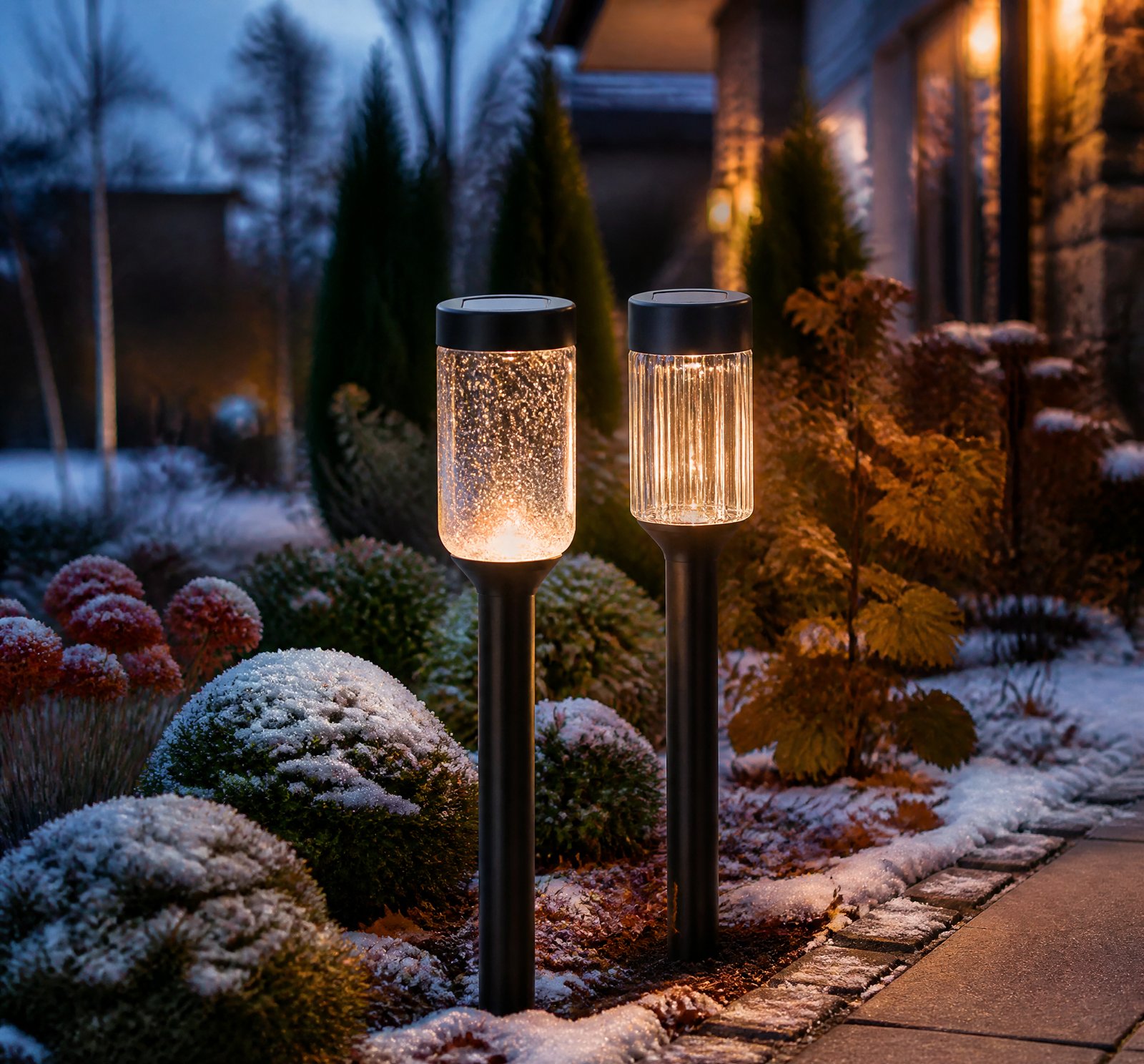
Quick answer: Da, lumina albă rece de 6500K este mai bună pentru securitate și vizibilitate în aer liber decât cea caldă. Ochiul uman este mai sensibil la lungimile de undă albastre-albe (555 nm), ceea ce îmbunătățește percepția vizuală și reducerea riscurilor [1][20]. De asemenea, LED-urile cu 6500K au o eficiență de extragere a luminii de 1m/W, făcându-le ideale pentru aplicații solare [1].
În România, creșterea numărului de locuințe și spații exterioare echipate cu sisteme solare a dus la o cerere sporită pentru lămpi solare eficiente. Una dintre cele mai importante alegeri la instalarea unor astfel de dispozitive este temperatura culorii luminii: caldă sau rece. Întrebarea principală pentru mulți consumatori este: „Este lumina albă rece de 6500K mai bună pentru securitate și vizibilitate în aer liber?” Răspunsul, susținut de cercetare, este clar: da.
Eficiența Energetică a Luminii Albe Reci
În aplicațiile solare, eficiența energetică este esențială, deoarece energie solară este limitată și stocată în baterii. Sursa [1] arată că LED-urile cu lumină albă rece (4500K – 8000K) au o eficiență de extragere a luminii mai mare decât cele cu lumină albă caldă (2600K – 3500K). Aceasta înseamnă că pentru aceeași cantitate de lumeni, o lampă LED cu 6500K consumă mai puțină energie. De exemplu, eficiența de extragere a luminii pentru LED-uri albe reci este de 1m/W [1], un avantaj crucial pentru sistemul solar, care nu poate suporta pierderi energetice mari.
Comparativ, lămpile cu lumină caldă sunt mai puțin eficiente din punct de vedere al conversiei energetice, ceea ce duce la o durată redusă de funcționare noaptea – un dezavantaj semnificativ în zonele cu iluminat limitat.
| Tip lumină | Temperatură culoare | Eficiență (m/W) | Aplicație recomandată |
|---|---|---|---|
| Albă rece | 6500K | 1m/W [1] | Securitate, vizibilitate în aer liber |
| Albă caldă | 2700K – 3500K | Mai mică | Întreținere rezidențială, atmosferă relaxantă |
Percepția Vizuală și Impactul asupra Securității
Chiar dacă eficiența este un factor major, percepția umană a luminii este tot la fel de importantă. Ochii umani sunt mai sensibili la lungimile de undă de aproximativ 555 nm – o zonă din spectrul albastru-alb, caracteristică luminii albe reci [1][20]. Această sensibilitate crește claritatea vizuală, ajutând la detectarea obstacolelor, a persoanelor sau a mișcărilor suspecte.
Sursa [4] menționează că LED-urile albe reci pot oferi o luminozitate cu 20% mai mare decât becurile halogene la o luminozitate mesopică tipică (0,1 cd/m²), ceea ce este esențial în condiții de întuneric. De asemenea, conspicuitatea marcajelor rutiere în noapte poate crește cu până la 63% atunci când se folosesc LED-uri albe reci în locul lumii galbene a becurilor cu sodiu [4]. Deși nu există diferențe semnificative în identificarea obiectelor periculoase între diferite spectre, claritatea generală și reacția rapidă sunt îmbunătățite.
Preferințe Culturale și Considerații Practice
Totuși, alegerea nu este doar tehnică – are și o componentă culturală. Sursa [6] subliniază că preferințele pentru temperatura culorii variază între regiuni și culturi. În unele orașe, înlocuirea becurilor cu sodiu (HPSL) cu LED-uri albe reci a generat plângeri de către locuitori, care au descris iluminatul ca „întunecat” și „opresiv”, deși intensitatea reală era mai mare [1]. Aceasta se datorează faptului că becurile HPSL emiteau mai mult în zonele de lungime de undă lungă (roșu), care au o senzație mai călduroasă și mai familiară pentru ochiul uman.
Prin urmare, în zonele rezidențiale sau cele cu o atmosferă de relaxare, o temperatură mai joasă (2700K – 3500K) poate fi preferată, chiar dacă este mai puțin eficientă. Dar pentru aplicații de securitate – intrări de garaj, curți, drumuri de acces – lumina de 6500K este recomandată pentru eficiență și vizibilitate.
Concluzii cheie
- Lumina albă rece de 6500K are eficiență energetică superioară, cu o eficiență de extragere a luminii de 1m/W [1].
- Ochiul uman este mai sensibil la lungimile de undă de 555 nm, îmbunătățind percepția vizuală în condiții de întuneric [1][20].
- LED-urile albe reci pot crește luminozitatea cu 20% și conspicuitatea marcajelor rutiere cu până la 63% față de becurile cu sodiu [4].
- Alegerea depinde de context: 6500K pentru securitate, 2700K–3500K pentru atmosferă rezidențială.
Întrebări frecvente
De ce lumina albă rece de 6500K este mai eficientă pentru lămpi solare?
Datorită eficienței de extragere a luminii de 1m/W, mai mare decât a celor calde [1]. Aceasta permite o durată mai lungă de funcționare pe aceeași cantitate de energie solară stocată.
Poate lumina albă rece afecta confortul vizual în curți?
Da, pentru unii oameni poate părea prea aspră, dar nu creează senzația de frig [9]. În aplicații de securitate, beneficiile vizuale depășesc dezavantajele percepției.
Există diferențe între LED-uri albe reci și galbene în detectarea pericolelor?
Nu, nu există diferențe semnificative în identificarea obiectelor periculoase între spectre diferite [4]. Totuși, lumina albă rece îmbunătățește claritatea generală și reacția rapidă.
References
- [1] LED Lighting Design Practical Applications — book
source passage
photoelectric sensor. Match the spectrum with the color matching function to get the chromaticity coordinates of white light. Then adjust the input current of different wave- length LEDs by a control system. This method is immune to temperature and time which influence the stability of color, and its adjustment accuracy is high, but its cost is also high. (iii) LED Color Temperature Selection in Road Lighting (Figure 6.99) At present, because light extraction efficiency (1 m/W) of high power LED with neutral white light (3500-4500 K) or cool white light (4500-8000 K) is generally higher than that with warm white light (2600-3500 K), most LED road lights adopt an LED with neutral white light or cool white light as their light sources. However, citizens in some cities report that after replacing the traditional high pressure sodium lamps (HPSL) with LED lamps, the road illuminance improves but it is dusky as a whole and makes people feel oppressive and lonely. That is 285 Design of LED Packaging Applications Figure 6.99 Road illumination performance of LED lamps with different color temperatures at Meishi Street, Nanhai District, Foshan City, Guangdong Province, China. (Color version of this figure is available online.) because the human eye is most sensitive to light with a 555 nm wavelength. Due to the fact that there is relatively more long wavelength light existing in HPSLs and LED lamps with warm white light, things tend to look brighter than those in neutral white light a
- [4] LED Lighting Testing and Certification — book
source passage
a duty cycle broader than 20% is able to weaken this effect, down to the rate of about 5–10% only. In Chapter 6, mesopic (twilight) brightness perception and visual detection per- formance under white LEDs as well as conventional lamp types were analyzed theoretically and through real field experiments. It turned out that, at a typical (fixed) mesopic luminance level of 0.1 cd m−2, a cool white LED can provide 20% more brightness than a tungsten halogen lamp of 3200 K. Also, the conspicuity of road markings at night travels with white LEDs can be 63% higher than with a yellow light of a high pressure sodium lamp. For object identification, however, no difference was found between the diverse lamp spectra. The detection of hazardous objects (which tend to appear at or around the visual threshold, that is, with low contrasts and offthe visual axis, usually in the eccen- tricity angle range between 2.2∘and 20∘) during nighttime driving conditions (which take place in the mesopic range at typical luminance levels between 0.1 and 1.5 cd m−2) is the most important visual task to optimize traffic lighting. The advantages of using cool white LEDs was pointed out in this respect. Until now, luminance, illuminance or other V(𝜆)-weighted luminous quanti- ties have been used for glare characterization and evaluation. The experiments described in Section 6.6 for discomfort and disability glare under mesopic condi- tions showed that the glare effect cannot be modeled and evaluated by the use of suc
- [6] LED Lighting Testing and Certification — book
source passage
for Indoor Lighting the blue curve diminishes by about 4000 K (from 10 000 K down to 6000 K) when the emission angle is changed from 0∘to 90∘. 7.3.3 Warm/Cold White LED At the first sight, the selection of LEDs regarding the criterion warm white or neu- tral white or cool white is an intercultural/interregional question because of the earlier mentioned culture or region dependent color temperature preference of the users. Technologically, it is a question of luminous efficiency, heat develop- ment and lifetime. In Figure 7.10, the relationship between junction temperature and board temperature is shown for a warm white LED (CCT = 2700 K (correlated color temperature)) and a cool white LED (CCT = 5000 K) for different electrical currents. It is obvious from Figure 7.10 that, at a board temperature of Ts = 60 ∘C, the junction temperature of the warm white LED at 1000 mA is 97 ∘C and of the cool white LED is about 89 ∘C. This difference of 8 K means that the warm white phos- phor absorbs more radiation producing more thermal energy. This, in turn, results in a shorter lifetime in comparison to the cool white LED. 7.3.4 Color Shift Figure 4.66 shows that two different LED types of similar color temperature (CCT = 4000 K) from two leading LED manufacturers exhibit very different color 44 40 45 50 55 60 65 70 75 80 85 90 5000 K – 1000 mA 5000 K – 700 mA 5000 K – 500 mA 5000 K – 350 mA 5000 K – 100 mA 2700 K – 1000 mA 2700 K – 700 mA 2700 K – 500 mA 2700 K – 350 mA 2700 K – 100 mA 54 64 74
- [9] Light pollution artificial light optimizes physiological energetics of nocturnal flying insects — book
source passage
appearing red and shorter wavelengths appearing blue and violet. Different lamps have different spectra: A lamp's spectral power distribution is a quantitative measure of the amount of energy (or power) emitted at different wavelengths. The broad spectral characteristics of different lamps are often discernible to the naked eye. "Warm white" sources, such as incandescent bulbs, emit more strongly at the middle and longer (red) wave¬ lengths. "Cool white" sources with a spectral power distribution favoring short wavelengths cast a light that appears harsher and colder to many observers, even though it may approximate the color of daylight. An LED's spectral power distribution is assessed by corre¬ lated color temperature, which is measured in Kelvins (K). An LED with strong emissions in the blue spectrum has a high CCT; strong emissions in the red spectrum produce a low CCT. Therefore, a 5000K LED gives off significantly more blue light than does a 3500K LED. Much of the recent interest in blue-rich white light sources stems from two factors. The first is the rapid improvement in the efficiency of white LED lighting. LEDs promise to soon surpass current lighting technologies in the ability to produce light for less energy. Further, LEDs produce light in a way that can be Light Source and Wavelength 93 more effectively controlled, increasing efficiency of fixtures and allowing light to be delivered precisely to the areas where and when it is needed. The second factor is more co
- [20] Green Lighting IKEA's Commitment — book
source passage
lead to valuable reductions in energy costs where smart metering and hourly differentiated electric rates are available. OUTDOOR LIGHTING SYSTEMS 143 High intensity discharge lighting systems have dominated outdoor lighting for many reasons including: m® High output and intensity of lamps, combined with refractor lenses or internal reflectors produces luminaires capable of lighting large areas Lamp starting capability through a wide temperature range Relatively low cost systems in small luminaires for mounting in a range of ap- plications from poles to wall surfaces to ground mount Outdoor lighting is a broad topic that cannot be covered to any satisfactory de- gree in a book on lighting retrofit. Therefore, other than a few special topics that apply to all outdoor lighting systems, the focus will be on retrofit potential for various types of outdoor lighting. One topic that does deserve mention is scotopic vision, and how it affects the choice of outdoor light sources. In a nutshell, the human eye is more sensitive to blue- white light than it is to yellow-orange light, particularly at low illuminance levels. This means that a high pressure sodium lumen is not perceived the same as a metal halide or LED lumen. Fewer lumens of a blue-white light are required to achieve the same visual acuity as a higher lumen level of a light source dominated by the yellow-orange segment of the visual light spectrum. The low color rendering index of HPS (CRI 22) also makes it harder to distin
photoelectric sensor. Match the spectrum with the color matching function to get the chromaticity coordinates of white light. Then adjust the input current of different wave- length LEDs by a control system. This method is immune to temperature and time which influence the stability of color, and its adjustment accuracy is high, but its cost is also high. (iii) LED Color Temperature Selection in Road Lighting (Figure 6.99) At present, because light extraction efficiency (1 m/W) of high power LED with neutral white light (3500-4500 K) or cool white light (4500-8000 K) is generally higher than that with warm white light (2600-3500 K), most LED road lights adopt an LED with neutral white light or cool white light as their light sources. However, citizens in some cities report that after replacing the traditional high pressure sodium lamps (HPSL) with LED lamps, the road illuminance improves but it is dusky as a whole and makes people feel oppressive and lonely. That is 285 Design of LED Packaging Applications Figure 6.99 Road illumination performance of LED lamps with different color temperatures at Meishi Street, Nanhai District, Foshan City, Guangdong Province, China. (Color version of this figure is available online.) because the human eye is most sensitive to light with a 555 nm wavelength. Due to the fact that there is relatively more long wavelength light existing in HPSLs and LED lamps with warm white light, things tend to look brighter than those in neutral white light a
a duty cycle broader than 20% is able to weaken this effect, down to the rate of about 5–10% only. In Chapter 6, mesopic (twilight) brightness perception and visual detection per- formance under white LEDs as well as conventional lamp types were analyzed theoretically and through real field experiments. It turned out that, at a typical (fixed) mesopic luminance level of 0.1 cd m−2, a cool white LED can provide 20% more brightness than a tungsten halogen lamp of 3200 K. Also, the conspicuity of road markings at night travels with white LEDs can be 63% higher than with a yellow light of a high pressure sodium lamp. For object identification, however, no difference was found between the diverse lamp spectra. The detection of hazardous objects (which tend to appear at or around the visual threshold, that is, with low contrasts and offthe visual axis, usually in the eccen- tricity angle range between 2.2∘and 20∘) during nighttime driving conditions (which take place in the mesopic range at typical luminance levels between 0.1 and 1.5 cd m−2) is the most important visual task to optimize traffic lighting. The advantages of using cool white LEDs was pointed out in this respect. Until now, luminance, illuminance or other V(𝜆)-weighted luminous quanti- ties have been used for glare characterization and evaluation. The experiments described in Section 6.6 for discomfort and disability glare under mesopic condi- tions showed that the glare effect cannot be modeled and evaluated by the use of suc
for Indoor Lighting the blue curve diminishes by about 4000 K (from 10 000 K down to 6000 K) when the emission angle is changed from 0∘to 90∘. 7.3.3 Warm/Cold White LED At the first sight, the selection of LEDs regarding the criterion warm white or neu- tral white or cool white is an intercultural/interregional question because of the earlier mentioned culture or region dependent color temperature preference of the users. Technologically, it is a question of luminous efficiency, heat develop- ment and lifetime. In Figure 7.10, the relationship between junction temperature and board temperature is shown for a warm white LED (CCT = 2700 K (correlated color temperature)) and a cool white LED (CCT = 5000 K) for different electrical currents. It is obvious from Figure 7.10 that, at a board temperature of Ts = 60 ∘C, the junction temperature of the warm white LED at 1000 mA is 97 ∘C and of the cool white LED is about 89 ∘C. This difference of 8 K means that the warm white phos- phor absorbs more radiation producing more thermal energy. This, in turn, results in a shorter lifetime in comparison to the cool white LED. 7.3.4 Color Shift Figure 4.66 shows that two different LED types of similar color temperature (CCT = 4000 K) from two leading LED manufacturers exhibit very different color 44 40 45 50 55 60 65 70 75 80 85 90 5000 K – 1000 mA 5000 K – 700 mA 5000 K – 500 mA 5000 K – 350 mA 5000 K – 100 mA 2700 K – 1000 mA 2700 K – 700 mA 2700 K – 500 mA 2700 K – 350 mA 2700 K – 100 mA 54 64 74
appearing red and shorter wavelengths appearing blue and violet. Different lamps have different spectra: A lamp's spectral power distribution is a quantitative measure of the amount of energy (or power) emitted at different wavelengths. The broad spectral characteristics of different lamps are often discernible to the naked eye. "Warm white" sources, such as incandescent bulbs, emit more strongly at the middle and longer (red) wave¬ lengths. "Cool white" sources with a spectral power distribution favoring short wavelengths cast a light that appears harsher and colder to many observers, even though it may approximate the color of daylight. An LED's spectral power distribution is assessed by corre¬ lated color temperature, which is measured in Kelvins (K). An LED with strong emissions in the blue spectrum has a high CCT; strong emissions in the red spectrum produce a low CCT. Therefore, a 5000K LED gives off significantly more blue light than does a 3500K LED. Much of the recent interest in blue-rich white light sources stems from two factors. The first is the rapid improvement in the efficiency of white LED lighting. LEDs promise to soon surpass current lighting technologies in the ability to produce light for less energy. Further, LEDs produce light in a way that can be Light Source and Wavelength 93 more effectively controlled, increasing efficiency of fixtures and allowing light to be delivered precisely to the areas where and when it is needed. The second factor is more co
lead to valuable reductions in energy costs where smart metering and hourly differentiated electric rates are available. OUTDOOR LIGHTING SYSTEMS 143 High intensity discharge lighting systems have dominated outdoor lighting for many reasons including: m® High output and intensity of lamps, combined with refractor lenses or internal reflectors produces luminaires capable of lighting large areas Lamp starting capability through a wide temperature range Relatively low cost systems in small luminaires for mounting in a range of ap- plications from poles to wall surfaces to ground mount Outdoor lighting is a broad topic that cannot be covered to any satisfactory de- gree in a book on lighting retrofit. Therefore, other than a few special topics that apply to all outdoor lighting systems, the focus will be on retrofit potential for various types of outdoor lighting. One topic that does deserve mention is scotopic vision, and how it affects the choice of outdoor light sources. In a nutshell, the human eye is more sensitive to blue- white light than it is to yellow-orange light, particularly at low illuminance levels. This means that a high pressure sodium lumen is not perceived the same as a metal halide or LED lumen. Fewer lumens of a blue-white light are required to achieve the same visual acuity as a higher lumen level of a light source dominated by the yellow-orange segment of the visual light spectrum. The low color rendering index of HPS (CRI 22) also makes it harder to distin