
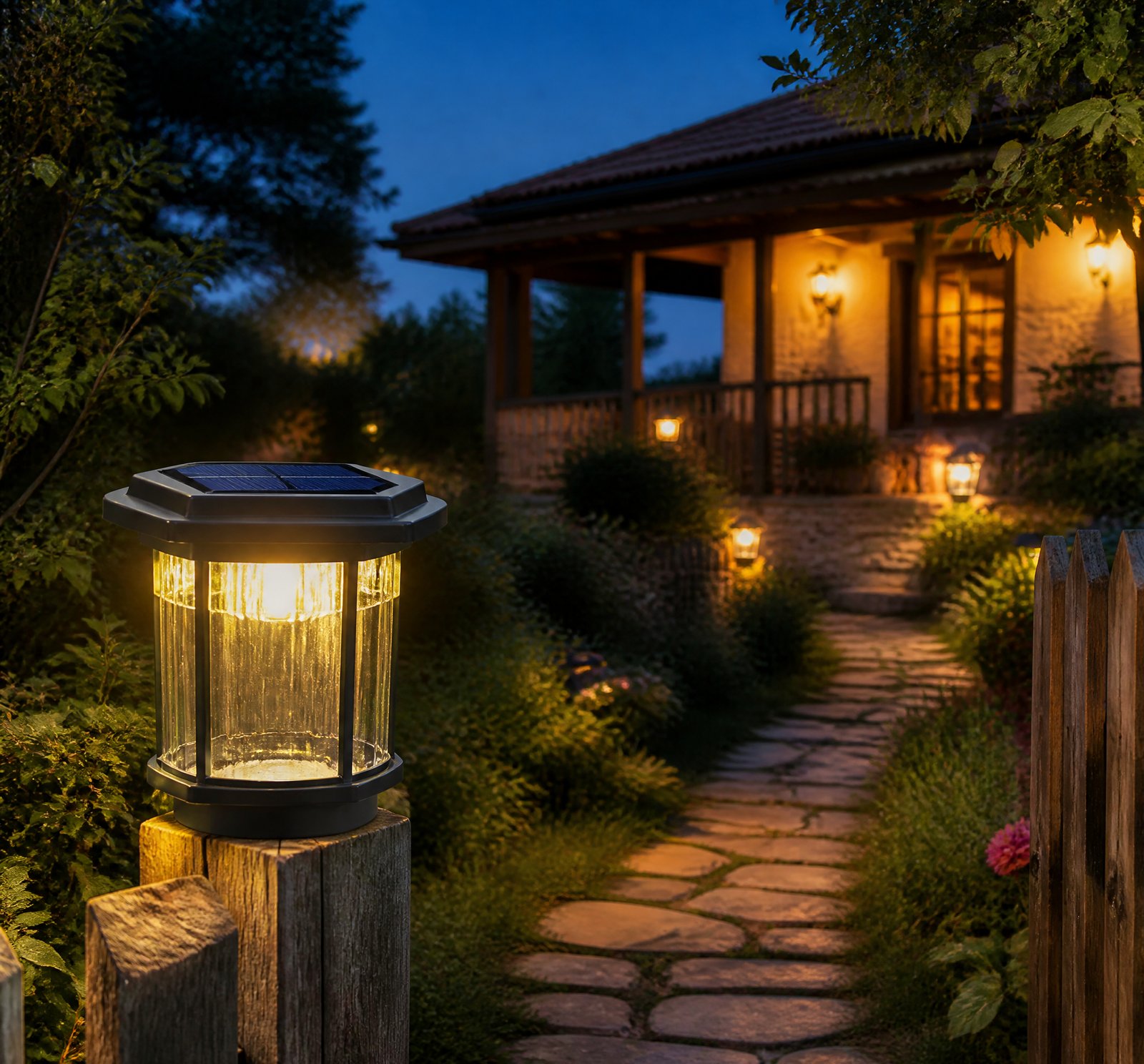
Quick answer: O temperatură de culoare de 6500K într-o lampă solară înseamnă că lumina emisă are o nuanță albastră intensă, percepută ca fiind rece și strălucitoare. Aceasta crește vizibilitatea și reduce oboseala oculară în noapte, dar poate cauza orbire sau senzația de lumină prea puternică în anumite aplicații [7].
O temperatură de culoare de 6500K într-o lampă solară nu este doar un număr tehnic — este un factor decisiv în modul în care percepem lumina, confortul vizual și chiar efectele asupra sănătății. Această valoare, exprimată în grade Kelvin (K), indică că lumina emisă este de tip „alb rece”, apropiată de lumina naturală a zilei [14]. Acest lucru are implicații semnificative atât pentru utilizare, cât și pentru percepție.
Ce înseamnă 6500K pentru o lampă solară?
Temperatura de culoare (CCT — Color Correlated Temperature) măsoară culoarea percepută a unei surse de lumină albe, comparată cu un radiator ideal negru încălzit la aceeași temperatură [14]. O lampă solară cu un CCT de 6500K emite o lumină cu o nuanță albastru-clară, similară cu lumina zilei în timpul amiezii [14]. Această nuanță este percepută ca fiind mai vibrantă și mai strălucitoare decât lumina caldă, chiar dacă nivelul de lumen este același [6].
Albastru rece vs galben cald: cum influențează percepția?
Diferența între lumina albă caldă (2700–3200 K) și cea rece (5000–6500 K) este semnificativă în percepția vizuală. Sursele de lumină cu un CCT mai mare sunt percepute ca fiind mai luminoase, chiar dacă intensitatea reală este similară [6]. Aceasta se datorează modului în care ochiul uman interpretează lumina albastră — ca fiind mai intensă și mai activă. Așadar, o lampă solară cu 6500K poate oferi un senză de claritate și vigilență, utilă în spații de muncă sau zone de circulație.
| Tip lumină | CCT (K) | Nuanță | Aplicație recomandată |
|---|---|---|---|
| Albă caldă | 2700–3200 | Galbenă/roșiatică | Interioare, dormitoare, terase |
| Albă rece | 5000–6500 | Albastru-clară | Iluminat stradal, garaje, birouri |
Impact asupra sănătății și bunei dispoziții
Lumina cu un CCT ridicat influențează direct fiziologia umană. Lumina albă rece de 6500K stimulează secreția de cortizol, hormonul responsabil pentru menținerea vigilenței și activității [23]. În schimb, lumina caldă suprimă mai puțin melatonina, hormonul somnului, reducând riscul de anumite tipuri de cancer [23]. Astfel, utilizarea unui CCT de 6500K în timpul zilei poate crește concentrația, dar ar trebui evitată în orele serale, pentru a nu perturba ritmul circadian.
Aplicații practice în România
În contextul românesc, unde iluminatul stradal și de exterior este din ce în ce mai eficient, alegerea unui CCT de 6500K poate fi ideală pentru străzi, parcări și intrări de garaj. Lumina rece este eficientă pentru vizibilitate și siguranță, influențând pozitiv concentrația șoferilor [7]. Cu toate acestea, în spații de trăire sau terase, o lumină mai caldă (2700–3200 K) creează o atmosferă plăcută și relaxantă, mai potrivită pentru momentele de odihnă.
Concluzii cheie
- O temperatură de culoare de 6500K înseamnă lumină albă rece, percepută ca strălucitoare și vibrantă [14].
- Aceasta crește vizibilitatea și reduce oboseala oculară în noapte, dar poate cauza orbire sau disconfort în anumite condiții [7].
- Influentează fiziologia: stimulează vigilența în zi, dar poate perturba somnul dacă este folosită seara.
- Alegerea CCT-ului depinde de aplicație: rece pentru exterior, cald pentru interior și relaxare [11].
Întrebări frecvente
O lampă solară cu 6500K este prea puternică pentru un drum de curte?
Da, o temperatură de culoare de 6500K poate fi percepută ca prea puternică în spații mici sau pentru conviețuire. Lumina rece poate cauza orbire sau disconfort, mai ales în zonele de relaxare [7].
Care este cel mai potrivit CCT pentru iluminatul de noapte în România?
Pentru iluminatul de noapte în România, un CCT între 3000 și 4000 K este recomandat pentru echilibru între vizibilitate și confort vizual. Evitarea valorilor de 6500K seara ajută la protejarea ritmului circadian [23].
Există diferențe culturale în preferințele pentru temperatură de culoare?
Da, preferințele variază în funcție de regiune. În țările apropiate de ecuator se preferă CCT-uri mai mari (mai reci), datorită luminii zilei naturale [9]. În România, preferințele se îndreaptă spre tone intermediare pentru echilibru.
References
- [6] LED lighting A critical look at the technology and application — book
source passage
Cowan, ordinate) for the 34 white LEDs of Figure 5.25 assuming that all of them give rise to a fixed luminance of L = 100 cd m−2 at an achromatic white surface (e.g., a painted wall). Abscissa: correlated color temperature (CCT). Light sources are grouped according to their general color rendering index (CRI Ra) level. As can be seen from Figure 5.43, Leq values increase with increasing CCT. For example, a LED light source with a yellowish white point (warm white) is predicted to be darker than a cool WLED. This is true for every color rendering group. This prediction agrees with the general tendency of several visual experiments at photopic luminance levels typical of interior lighting: a stimulus of a certain white tone of a higher CCT was generally perceived as brighter, at least within a certain color rendering group [72]. This review [72] of photopic brightness experiments with different white tones suggested that both descriptors, CCT and CRI Ra, shall be considered to predict the perceived brightness of an interior: “If lamp A has a higher CCT and CRI than lamp B, the interior will appear brighter under lamp A. If the lamps have similar CCT, the lamp of higher CRI will appear brighter, and similarly if they have similar CRI the lamp of higher CCT will appear brighter” [72]. This finding is important to predict the brightness impression if large achromatic interior surfaces is illuminated by a WLED light source within a given color rendering group. The Ware–Cowan bright
- [7] State-of-the-art interior illumination Bridgelux Inc LED Lighting — authority
source passage
also boast a wide fluorescence angle, typically 120°. They come in versions with a varied colour temperature, i.e. from 2700 K to 6500 K, and this parameter is adjustable in selected models. The street light hue can significantly impact drivers’ concentration levels. Tunable-White – human-centred designs The brightness of a single LED may amount even up to 3980 lm. The above-mentioned light temperature setting is related to the increasingly more popular issue of the Human Centric Lighting (HCL), which has become a hype especially among architects and interior designers. It emphasises the need to adjust artificial interior illumination to human needs. This is achieved, for example, by recreating, through illumination, the natural light cycle, i.e. changing the colour temperature according to the time of day (warmer hues in the morning and evening). Some related techniques can be implemented to stimulate concentration or, conversely, relaxation. All in all, this is how optimum illumination is obtained in household, school, hospital, or office conditions. In such applications, products from the Bridgelux Vesta ® series may come in handy, as they offer you the option to adjust the colour temperature (thanks to the Tunable-White technology). It can be set within various ranges: from 1800–3000 K to 2700–6500 K. The rated power of such components ranges from 8.7 W to 31.8 W (brightness from 3980 lm). Regardless of the model and the CCT value selected, the light emitted by the compon
- [9] Gama Sonic's Path to Energy-Efficient Lighting — book
source passage
chromaticity diagram (Plate 3.3). The CIE diagram simultaneously provides a sense of the visual appearance of the light sources and an indication of how visually “warm”, “cool” or tinted a space lit with the specific lamp will appear. In general, lamp designers aim to give their lamps chromaticity characteristics that make the light look relatively natural, i.e. that correspond to the chromaticity of daylight as it varies by season and time of day. Previous generations of fluorescent lamps were only available with a “cool white” CCT of 4 100 K, but the development of new generations of rare-earth phosphors has now enabled a much broader range of colour temperatures to be produced for fluorescent lamps. In North America this has resulted in “warmer” CCT fluorescent temperatures of around 3 500 K becoming prevalent. Interestingly, an inspection of lamp sales around the world reveals an apparent user preference for “cooler” CCT temperatures the closer the illuminated location is to the equator,and the converse applies for the closer it is to the poles.This may be explained by the desire for the chromaticity of light sources to be matched with that of the local daylight,which tends to be “cooler” (i.e. have a higher CCT) the closer one is to the equator. Most of us have experienced situations where the colour of an item viewed indoors turns out to look quite different when taken outside.This can arise because of differences in the colour-rendering properties of electric lamps com
- [11] LED lighting A critical look at the technology and application — book
source passage
Figure 8.15 An S4-class street in Darmstadt, Germany, illuminated partly by white high pressure mercury luminaires at 4000 K and partly by yellowish-orange high pressure sodium luminaires. (Photo Source: Technische Universität Darmstadt.) A marketing study prior to luminaire development provides valuable information on the price, design features, technological development tendencies, and user acceptance for the future luminaires to be designed. Development engineers can evaluate the intended application of the luminaire like the envisioned temperature and humidity range, rain intensity, wind strength, quality of AC voltage and the possibilities of mounting the luminaire onto the pole. An important decision for the user acceptance of the envisioned luminaire is the definition of its correlated color temperature (CCT). It is also an intercultural or interregional question depending on the culture or country of the intended users. It is well known that different countries, regions or cultures do have a different CCT preference (e.g., either warm white in the range of 2700–3200 K or cool white between 5000 and 6500 K). For the engineers, the decision for a white light in warm white or in cool white is an important analytical aspect. A cool white LED has about 15–20% more luminous flux than a similar warm white LED so that a luminaire with the same luminous flux needs more warm white LEDs, that is, there is a higher cost and much more technical effort. Or, a luminaire with warm wh
- [14] Light Emitting Diodes Technology, Manufacturing, and Applications — book
source passage
tem- perature in Kelvin divided by one million. 2.3.7.9 Representative Lighting Color Temperature Incandescent lights have a low color temperature of approximately 2800 K. In comparison, daylight has a high color temperature at or above 5000 K. In between the two are popular fluorescent lighting referred to as “cool white” at approximately 4000 K and “white” or “bright white” at approximately 2900–3100 K. Table 2.4 provides a summary of a variety of lighting and their color temperatures or temperature range in Kelvin. In general, lighting having a low color temperature at approximately 2200 K has a red-orange tone. At 2800 K, lighting has a red-yellowish tone and the color is typically referred to as “warm white” or “soft white.” Daylight has a relatively high color temperature at or above 5000 K and appears bluish. In between, a halogen lamp at 3000 K generates a yellowish light, whereas the color of the most popular fluorescent light, which is rated at approximately 4000 K, is referred to as “cool white.” At the high end of the color temperature, an LED “cool white” occurs at a color tem- perature of 8000 K. Readers are referred to Table 2.1 for a list of common LEDs and their color temperatures. Table 2.4 Representative Color Temperatures for a Variety of Lighting Types of lighting Kelvin High-pressure sodium 2200 Incandescent (soft white) 2800 Halogen 3000 Fluorescent (cool white) 4000 Daylight >5000 LED (cool white) 8000 50 Introduction to LED Technology/Applications 2.3
- [23] Organic Light-Emitting Diodes A Survey — book
source passage
14.1 shows the color temperature of sunlight at different times, regions, and weather. The color temperature is 2500 K at dawn, 3250 K at dusk, 5500 K at noon (or 8000 K at noon in a high-latitude country), and 6500 K on a cloudy day. The spectra of sunlight with different color temperatures are shown in Fig. 14.2. They are continuous, and the intensity of blue-emission increases with the increase of color temperature.17 14.1 The color temperature of sunlight at different times, regions, and weathers. 14.2 The spectra of sunlight at color temperatures from 3000 to 8000 K.52 The importance of color temperature Color temperature of light plays a crucial role in human physiology and psychology.9–16 High color temperature light stimulates the secretion of cortisol, a hormone that keeps people awake and active.9,11,15 High color temperature light also markedly suppresses the nocturnal secretion of oncostatic melatonin (MLT), increasing the risk of breast, colorectal, and prostate cancer. In contrast, low color temperature light has a lesser effect on MLT suppression, helps stabilize autonomic nerves, and provides a warm and comfortable sensation.13,14,16 The benefits of using OLEDs To get sunlight-style illumination, daylight color emission with a wide color temperature range is essential. However, current lighting devices give off only daylight color with a fixed color temperature. The latest white LEDs can be adjusted to a limited extent,26,27 but there still is an unpleasant gl
Cowan, ordinate) for the 34 white LEDs of Figure 5.25 assuming that all of them give rise to a fixed luminance of L = 100 cd m−2 at an achromatic white surface (e.g., a painted wall). Abscissa: correlated color temperature (CCT). Light sources are grouped according to their general color rendering index (CRI Ra) level. As can be seen from Figure 5.43, Leq values increase with increasing CCT. For example, a LED light source with a yellowish white point (warm white) is predicted to be darker than a cool WLED. This is true for every color rendering group. This prediction agrees with the general tendency of several visual experiments at photopic luminance levels typical of interior lighting: a stimulus of a certain white tone of a higher CCT was generally perceived as brighter, at least within a certain color rendering group [72]. This review [72] of photopic brightness experiments with different white tones suggested that both descriptors, CCT and CRI Ra, shall be considered to predict the perceived brightness of an interior: “If lamp A has a higher CCT and CRI than lamp B, the interior will appear brighter under lamp A. If the lamps have similar CCT, the lamp of higher CRI will appear brighter, and similarly if they have similar CRI the lamp of higher CCT will appear brighter” [72]. This finding is important to predict the brightness impression if large achromatic interior surfaces is illuminated by a WLED light source within a given color rendering group. The Ware–Cowan bright
also boast a wide fluorescence angle, typically 120°. They come in versions with a varied colour temperature, i.e. from 2700 K to 6500 K, and this parameter is adjustable in selected models. The street light hue can significantly impact drivers’ concentration levels. Tunable-White – human-centred designs The brightness of a single LED may amount even up to 3980 lm. The above-mentioned light temperature setting is related to the increasingly more popular issue of the Human Centric Lighting (HCL), which has become a hype especially among architects and interior designers. It emphasises the need to adjust artificial interior illumination to human needs. This is achieved, for example, by recreating, through illumination, the natural light cycle, i.e. changing the colour temperature according to the time of day (warmer hues in the morning and evening). Some related techniques can be implemented to stimulate concentration or, conversely, relaxation. All in all, this is how optimum illumination is obtained in household, school, hospital, or office conditions. In such applications, products from the Bridgelux Vesta ® series may come in handy, as they offer you the option to adjust the colour temperature (thanks to the Tunable-White technology). It can be set within various ranges: from 1800–3000 K to 2700–6500 K. The rated power of such components ranges from 8.7 W to 31.8 W (brightness from 3980 lm). Regardless of the model and the CCT value selected, the light emitted by the compon
chromaticity diagram (Plate 3.3). The CIE diagram simultaneously provides a sense of the visual appearance of the light sources and an indication of how visually “warm”, “cool” or tinted a space lit with the specific lamp will appear. In general, lamp designers aim to give their lamps chromaticity characteristics that make the light look relatively natural, i.e. that correspond to the chromaticity of daylight as it varies by season and time of day. Previous generations of fluorescent lamps were only available with a “cool white” CCT of 4 100 K, but the development of new generations of rare-earth phosphors has now enabled a much broader range of colour temperatures to be produced for fluorescent lamps. In North America this has resulted in “warmer” CCT fluorescent temperatures of around 3 500 K becoming prevalent. Interestingly, an inspection of lamp sales around the world reveals an apparent user preference for “cooler” CCT temperatures the closer the illuminated location is to the equator,and the converse applies for the closer it is to the poles.This may be explained by the desire for the chromaticity of light sources to be matched with that of the local daylight,which tends to be “cooler” (i.e. have a higher CCT) the closer one is to the equator. Most of us have experienced situations where the colour of an item viewed indoors turns out to look quite different when taken outside.This can arise because of differences in the colour-rendering properties of electric lamps com
Figure 8.15 An S4-class street in Darmstadt, Germany, illuminated partly by white high pressure mercury luminaires at 4000 K and partly by yellowish-orange high pressure sodium luminaires. (Photo Source: Technische Universität Darmstadt.) A marketing study prior to luminaire development provides valuable information on the price, design features, technological development tendencies, and user acceptance for the future luminaires to be designed. Development engineers can evaluate the intended application of the luminaire like the envisioned temperature and humidity range, rain intensity, wind strength, quality of AC voltage and the possibilities of mounting the luminaire onto the pole. An important decision for the user acceptance of the envisioned luminaire is the definition of its correlated color temperature (CCT). It is also an intercultural or interregional question depending on the culture or country of the intended users. It is well known that different countries, regions or cultures do have a different CCT preference (e.g., either warm white in the range of 2700–3200 K or cool white between 5000 and 6500 K). For the engineers, the decision for a white light in warm white or in cool white is an important analytical aspect. A cool white LED has about 15–20% more luminous flux than a similar warm white LED so that a luminaire with the same luminous flux needs more warm white LEDs, that is, there is a higher cost and much more technical effort. Or, a luminaire with warm wh
tem- perature in Kelvin divided by one million. 2.3.7.9 Representative Lighting Color Temperature Incandescent lights have a low color temperature of approximately 2800 K. In comparison, daylight has a high color temperature at or above 5000 K. In between the two are popular fluorescent lighting referred to as “cool white” at approximately 4000 K and “white” or “bright white” at approximately 2900–3100 K. Table 2.4 provides a summary of a variety of lighting and their color temperatures or temperature range in Kelvin. In general, lighting having a low color temperature at approximately 2200 K has a red-orange tone. At 2800 K, lighting has a red-yellowish tone and the color is typically referred to as “warm white” or “soft white.” Daylight has a relatively high color temperature at or above 5000 K and appears bluish. In between, a halogen lamp at 3000 K generates a yellowish light, whereas the color of the most popular fluorescent light, which is rated at approximately 4000 K, is referred to as “cool white.” At the high end of the color temperature, an LED “cool white” occurs at a color tem- perature of 8000 K. Readers are referred to Table 2.1 for a list of common LEDs and their color temperatures. Table 2.4 Representative Color Temperatures for a Variety of Lighting Types of lighting Kelvin High-pressure sodium 2200 Incandescent (soft white) 2800 Halogen 3000 Fluorescent (cool white) 4000 Daylight >5000 LED (cool white) 8000 50 Introduction to LED Technology/Applications 2.3
14.1 shows the color temperature of sunlight at different times, regions, and weather. The color temperature is 2500 K at dawn, 3250 K at dusk, 5500 K at noon (or 8000 K at noon in a high-latitude country), and 6500 K on a cloudy day. The spectra of sunlight with different color temperatures are shown in Fig. 14.2. They are continuous, and the intensity of blue-emission increases with the increase of color temperature.17 14.1 The color temperature of sunlight at different times, regions, and weathers. 14.2 The spectra of sunlight at color temperatures from 3000 to 8000 K.52 The importance of color temperature Color temperature of light plays a crucial role in human physiology and psychology.9–16 High color temperature light stimulates the secretion of cortisol, a hormone that keeps people awake and active.9,11,15 High color temperature light also markedly suppresses the nocturnal secretion of oncostatic melatonin (MLT), increasing the risk of breast, colorectal, and prostate cancer. In contrast, low color temperature light has a lesser effect on MLT suppression, helps stabilize autonomic nerves, and provides a warm and comfortable sensation.13,14,16 The benefits of using OLEDs To get sunlight-style illumination, daylight color emission with a wide color temperature range is essential. However, current lighting devices give off only daylight color with a fixed color temperature. The latest white LEDs can be adjusted to a limited extent,26,27 but there still is an unpleasant gl