
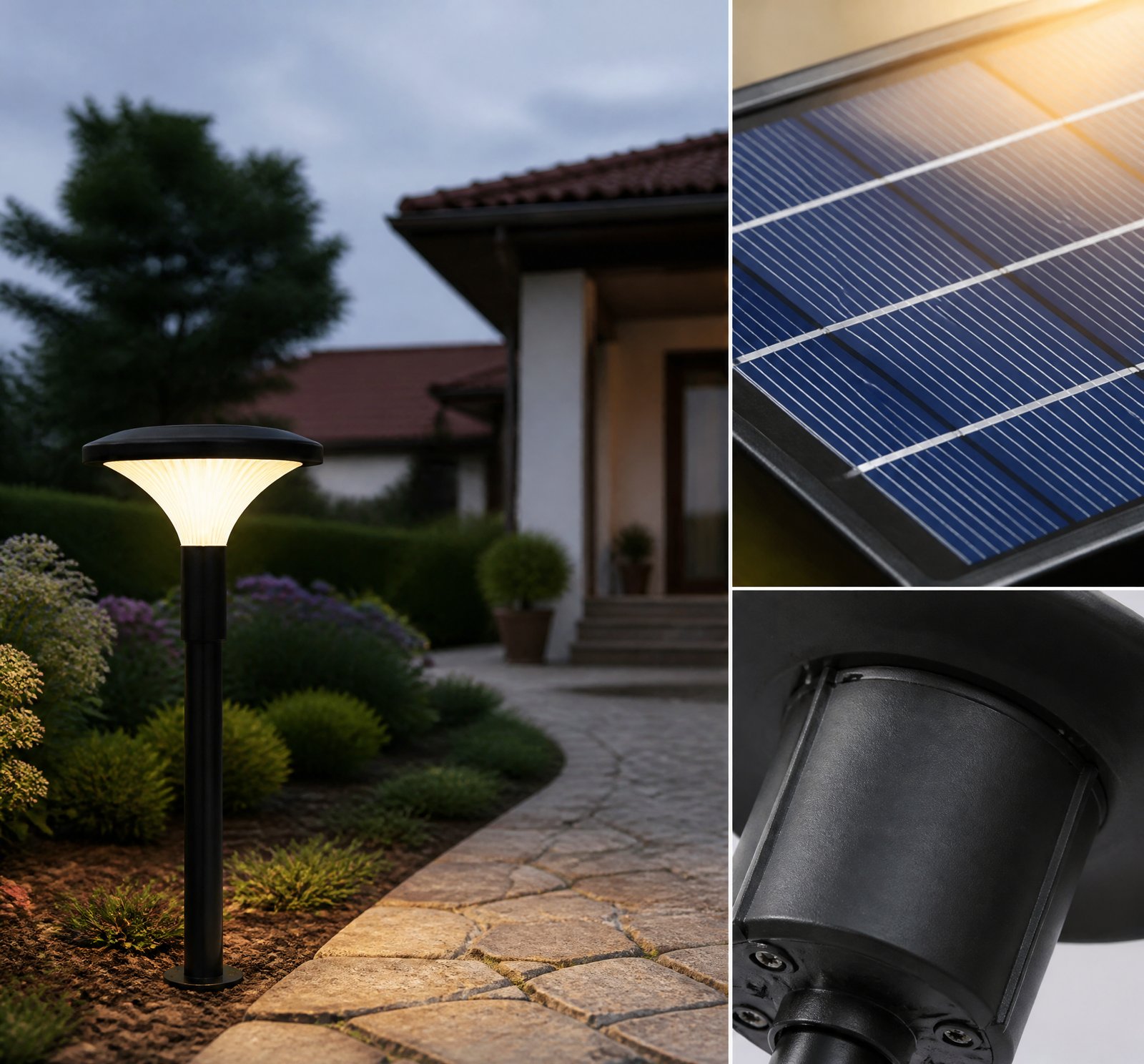
> Quick answer: A color temperature of 6500 K provides a cool white or daylight-like spectrum that enhances alertness but does not necessarily improve perceived brightness, contrast, or visibility compared to warmer 3000–4000 K solar lamps [8][21]. Human preference and context play significant roles.
Color temperature is a crucial factor when choosing the right solar lamp for outdoor tasks. The specified color temperature of 6500 K represents a cool white or daylight-like spectrum, while warmer options range from 3000–4000 K. This article delves into how these different temperatures affect perceived brightness, contrast, and visibility in an outdoor setting.
Color Temperature Basics
The 6500 K color temperature is characterized by its blue-white appearance [2][3][10][13][16]. This high CCT contrasts with the warmer, yellowish hues of lower CCTs such as 3000 K. The higher proportion of blue light in cooler sources influences human visual perception and alertness [8][9][21].
Perceived Brightness
Perceived brightness is influenced by both luminous efficacy and spectral sensitivity. While higher CCTs are associated with a cool, bright appearance, the excerpts do not confirm that 6500 K lamps are brighter than 3000–4000 K lamps when lumen output is matched [8][21]. The human eye’s peak sensitivity to light around 555 nm (green) means that blue-peak SPDs may not align optimally with this wavelength, suggesting no objective or subjective brightness advantage [8].
Contrast Perception
Contrast perception is affected by the spectral content of lighting. Higher CCTs, such as 6500 K, tend to enhance the perception of blue and white tones, which can improve contrast under overcast conditions [10][20]. However, no direct data evaluate how these contrasts are perceived in low-light or nighttime settings where warmer CCTs may reduce glare [7].
Visibility for Outdoor Tasks
Visibility for outdoor tasks is influenced by both luminance and spectral quality. Higher CCTs like 6500 K are associated with improved cognitive performance and alertness, potentially enhancing task performance requiring sustained focus [8]. However, high CCT LEDs can have uneven SPDs that cause color rendering issues [12][14], which may affect long-term visibility.
Human-Centered Design Considerations
The human preference for different CCTs varies based on context. The Kruithof curve suggests that warmer light is preferred at low illuminance levels, while cooler light is preferred in high-illuminance environments [4][9]. This implies that 3000–4000 K lamps may be more comfortable under nighttime conditions, whereas 6500 K might excel in high-light settings like parking lots.
Comparison Table
| Aspect | 6500 K Light | 3000-4000 K Light |
|–––––-|––––––|–––––––|
| Brightness | Subjective | Subjective |
| Contrast | Enhanced | Reduced Glare |
| Visibility | Alertness Boost | Color Accuracy |
Key Takeaways
- Higher CCTs (6500 K) provide a cool white spectrum that enhances alertness but do not necessarily improve perceived brightness or contrast.
- Human preference and context are critical factors in choosing the right color temperature for outdoor lighting tasks.
- Warmer CCTs (3000–4000 K) are often preferred in low-light settings due to reduced glare and enhanced visual comfort.
Frequently Asked Questions
[{„q”: „How does 6500 K affect contrast compared to warmer temperatures?”, „a”: „Higher color temperatures like 6500 K enhance the perception of blue and white tones, which can improve contrast under overcast conditions [10][20].”}, {„q”: „Is 6500 K brighter than warmer options?”, „a”: „While higher CCTs are associated with a cool, bright appearance, no evidence confirms that 6500 K lamps are objectively or subjectively brighter than 3000–4000 K lamps when lumen output is matched [8][21].”}, {„q”: „What are the advantages of warmer CCTs for outdoor tasks?”, „a”: „Warmer CCTs (3000-4000 K) reduce glare and offer enhanced visual comfort, making them preferred in low-light settings such as nighttime walking [7].”}]
References
- [2] Architectural_lighting_design_-_Wikipedia__f8fb0fee — wikipedia
source passage
intended.[35] They will also be able to determine the contrast ratio between light and dark areas. In many cases these studies are referenced against IESNA or CIBSE recommended lighting practices for the type of application. Depending on the type of area, different design aspects may be emphasized for safety or practicality (i.e. such as maintaining uniform light levels, avoiding glare or highlighting certain areas). A specialized lighting design application is often used to create these, which typically combine the use of two-dimensional digital CAD drawings and lighting simulation software. Color temperature for white light sources also affects their use for certain applications. The color temperature of a white light source is the temperature in kelvin of a theoretical black body emitter that most closely matches the spectral characteristics of the lamp. Incandescent light bulbs have a color temperature around 2700 to 3000 kelvin; daylight is around 6500 kelvin. Lower color temperature lamps have relatively more energy in the yellow and red part of the visible spectrum, while high color temperatures correspond to lamps with more of a blue-white appearance. For critical inspection or color matching tasks, or for retail displays of food and clothing, the color temperature of the lamps will be selected for the best overall lighting effect. Color may also be used for functional reasons. For example, blue light makes it difficult to see veins and thus may be used to discourage
- [3] High-Efficiency_Lighting_Building_America_Solution_Center__5e70b97f — authority
source passage
energy use 75% compared to standard incandescent bulbs, according to the EPA. One concern about high-efficiency lighting choices has been color rendition, as some early lighting options, such as compact fluorescents, often appeared whiter or bluer than the familiar "warm" incandescents. Light color is measured on a temperature scale using Kelvin (K) units. Energy-efficient lighting products are available today in a variety of color renditions ranging from lower Kelvin (<3000K) "warm" yellowish lights to higher Kelvin (>5000K) cool white lights. For comparison, daylight is typically identified as 4500K or higher. – For a warmer light, look for bulbs marked 2700-3000K. – For a whiter light, look for bulbs marked 3500-4100K. – For cooler white light, look for bulbs marked 5000-6500K. Desired light output may also be hard to gauge for consumers used to thinking in terms of watts. Light output is measured in lumens. For comparison, a standard 100-Watt incandescent bulb puts out about 1600 lumens and a standard incandescent 60-W bulb puts out about 800 lumens. LED lights can output the same lumen levels, but at much lower wattage. Lumens and color temperature should be listed on the bulb packaging. Look for ENERGY STAR labeled lighting, which is required to meet criteria for light output, color, longevity, and efficiency. See these DOE websites for more on the history of lighting technology and basic principles of artificial lighting. Solid State Light Emitting Diodes (LEDs) LEDs,
- [4] LED_Lighting_in_Museums_and_Art_Galleries_Technical_-_Canadaca__7f9b6307 — authority
source passage
simply the temperature of the filament, about 2800 K for traditional incandescent lamps and 3000 K for quartz halogen lamps. The sun radiates at about 5900 K, but daylight varies from 3000 K to 10,000 K, depending on the time of day and cloud cover. Our visual system evolved to accommodate this wide range of colour temperatures and to still see the colours of the world as constant, more or less. The question of which CCT is best for museum lighting, and how much it matters, is complicated. With the advent of fluorescent lamps in the 1950s, manufacturers were no longer restricted by the maximum temperature of an incandescent filament; they could simulate daylight and every other CCT in between it and an incandescent filament. Since then, advice has relied on a graph known as the Kruithof curve. It indicated that people preferred warm light (2800 to 3000 K) when illumination was at the low levels of museums (50 to 200 lux). This was a convenient conclusion for museums since incandescent (2800 K) and quartz halogen (3000 K) lamps operated in this range. The majority of LED lamps still cater to these two traditional temperatures (Figure 3), but since LEDs can be made at any CCT, the question of what is best for museums is once again under examination. Boyce and Cuttle (1990) studied “pleasantness” of the space and the ability to discriminate colours, and they found no significant relation to CCT. A recent literature review simply concluded that the Kruithof diagram had been misun
- [7] Best_Solar_Lamp_Post_Our_Top_5_Picks_Reviewed__86196132 — blog
source passage
pollution and frankly, wasted energy—and money. That’s where you need to think about the ultimate purpose of your purchase. If you’re planning on having them to light your way into the house, the temperature of the light won’t matter too much as long as they’re bright enough to prevent a fall. However, if you want to linger on your deck, you might find that warmer temps in the 2700 degree Kelvin range are less glaring and easier on your eyes. You’ll find this information along with the wattage, cost, and energy usage on the product’s label. Related Articles: Best Solar Pool Covers LEDs You’ll find a variety of products with a broad spectrum of numbers and lumens for the LEDs. It’s a smart idea to make a note of these figures for comparison purposes, especially if you’re new to using these items. Look for the quantity and light temperature which you’ll find with the list of specs. Solar Panels The construction and layout of the solar panels is one sure way that you can differentiate a quality product from one that may pose problems down the road. Sometimes, there’s not a lot you can do when it comes to getting the optimal amount of light to your solar-powered devices. However, you can look over the design to see if it’s one that tries to maximize its usefulness. We prefer lamp posts that have a 360-degree exposure to sunlight to ensure that the unit is getting as much sun as possible even with the limitations that are beyond your control. You’ll often see that these products a
- [8] LED_professional_Symposium_Expert_Talks_on_Light__Each_Place_Has_Its_Own_Purpose_Complete_it_with_the_Right_Light_Part_II_Mar_30_2__1OBJE8ONkFQ — youtube
source passage
# Each Place Has Its Own Purpose, Complete it with the Right Light – Part II | Mar 30, 2021 Source: YouTube — LED professional Symposium – Expert Talks on Light URL: https://www.youtube.com/watch?v=1OBJE8ONkFQ Video ID: 1OBJE8ONkFQ Transcript: generated thank you for joining the webinar this webinar is brought to you by samsung electronics to discuss the new horizon of led lighting my name is elio jinha kim and i'm responsible for lighting led product marketing and application engineering at samsung electronics i have prepared really cool story about creating a cozy awakening lighting that doesn't really have to be coolest in the correlated color temperature let's find out more okay let me start by asking a question to all of you here are two different correlated color temperatures lighting four thousand kelvin and five thousand kelvin the latter being cooler in visual perception which cct of lighting would you prefer for concentration i mean for tasks requiring a sustained focusing many of you must have chosen 5000 kelvin lighting for better concentration because you're aware of the common knowledge in lighting design color light makes you alert improves your cognitive capability to become more productive at work well i can give you a list of research reports and papers from academia and government agencies on the effect of the lighting conditions to the learning abilities performance and vitality of the subjects every one of them ends up with the same conclusion that blue r
- [9] Human-Focused_Outdoor_Illumination_Trade-Off_Between_Pleasing__d9d16d41 — authority
source passage
# Human-Focused Outdoor Illumination: Trade-Off Between Pleasing Color and Circadian Action, by the Vilnius University Source: Blog/Web URL: https://www.led-professional.com/resources-1/articles/human-focused-outdoor-illumination-trade-off-between-pleasing-color-and-circadian-action Author: Date: 2016-05-17 The correlated color temperature (CCT) of a light source is defined as the temperature of an ideal black-body radiator that radiates light of the same hue as the light source under test. The light within the range of 2,500 to 10,000 K is usually treated as “white” with warm yellowish and cool bluish hues at the low and high ends of the CCT range, respectively. Until the era of solid-state lighting, the available colour temperatures were limited to a finite number of choices due to the technological limitations of incandescent, fluorescent and discharge lamp technology. In 1941 A. A. Kruithof, the researcher of Philips Labs, raised the hypothesis that humans prefer light of different CCT under certain conditions of illuminance [1]. Despite the incomplete experimental data, the key point of the Kruithof hypothesis is the existence of the regions of illuminance levels and colour temperatures that are perceived by an observer as “pleasing” (Figure 1). According to this work the “pleasing” lighting conditions are achieved within the narrow area between the red and blue curves in figure 1, while the upper and lower areas are perceived as unpleasantly yellowish and bluish, respec
- [10] US7178941B2_-_Lighting_methods_and_systems_-_Google_Patents__3273f439 — patent
source passage
different wavelength components and/or bandwidths. It also should be appreciated that the term “color” may be used in connection with both white and non-white light. The term “color temperature” generally is used herein in connection with white light, although this usage is not intended to limit the scope of this term. Color temperature essentially refers to a particular color content or shade (e.g., reddish, bluish) of white light. The color temperature of a given radiation sample conventionally is characterized according to the temperature in degrees Kelvin (K) of a black body radiator that radiates essentially the same spectrum as the radiation sample in question. The color temperature of white light generally falls within a range of from approximately 700 degrees K (generally considered the first visible to the human eye) to over 10,000 degrees K. Lower color temperatures generally indicate white light having a more significant red component or a “warmer feel,” while higher color temperatures generally indicate white light having a more significant blue component or a “cooler feel.” By way of example, a wood burning fire has a color temperature of approximately 1,800 degrees K, a conventional incandescent bulb has a color temperature of approximately 2848 degrees K, early morning daylight has a color temperature of approximately 3,000 degrees K, and overcast midday skies have a color temperature of approximately 10,000 degrees K. A color image viewed under white light hav
- [12] LED_Lighting_in_Museums_and_Art_Galleries_Technical_-_Canadaca__7f9b6307 — authority
source passage
They tested two LEDs that represent widely available models (CRI of 82 and 88, so not good-quality, but within the Energy Star criteria, colour temperature of 3000 K and 4000 K). These had moderate size blue bumps at 450 nm (between the smallest and biggest blue bumps of Figure 2.) They also tested daylight with a UV filter. The rate of damage was compared to that caused by a 3000 K quartz halogen lamp with a good UV filter. Their results are consistent with results shown for the blue pump LEDs of 3000 K and 7716 K in Figure 6: some pigments fade up to 30% faster, some up to 30% slower. Daylight with an imperfect UV filter was much worse (as in Figure 6): some inorganic pigments changed up to three times faster than under the 3000 K quartz halogen lamp with UV filter. We can make the following judgements about LED lamps, based on Figure 6, where “benchmark” refers to the halogen lamp of 3000 K with a perfect UV filter: – LED lamps that use a blue pump, that have a similar colour temperature to that of our benchmark and that have good or excellent colour rendering (“LED, blue pump, 3000 K,” blue squares with a white “+”) cause the same amount of damage or a slower rate of damage as our benchmark. On the other hand, LED lamps with large blue spikes (“LED, blue pump, 7716 K,” blue squares with a white “x”) can cause up to twice as much damage as our benchmark. Such large blue spikes cause not only a poor CRI but also colour temperatures far above our benchmark. – LED lamps that
- [13] Color_temperature_-_Wikipedia__ffbb7f9f — wikipedia
source passage
conjunction could potentially produce a stark contrast, so sometimes fixtures with HID lamps, commonly producing light of 6000–7000 K, are fitted with 3200 K filters to emulate tungsten light. Fixtures with color mixing features or with multiple colors (if including 3200 K), are also capable of producing tungsten-like light. Color temperature may also be a factor when selecting lamps, since each is likely to have a different color temperature. Correlated color temperature (CCT, Tcp) refers to the "temperature of a Planckian radiator whose perceived color most closely resembles that of a given stimulus at the same brightness and under specified viewing conditions".[31][32] The SI unit is the Kelvin (K). The CIE color rendering index (CRI) is a method to determine how well a light source's illumination of eight sample patches compares to the illumination provided by a reference source. Cited together, the CRI and CCT give a numerical estimate of what reference (ideal) light source best approximates a particular artificial light, and what the difference is. Light sources and illuminants may be characterized by their spectral power distribution (SPD). The relative SPD curves provided by many manufacturers may have been produced using 10 nm increments or more on their spectroradiometer.[33] The result is what would seem to be a smoother ("fuller spectrum") power distribution than the lamp actually has. Owing to their spiky distribution, much finer increments are advisable for taki
- [14] LED_Lighting_in_Museums_and_Art_Galleries_Technical_-_Canadaca__7f9b6307 — authority
source passage
in Canada and the U.S. In terms of CRI, R9 and Duv at time of purchase, we do not consider this specification to be adequate for museum and art gallery lighting, but its criteria for lamp stability over time are useful as a minimum acceptable performance under warranty. For museum and art gallery areas not displaying objects, where energy savings may be the priority, lamps below the good category but with Energy Star designation might be acceptable. Colour temperature is a matter of preference, not quality. Our only recommendation is that one use the same colour temperature for all lamps within a given space. The longstanding belief that at museum lux levels of 50 lux to 200 lux, viewers always prefer warm light (2800 K to 3000 K) has been shown to be false. Colour temperatures as high as 5000 K may be preferred in some situations. Manufacturers have not responded fully to this new information, and the colour temperature of quartz halogen lamps (3000 K) is still the target of many manufacturers producing good and excellent LED lamps for the museum market. For those who do not wish to experiment with colour temperature, 3000 K is still a pleasant all-purpose choice for museum lighting. This issue is discussed further in the section Colour temperature and lux levels. The incomplete and bumpy spectrum of many LED lamps The undeniable elegance of incandescent lamps, both traditional and halogen, rests not only on their simplicity but also on the fact that they produce light in th
- [16] Lighting_-_Wikipedia__997723be — wikipedia
source passage
incandescent bulb has a color temperature around 2800 to 3000 kelvins; daylight is around 6400 kelvins. Lower color temperature lamps have relatively more energy in the yellow and red part of the visible spectrum, while high color temperatures correspond to lamps with more of a blue-white appearance. For critical inspection or color matching tasks, or for retail displays of food and clothing, the color temperature of the lamps will be selected for the best overall lighting effect.[11] Lighting is classified by intended use as general, accent, or task lighting, depending largely on the distribution of the light produced by the fixture. – Task lighting is mainly functional and is usually the most concentrated, for purposes such as reading or inspection of materials. For example, reading poor-quality reproductions may require task lighting levels up to 1500 lux (140 footcandles), and some inspection tasks or surgical procedures require even higher levels. – Accent lighting is mainly decorative, intended to highlight pictures, plants, or other elements of interior design or landscaping. – General lighting (sometimes referred to as ambient light) fills in between the two and is intended for general illumination of an area. Indoors, this would be a basic lamp on a table or floor, or a fixture on the ceiling. Outdoors, general lighting for a parking lot may be as low as 10-20 lux (1-2 footcandles) since pedestrians and motorists already used to the dark will need little light for cr
- [20] ES2934308T3_-_lighting_unit_-_Google_Patents__8c8a8849 — patent
source passage
of a given radiation sample is conventionally characterized according to the temperature in Kelvin (K) of a blackbody radiator that radiates essentially the same spectrum as the radiation sample in question. The color temperature of white light generally falls within a range of about 700 degrees K (generally considered the first visible to the human eye) to over 10,000 degrees K. Las temperaturas de color más bajas generalmente indican que la luz blanca tiene un componente rojo más significativo o una "sensación más cálida", mientras que las temperaturas de color más altas generalmente indican que la luz blanca tiene un componente azul más significativo o una "sensación más fría". A modo de ejemplo, un fuego de leña tiene una temperatura de color de aproximadamente 1800 grados K, una bombilla incandescente convencional tiene una temperatura de color de aproximadamente 2848 grados K, la luz del día temprano en la mañana tiene una temperatura de color de aproximadamente 3000 grados K y los cielos nublados del mediodía tienen una temperatura de color de aproximadamente 10,000 grados K. Una imagen en color vista bajo luz blanca con una temperatura de color de aproximadamente 3000 grados K tiene un tono relativamente rojizo, mientras que la misma imagen en color vista bajo luz blanca con una temperatura de color de aproximadamente 10,000 grados K tiene un tono relativamente azulado.Lower color temperatures generally indicate that white light has a more significant red component or
- [21] State-of-the-art_interior_illumination_Bridgelux_Inc_LED_Lighting__b16ac2a2 — authority
source passage
also boast a wide fluorescence angle, typically 120°. They come in versions with a varied colour temperature, i.e. from 2700 K to 6500 K, and this parameter is adjustable in selected models. The street light hue can significantly impact drivers’ concentration levels. Tunable-White – human-centred designs The brightness of a single LED may amount even up to 3980 lm. The above-mentioned light temperature setting is related to the increasingly more popular issue of the Human Centric Lighting (HCL), which has become a hype especially among architects and interior designers. It emphasises the need to adjust artificial interior illumination to human needs. This is achieved, for example, by recreating, through illumination, the natural light cycle, i.e. changing the colour temperature according to the time of day (warmer hues in the morning and evening). Some related techniques can be implemented to stimulate concentration or, conversely, relaxation. All in all, this is how optimum illumination is obtained in household, school, hospital, or office conditions. In such applications, products from the Bridgelux Vesta ® series may come in handy, as they offer you the option to adjust the colour temperature (thanks to the Tunable-White technology). It can be set within various ranges: from 1800–3000 K to 2700–6500 K. The rated power of such components ranges from 8.7 W to 31.8 W (brightness from 3980 lm). Regardless of the model and the CCT value selected, the light emitted by the compon
intended.[35] They will also be able to determine the contrast ratio between light and dark areas. In many cases these studies are referenced against IESNA or CIBSE recommended lighting practices for the type of application. Depending on the type of area, different design aspects may be emphasized for safety or practicality (i.e. such as maintaining uniform light levels, avoiding glare or highlighting certain areas). A specialized lighting design application is often used to create these, which typically combine the use of two-dimensional digital CAD drawings and lighting simulation software. Color temperature for white light sources also affects their use for certain applications. The color temperature of a white light source is the temperature in kelvin of a theoretical black body emitter that most closely matches the spectral characteristics of the lamp. Incandescent light bulbs have a color temperature around 2700 to 3000 kelvin; daylight is around 6500 kelvin. Lower color temperature lamps have relatively more energy in the yellow and red part of the visible spectrum, while high color temperatures correspond to lamps with more of a blue-white appearance. For critical inspection or color matching tasks, or for retail displays of food and clothing, the color temperature of the lamps will be selected for the best overall lighting effect. Color may also be used for functional reasons. For example, blue light makes it difficult to see veins and thus may be used to discourage
energy use 75% compared to standard incandescent bulbs, according to the EPA. One concern about high-efficiency lighting choices has been color rendition, as some early lighting options, such as compact fluorescents, often appeared whiter or bluer than the familiar "warm" incandescents. Light color is measured on a temperature scale using Kelvin (K) units. Energy-efficient lighting products are available today in a variety of color renditions ranging from lower Kelvin (<3000K) "warm" yellowish lights to higher Kelvin (>5000K) cool white lights. For comparison, daylight is typically identified as 4500K or higher. – For a warmer light, look for bulbs marked 2700-3000K. – For a whiter light, look for bulbs marked 3500-4100K. – For cooler white light, look for bulbs marked 5000-6500K. Desired light output may also be hard to gauge for consumers used to thinking in terms of watts. Light output is measured in lumens. For comparison, a standard 100-Watt incandescent bulb puts out about 1600 lumens and a standard incandescent 60-W bulb puts out about 800 lumens. LED lights can output the same lumen levels, but at much lower wattage. Lumens and color temperature should be listed on the bulb packaging. Look for ENERGY STAR labeled lighting, which is required to meet criteria for light output, color, longevity, and efficiency. See these DOE websites for more on the history of lighting technology and basic principles of artificial lighting. Solid State Light Emitting Diodes (LEDs) LEDs,
simply the temperature of the filament, about 2800 K for traditional incandescent lamps and 3000 K for quartz halogen lamps. The sun radiates at about 5900 K, but daylight varies from 3000 K to 10,000 K, depending on the time of day and cloud cover. Our visual system evolved to accommodate this wide range of colour temperatures and to still see the colours of the world as constant, more or less. The question of which CCT is best for museum lighting, and how much it matters, is complicated. With the advent of fluorescent lamps in the 1950s, manufacturers were no longer restricted by the maximum temperature of an incandescent filament; they could simulate daylight and every other CCT in between it and an incandescent filament. Since then, advice has relied on a graph known as the Kruithof curve. It indicated that people preferred warm light (2800 to 3000 K) when illumination was at the low levels of museums (50 to 200 lux). This was a convenient conclusion for museums since incandescent (2800 K) and quartz halogen (3000 K) lamps operated in this range. The majority of LED lamps still cater to these two traditional temperatures (Figure 3), but since LEDs can be made at any CCT, the question of what is best for museums is once again under examination. Boyce and Cuttle (1990) studied “pleasantness” of the space and the ability to discriminate colours, and they found no significant relation to CCT. A recent literature review simply concluded that the Kruithof diagram had been misun
pollution and frankly, wasted energy—and money. That’s where you need to think about the ultimate purpose of your purchase. If you’re planning on having them to light your way into the house, the temperature of the light won’t matter too much as long as they’re bright enough to prevent a fall. However, if you want to linger on your deck, you might find that warmer temps in the 2700 degree Kelvin range are less glaring and easier on your eyes. You’ll find this information along with the wattage, cost, and energy usage on the product’s label. Related Articles: Best Solar Pool Covers LEDs You’ll find a variety of products with a broad spectrum of numbers and lumens for the LEDs. It’s a smart idea to make a note of these figures for comparison purposes, especially if you’re new to using these items. Look for the quantity and light temperature which you’ll find with the list of specs. Solar Panels The construction and layout of the solar panels is one sure way that you can differentiate a quality product from one that may pose problems down the road. Sometimes, there’s not a lot you can do when it comes to getting the optimal amount of light to your solar-powered devices. However, you can look over the design to see if it’s one that tries to maximize its usefulness. We prefer lamp posts that have a 360-degree exposure to sunlight to ensure that the unit is getting as much sun as possible even with the limitations that are beyond your control. You’ll often see that these products a
# Each Place Has Its Own Purpose, Complete it with the Right Light – Part II | Mar 30, 2021 Source: YouTube — LED professional Symposium – Expert Talks on Light URL: https://www.youtube.com/watch?v=1OBJE8ONkFQ Video ID: 1OBJE8ONkFQ Transcript: generated thank you for joining the webinar this webinar is brought to you by samsung electronics to discuss the new horizon of led lighting my name is elio jinha kim and i'm responsible for lighting led product marketing and application engineering at samsung electronics i have prepared really cool story about creating a cozy awakening lighting that doesn't really have to be coolest in the correlated color temperature let's find out more okay let me start by asking a question to all of you here are two different correlated color temperatures lighting four thousand kelvin and five thousand kelvin the latter being cooler in visual perception which cct of lighting would you prefer for concentration i mean for tasks requiring a sustained focusing many of you must have chosen 5000 kelvin lighting for better concentration because you're aware of the common knowledge in lighting design color light makes you alert improves your cognitive capability to become more productive at work well i can give you a list of research reports and papers from academia and government agencies on the effect of the lighting conditions to the learning abilities performance and vitality of the subjects every one of them ends up with the same conclusion that blue r
# Human-Focused Outdoor Illumination: Trade-Off Between Pleasing Color and Circadian Action, by the Vilnius University Source: Blog/Web URL: https://www.led-professional.com/resources-1/articles/human-focused-outdoor-illumination-trade-off-between-pleasing-color-and-circadian-action Author: Date: 2016-05-17 The correlated color temperature (CCT) of a light source is defined as the temperature of an ideal black-body radiator that radiates light of the same hue as the light source under test. The light within the range of 2,500 to 10,000 K is usually treated as “white” with warm yellowish and cool bluish hues at the low and high ends of the CCT range, respectively. Until the era of solid-state lighting, the available colour temperatures were limited to a finite number of choices due to the technological limitations of incandescent, fluorescent and discharge lamp technology. In 1941 A. A. Kruithof, the researcher of Philips Labs, raised the hypothesis that humans prefer light of different CCT under certain conditions of illuminance [1]. Despite the incomplete experimental data, the key point of the Kruithof hypothesis is the existence of the regions of illuminance levels and colour temperatures that are perceived by an observer as “pleasing” (Figure 1). According to this work the “pleasing” lighting conditions are achieved within the narrow area between the red and blue curves in figure 1, while the upper and lower areas are perceived as unpleasantly yellowish and bluish, respec
different wavelength components and/or bandwidths. It also should be appreciated that the term “color” may be used in connection with both white and non-white light. The term “color temperature” generally is used herein in connection with white light, although this usage is not intended to limit the scope of this term. Color temperature essentially refers to a particular color content or shade (e.g., reddish, bluish) of white light. The color temperature of a given radiation sample conventionally is characterized according to the temperature in degrees Kelvin (K) of a black body radiator that radiates essentially the same spectrum as the radiation sample in question. The color temperature of white light generally falls within a range of from approximately 700 degrees K (generally considered the first visible to the human eye) to over 10,000 degrees K. Lower color temperatures generally indicate white light having a more significant red component or a “warmer feel,” while higher color temperatures generally indicate white light having a more significant blue component or a “cooler feel.” By way of example, a wood burning fire has a color temperature of approximately 1,800 degrees K, a conventional incandescent bulb has a color temperature of approximately 2848 degrees K, early morning daylight has a color temperature of approximately 3,000 degrees K, and overcast midday skies have a color temperature of approximately 10,000 degrees K. A color image viewed under white light hav
They tested two LEDs that represent widely available models (CRI of 82 and 88, so not good-quality, but within the Energy Star criteria, colour temperature of 3000 K and 4000 K). These had moderate size blue bumps at 450 nm (between the smallest and biggest blue bumps of Figure 2.) They also tested daylight with a UV filter. The rate of damage was compared to that caused by a 3000 K quartz halogen lamp with a good UV filter. Their results are consistent with results shown for the blue pump LEDs of 3000 K and 7716 K in Figure 6: some pigments fade up to 30% faster, some up to 30% slower. Daylight with an imperfect UV filter was much worse (as in Figure 6): some inorganic pigments changed up to three times faster than under the 3000 K quartz halogen lamp with UV filter. We can make the following judgements about LED lamps, based on Figure 6, where “benchmark” refers to the halogen lamp of 3000 K with a perfect UV filter: – LED lamps that use a blue pump, that have a similar colour temperature to that of our benchmark and that have good or excellent colour rendering (“LED, blue pump, 3000 K,” blue squares with a white “+”) cause the same amount of damage or a slower rate of damage as our benchmark. On the other hand, LED lamps with large blue spikes (“LED, blue pump, 7716 K,” blue squares with a white “x”) can cause up to twice as much damage as our benchmark. Such large blue spikes cause not only a poor CRI but also colour temperatures far above our benchmark. – LED lamps that
conjunction could potentially produce a stark contrast, so sometimes fixtures with HID lamps, commonly producing light of 6000–7000 K, are fitted with 3200 K filters to emulate tungsten light. Fixtures with color mixing features or with multiple colors (if including 3200 K), are also capable of producing tungsten-like light. Color temperature may also be a factor when selecting lamps, since each is likely to have a different color temperature. Correlated color temperature (CCT, Tcp) refers to the "temperature of a Planckian radiator whose perceived color most closely resembles that of a given stimulus at the same brightness and under specified viewing conditions".[31][32] The SI unit is the Kelvin (K). The CIE color rendering index (CRI) is a method to determine how well a light source's illumination of eight sample patches compares to the illumination provided by a reference source. Cited together, the CRI and CCT give a numerical estimate of what reference (ideal) light source best approximates a particular artificial light, and what the difference is. Light sources and illuminants may be characterized by their spectral power distribution (SPD). The relative SPD curves provided by many manufacturers may have been produced using 10 nm increments or more on their spectroradiometer.[33] The result is what would seem to be a smoother ("fuller spectrum") power distribution than the lamp actually has. Owing to their spiky distribution, much finer increments are advisable for taki
in Canada and the U.S. In terms of CRI, R9 and Duv at time of purchase, we do not consider this specification to be adequate for museum and art gallery lighting, but its criteria for lamp stability over time are useful as a minimum acceptable performance under warranty. For museum and art gallery areas not displaying objects, where energy savings may be the priority, lamps below the good category but with Energy Star designation might be acceptable. Colour temperature is a matter of preference, not quality. Our only recommendation is that one use the same colour temperature for all lamps within a given space. The longstanding belief that at museum lux levels of 50 lux to 200 lux, viewers always prefer warm light (2800 K to 3000 K) has been shown to be false. Colour temperatures as high as 5000 K may be preferred in some situations. Manufacturers have not responded fully to this new information, and the colour temperature of quartz halogen lamps (3000 K) is still the target of many manufacturers producing good and excellent LED lamps for the museum market. For those who do not wish to experiment with colour temperature, 3000 K is still a pleasant all-purpose choice for museum lighting. This issue is discussed further in the section Colour temperature and lux levels. The incomplete and bumpy spectrum of many LED lamps The undeniable elegance of incandescent lamps, both traditional and halogen, rests not only on their simplicity but also on the fact that they produce light in th
incandescent bulb has a color temperature around 2800 to 3000 kelvins; daylight is around 6400 kelvins. Lower color temperature lamps have relatively more energy in the yellow and red part of the visible spectrum, while high color temperatures correspond to lamps with more of a blue-white appearance. For critical inspection or color matching tasks, or for retail displays of food and clothing, the color temperature of the lamps will be selected for the best overall lighting effect.[11] Lighting is classified by intended use as general, accent, or task lighting, depending largely on the distribution of the light produced by the fixture. – Task lighting is mainly functional and is usually the most concentrated, for purposes such as reading or inspection of materials. For example, reading poor-quality reproductions may require task lighting levels up to 1500 lux (140 footcandles), and some inspection tasks or surgical procedures require even higher levels. – Accent lighting is mainly decorative, intended to highlight pictures, plants, or other elements of interior design or landscaping. – General lighting (sometimes referred to as ambient light) fills in between the two and is intended for general illumination of an area. Indoors, this would be a basic lamp on a table or floor, or a fixture on the ceiling. Outdoors, general lighting for a parking lot may be as low as 10-20 lux (1-2 footcandles) since pedestrians and motorists already used to the dark will need little light for cr
of a given radiation sample is conventionally characterized according to the temperature in Kelvin (K) of a blackbody radiator that radiates essentially the same spectrum as the radiation sample in question. The color temperature of white light generally falls within a range of about 700 degrees K (generally considered the first visible to the human eye) to over 10,000 degrees K. Las temperaturas de color más bajas generalmente indican que la luz blanca tiene un componente rojo más significativo o una "sensación más cálida", mientras que las temperaturas de color más altas generalmente indican que la luz blanca tiene un componente azul más significativo o una "sensación más fría". A modo de ejemplo, un fuego de leña tiene una temperatura de color de aproximadamente 1800 grados K, una bombilla incandescente convencional tiene una temperatura de color de aproximadamente 2848 grados K, la luz del día temprano en la mañana tiene una temperatura de color de aproximadamente 3000 grados K y los cielos nublados del mediodía tienen una temperatura de color de aproximadamente 10,000 grados K. Una imagen en color vista bajo luz blanca con una temperatura de color de aproximadamente 3000 grados K tiene un tono relativamente rojizo, mientras que la misma imagen en color vista bajo luz blanca con una temperatura de color de aproximadamente 10,000 grados K tiene un tono relativamente azulado.Lower color temperatures generally indicate that white light has a more significant red component or
also boast a wide fluorescence angle, typically 120°. They come in versions with a varied colour temperature, i.e. from 2700 K to 6500 K, and this parameter is adjustable in selected models. The street light hue can significantly impact drivers’ concentration levels. Tunable-White – human-centred designs The brightness of a single LED may amount even up to 3980 lm. The above-mentioned light temperature setting is related to the increasingly more popular issue of the Human Centric Lighting (HCL), which has become a hype especially among architects and interior designers. It emphasises the need to adjust artificial interior illumination to human needs. This is achieved, for example, by recreating, through illumination, the natural light cycle, i.e. changing the colour temperature according to the time of day (warmer hues in the morning and evening). Some related techniques can be implemented to stimulate concentration or, conversely, relaxation. All in all, this is how optimum illumination is obtained in household, school, hospital, or office conditions. In such applications, products from the Bridgelux Vesta ® series may come in handy, as they offer you the option to adjust the colour temperature (thanks to the Tunable-White technology). It can be set within various ranges: from 1800–3000 K to 2700–6500 K. The rated power of such components ranges from 8.7 W to 31.8 W (brightness from 3980 lm). Regardless of the model and the CCT value selected, the light emitted by the compon