
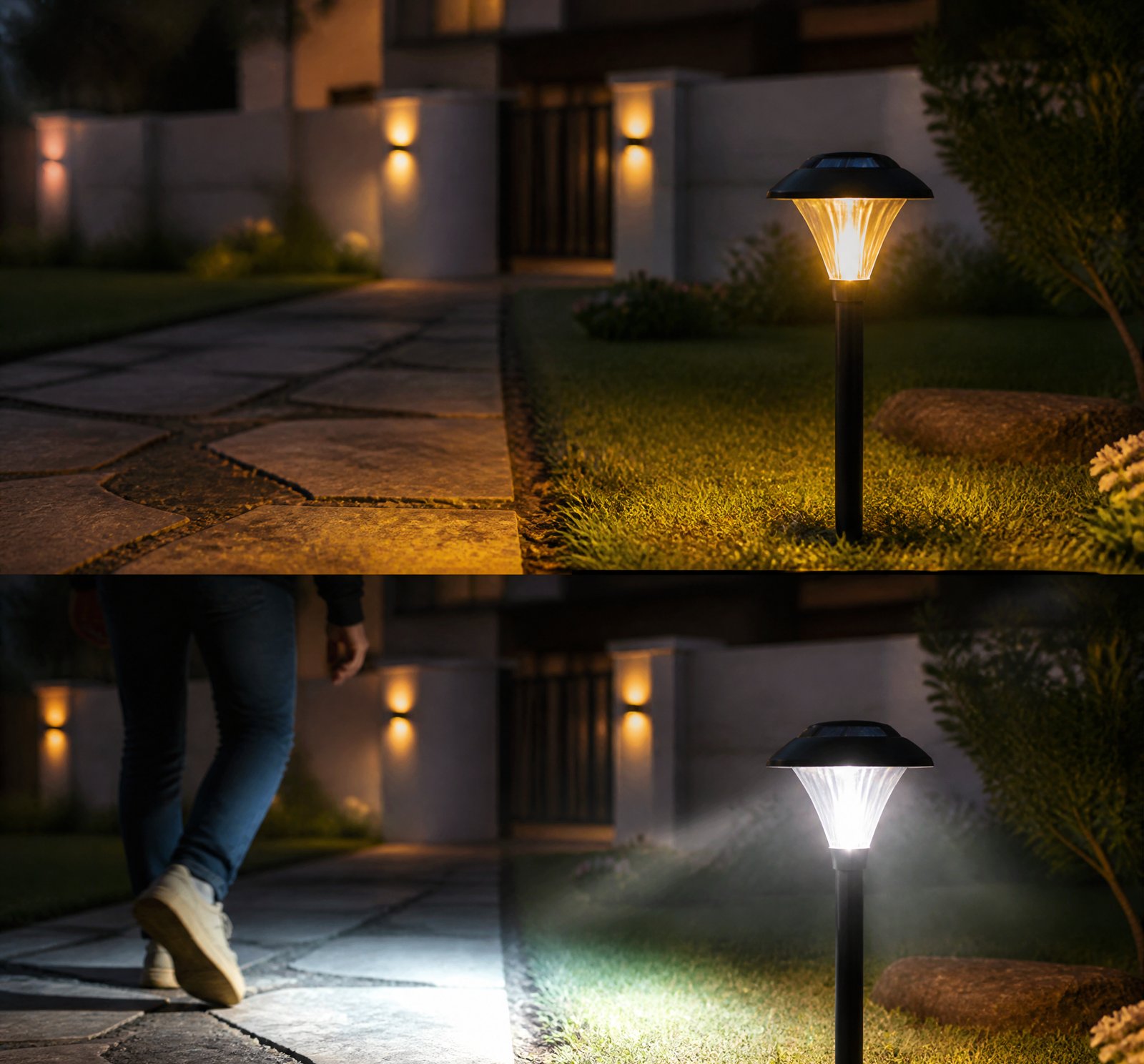
> Quick answer: The provided research does not specify a precise failure rate of PIR motion sensors in solar lamps after 3–5 years of outdoor exposure [1]. Environmental stressors like UV, temperature, and vibration affect larger PV systems but specific impacts on PIR sensors are undocumented.
While the research provides extensive data on the degradation of solar panels and broader photovoltaic (PV) systems, it lacks specific information about the failure rate of PIR motion sensors in solar lamps after 3–5 years of outdoor exposure [1]. However, understanding how environmental stressors such as UV radiation, temperature variations, and vibration affect electronic components like PIR sensors can offer valuable insights.
Environmental Stressors Affecting Solar Lamps
UV Radiation
UV radiation is a significant factor in PV module degradation, particularly for next-generation technologies such as TOPCon cells [4][7]. The research indicates that UV-induced degradation can reach 0.25–0.35% per year in tropical and desert climates [11][12], suggesting that UV exposure could also impact PIR sensors over time.
Temperature Variations
Temperature cycling—repeated heating and cooling—is another key factor in PV module failure [13]. High temperatures reduce efficiency, while extreme temperature fluctuations can induce mechanical stress leading to microcracks or delamination of encapsulants [25]. This thermal stress could similarly affect the solder joints, circuit boards, or infrared detectors within PIR sensors.
Vibration
Continuous mechanical stress from nearby machinery can loosen electrical connections in industrial lighting systems, potentially degrading drivers and affecting reliability [20]. While this effect is noted for broader electronic components, it remains unclear how vibration specifically impacts PIR sensors in solar lamps.
Degradation Mechanisms and Testing Standards
Real-World vs. Standardized Testing
Current UV testing standards may underestimate real-world degradation. For example, the international standard requires only 15 kWh/m² of UV exposure for certification [7][8], but field data from high-irradiance regions show UV exposure levels can be up to 5.4 times higher [12]. This discrepancy raises concerns about the reliability of warranty predictions and long-term performance modeling.
Nonlinear Degradation
Degradation rates are not always linear, with some module types showing seasonal variations and early rapid degradation followed by stabilization [5]. While this insight primarily applies to PV modules, it suggests that similar patterns might be observed in PIR sensors over time.
Key Takeaways
- The failure rate of PIR motion sensors in solar lamps after 3–5 years is not specified in the research.
- UV radiation and temperature variations are significant stressors for electronic components but their specific impact on PIR sensors remains undocumented.
- Standardized testing may underestimate real-world degradation due to higher UV exposure levels.
Frequently Asked Questions
[
{„q”: „What environmental factors affect solar lamp performance?”, „a”: „UV radiation, temperature cycling, and vibration can all degrade the components in solar lamps [20][13].”},
{„q”: „How long do typical solar lamps last?”, „a”: „Solar lamps generally last two to five years depending on materials used [1].”},
{„q”: „Can standardized tests predict real-world degradation accurately?”, „a”: „No, current UV testing standards may underestimate real-world degradation due to higher UV exposure levels in some regions [7][8].” }
]
References
- [1] The_Best_Solar_Path_Lights_Family_Handyman__678b96d2 — reddit
source passage
lights do wear out over time, but their lifespan can vary depending on several factors,” Price says. “The batteries in these lights typically last between one to three years. Over time, the battery’s capacity will diminish, leading to shorter illumination periods. Solar panels themselves can also degrade, losing efficiency after several years of exposure to the elements. The materials used in the lights, such as plastics and metals, will also experience wear and tear due to weather conditions like UV exposure, rain, and temperature changes.” Price also notes that the LEDs used in solar lights tend to “have a long lifespan, often up to 50,000 hours, so they are unlikely to be the first component to fail. Regular maintenance, such as cleaning the solar panels and checking the battery connections, can help prolong the life of your solar path lights.” How long do solar path lights last? Solar path lights span two to five years, depending on the materials they’re crafted from. The update of the lighted also dictates their longevity. What is the downside of solar path lights? The only downside to solar-powered lights is that when seasons begin to change, and darkness sets in earlier, the lights can lose their charge, which normally lasts for eight to twelve hours. Once the weather changes, the light’s performance can also change temporarily. Also, don’t forget to check out these awesome solar fence lights and solar lights for camping.
- [4] UNSW_Next-gen_solar_module_could_degrade_faster_than_expected__bfa0f162 — authority
source passage
you could expect depending on your location,” corresponding author Dr Poddar said. “It gives a holistic overview for manufacturers or developers who want to install panels somewhere, without having to do all the background calculations themselves.” The findings carry particular significance as the solar industry rapidly deploys advanced high-efficiency technologies designed to capture a broader portion of the solar spectrum, including ultraviolet light. While traditional silicon solar modules primarily rely on visible and infrared light to generate electricity, newer cell architectures such as TOPCon and heterojunction are engineered to harness UV radiation for improved conversion efficiency. That improvement, however, may come with unintended consequences for long-term reliability, with recent research documenting notable UV sensitivity in certain next-generation designs. “Our results highlight that modules with similar technology and orientation can still exhibit region-specific degradation,” the researchers state in the paper. “This is due to the influence of local weather and climate when exposed to outdoor conditions. This underscores the need for climate-specific indoor testing and accelerated tests for reliability and better lifetime predictions. “Notably, UV photodegradation alone can account for nearly a quarter of the total annual degradation in monocrystalline silicon modules in regions with high UV dose, potentially reducing system lifetime by seven to ten years.”
- [5] Photovoltaics_researchers_release_five-year_early-life__faf45c3a — authority
source passage
five years to monitor degradation rates over time. They found that degradation rates are highly nonlinear over time, and seasonal variations were present in some module types. Mean and median degradation rate values of -0.6% per year were consistent with rates measured for older modules. Of the 23 systems studied, the study found that six had degradation rates that would exceed the warranty limits in the future, whereas 13 systems demonstrated the potential of achieving lifetimes beyond 30 years, assuming degradation rate trends have stabilized. “This is an encouraging outcome. With the increasing installations of photovoltaics, consumers and other stakeholders will be interested to learn that PV durability appears to be consistent in the face of rapid technology improvements and cost reductions,” Marios said. “However, it is also concerning that 26% of the systems might exceed the warranty limits. Opportunities still exist to reduce degradation rates to levels that enable even longer PV module lifetimes. For example, for 35- and 50-year lifetimes, PV modules should operate at degradation rate values greater than -0.55% per year and -0.4% per year, respectively.” The scientists also raised important points for discussion. How the degradation rate is defined, whether relative to specifications or initial post-stabilization rating, can influence the resulting rate. This resulting rate may have significant influence on purchase costs, warranty and insurance claims or feasibility
- [7] Solving_the_UV_problem_of_n-type_solar_-_pv_magazine_Global__bfc868bc — magazine
source passage
got from the research community suggests that for these more delicate cell structures, UV is a more significant factor,” said Erion-Lorico. “It was reintroduced into extended reliability tests, including Kiwa PVEL’s PQP.” Devising accelerated tests to accurately predict how UV light will affect PV modules over 30 years in the field poses a significant challenge. Tests can currently accelerate by a factor of around five – meaning that one full year in a UV test chamber would represent five years installed in the field, according to Erion-Lorico’s estimates. “It’s hard to accelerate UV testing much more than we’re already doing and still have the results representative to field conditions, not just frying the module,” he explained. Added complexity also comes from the very different levels of UV exposure modules can experience, depending on where they are installed. Data from the Middle East Solar Industry Association indicate that a module installed in Dubai receives 5.4 times the UV exposure of one installed in Berlin, for example. RETC Chief Executive Cherif Kedir said, in a September 2024 pv magazine webinar, that UV degradation is a cumulative effect and even where testing has shown a module is susceptible to UV damage, longer term observation is needed to indicate the progression over time. “We’re trying to perform long term UV exposures to see if [a PV module] keeps degrading every year,” said Kedir, adding that another unknown is whether even low-level UV degradation co
- [8] Solving_the_UV_problem_of_n-type_solar_-_pv_magazine_Global__bfc868bc — authority
source passage
got from the research community suggests that for these more delicate cell structures, UV is a more significant factor,” said Erion-Lorico. “It was reintroduced into extended reliability tests, including Kiwa PVEL’s PQP.” Devising accelerated tests to accurately predict how UV light will affect PV modules over 30 years in the field poses a significant challenge. Tests can currently accelerate by a factor of around five – meaning that one full year in a UV test chamber would represent five years installed in the field, according to Erion-Lorico’s estimates. “It’s hard to accelerate UV testing much more than we’re already doing and still have the results representative to field conditions, not just frying the module,” he explained. Added complexity also comes from the very different levels of UV exposure modules can experience, depending on where they are installed. Data from the Middle East Solar Industry Association indicate that a module installed in Dubai receives 5.4 times the UV exposure of one installed in Berlin, for example. RETC Chief Executive Cherif Kedir said, in a September 2024 pv magazine webinar, that UV degradation is a cumulative effect and even where testing has shown a module is susceptible to UV damage, longer term observation is needed to indicate the progression over time. “We’re trying to perform long term UV exposures to see if [a PV module] keeps degrading every year,” said Kedir, adding that another unknown is whether even low-level UV degradation co
- [11] UNSW_study_finds_tracker-based_PV_systems_-_pv_magazine_Global__7e8abfb2 — magazine
source passage
# UNSW study finds tracker-based PV systems experience higher UV degradation than fixed-tilt arrays – pv magazine Global Source: Blog/Web URL: https://www.pv-magazine.com/2026/04/02/unsw-study-finds-tracker-based-pv-systems-experience-higher-uv-degradation-than-fixed-tilt-arrays/ Author: Emiliano Bellini Date: 2026-04-02 UNSW study finds tracker-based PV systems experience higher UV degradation than fixed-tilt arrays Utraviolet (UV) radiation has been long recognized as a key driver of PV module degradation. This factor, however, is significantly underestimated in current testing standards, particularly for modern system designs and high-irradiance regions. With this in mind, a group of researchers at the University of New South Wales (UNSW) in Australia has developed a high-precision global UV irradiance model on tilted surfaces, capturing the impact of system design, climate, and atmospheric conditions. “Our new model demonstrates that identical module technologies degrade differently depending on deployment location, highlighting the need for climate-specific reliability assessment,” corresponding author Bram Hoex told pv magazine. “It also offers a pathway to move beyond generic accelerated testing toward regionally relevant degradation modeling and qualification protocols.” The researchers highlighted that global UV irradiance can range from below 30 W/m² in high-latitude regions to over 80 W/m² in deserts and dry climates. In some locations, the UV dose specified in the
- [12] UNSW_study_finds_tracker-based_PV_systems_-_pv_magazine_Global__7e8abfb2 — magazine
source passage
installations. Over the course of a typical project lifetime, this difference can accumulate to several percentage points of additional power loss, directly impacting the economics and long-term performance of the PV system. The study also showed that identical PV modules can degrade at markedly different rates depending on their installation location. The key factors driving this variability include UV irradiance, temperature, humidity, and atmospheric conditions such as ozone levels, aerosols, and cloud cover. Among the most challenging environments are tropical and desert regions, where high UV exposure combines with intense thermal and environmental stress, accelerating module degradation. “Current standards significantly underestimate real-world UV exposure, in some cases by orders of magnitude relative to lifetime conditions,” Hoex stressed. “UV exposure varies significantly with location and system configuration, with tracking systems experiencing up to around two times higher degradation rates in high-irradiance regions. In arid and tropical climates, UV-induced degradation can reach about 0.25–0.35%/year, contributing substantially to long-term performance loss.” The novel high-precision model to estimate UV radiation in PV systems was presented in the paper “Closing the UV-Induced Photodegradation Gap Through Global Scale Modeling of Fixed Tilt and Tracking Photovoltaic Systems,” pubished in the IEEE Journal of Photovoltaics. “This work forms part of our group’s bro
- [13] What_forces_cause_solar_panel_degradation_and_failure__8652ad31 — magazine
source passage
# What forces cause solar panel degradation and failure Source: Blog/Web URL: https://www.solarpowerworldonline.com/2017/06/causes-solar-panel-degradation/ Author: Kelly Pickerel Date: 2017-06-05 Although crystalline solar power panels are often sold with 25- to 30-year lifespan guarantees, those 30-year-old modules won’t be performing as well as they did on Day 1. Performance declines as solar cells experience degradation due to unavoidable circumstances like UV exposure and weather cycles. Manufacturers realize this, so solar panels come with a power output or performance warranty that usually guarantees 80% production at 25 years. Panel companies are only comfortable offering this guarantee because of a 2012 NREL study (“Photovoltaic Degradation Rates—An Analytical Review”) that found solar panels degrade about 0.5% to 3% each year, barring any equipment issues. So panels degrade automatically; that’s worked into their performance warranties. There are also outside forces that can contribute to a panel’s degradation and possible failure. We talked with Sarah Kurtz, research fellow at NREL and co-author of that oft-cited 2012 study, on how technology and manufacturing changes, along with installation practices, affect degradation rates. A complex issue According to NREL, modules can fail because of unavoidable elements like thermal cycling, damp heat, humidity freeze and UV exposure. Thermal cycling can cause solder bond failures and cracks in solar cells. Damp heat has bee
- [20] Environmental_Conditions_That_Impact_Industrial_Lighting_Reliability__ab57af9a — magazine
source passage
to humidity, washdowns or salt spray may experience accelerated corrosion of fixture housings and mounting hardware. Over time, this corrosion can compromise both lighting performance and fixture integrity. Lighting systems designed for these environments often incorporate protective finishes, corrosion-resistant materials and sealed enclosures to help maintain durability under these conditions. Vibration and Mechanical Stress Continuous vibration from heavy industrial equipment is another factor that can affect lighting reliability. Fixtures mounted near motors, conveyors or other machinery may experience constant mechanical stress over time. Although LED lighting technology is generally more robust than traditional light sources, poorly designed fixtures can still suffer failures related to vibration. Drivers, electrical connections, and mechanical components may loosen or degrade if they are not engineered to withstand these conditions. Fixtures tested for vibration resistance and designed with rugged mechanical construction are better suited for environments where equipment operates continuously. Considering Environmental Conditions in Lighting Design Lighting plays a critical role in maintaining safe and efficient operations across industrial facilities. However, environmental factors such as dust, chemical exposure, high temperatures, moisture and vibration can all influence how reliably lighting systems perform over time. Evaluating these environmental conditions durin
- [25] Solar_panel_-_Wikipedia__afb0eaf3 — wikipedia
source passage
high temperatures negatively impact efficiency, colder temperatures can improve solar panel performance due to reduced electrical resistance within the cells. However, winter conditions introduce additional challenges such as snow accumulation and reduced daylight hours, which can offset the efficiency benefits of lower temperatures. Solar panels are still capable of generating power in winter, but overall output may be lower due to limited sunlight exposure and potential obstructions.[68] The ability of solar modules to withstand damage by rain, hail, heavy snow load, and cycles of heat and cold varies by manufacturer, although most solar panels on the U.S. market are UL listed, meaning they have gone through testing to withstand hail.[69] Potential-induced degradation (also called PID) is a potential-induced performance degradation in crystalline photovoltaic modules, caused by so-called stray currents.[70] This effect may cause power loss of up to 30%.[71] The power output of a photovoltaic (PV) device decreases over time due to exposure to solar radiation as well as other external conditions. The degradation index, defined as the annual percentage of output power loss, is a key factor in determining the long-term production of a photovoltaic plant. To estimate this degradation, the percentage of decrease associated with each of the electrical parameters is calculated. Individual degradation of a solar panel can negatively influence the performance of a complete string.[72
lights do wear out over time, but their lifespan can vary depending on several factors,” Price says. “The batteries in these lights typically last between one to three years. Over time, the battery’s capacity will diminish, leading to shorter illumination periods. Solar panels themselves can also degrade, losing efficiency after several years of exposure to the elements. The materials used in the lights, such as plastics and metals, will also experience wear and tear due to weather conditions like UV exposure, rain, and temperature changes.” Price also notes that the LEDs used in solar lights tend to “have a long lifespan, often up to 50,000 hours, so they are unlikely to be the first component to fail. Regular maintenance, such as cleaning the solar panels and checking the battery connections, can help prolong the life of your solar path lights.” How long do solar path lights last? Solar path lights span two to five years, depending on the materials they’re crafted from. The update of the lighted also dictates their longevity. What is the downside of solar path lights? The only downside to solar-powered lights is that when seasons begin to change, and darkness sets in earlier, the lights can lose their charge, which normally lasts for eight to twelve hours. Once the weather changes, the light’s performance can also change temporarily. Also, don’t forget to check out these awesome solar fence lights and solar lights for camping.
you could expect depending on your location,” corresponding author Dr Poddar said. “It gives a holistic overview for manufacturers or developers who want to install panels somewhere, without having to do all the background calculations themselves.” The findings carry particular significance as the solar industry rapidly deploys advanced high-efficiency technologies designed to capture a broader portion of the solar spectrum, including ultraviolet light. While traditional silicon solar modules primarily rely on visible and infrared light to generate electricity, newer cell architectures such as TOPCon and heterojunction are engineered to harness UV radiation for improved conversion efficiency. That improvement, however, may come with unintended consequences for long-term reliability, with recent research documenting notable UV sensitivity in certain next-generation designs. “Our results highlight that modules with similar technology and orientation can still exhibit region-specific degradation,” the researchers state in the paper. “This is due to the influence of local weather and climate when exposed to outdoor conditions. This underscores the need for climate-specific indoor testing and accelerated tests for reliability and better lifetime predictions. “Notably, UV photodegradation alone can account for nearly a quarter of the total annual degradation in monocrystalline silicon modules in regions with high UV dose, potentially reducing system lifetime by seven to ten years.”
five years to monitor degradation rates over time. They found that degradation rates are highly nonlinear over time, and seasonal variations were present in some module types. Mean and median degradation rate values of -0.6% per year were consistent with rates measured for older modules. Of the 23 systems studied, the study found that six had degradation rates that would exceed the warranty limits in the future, whereas 13 systems demonstrated the potential of achieving lifetimes beyond 30 years, assuming degradation rate trends have stabilized. “This is an encouraging outcome. With the increasing installations of photovoltaics, consumers and other stakeholders will be interested to learn that PV durability appears to be consistent in the face of rapid technology improvements and cost reductions,” Marios said. “However, it is also concerning that 26% of the systems might exceed the warranty limits. Opportunities still exist to reduce degradation rates to levels that enable even longer PV module lifetimes. For example, for 35- and 50-year lifetimes, PV modules should operate at degradation rate values greater than -0.55% per year and -0.4% per year, respectively.” The scientists also raised important points for discussion. How the degradation rate is defined, whether relative to specifications or initial post-stabilization rating, can influence the resulting rate. This resulting rate may have significant influence on purchase costs, warranty and insurance claims or feasibility
got from the research community suggests that for these more delicate cell structures, UV is a more significant factor,” said Erion-Lorico. “It was reintroduced into extended reliability tests, including Kiwa PVEL’s PQP.” Devising accelerated tests to accurately predict how UV light will affect PV modules over 30 years in the field poses a significant challenge. Tests can currently accelerate by a factor of around five – meaning that one full year in a UV test chamber would represent five years installed in the field, according to Erion-Lorico’s estimates. “It’s hard to accelerate UV testing much more than we’re already doing and still have the results representative to field conditions, not just frying the module,” he explained. Added complexity also comes from the very different levels of UV exposure modules can experience, depending on where they are installed. Data from the Middle East Solar Industry Association indicate that a module installed in Dubai receives 5.4 times the UV exposure of one installed in Berlin, for example. RETC Chief Executive Cherif Kedir said, in a September 2024 pv magazine webinar, that UV degradation is a cumulative effect and even where testing has shown a module is susceptible to UV damage, longer term observation is needed to indicate the progression over time. “We’re trying to perform long term UV exposures to see if [a PV module] keeps degrading every year,” said Kedir, adding that another unknown is whether even low-level UV degradation co
got from the research community suggests that for these more delicate cell structures, UV is a more significant factor,” said Erion-Lorico. “It was reintroduced into extended reliability tests, including Kiwa PVEL’s PQP.” Devising accelerated tests to accurately predict how UV light will affect PV modules over 30 years in the field poses a significant challenge. Tests can currently accelerate by a factor of around five – meaning that one full year in a UV test chamber would represent five years installed in the field, according to Erion-Lorico’s estimates. “It’s hard to accelerate UV testing much more than we’re already doing and still have the results representative to field conditions, not just frying the module,” he explained. Added complexity also comes from the very different levels of UV exposure modules can experience, depending on where they are installed. Data from the Middle East Solar Industry Association indicate that a module installed in Dubai receives 5.4 times the UV exposure of one installed in Berlin, for example. RETC Chief Executive Cherif Kedir said, in a September 2024 pv magazine webinar, that UV degradation is a cumulative effect and even where testing has shown a module is susceptible to UV damage, longer term observation is needed to indicate the progression over time. “We’re trying to perform long term UV exposures to see if [a PV module] keeps degrading every year,” said Kedir, adding that another unknown is whether even low-level UV degradation co
# UNSW study finds tracker-based PV systems experience higher UV degradation than fixed-tilt arrays – pv magazine Global Source: Blog/Web URL: https://www.pv-magazine.com/2026/04/02/unsw-study-finds-tracker-based-pv-systems-experience-higher-uv-degradation-than-fixed-tilt-arrays/ Author: Emiliano Bellini Date: 2026-04-02 UNSW study finds tracker-based PV systems experience higher UV degradation than fixed-tilt arrays Utraviolet (UV) radiation has been long recognized as a key driver of PV module degradation. This factor, however, is significantly underestimated in current testing standards, particularly for modern system designs and high-irradiance regions. With this in mind, a group of researchers at the University of New South Wales (UNSW) in Australia has developed a high-precision global UV irradiance model on tilted surfaces, capturing the impact of system design, climate, and atmospheric conditions. “Our new model demonstrates that identical module technologies degrade differently depending on deployment location, highlighting the need for climate-specific reliability assessment,” corresponding author Bram Hoex told pv magazine. “It also offers a pathway to move beyond generic accelerated testing toward regionally relevant degradation modeling and qualification protocols.” The researchers highlighted that global UV irradiance can range from below 30 W/m² in high-latitude regions to over 80 W/m² in deserts and dry climates. In some locations, the UV dose specified in the
installations. Over the course of a typical project lifetime, this difference can accumulate to several percentage points of additional power loss, directly impacting the economics and long-term performance of the PV system. The study also showed that identical PV modules can degrade at markedly different rates depending on their installation location. The key factors driving this variability include UV irradiance, temperature, humidity, and atmospheric conditions such as ozone levels, aerosols, and cloud cover. Among the most challenging environments are tropical and desert regions, where high UV exposure combines with intense thermal and environmental stress, accelerating module degradation. “Current standards significantly underestimate real-world UV exposure, in some cases by orders of magnitude relative to lifetime conditions,” Hoex stressed. “UV exposure varies significantly with location and system configuration, with tracking systems experiencing up to around two times higher degradation rates in high-irradiance regions. In arid and tropical climates, UV-induced degradation can reach about 0.25–0.35%/year, contributing substantially to long-term performance loss.” The novel high-precision model to estimate UV radiation in PV systems was presented in the paper “Closing the UV-Induced Photodegradation Gap Through Global Scale Modeling of Fixed Tilt and Tracking Photovoltaic Systems,” pubished in the IEEE Journal of Photovoltaics. “This work forms part of our group’s bro
# What forces cause solar panel degradation and failure Source: Blog/Web URL: https://www.solarpowerworldonline.com/2017/06/causes-solar-panel-degradation/ Author: Kelly Pickerel Date: 2017-06-05 Although crystalline solar power panels are often sold with 25- to 30-year lifespan guarantees, those 30-year-old modules won’t be performing as well as they did on Day 1. Performance declines as solar cells experience degradation due to unavoidable circumstances like UV exposure and weather cycles. Manufacturers realize this, so solar panels come with a power output or performance warranty that usually guarantees 80% production at 25 years. Panel companies are only comfortable offering this guarantee because of a 2012 NREL study (“Photovoltaic Degradation Rates—An Analytical Review”) that found solar panels degrade about 0.5% to 3% each year, barring any equipment issues. So panels degrade automatically; that’s worked into their performance warranties. There are also outside forces that can contribute to a panel’s degradation and possible failure. We talked with Sarah Kurtz, research fellow at NREL and co-author of that oft-cited 2012 study, on how technology and manufacturing changes, along with installation practices, affect degradation rates. A complex issue According to NREL, modules can fail because of unavoidable elements like thermal cycling, damp heat, humidity freeze and UV exposure. Thermal cycling can cause solder bond failures and cracks in solar cells. Damp heat has bee
to humidity, washdowns or salt spray may experience accelerated corrosion of fixture housings and mounting hardware. Over time, this corrosion can compromise both lighting performance and fixture integrity. Lighting systems designed for these environments often incorporate protective finishes, corrosion-resistant materials and sealed enclosures to help maintain durability under these conditions. Vibration and Mechanical Stress Continuous vibration from heavy industrial equipment is another factor that can affect lighting reliability. Fixtures mounted near motors, conveyors or other machinery may experience constant mechanical stress over time. Although LED lighting technology is generally more robust than traditional light sources, poorly designed fixtures can still suffer failures related to vibration. Drivers, electrical connections, and mechanical components may loosen or degrade if they are not engineered to withstand these conditions. Fixtures tested for vibration resistance and designed with rugged mechanical construction are better suited for environments where equipment operates continuously. Considering Environmental Conditions in Lighting Design Lighting plays a critical role in maintaining safe and efficient operations across industrial facilities. However, environmental factors such as dust, chemical exposure, high temperatures, moisture and vibration can all influence how reliably lighting systems perform over time. Evaluating these environmental conditions durin
high temperatures negatively impact efficiency, colder temperatures can improve solar panel performance due to reduced electrical resistance within the cells. However, winter conditions introduce additional challenges such as snow accumulation and reduced daylight hours, which can offset the efficiency benefits of lower temperatures. Solar panels are still capable of generating power in winter, but overall output may be lower due to limited sunlight exposure and potential obstructions.[68] The ability of solar modules to withstand damage by rain, hail, heavy snow load, and cycles of heat and cold varies by manufacturer, although most solar panels on the U.S. market are UL listed, meaning they have gone through testing to withstand hail.[69] Potential-induced degradation (also called PID) is a potential-induced performance degradation in crystalline photovoltaic modules, caused by so-called stray currents.[70] This effect may cause power loss of up to 30%.[71] The power output of a photovoltaic (PV) device decreases over time due to exposure to solar radiation as well as other external conditions. The degradation index, defined as the annual percentage of output power loss, is a key factor in determining the long-term production of a photovoltaic plant. To estimate this degradation, the percentage of decrease associated with each of the electrical parameters is calculated. Individual degradation of a solar panel can negatively influence the performance of a complete string.[72