
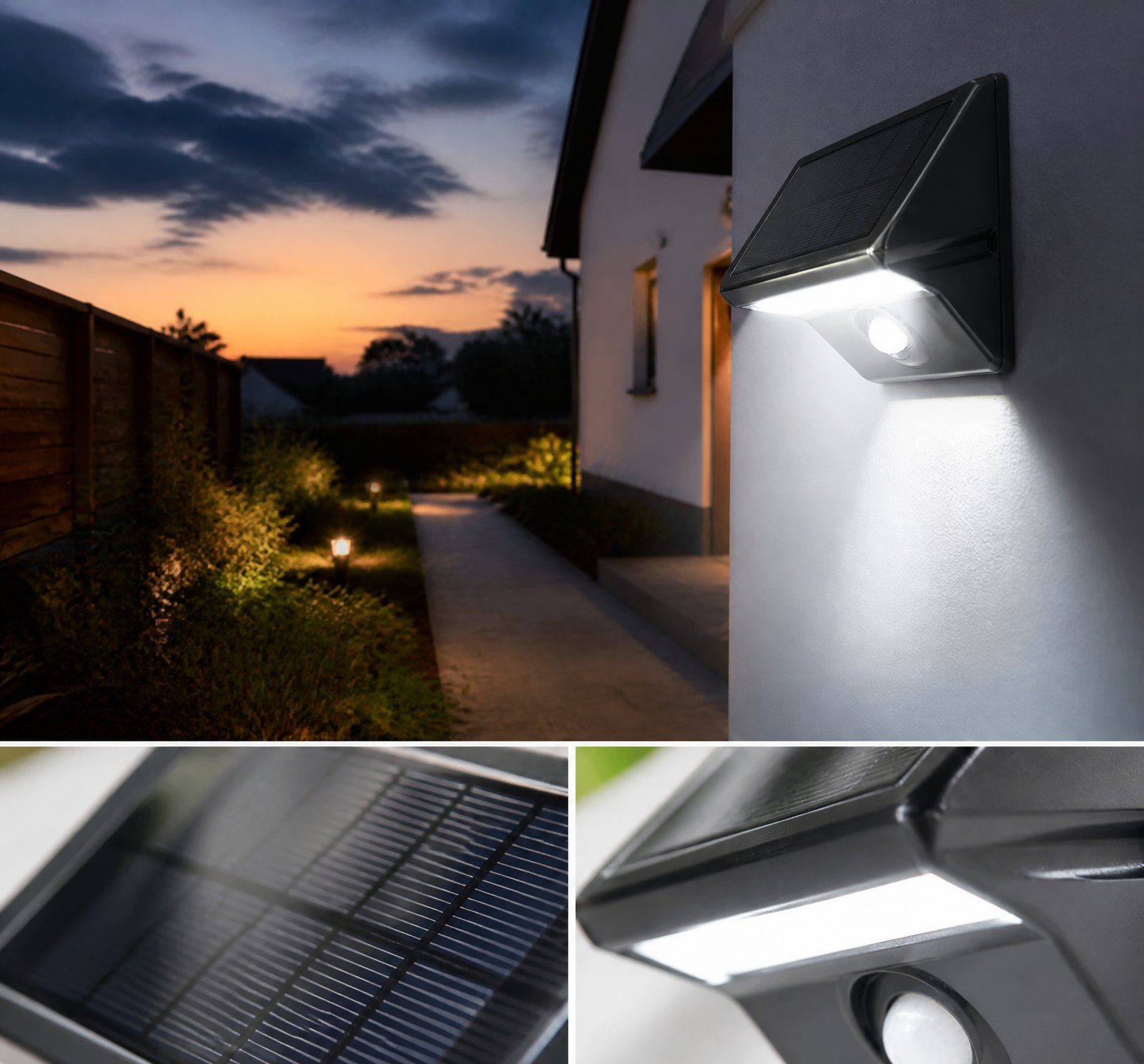
> Quick answer: Smart connectivity, sensors, and adaptive controls will redefine residential solar lighting by turning static systems into dynamic, responsive components of intelligent homes in Romania. These technologies optimize energy use, enhance user comfort, and integrate with broader smart home ecosystems [1][4].
The future of residential solar lighting is not limited to hardware improvements but lies in the seamless integration of software, networked intelligence, and real-time environmental feedback. Smart connectivity, sensors, and adaptive controls are at the heart of this transformation, revolutionizing how we interact with light.
The Core Transformation: Sensors for Enhanced Efficiency
At its core, smart solar lighting leverages sensors and adaptive controls to enhance energy efficiency and user-centric operation [3]. For instance, occupancy and daylight sensors can be embedded in lighting fixtures or integrated into a networked control system, enabling automatic adjustments based on real-time conditions. This means that lights can dim or turn off when no one is present, significantly reducing energy consumption [3][21].
Example: In residential settings, this capability allows for granular control across multiple zones without the need for rewiring or physical disruption, ensuring stored energy is used only when needed and extending battery life. This is particularly valuable in off-grid or backup applications during power outages.
Connectivity: Beyond Lighting
Connectivity amplifies the intelligence of solar lamps by enabling remote monitoring, cloud-based updates, and centralized control via smartphones or tablets [1][10]. For example, users can reprogram lighting zones, adjust scenes, or trigger animations through a mobile app. This flexibility is not just convenient; it reflects a shift toward systems that evolve over time with software updates delivered via the cloud [1].
Example: Modern systems can gain new capabilities—such as improved scheduling and enhanced security features—without requiring hardware replacement, ensuring future-proofing for sophisticated residential energy management.
Networked Systems: Outdoor and Public Lighting Implications
The convergence of solar power, smart controls, and networked systems is already evident in outdoor and public lighting. For instance, patents describe solar-powered street lamps that operate independently or as a networked array with communication via satellite or cellular networks [6][16]. These systems can perform functions beyond lighting, such as providing Wi-Fi hotspots and data analysis for urban planning.
Example: In residential settings, these principles translate to solar lamps acting as nodes in an IoT ecosystem, contributing to energy monitoring, security, or local data collection. A garden lamp could detect motion via infrared sensors, trigger a light, and simultaneously send an alert to a homeowner’s phone [25].
Human-Centric Design: Enhancing Well-Being
Adaptive controls extend beyond energy savings to include human-centric design and health. Tunable white lighting and dynamic dimming can support circadian rhythms, improve mood, and enhance productivity [4]. In commercial spaces, such systems already create environments that promote well-being.
Example: Residential applications could see similar benefits with programmable color temperature shifts throughout the day, mimicking natural daylight patterns to influence sleep quality and overall comfort in homes where occupants spend significant time indoors.
Solar Lamps as Network Nodes
Modern solar lamps are evolving into multifunctional nodes capable of acting as communication hubs for other devices. They can support wireless protocols like Bluetooth Mesh or Wi-Fi [14][17]. This means a lamp could serve as a relay, enabling efficient operation and integration with security cameras, door sensors, or climate controls.
Example: A solar-powered garden lamp could detect motion via infrared sensors, trigger a light, and send an alert to the homeowner’s phone. In residential contexts, such systems integrate seamlessly into broader smart home ecosystems.
Data Collection and Analytics
The true value of next-generation solar lighting lies in its ability to collect and act on data [8]. Modern systems are gateways for sensor data that can inform building management decisions, revealing patterns in occupancy, energy use, and environmental conditions. Homeowners can make informed choices about their living environment based on real-time feedback.
Example: A residential system could track light usage across different rooms and correlate it with outdoor light levels to adjust schedules automatically, maximizing solar charging and minimizing waste [3].
Challenges and Gaps
While the potential of smart solar lighting is clear, there are critical gaps. These include performance gains from adaptive controls in residential settings, energy savings quantification through sensor integration, cost implications, reliability of long-term battery performance, cybersecurity risks, user privacy concerns, and lack of consensus on optimal control architecture.
Example: The sources do not specify the exact benefits or quantify achievable savings, nor do they address industry challenges like standardized protocols for integrating solar lighting into smart home ecosystems [8].
Key Takeaways
- Smart connectivity, sensors, and adaptive controls transform residential solar lighting from static systems to dynamic, responsive nodes.
- Networked intelligence enables automatic adjustments based on real-time conditions, enhancing energy efficiency and user comfort.
- Future-proofing through software updates ensures systems can evolve without hardware replacement.
Comparison Table: Traditional vs. Next-Generation Solar Lamps
| Feature | Traditional Solar Lamp | Next-Generation Smart Solar Lamp |
|––––––––|––––––––––––––-|––––––––––––––––––|
| Connectivity | None | Remote monitoring, cloud-based updates |
| Sensors | Absent | Occupancy and daylight sensors |
| Controls | Basic on/off | Adaptive controls for dimming and color temperature |
| Data Collection | Limited | Extensive sensor data collection |
Frequently Asked Questions
[{„q”: „How do occupancy and daylight sensors improve energy efficiency?”, „a”: „Occupancy and daylight sensors embedded in lighting fixtures or integrated into a networked control system enable automatic adjustments based on real-time conditions, reducing unnecessary energy consumption [3][21].”},
{„q”: „What are the benefits of remote monitoring and cloud-based updates for solar lamps?”, „a”: „Remote monitoring allows homeowners to adjust lighting zones, scenes, or trigger animations through mobile apps. Cloud-based updates ensure systems can gain new capabilities without hardware replacement [1][10].”},
{„q”: „How do next-generation smart solar lamps support human-centric design principles?”, „a”: „Tunable white lighting and dynamic dimming support circadian rhythms, improve mood, and enhance productivity, promoting overall well-being in residential settings [4].” }]
References
- [1] Intelligent_buildings_need_equally_smart_lighting_controls_Buildings__d8547a61 — authority
source passage
automatically via cloud updates. Physical hardware is the front end, and we count on it becoming smarter and more capable as software and firmware are enhanced. In an era when building technology can struggle to keep pace with innovation, connected lighting controls will receive regular software updates, ensuring the system gains functionality and capability over time. This is also the promise of connected lighting control—the ability to make changes right from smart phone apps with confidence that new capabilities are just a cloud update away. With the right lighting system, the built environment becomes more dynamic and sustainable, enhances well-being, and provides the data and insights that drive operational improvements. Sustainability andwell-being:Optimizingthe user experience The past few years have underscored the importance of well-being in the workplace and other commercial spaces. Design frameworks encourage a culture of well-being and may help employers attract and retain high-caliber talent. This is all good news for owners looking to differentiate their properties in a competitive real estate market. Lighting is functionaland necessary; it is ubiquitous in any indoor space. Butlighting also has the power to be an attractive building amenity, a means to more resilient spaces, and a system that continues to enhance building value over time.As your commercial buildings evolve, look fordigital and wireless lighting and shadingsolutionsthat welcome people into the s
- [3] Intelligent_buildings_need_equally_smart_lighting_controls_Buildings__d8547a61 — authority
source passage
for most projects from both a budgetary and scheduling perspective. Systems that include LLLCs magnify the power of smart LEDs, integrating the benefits of a large, networked control system directly into the individual LED fixtures. For small offices, retail or hospitality spaces, or large, multiuse commercial buildings, individual fixture control can deliver programming versatility. Collected occupant data, combined with the ability to rezone or reprogram lighting without rewiring or disruption to the space, contributes to more efficient lighting strategies over the life of the building. How do LLLCs increase the versatility of a lighting control system? Occupancy sensors and daylight sensors can be designed directly into the LLLC device, or the fixture can communicate with system sensors in each building area or zone to automatically adjust lighting based on sensor data—critical for meeting a variety of energy and building codes. System software can then use that data to help the facilities team manage energy use, make the most of natural daylight in a space, and inform building management decisions. The result is a system that evolves and can overcome changes during and post construction—even when the system is already fully programmed. This makes the project engineer’s job simpler and also less risky; additionally, the added versatility is equally important to the owner or tenant who can now use fixture-level occupant data to improve the comfort, efficiency, and even valu
- [4] Intelligent_buildings_need_equally_smart_lighting_controls_Buildings__d8547a61 — authority
source passage
# Intelligent buildings need equally smart lighting controls Source: Blog/Web URL: https://www.buildings.com/building-systems-om/lighting/article/33018276/intelligent-buildings-need-equally-smart-lighting-controls Author: Chris Udall Date: 2023-06-08 Intelligent buildings need equally smart lighting controls With LEDs being the standard light source in new commercial buildings and retrofits, building owners and occupants can benefit from the versatility and efficiency of advanced digital controls Advances in technology drive demand for intelligent building systems and put a spotlight on the growth of smart lighting control solutions. By integrating connected, digital lighting into building and renovation projects, engineers, designers, and contractors can deliver high-value, energy efficient, sustainable, and comfortable spaces for building owners and occupants. The impact of smart lighting is directly linked to the evolution of LEDs. As efficient and versatile LEDs replaced fluorescent lighting in commercial projects, lighting professionals were able to use digital control technology to design personal, dynamic, and human-centric lighting systems. The result is integrated, high-performance dimming, automated shading, and tunable white solutions in spaces that are beautiful and inviting, as well as efficient and future-proof. Flexible, connected lighting systems are essential for smart buildings to be groundbreaking the moment their doors first open and to improve over time.
- [6] WO2010057138A2_-_Energy-efficient_solar-powered_outdoor_lighting__593d23e6 — patent
source passage
Computer Science (AREA) – General Engineering & Computer Science (AREA) – Sustainable Development (AREA) – Life Sciences & Earth Sciences (AREA) – Chemical & Material Sciences (AREA) – Computer Networks & Wireless Communication (AREA) – Sustainable Energy (AREA) – Combustion & Propulsion (AREA) – Thermal Sciences (AREA) – Mechanical Engineering (AREA) – Manufacturing & Machinery (AREA) – Chemical Kinetics & Catalysis (AREA) – Electrochemistry (AREA) – General Chemical & Material Sciences (AREA) – Physics & Mathematics (AREA) – Circuit Arrangement For Electric Light Sources In General (AREA) Abstract One or more outdoor lights may operate independently with sensing and control processes mainly on-pole, or may communicate as a networked array of poles, wherein a master/coordinating pole/node transmits signals from the networked array to a control station, and receive signals from the control station for the networked array, via call phone and/or satellite. Independent poles and/or the networked array of poles may be adapted for energy-saving processes; cooperation with the grid; renewable power production and storage by means of solar panels and associated batteries; and/or to provide Wi-Fi hot-spots, public safety alarms, information or data-analysis to the public or customers. An energy-saving active control system controls charging of the batteries and distribution of energy from the solar panel and/or the batteries, so that the batteries remain undamaged, and the light(s) r
- [8] Site_Search_-_theilporguk__6ceccd9f — magazine
source passage
# Site Search Source: Blog/Web URL: https://theilp.org.uk/site-search.html?q=extern Author: Date: 2025-09-10 The focus of this publication will be on informing and enabling, to produce an exterior lighting scheme that will, if required, be at reduced risk from both indirect lightning strike, and switching surges from the external supply cable network, serving electrical and electronic equipment. A recent study by British automotive services company RAC revealed that 25% of UK drivers who perceive vehicle headlights as overly bright reduce their nighttime journeys to avoid glare. An additional 22% of drivers who took part in the study expressed a desire to reduce their nighttime driving. “Passion for lighting, regardless of our differences, keeps us all connected and will be our strength moving forwards “, the Institution of Lighting Professionals’ new President has said in her President’s Address. As a lighting industry and profession, through LED technology we have made huge strides in reducing energy use and carbon emissions. Our next challenge is reduce light pollution to safeguard wildlife and protect people’s enjoyment of star laden Dark Skies. Today, lighting control systems are no longer simply a platform for management of public lighting assets. They are a gateway to enable sensors and data analytics and additional value to flow from these assets. As an example, sensor-enabled luminaires can monitor and report on traffic data as well as air quality information, to hel
- [10] How_to_Light_What_should_I_consider_when_retrofitting_-_Lux_Review__901ab126 — authority
source passage
wiring separate groups of luminaires in one room to separate indoor controllers, consumers can switch off lighting above television screens to watch a film while leaving dimmed luminaires on at the back of the room, creating a relaxing, ambient aesthetic for occasions such as movie nights. Switches and dimmers Another important element to consider when retrofitting your home’s lighting to a connected lighting solution is how you intend to control it. Configuring lighting scenes based upon your own requirements is an easy task with the use of a smartphone or tablet, but what if you want to use a more traditional method of control, while still having the ability to control a connected lighting system? Smart switches and dimmers are now available with most smart lighting solutions, enabling consumers to assign specific actions or scenes to switches, such as reducing luminaires to 50 per cent, triggering a lighting animation or simply switching off the lights within certain rooms. Smart switches can be used alongside, or in replacement of, traditional lighting switches, so it’s important to consider the application of the connected system. Communal workspaces with multiple users, for example, may benefit from both smart and traditional lighting switches. Sensors In addition to the smart switches available with a variety of connected lighting systems, there’s also a range of indoor and outdoor sensors available. Smart sensors enable consumers to further optimise a connected lighti
- [14] US8491159B2_-_Wireless_emergency_lighting_system_-_Google_Patents__b5668615 — patent
source passage
lights may be used to reduce demand on the power grid by switching to battery power at peak times, then recharging off peak. One advantage of the present invention is the ability to create programmable light bulbs, tubes or lamps with integrated sensors. These intelligent lights may contain integrated controls that turn on, off, or change light intensity based on a programmable schedule, the detection of sensor inputs, or a change in lighting conditions. One advantage of the present invention is the ability to communicate controls to and between these LED lighting facilities. In some embodiments, intelligent lights may contain wireless transmitters and receivers allowing them to coordinate functions within groups of light bulbs or allowing them to receive control and programming over a network as well as forward or route traffic to other light bulbs that are part of the network. Thus, for example, a removable light bulb may also act as a node in a network of light bulbs providing the ability to deploy a lighting installation and a network to control the lighting installation by plugging light bulbs into sockets. It should be appreciated that combinations of the foregoing concepts and additional concepts discussed in greater detail below are contemplated as being part of the inventive subject matter disclosed herein. In particular, all combinations of claimed subject matter appearing at the end of this disclosure, or elsewhere herein, are contemplated as being part of the inve
- [16] US20120020060A1_-_Energy-efficient_solar-powered_-_Google_Patents__619c8cff — patent
source passage
of full brightness, and said third fraction is 7.5%-25% of full brightness. – Said methods may include brightening said LEDs to said third fraction of full brightness for a third predetermined amount of time before dawn. Landscapes – Engineering & Computer Science (AREA) – General Engineering & Computer Science (AREA) – Life Sciences & Earth Sciences (AREA) – Sustainable Development (AREA) – Sustainable Energy (AREA) – Computer Networks & Wireless Communication (AREA) – Power Engineering (AREA) – Circuit Arrangement For Electric Light Sources In General (AREA) – Non-Portable Lighting Devices Or Systems Thereof (AREA) – Photovoltaic Devices (AREA) Abstract One or more outdoor lights may operate independently with sensing and control processes mainly on-pole, or may communicate as a networked array of poles, wherein a master/coordinating pole/node transmits signals from the networked array to a control station, and receive signals from the control station for the networked array, via call phone and/or satellite. Independent poles and/or the networked array of poles may be adapted for energy-saving processes; cooperation with the grid; renewable power production and storage by means of solar panels and associated batteries; and/or to provide Wi-Fi hot-spots, public safety alarms, information or data-analysis to the public or customers. An energy-saving active control system controls charging of the batteries and distribution of energy from the solar panel and/or the batteries, s
- [17] Magazines_LED_professional_Review_LpR__5468857e — authority
source passage
by Dee Denteneer, Secretary General of the Zhaga Consortium (p 08) Tech-Talks Bregenz Karl Jónsson, IoT Architect, Tridonic compiled by Arno Grabher-Meyer, LED professional (p 38) Research Thin-Film Light Management System for Intelligent Large-Area LED Luminaires by Oscar Fernandez, Centre Suisse d’Electronique et de Microtechnique SA (p 46) Advanced Bluetooth 4.0+ -Based Smart Lighting Technology by Saara Guastella, Casambi (p 52) Power over Ethernet Lighting for Commercial Buildings by Giovanni Frezza, Molex (p 56) Technologies Create Colorful and Bright LED Light with an LED Matrix Dimmer by Keith Szolusha, Linear Technology (p 62) Applications Safety Concept for LED Street Lighting by Andreas Schamber, Phoenix Contact (p 68) Illuminating Education – Providing a Brighter Future for Students by Jay Black, Revolution Lighting Technologies (p 72) Special The Value of Dark Skies – About Environmentally Friendly Lighting by J. Scott Feierabend, International Dark-Sky Association (IDA) (p 80) LpR 53 | Jan/Feb 2016 > Research: Hybrid LEDs > Trends: Embedded Lighting > Technology: Light Flicker > Tech-Talks BREGENZ: Wolfgang Nemitz Full version and archive access: Click Here Commentary Design Beyond FFF by Ed van den Kieboom, InnovationFab Events (p 08) Tech-Talks Bregenz Wolfgang Nemitz, Scientist, Joanneum Research compiled by S. Luger, LED professional (p 24) Research Human-Focused Outdoor Illumination: Trade-Off Between Pleasing Color and Circadian Action by Dr. Pranciškus Vi
- [21] Press_Releases_Bridgelux_Inc_LED_Lighting__0a26bc94 — authority
source passage
That could mean different types of dimming, daylight harvesting, – a huge catalyst of savings. If you could swap out all lights you could see a reduction of 35% of lighting consumed. With basic connectivity and dimming you could increase efficiency again by another 30-50%.” After that, it gets really fun and creative. Because with LEDs, you can do things with color and connectivity that you simply cannot do with a light source that is not solid state. “Then you get more nuanced controls, and with a feedback loop, you can think about more controlled applications in retail. You could talk about a 10% reduction in overall energy cost in a supermarket. Perhaps you could boost profit margins. But if you add sensing technology you could start to control lights. If somebody gets closer to display, for example, you could bump up the lumens and change the colors.” Given the rapid state of innovation and evolution in the LED space, where does Bullington see this going? First, he sees continued improvement in cost-effectiveness for the consumer, that in some ways have hurt the bottom lines of the LED players. The paradox is that the massive compression of cost that has enabled that. We’ve seen a huge reduction in component costs – chip plus package; those prices even at the high end have fallen 35-50% a year for the last three years. That’s bad for margins, and good for market penetration. You will see market consolidation. Bullington also expects LED market penetration to continue rapi
- [25] US7588349B2_-_Solar-infrared-rays_sensing_garden_lamp__7d961ccb — patent
source passage
present invention and allowing the application. Landscapes – Engineering & Computer Science (AREA) – General Engineering & Computer Science (AREA) – Life Sciences & Earth Sciences (AREA) – Sustainable Development (AREA) – Circuit Arrangement For Electric Light Sources In General (AREA) Abstract A solar-infrared-rays sensing garden lamp is provided. It mainly comprises a garden lamp body with a control apparatus set inside. The control apparatus charges a power supply via the solar energy in the daytime, and provides power via the power supply in the nighttime. Therefore a infrared rays sensing circuit set on the garden lamp body at a surface thereof can sense omnibearingly in the nighttime. When the infrared rays sensing circuit senses unusual situation, it drives a corresponding lighting unit to illuminate and transmits a triggered signal to the voice control unit for driving a speaker and giving off sounds. Description 1. Field of the Invention The present invention relates to a solar-infrared-rays sensing garden lamp. More particularly, the present invention relates to a solar-infrared-rays sensing garden lamp that is rechargeable and able to provide power by transferring the solar energy and enable an infrared rays sensing circuit and a lighting unit on the garden lamp at a surface thereof to operate. 2. Descriptions of the Related Art Conventionally, garden lamps are able to illuminate darkness and outdoor buildings, plants, and trees to be appealing and sensuous at nigh
automatically via cloud updates. Physical hardware is the front end, and we count on it becoming smarter and more capable as software and firmware are enhanced. In an era when building technology can struggle to keep pace with innovation, connected lighting controls will receive regular software updates, ensuring the system gains functionality and capability over time. This is also the promise of connected lighting control—the ability to make changes right from smart phone apps with confidence that new capabilities are just a cloud update away. With the right lighting system, the built environment becomes more dynamic and sustainable, enhances well-being, and provides the data and insights that drive operational improvements. Sustainability andwell-being:Optimizingthe user experience The past few years have underscored the importance of well-being in the workplace and other commercial spaces. Design frameworks encourage a culture of well-being and may help employers attract and retain high-caliber talent. This is all good news for owners looking to differentiate their properties in a competitive real estate market. Lighting is functionaland necessary; it is ubiquitous in any indoor space. Butlighting also has the power to be an attractive building amenity, a means to more resilient spaces, and a system that continues to enhance building value over time.As your commercial buildings evolve, look fordigital and wireless lighting and shadingsolutionsthat welcome people into the s
for most projects from both a budgetary and scheduling perspective. Systems that include LLLCs magnify the power of smart LEDs, integrating the benefits of a large, networked control system directly into the individual LED fixtures. For small offices, retail or hospitality spaces, or large, multiuse commercial buildings, individual fixture control can deliver programming versatility. Collected occupant data, combined with the ability to rezone or reprogram lighting without rewiring or disruption to the space, contributes to more efficient lighting strategies over the life of the building. How do LLLCs increase the versatility of a lighting control system? Occupancy sensors and daylight sensors can be designed directly into the LLLC device, or the fixture can communicate with system sensors in each building area or zone to automatically adjust lighting based on sensor data—critical for meeting a variety of energy and building codes. System software can then use that data to help the facilities team manage energy use, make the most of natural daylight in a space, and inform building management decisions. The result is a system that evolves and can overcome changes during and post construction—even when the system is already fully programmed. This makes the project engineer’s job simpler and also less risky; additionally, the added versatility is equally important to the owner or tenant who can now use fixture-level occupant data to improve the comfort, efficiency, and even valu
# Intelligent buildings need equally smart lighting controls Source: Blog/Web URL: https://www.buildings.com/building-systems-om/lighting/article/33018276/intelligent-buildings-need-equally-smart-lighting-controls Author: Chris Udall Date: 2023-06-08 Intelligent buildings need equally smart lighting controls With LEDs being the standard light source in new commercial buildings and retrofits, building owners and occupants can benefit from the versatility and efficiency of advanced digital controls Advances in technology drive demand for intelligent building systems and put a spotlight on the growth of smart lighting control solutions. By integrating connected, digital lighting into building and renovation projects, engineers, designers, and contractors can deliver high-value, energy efficient, sustainable, and comfortable spaces for building owners and occupants. The impact of smart lighting is directly linked to the evolution of LEDs. As efficient and versatile LEDs replaced fluorescent lighting in commercial projects, lighting professionals were able to use digital control technology to design personal, dynamic, and human-centric lighting systems. The result is integrated, high-performance dimming, automated shading, and tunable white solutions in spaces that are beautiful and inviting, as well as efficient and future-proof. Flexible, connected lighting systems are essential for smart buildings to be groundbreaking the moment their doors first open and to improve over time.
Computer Science (AREA) – General Engineering & Computer Science (AREA) – Sustainable Development (AREA) – Life Sciences & Earth Sciences (AREA) – Chemical & Material Sciences (AREA) – Computer Networks & Wireless Communication (AREA) – Sustainable Energy (AREA) – Combustion & Propulsion (AREA) – Thermal Sciences (AREA) – Mechanical Engineering (AREA) – Manufacturing & Machinery (AREA) – Chemical Kinetics & Catalysis (AREA) – Electrochemistry (AREA) – General Chemical & Material Sciences (AREA) – Physics & Mathematics (AREA) – Circuit Arrangement For Electric Light Sources In General (AREA) Abstract One or more outdoor lights may operate independently with sensing and control processes mainly on-pole, or may communicate as a networked array of poles, wherein a master/coordinating pole/node transmits signals from the networked array to a control station, and receive signals from the control station for the networked array, via call phone and/or satellite. Independent poles and/or the networked array of poles may be adapted for energy-saving processes; cooperation with the grid; renewable power production and storage by means of solar panels and associated batteries; and/or to provide Wi-Fi hot-spots, public safety alarms, information or data-analysis to the public or customers. An energy-saving active control system controls charging of the batteries and distribution of energy from the solar panel and/or the batteries, so that the batteries remain undamaged, and the light(s) r
# Site Search Source: Blog/Web URL: https://theilp.org.uk/site-search.html?q=extern Author: Date: 2025-09-10 The focus of this publication will be on informing and enabling, to produce an exterior lighting scheme that will, if required, be at reduced risk from both indirect lightning strike, and switching surges from the external supply cable network, serving electrical and electronic equipment. A recent study by British automotive services company RAC revealed that 25% of UK drivers who perceive vehicle headlights as overly bright reduce their nighttime journeys to avoid glare. An additional 22% of drivers who took part in the study expressed a desire to reduce their nighttime driving. “Passion for lighting, regardless of our differences, keeps us all connected and will be our strength moving forwards “, the Institution of Lighting Professionals’ new President has said in her President’s Address. As a lighting industry and profession, through LED technology we have made huge strides in reducing energy use and carbon emissions. Our next challenge is reduce light pollution to safeguard wildlife and protect people’s enjoyment of star laden Dark Skies. Today, lighting control systems are no longer simply a platform for management of public lighting assets. They are a gateway to enable sensors and data analytics and additional value to flow from these assets. As an example, sensor-enabled luminaires can monitor and report on traffic data as well as air quality information, to hel
wiring separate groups of luminaires in one room to separate indoor controllers, consumers can switch off lighting above television screens to watch a film while leaving dimmed luminaires on at the back of the room, creating a relaxing, ambient aesthetic for occasions such as movie nights. Switches and dimmers Another important element to consider when retrofitting your home’s lighting to a connected lighting solution is how you intend to control it. Configuring lighting scenes based upon your own requirements is an easy task with the use of a smartphone or tablet, but what if you want to use a more traditional method of control, while still having the ability to control a connected lighting system? Smart switches and dimmers are now available with most smart lighting solutions, enabling consumers to assign specific actions or scenes to switches, such as reducing luminaires to 50 per cent, triggering a lighting animation or simply switching off the lights within certain rooms. Smart switches can be used alongside, or in replacement of, traditional lighting switches, so it’s important to consider the application of the connected system. Communal workspaces with multiple users, for example, may benefit from both smart and traditional lighting switches. Sensors In addition to the smart switches available with a variety of connected lighting systems, there’s also a range of indoor and outdoor sensors available. Smart sensors enable consumers to further optimise a connected lighti
lights may be used to reduce demand on the power grid by switching to battery power at peak times, then recharging off peak. One advantage of the present invention is the ability to create programmable light bulbs, tubes or lamps with integrated sensors. These intelligent lights may contain integrated controls that turn on, off, or change light intensity based on a programmable schedule, the detection of sensor inputs, or a change in lighting conditions. One advantage of the present invention is the ability to communicate controls to and between these LED lighting facilities. In some embodiments, intelligent lights may contain wireless transmitters and receivers allowing them to coordinate functions within groups of light bulbs or allowing them to receive control and programming over a network as well as forward or route traffic to other light bulbs that are part of the network. Thus, for example, a removable light bulb may also act as a node in a network of light bulbs providing the ability to deploy a lighting installation and a network to control the lighting installation by plugging light bulbs into sockets. It should be appreciated that combinations of the foregoing concepts and additional concepts discussed in greater detail below are contemplated as being part of the inventive subject matter disclosed herein. In particular, all combinations of claimed subject matter appearing at the end of this disclosure, or elsewhere herein, are contemplated as being part of the inve
of full brightness, and said third fraction is 7.5%-25% of full brightness. – Said methods may include brightening said LEDs to said third fraction of full brightness for a third predetermined amount of time before dawn. Landscapes – Engineering & Computer Science (AREA) – General Engineering & Computer Science (AREA) – Life Sciences & Earth Sciences (AREA) – Sustainable Development (AREA) – Sustainable Energy (AREA) – Computer Networks & Wireless Communication (AREA) – Power Engineering (AREA) – Circuit Arrangement For Electric Light Sources In General (AREA) – Non-Portable Lighting Devices Or Systems Thereof (AREA) – Photovoltaic Devices (AREA) Abstract One or more outdoor lights may operate independently with sensing and control processes mainly on-pole, or may communicate as a networked array of poles, wherein a master/coordinating pole/node transmits signals from the networked array to a control station, and receive signals from the control station for the networked array, via call phone and/or satellite. Independent poles and/or the networked array of poles may be adapted for energy-saving processes; cooperation with the grid; renewable power production and storage by means of solar panels and associated batteries; and/or to provide Wi-Fi hot-spots, public safety alarms, information or data-analysis to the public or customers. An energy-saving active control system controls charging of the batteries and distribution of energy from the solar panel and/or the batteries, s
by Dee Denteneer, Secretary General of the Zhaga Consortium (p 08) Tech-Talks Bregenz Karl Jónsson, IoT Architect, Tridonic compiled by Arno Grabher-Meyer, LED professional (p 38) Research Thin-Film Light Management System for Intelligent Large-Area LED Luminaires by Oscar Fernandez, Centre Suisse d’Electronique et de Microtechnique SA (p 46) Advanced Bluetooth 4.0+ -Based Smart Lighting Technology by Saara Guastella, Casambi (p 52) Power over Ethernet Lighting for Commercial Buildings by Giovanni Frezza, Molex (p 56) Technologies Create Colorful and Bright LED Light with an LED Matrix Dimmer by Keith Szolusha, Linear Technology (p 62) Applications Safety Concept for LED Street Lighting by Andreas Schamber, Phoenix Contact (p 68) Illuminating Education – Providing a Brighter Future for Students by Jay Black, Revolution Lighting Technologies (p 72) Special The Value of Dark Skies – About Environmentally Friendly Lighting by J. Scott Feierabend, International Dark-Sky Association (IDA) (p 80) LpR 53 | Jan/Feb 2016 > Research: Hybrid LEDs > Trends: Embedded Lighting > Technology: Light Flicker > Tech-Talks BREGENZ: Wolfgang Nemitz Full version and archive access: Click Here Commentary Design Beyond FFF by Ed van den Kieboom, InnovationFab Events (p 08) Tech-Talks Bregenz Wolfgang Nemitz, Scientist, Joanneum Research compiled by S. Luger, LED professional (p 24) Research Human-Focused Outdoor Illumination: Trade-Off Between Pleasing Color and Circadian Action by Dr. Pranciškus Vi
That could mean different types of dimming, daylight harvesting, – a huge catalyst of savings. If you could swap out all lights you could see a reduction of 35% of lighting consumed. With basic connectivity and dimming you could increase efficiency again by another 30-50%.” After that, it gets really fun and creative. Because with LEDs, you can do things with color and connectivity that you simply cannot do with a light source that is not solid state. “Then you get more nuanced controls, and with a feedback loop, you can think about more controlled applications in retail. You could talk about a 10% reduction in overall energy cost in a supermarket. Perhaps you could boost profit margins. But if you add sensing technology you could start to control lights. If somebody gets closer to display, for example, you could bump up the lumens and change the colors.” Given the rapid state of innovation and evolution in the LED space, where does Bullington see this going? First, he sees continued improvement in cost-effectiveness for the consumer, that in some ways have hurt the bottom lines of the LED players. The paradox is that the massive compression of cost that has enabled that. We’ve seen a huge reduction in component costs – chip plus package; those prices even at the high end have fallen 35-50% a year for the last three years. That’s bad for margins, and good for market penetration. You will see market consolidation. Bullington also expects LED market penetration to continue rapi
present invention and allowing the application. Landscapes – Engineering & Computer Science (AREA) – General Engineering & Computer Science (AREA) – Life Sciences & Earth Sciences (AREA) – Sustainable Development (AREA) – Circuit Arrangement For Electric Light Sources In General (AREA) Abstract A solar-infrared-rays sensing garden lamp is provided. It mainly comprises a garden lamp body with a control apparatus set inside. The control apparatus charges a power supply via the solar energy in the daytime, and provides power via the power supply in the nighttime. Therefore a infrared rays sensing circuit set on the garden lamp body at a surface thereof can sense omnibearingly in the nighttime. When the infrared rays sensing circuit senses unusual situation, it drives a corresponding lighting unit to illuminate and transmits a triggered signal to the voice control unit for driving a speaker and giving off sounds. Description 1. Field of the Invention The present invention relates to a solar-infrared-rays sensing garden lamp. More particularly, the present invention relates to a solar-infrared-rays sensing garden lamp that is rechargeable and able to provide power by transferring the solar energy and enable an infrared rays sensing circuit and a lighting unit on the garden lamp at a surface thereof to operate. 2. Descriptions of the Related Art Conventionally, garden lamps are able to illuminate darkness and outdoor buildings, plants, and trees to be appealing and sensuous at nigh