
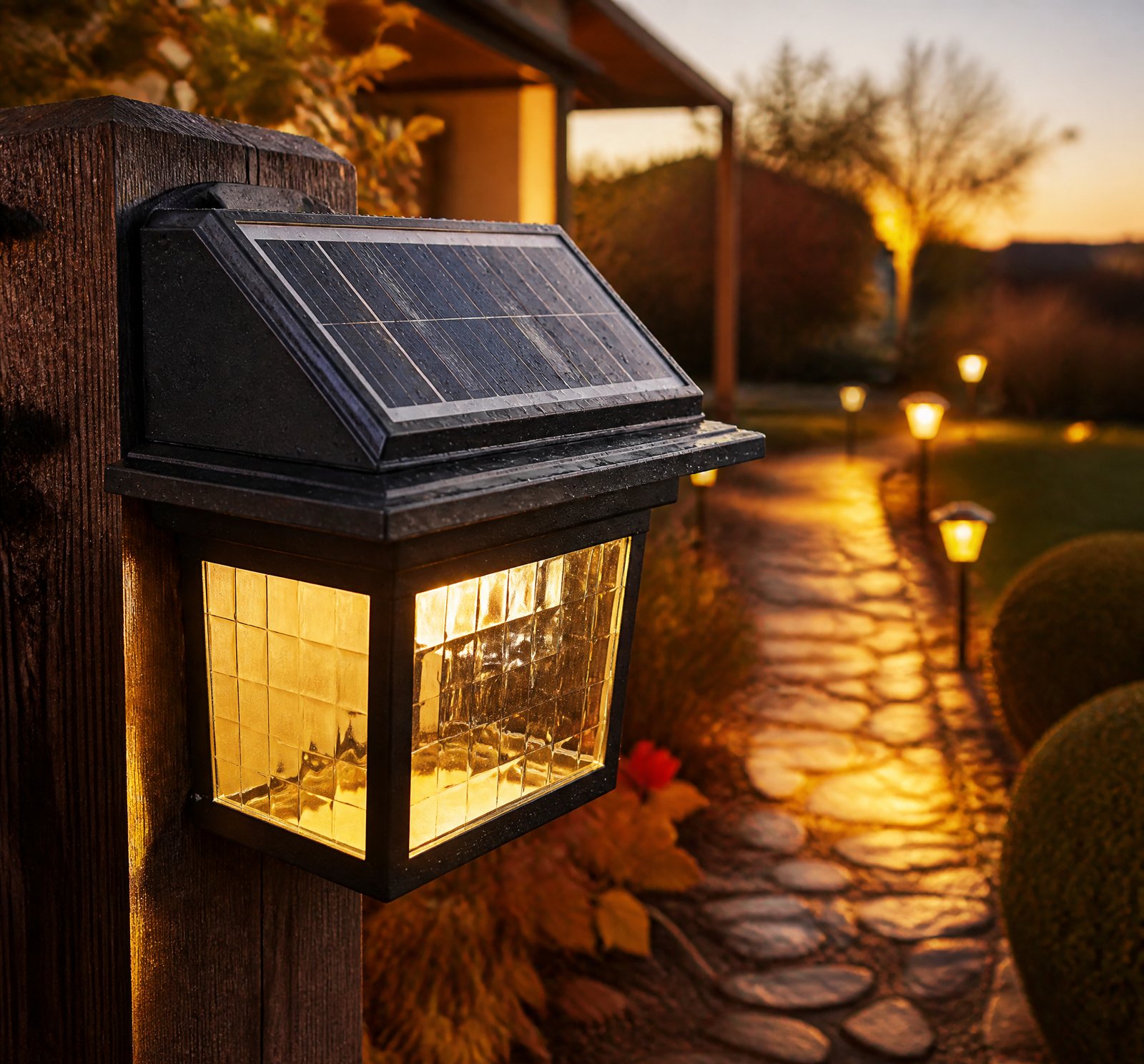
Quick answer: Cel mai frecvent component responsabil de defectarea prematură a lămpilor solare este circuitul de alimentare (driver), care este cel mai slab nod din sistem datorită sensibilității la temperatură [1]. Pentru a preveni această defecțiune înainte de cumpărare, verifică autonomia în condiții de cer înnorat (în ore) și caracteristica L80 (menținerea fluxului luminos la 80% după un an). Prezența unui BMS și a unui controler MPPT/PWM de calitate este esențială pentru protejarea bateriei.
Luminile solare au devenit o soluție populară pentru iluminat exterior în România, oferind economii de energie și independență față de rețeaua electrică. Totuși, mulți consumatori se confruntă cu un fenomen repetat: lămpile își pierd funcționalitatea după doar câțiva ani, uneori chiar mai repede. Ce factor îi face să eșueze înainte de termenul de garanție? Cercetările arată clar că răspunsul nu este acela pe care-l așteptăm.
Componenta care cauzează cele mai multe defectări premature
Cel mai frecvent component responsabil de defectarea prematură a lămpilor solare este circuitul de alimentare (driver). Un studiu DOE privind lumini LED exterioare a arătat că driverul a fost responsabil de aproape 60% dintre defectele catastrofale, în timp ce propriile diode LED au fost defecte doar în 10% din cazuri [1]. Această proporție este semnificativă și indică o vulnerabilitate structurală majoră în sistemele de iluminat LED, mai ales în condiții de mediu extrem — vară fierbinte, ierni reci, umiditate.
Vulnerabilitatea termică a componentelor
Driverul este afectat grav de temperatură, în conformitate cu modelul Arrhenius, care prevede o dublare a duratei de viață pentru fiecare scădere de 10 °C a temperaturii într-o anumită gamă limitată [1]. În România, unde temperaturile de vară pot atinge 35-40°C, un driver slab încălzit poate degrada rapid. Un design eficient care include izolație termică, ventilare sau materiale de înaltă conductivitate termică poate preveni această degradare [1][8].
Alte componente critice și riscuri de mediu
Pe lângă driver, alte componente sunt vulnerabile la stres mecanic: cabluri, prize, jack-uri și comutatoare sunt frecvent defectate în condiții de utilizare intensă sau de securitate, mai ales în zonele rurale unde lămpile sunt mutate din cauza riscului de furt [4]. În zonele costale sau industriale, coroziunea cauzată de aerul sărat poate deteriora rapid corpul metalic, iar apa care pătrunde prin fisuri poate afecta bateria și circuitul intern [14].
Riscuri legate de panou și sticlă
Deși panoul solar este esențial, nu este cel mai frecvent cauză de defectare. Studiile arată că panourile au o rată redusă de eșec, iar în unele proiecte, aceasta a fost chiar mai mică după 2000 [16]. Totuși, reducerea greutății prin sticlă mai subțire crește riscul de fracturare, mai ales în condiții de încălzire neuniformă sau impact mecanic [8][10]. Diferențele de producție între loturi pot duce la o diferență de până la un ordin de mărime în numărul de crăpături [8].
Prevenirea degradării bateriei
Bateria este altă sursă de probleme, mai ales în cazul descărcării profunde. Sursele nu indică direct că este cea mai frecvent defectată, dar evidențiază că durata de viață scurtă este legată de calitatea sistemului de management al bateriei (BMS) [4]. Un BMS eficient previne descărcarea profundă, prelungind semnificativ viața bateriei LiFePO4 [4].
Măsură specifică de evaluare înainte de cumpărare
Pentru a evalua fiabilitatea înainte de cumpărare, verifică:
– Autonomia în condiții de cer înnorat, exprimată în ore
– Caracteristica L80 (menținerea fluxului luminos la 80% după un an)
– Prezența unui BMS și a unui controler MPPT/PWM de calitate
| Caracteristică | Importanță | Cauză de risc dacă este absentă |
|---|---|---|
| BMS (Management Baterie) | Foarte mare | Descărcare profundă, viață scurtă baterie [4] |
| Controler MPPT/PWM | Mare | Eficacitate de încărcare redusă, pierderi energetice |
| Design termic | Esențial | Încălzire excesivă a driverului [1] |
| Izolație termică | Important | Degradare rapidă a componentelor interne [1] |
Concluzii cheie
- Driverul este cel mai slab nod din sistemul de iluminat LED, responsabil de 60% dintre defecte [1].
- Încălzirea excesivă din cauza temperaturii este un factor major de degradare [1].
- Autonomia în condiții de cer înnorat și L80 sunt măsuri măsurabile pentru a evalua fiabilitatea înainte de cumpărare.
- BMS și controler de calitate sunt esențiale pentru prevenirea degradării premature a bateriei.
- Designul termic și materialele de înaltă calitate reduc riscul de eșec [8][10].
Întrebări frecvente
Ce înseamnă L80 în contextul lămpilor solare?
L80 înseamnă că lampa va menține 80% din fluxul luminos inițial după un an de funcționare. Este o măsură standard pentru durabilitatea LED-urilor.
De ce BMS este important pentru bateria unei lămpi solare?
BMS protejează bateria împotriva descărcării profunde, care scurtează semnificativ durata de viață. Este esențial pentru bateriile LiFePO4 [4].
Poate un panou solar să se fractureze spontan?
Da. Datorită sticlei mai subțiri pentru reducerea costurilor, riscul de fracturare spontană crește, mai ales la încălzire neuniformă sau impact mecanic [8][10].
References
- [1] What Happened To The 100000-Hour LED Bulbs – Hackaday — authority
source passage
might be responsible for failures. The US Department of Energy (DoE)’s solid-state lighting program supports research and development of LED technologies, and their website contains volumes of data on LED lighting systems. Their Lifetime and Reliability Fact Sheet contains data on the failure rate of 5,400 outdoor lamps over 34 million hours of operation. Interestingly, the LEDs themselves account for only 10% of the failures; driver circuitry, on the other hand, was responsible almost 60% of the time. The remainder of failures were due to housing problems, which may not be as applicable for bulbs in indoor use. This data shows that at least for catastrophic failures (where the lamp ceases to emit light), extending lifetime means improving the power supplies. Locate the Weakest Link: Component Lifetime The lifetime of a bulb (or power supply) can be no longer than the lifetime of any of its components. Among the components found inside the bulbs, two stand out as life-limiters: the semiconductors and the electrolytic capacitors. Both of these components suffer from a failure rate that is a strong function of temperature. The typical model for this effect, based on the Arrhenius equation, predicts a doubling of lifetime for each 10 degree Celsius decrease in temperature, at least over a limited range. The two longer-lived bulbs use twice as many packages to carry approximately the same number of LED dice as the GE Basic lamp, decreasing thermal resistance to their respective h
- [4] Impacts of PicoPV and Consumer Research – energypedia — authority
source passage
Outstanding Products). Particular technical improvements concluded from the Ugandan field tests are: manufacturers need to improve products’ solar fraction, equip lamps only with advanced charge controllers, and work on the robustness of the products, and of the connection parts in particular. Problems were: frequent deep-discharge of batteries, low battery life-spans and overall unsatisfactory lighting service were the frequently observed. Apart from that, the components that most often caused lamps to fail were cables, plugs, input jacks and switches. These parts are obviously under extreme stress when lamps are in everyday use by extended families with several children, and when modules are put down for charging on the ground in the courtyard (while lamps are kept inside to protect them against thieves). [1] In Ethiopia, broken switches and deeply discharged batteries were a frequent problem. Robustness has to be improved as well, because users often carry their systems around due to fear of theft. General Experiences Field Tests The GIZ PicoPV country survey results underpin that an ‘one-size-fits-all’ lamp model does not exist. The lamp models were rated differently by users across different continents, and they were liked and disliked for different reasons. However, there are some aspects that turned out to be important for consumers in all the test countries. Aspect's Customers Above all, light quality, including the size of the light cone and light intensity, mattered
- [8] Understanding and preventing PV module glass fracture — authority
source passage
# Understanding and preventing PV module glass fracture Source: Blog/Web URL: https://www.vde.com/en/vde-americas/newsroom/pv-module-glass-fracture-byline?trk=public_post_comment-text Author: Date: 2025-09-19 Solar glass fracture is a probabilistic event that occurs based on a combination of internal and external factors, many of which are hiding in plain sight. As an example, module manufacturers have largely continued to treat solar glass as a commodity—meaning it is rarely subject to batch traceability or lot tracking—even though tempering process control becomes more important as modules get bigger, as shown in Figure 6. Meanwhile, forensic analysis has revealed evidence that glass supply chain plays at least some role in the proliferation of low-energy glass fracture. “A developer came to RETC recently with two side-by-side projects,” recounts Kedir. “While both sites used modules from the same manufacturer, the number of cracks exhibited on one site was an order of magnitude higher than the other. Testing modules from the site experiencing glass failure, we found that 75% of samples tested under the design load rating. It turned out that the modules at these side-by-side sites came from two different production lines, each supplied by a different glass manufacturer.” If a change in glass vendor at the point of production can account for an order of magnitude difference in early mortality in the field, why isn’t this variable part of a standard bill of materials (BOM) ve
- [10] Solar modules under pressure The growing risk of spontaneous — magazine
source passage
# Solar modules under pressure: The growing risk of spontaneous glass breakage – pv magazine Global Source: Blog/Web URL: https://www.pv-magazine.com/2026/01/15/solar-modules-under-pressure-the-growing-risk-of-spontaneous-glass-breakage/ Author: Alexia Chappond et Gauthier Dambrine; Skyray; Pv Magazine Date: 2026-01-15 Solar modules under pressure: The growing risk of spontaneous glass breakage With the rapid growth of solar photovoltaics, module reliability has become a central issue for the industry. Among the quality problems that have emerged recently, spontaneous glass breakage is attracting increasing attention. Long considered isolated incidents, glass breakages are now becoming more frequent, revealing the limitations of certain industrial choices and the need for heightened vigilance. The rise of solar energy has been accompanied by the constant evolution of technologies and manufacturing processes. To meet global demand and reduce costs, many manufacturers have opted for larger, more powerful, but also lighter modules. A lighter module has the undeniable advantage of reducing the weight on structures, and therefore the costs of the building structure. With glass representing more than half the module’s weight, this quest for lightness has naturally led to the use of increasingly thinner glass. While this development allows for lighter structures and simplifies logistics, it has consequences for the robustness of the modules. Indeed, thinner glass, even if tempered,
- [14] Solar Street Light From Germany Why Solar Street Lighting Fails in Storms Structural Integrity for EPC Projects yvEyflD92L4 — youtube
source passage
# Why Solar Street Lighting Fails in Storms? (Structural Integrity for EPC Projects) Source: YouTube — Solar Street Light From Germany URL: https://www.youtube.com/watch?v=yvEyflD92L4 Video ID: yvEyflD92L4 Transcript: generated The long-term durability of a solar street lighting project doesn't depend only on the battery. It also depends on how strong and stable the structure is. Often, lights collapse during powerful storms or the body corrodes within just a few months due to salty air. This puts your entire investment at serious risk. Why do such mechanical failures occur? In today's technical discussion, we'll explore the real secrets behind the durability of solar street lighting systems. In coastal or industrial areas, salt in the air causes iron or regular steel bodies to oxidize quickly and develop rust. Once holes form in the structure, rainwater can directly reach the battery and circuitry, rendering the entire system unusable. On the other hand, low-quality plastic bodies tend to crack under excessive sunlight. Once this kind of damage begins, it becomes nearly impossible to repair and significantly increases the overall project cost. When lights are installed on tall poles, wind pressure or wind load increases significantly. If the bracket or overall mechanical design isn't properly engineered, even winds of 100 km/h can cause the light to detach from the pole and fall. This is not only a financial loss, but also a serious safety hazard. We need to understand why m
- [16] How long do residential solar panels last pv magazine International — authority
source passage
study found a median failure rate of 5 panels out of 10,000 annually. Panel failure has improved markedly over time, as it was found that systems installed between 1980 and 2000 demonstrated a failure rate double the post-2000 group. (Read: “Top solar panel brands in performance, reliability and quality“) System downtime is rarely attributed to panel failure. In fact, a study by kWh Analytics found that 80% of all solar plant downtime is a result of failing inverters, the device that converts the panel’s DC current to usable AC. pv magazine will analyze inverter performance in the next installment of this series.
might be responsible for failures. The US Department of Energy (DoE)’s solid-state lighting program supports research and development of LED technologies, and their website contains volumes of data on LED lighting systems. Their Lifetime and Reliability Fact Sheet contains data on the failure rate of 5,400 outdoor lamps over 34 million hours of operation. Interestingly, the LEDs themselves account for only 10% of the failures; driver circuitry, on the other hand, was responsible almost 60% of the time. The remainder of failures were due to housing problems, which may not be as applicable for bulbs in indoor use. This data shows that at least for catastrophic failures (where the lamp ceases to emit light), extending lifetime means improving the power supplies. Locate the Weakest Link: Component Lifetime The lifetime of a bulb (or power supply) can be no longer than the lifetime of any of its components. Among the components found inside the bulbs, two stand out as life-limiters: the semiconductors and the electrolytic capacitors. Both of these components suffer from a failure rate that is a strong function of temperature. The typical model for this effect, based on the Arrhenius equation, predicts a doubling of lifetime for each 10 degree Celsius decrease in temperature, at least over a limited range. The two longer-lived bulbs use twice as many packages to carry approximately the same number of LED dice as the GE Basic lamp, decreasing thermal resistance to their respective h
Outstanding Products). Particular technical improvements concluded from the Ugandan field tests are: manufacturers need to improve products’ solar fraction, equip lamps only with advanced charge controllers, and work on the robustness of the products, and of the connection parts in particular. Problems were: frequent deep-discharge of batteries, low battery life-spans and overall unsatisfactory lighting service were the frequently observed. Apart from that, the components that most often caused lamps to fail were cables, plugs, input jacks and switches. These parts are obviously under extreme stress when lamps are in everyday use by extended families with several children, and when modules are put down for charging on the ground in the courtyard (while lamps are kept inside to protect them against thieves). [1] In Ethiopia, broken switches and deeply discharged batteries were a frequent problem. Robustness has to be improved as well, because users often carry their systems around due to fear of theft. General Experiences Field Tests The GIZ PicoPV country survey results underpin that an ‘one-size-fits-all’ lamp model does not exist. The lamp models were rated differently by users across different continents, and they were liked and disliked for different reasons. However, there are some aspects that turned out to be important for consumers in all the test countries. Aspect's Customers Above all, light quality, including the size of the light cone and light intensity, mattered
# Understanding and preventing PV module glass fracture Source: Blog/Web URL: https://www.vde.com/en/vde-americas/newsroom/pv-module-glass-fracture-byline?trk=public_post_comment-text Author: Date: 2025-09-19 Solar glass fracture is a probabilistic event that occurs based on a combination of internal and external factors, many of which are hiding in plain sight. As an example, module manufacturers have largely continued to treat solar glass as a commodity—meaning it is rarely subject to batch traceability or lot tracking—even though tempering process control becomes more important as modules get bigger, as shown in Figure 6. Meanwhile, forensic analysis has revealed evidence that glass supply chain plays at least some role in the proliferation of low-energy glass fracture. “A developer came to RETC recently with two side-by-side projects,” recounts Kedir. “While both sites used modules from the same manufacturer, the number of cracks exhibited on one site was an order of magnitude higher than the other. Testing modules from the site experiencing glass failure, we found that 75% of samples tested under the design load rating. It turned out that the modules at these side-by-side sites came from two different production lines, each supplied by a different glass manufacturer.” If a change in glass vendor at the point of production can account for an order of magnitude difference in early mortality in the field, why isn’t this variable part of a standard bill of materials (BOM) ve
# Solar modules under pressure: The growing risk of spontaneous glass breakage – pv magazine Global Source: Blog/Web URL: https://www.pv-magazine.com/2026/01/15/solar-modules-under-pressure-the-growing-risk-of-spontaneous-glass-breakage/ Author: Alexia Chappond et Gauthier Dambrine; Skyray; Pv Magazine Date: 2026-01-15 Solar modules under pressure: The growing risk of spontaneous glass breakage With the rapid growth of solar photovoltaics, module reliability has become a central issue for the industry. Among the quality problems that have emerged recently, spontaneous glass breakage is attracting increasing attention. Long considered isolated incidents, glass breakages are now becoming more frequent, revealing the limitations of certain industrial choices and the need for heightened vigilance. The rise of solar energy has been accompanied by the constant evolution of technologies and manufacturing processes. To meet global demand and reduce costs, many manufacturers have opted for larger, more powerful, but also lighter modules. A lighter module has the undeniable advantage of reducing the weight on structures, and therefore the costs of the building structure. With glass representing more than half the module’s weight, this quest for lightness has naturally led to the use of increasingly thinner glass. While this development allows for lighter structures and simplifies logistics, it has consequences for the robustness of the modules. Indeed, thinner glass, even if tempered,
# Why Solar Street Lighting Fails in Storms? (Structural Integrity for EPC Projects) Source: YouTube — Solar Street Light From Germany URL: https://www.youtube.com/watch?v=yvEyflD92L4 Video ID: yvEyflD92L4 Transcript: generated The long-term durability of a solar street lighting project doesn't depend only on the battery. It also depends on how strong and stable the structure is. Often, lights collapse during powerful storms or the body corrodes within just a few months due to salty air. This puts your entire investment at serious risk. Why do such mechanical failures occur? In today's technical discussion, we'll explore the real secrets behind the durability of solar street lighting systems. In coastal or industrial areas, salt in the air causes iron or regular steel bodies to oxidize quickly and develop rust. Once holes form in the structure, rainwater can directly reach the battery and circuitry, rendering the entire system unusable. On the other hand, low-quality plastic bodies tend to crack under excessive sunlight. Once this kind of damage begins, it becomes nearly impossible to repair and significantly increases the overall project cost. When lights are installed on tall poles, wind pressure or wind load increases significantly. If the bracket or overall mechanical design isn't properly engineered, even winds of 100 km/h can cause the light to detach from the pole and fall. This is not only a financial loss, but also a serious safety hazard. We need to understand why m
study found a median failure rate of 5 panels out of 10,000 annually. Panel failure has improved markedly over time, as it was found that systems installed between 1980 and 2000 demonstrated a failure rate double the post-2000 group. (Read: “Top solar panel brands in performance, reliability and quality“) System downtime is rarely attributed to panel failure. In fact, a study by kWh Analytics found that 80% of all solar plant downtime is a result of failing inverters, the device that converts the panel’s DC current to usable AC. pv magazine will analyze inverter performance in the next installment of this series.