
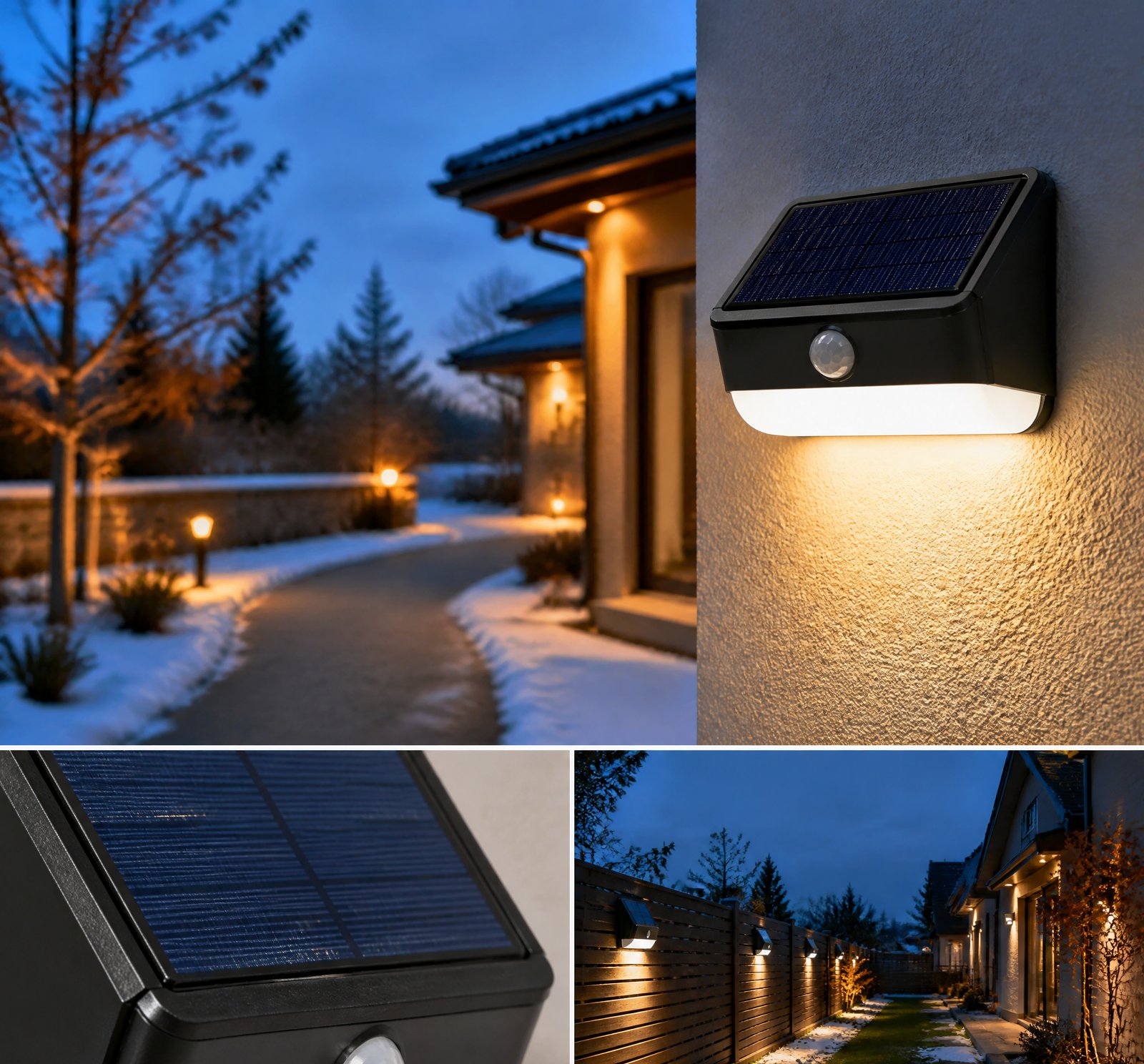
Quick answer: Pentru a verifica dacă afirmațiile privind lumeni, CCT și durata de viață ale unui panou solar sunt credibile, verifică prezența rapoartelor de testare independente conform standardelor IES LM-79 pentru flux luminos și LM-80 pentru menținerea fluxului, iar proiecțiile pe termen lung se bazează pe metoda TM-21-11 [2][7][15]. Atenție: standardele nu acoperă întreaga viață a sistemului, doar componente individuale [7][17].
În era iluminatului solar, promisiunile legate de performanță — 2000 de lumeni, durată de viață de 50.000 de ore sau o temperatură de culoare de 6500K — sunt frecvente în anunțuri. Dar cum poți fi sigur că aceste valori nu sunt doar marketing? Credibilitatea afirmațiilor depinde de standardele internaționale de testare, nu de promovarea producătorului.
Cum sunt reglementate valorile de lumeni și CCT?
Valorile de flux luminos (lumeni) și temperatură a culorii (CCT) sunt măsurate conform standardului IES LM-79-08, care definește metodele pentru măsurarea parametrilor fotometrice și electrice ai produselor LED [2][7]. Această metodă, cunoscută ca „fotometrie absolută”, necesită testarea întregului luminaire — panou solar inclus — în condiții standard, permițând o comparație obiectivă între produse [2][5]. Rezultatele LM-79 sunt esențiale pentru evaluarea performanței reale în condiții de utilizare efectivă, nu doar a LED-urilor izolate [2][25]. De asemenea, CCT-ul este măsurat în cadrul acestor standarde și poate fi monitorizat în timp pentru a evalua stabilitatea cromatică [2][7]. Sursele precum ANSI/NEMA C78.377-2017 permit clasificarea LED-urilor în „binuri”, asigurând uniformitatea într-o categorie, dar nu garantează că valoarea va rămâne constantă pe tot parcursul vieții [10].
Ce spune standardul LM-80 despre durata de viață?
Standardele nu oferă o măsură directă a duratei de viață a unui luminaire complet, ci se concentrează pe sursele LED. IES LM-80-08 stabilește o metodologie pentru măsurarea scăderii fluxului luminos a LED-urilor în condiții controlate, pe o perioadă minimă de 6.000 de ore, cu colectarea datelor la fiecare 1.000 de ore [1][7][25]. Testele sunt efectuate la trei temperaturi de caz diferite, în camere termice controlate, pentru a evalua impactul temperaturii asupra performanței [1][5]. Aceste rezultate nu sunt o măsură directă a duratei de viață, ci o bază pentru proiecții [7][17]. Deoarece testarea completă pentru 30.000–50.000 de ore ar fi impracticabilă, se aplică metoda TM-21-11, o metodologie acceptată în industrie care extrapolează datele LM-80 pentru a estima menținerea fluxului luminos pe termen lung [7][15][23]. TM-21-11 este esențială pentru a transforma datele de testare în informații utile pentru utilizator, dar nu este o metodă de certificare directă — doar o estimare [15][23].
Ce componente afectează performanța reală a unui panou solar?
Standardele LM-79 și LM-80 nu acoperă întreaga viață a unui luminaire. Performanța reală depinde de multe componente: driverul, sistemul de management al bateriei (BMS), izolația termică, carcasă, senzorul de mișcare și condițiile de mediu [5][25]. De exemplu, o baterie LiFePO4 cu izolație termică rezistentă la -25 °C poate menține performanța în condiții extreme, dar această caracteristică nu este testată în cadrul LM-79 sau LM-80 [25]. De asemenea, durata de viață este influențată de curentul de alimentare, temperatura în situs și ciclurile de încărcare/descărcare, care nu sunt direct măsurate în testele LM-80 [7][17]. Carcasa rezistentă la apă IP65 sau senzorii PIR și crepusculari sunt componente esențiale, dar nu sunt incluse în testele standard [5][25].
Cum poate un cumpărător verifica credibilitatea unui anunț?
Cumpărătorul nu trebuie să se bazeze doar pe declarațiile producătorului, ci să verifice dacă acestea sunt susținute de date reale și testate de laboratoare certificate [16]. Site-ul DOE CALiPER și baza de date LED Lighting Facts oferă informații neutre despre performanța produselor pe piață [8][16]. Acestea permit compararea valorilor reale de lumeni, CCT și eficiență cu cele declarate de producător. Programele de demonstrație precum GATEWAY, susținute de Departamentul de Energie al SUA, oferă date empirice din aplicații reale, cum ar fi iluminatul în muzeu sau spații publice [19]. În plus, standardele nu prevăd un „pas/fail” pentru testele de menținere a fluxului luminos — scopul este înregistrarea degradării, nu impunerea unei limite stricte [23]. Acest lucru înseamnă că un produs poate fi considerat „bun” chiar dacă lumenii scad sub o anumită valoare, atâta timp cât scăderea este corect documentată [23].
Comparativ: Standarde vs. Realitatea de pe teren
| Standard | Ce măsoară | Limitări | Sursa |
|---|---|---|---|
| IES LM-79 | Flux luminos, eficiență, CCT, CRI | Doar componenta LED în luminaire complet | [2][7] |
| IES LM-80 | Degradarea fluxului LED pe 6.000+ ore | Nu include sistemul complet, doar sursa | [1][5] |
| TM-21-11 | Proiecții de menținere luminosă | Estimare, nu certificare directă | [7][15][23] |
Concluzii cheie
- Afirmațiile de performanță trebuie verificate prin rapoarte de testare independente conform IES LM-79 și LM-80 [2][7].
- Proiecțiile de durată de viață se bazează pe metoda TM-21-11, dar nu sunt garanții absolute [15][23].
- Standardele nu acoperă degradarea sistemului în ansamblu, doar componente individuale [7][17].
- Valorile de 2000 de lumeni sau 6500K CCT nu sunt garantate pe termen lung fără documentație de testare adecvată [2][10].
- Cumpărătorul poate folosi resurse neutre precum LED Lighting Facts și DOE CALiPER pentru verificare [8][16].
Întrebări frecvente
Ce înseamnă un raport LM-79 pentru un panou solar?
Înseamnă că fluxul luminos, eficiența, CCT și CRI au fost măsurate în condiții reale pentru întregul luminaire, nu doar pentru LED-uri izolate [2][7].
De ce durata de viață a unui panou solar nu este garantată de standardele LM-80?
Deoarece LM-80 testează doar sursa LED, nu întregul sistem, inclusiv driver, baterie sau senzori, care pot afecta durata reală [7][17].
Cum poate un cumpărător verifica dacă un anunț are valoare?
Prin verificarea prezenței rapoartelor LM-79/LM-80 și compararea valorilor cu bazele de date neutre precum LED Lighting Facts [8][16].
References
- [1] Labeling and Certification Testing Issues by UL LED professional — authority
source passage
is necessary and what affects the workflow of the certification process. His main aim is to clarify the time it takes to test LED lighting products for the applicable industry performance standards and to qualify products for the EPA Energy Star program. There are two approved methods for LED light sources that result in replicable test measurements and a reliable comparison of test data that is generated by different laboratories. IES LM-80-08 “Measuring Lumen Maintenance of LED Light Sources” contains a process whereby changes in light output are measured under controlled conditions. This testing is typically conducted by the manufacturer of the individual LED light source. That data is then supplied to an end-user so that it may be utilized in future qualification testing. IES LM-79-08 “Electrical and Photometric Measurements of Solid-State Lighting Products” describes the test methods for measuring Solid-State lighting luminaires or lamps. These test methods incorporate the use of absolute photometry for testing these products rather than relative photometry which had been the industry standard. Figure 3: Typical lumen maintenance temperature parameter measuring points for LM-80 test Test durations for each of these standards vary and can be summarized as the following: • For LM-80 testing, the units under test (UUT) will be driven for a period of at least 6,000 hours (250 days) under specified ambient conditions. Photometric and Chromaticity data is collected initially a
- [2] Knowledge Base — authority
source passage
of solid-state components is significantly affected by the design parameters of the lighting fixture, so a new photometric testing standard was established called LM-79-08. This testing standard, referred to as “Absolute Photometry”, requires that all components be tested within the luminaire under standard operating and environmental conditions, allowing for meaningful comparisons of fixture performance. LM-79-08 reports lumen output, efficacy, color temperature (CCT) and color rendering (CRI). Our LED products are tested in accordance with LM-79-08 by independent testing laboratories certified by the United States Department of Energy to ensure accuracy.
- [5] Lumen-maintenance testing for LED lamps light engines Buildings — authority
source passage
auxiliary equipment and fixtures. These conditions are not accounted for in the LM-80 testing of LED sources. As a result, it may become necessary for the IES to provide recommendations on these test conditions, and test methods would need to be designed to give comparable results when adopted by various testing laboratories. A lumen-maintenance test standard for LED lamps, engines and luminaires is still being developed, with multiple drafts created, and some preliminary balloting already completed. Different from the LM-80 test standard, this new document will address the tests that are more uniquely applicable to LED lighting systems, including temperature conditions, operational duty cycle and test duration. For LED sources, LM-80 recommends three case temperatures at which testing is performed. Often, the LEDs being tested are placed in temperature-controlled thermal chambers with sophisticated active-cooling systems. These precisely set the LED case temperatures to meet test requirements, with each test running for a minimum of 6000 hours at each case temperature. It can be cost-prohibitive and impractical to test entire LED light systems – such as large luminaires for outdoor roadway lighting fixtures or chandeliers for indoor lighting – in the temperature-controlled chamber for long periods of time. Instead, the TPC recommends LED lighting systems be tested in a condition as close as possible to the installation orientation and mounting method, which in many cases is
- [7] Knowledge Base — authority
source passage
environment. The gasket will not shrink over time giving year after year of reliable service. LED Testing Standards LM-80-08 LM-80-08 is the latest testing standard for LED diodes and applies to the LED sources in a standard test environment, independent of a specific lighting fixture. Testing is performed for a minimum of 6,000 hours with data collection every 1,000 hours. During testing, LEDs are assessed for failure, chromaticity, luminous flux, color temperature (CCT) and color rendering (CRI). LM-80-08 allows the creation, by LED manufacturers, of predicted life charts to establish expected design life. It is not a direct measure of LED system performance, but it will provide the lighting professional with assurance that the LEDs used in our products have been tested for chromaticity stability and predicted lumen maintenance. We only use chips that have been tested to this standard. TM-21-11 TM-21-11is an industry accepted statistical method that utilizes LM-80-08 data combined with specific fixture measurements to project long-term lumen maintenance of LED light sources. LEDs, by their nature, will last a very long time when utilized in a properly designed environment, but this performance is dependent on the design parameters of the actual fixture. Drive current, in-situ temperature and other environmental factors can dramatically affect useful LED life. TM-21-11 gives the lighting professional a basis to judge long-term lumen maintenance life expectancy of a specific
- [8] LED Lighting in Museums and Art Galleries Technical – Canadaca — authority
source passage
Kerschner, Director of Preservation and Conservation, Shelburne Museum, U.S.; and – the numerous company representatives in the lighting industry who shared their products with us for laboratory testing. The first version of this Technical Bulletin was prepared as a guide book for a lighting workshop conducted at CCI in the summer of 2011. Further revisions were made between 2011 and 2016 as numerous designers and conservators requested the guide and reacted to it, and because of the rapid growth of the literature and products. We appreciate the queries, comments and advice of the workshop participants and subsequent readers. The Bulletin was completely revised in 2018, particularly the sections on damage and on preferred colour temperature, the latter based on presentations given at the 1st International Museum Lighting Symposium and Workshops in 2017. Jean Tétreault assisted with technical aspects and terminology in the French version of the Bulletin. Technical sources of information LED lamps listed by CRI and R9 One can search for LED lamps of a particular CRI and R9 (as well as bulb type, size, etc.) on the EnergyStar Light Bulbs website and in the LED Lighting Facts database (consult endnote 1). Product testing (CALiPER) Solid-state lighting (SSL) technologies are changing and improving rapidly, and products arriving on the market exhibit a wide range of performances. (LED lamps are a subset of SSL.) The DOE Solid-State Lighting Program supports testing of a wide array
- [10] Glossary – DesignLights Consortium — authority
source passage
methodology. The manufacturer must provide a description of the scaling methodology employed and the technical basis for its validity. A list of candela values corresponding to each vertical angle of photometry. The order of the candela values shall exactly correspond to the list of vertical angles. Successive planes are listed in a sequence corresponding to the list of horizontal angles. A grouping of SSL products by broad application type. Eligible categories include indoor luminaires, indoor retrofit kits, outdoor luminaires, outdoor retrofit kits, linear replacement lamps, mogul screw-base replacements for HID lamps, and four pin-base replacement lamps for CFLs. The IES defines bin as “A restricted range of LED performance characteristics used to delimit a subset of LEDs near a nominal LED performance as identified by chromaticity, photometry, and/or forward-voltage performance.” Products within a CCT bin have been sorted by chromaticity according to ANSI/NEMA C78.377-2017. Products that have a control signal specifically for adjusting CCT while maintaining nominally constant lumen output. These products may include a second, independent dimming control. CCT-Tunable products generally include products that combine the output of two LED primaries and products with three or more white and/or RGB LED primaries, so long as they only produce light in standardized quadrangles as defined in ANSI/NEMA C78.377-2024 in response to their control signal. All products are required to
- [15] Understanding the difference between LED rated life and Buildings — authority
source passage
# Understanding the difference between LED rated life and lumen-maintenance life (MAGAZINE) Source: Blog/Web URL: https://www.buildings.com/home/article/55259473/understanding-the-difference-between-led-rated-life-and-lumen-maintenance-life-magazine Author: Date: 2011-10-21 With the completion of the IES test method TM-21-11 (see page 9), the SSL industry now has a standard method of obtaining long-term lumen-maintenance information for LED light sources. The method is made up of two steps. First, the LED light sources must be tested per LM-80. The new TM-21 method is then applied to the collected measurement data to make lumen-maintenance projections, including in-situ temperature calculations. However, there is still one measure that is missing: the rated life for LED light sources. Rated life is an essential reliability property for LED integrators that design LED luminaires, providing luminaire users with warranty and usage information Rated life The rated life of a lamp or light source is defined, per ANSI/IES RP-16, as “the life value assigned to a particular type lamp. This is commonly a statistically-determined estimate of median operational life.” The rated life in hours of an LED lamp or light source, specified by the manufacturer, applies under certain operational conditions and for defined failure criteria. The statistical measure for the rated life is designated Bp and is measured in hours, where p is a percentage. For example, a B50 rated life of 1,000 hours mea
- [16] LED Lighting in Museums and Art Galleries Technical – Canadaca — authority
source passage
Obtain LM-79 reports (lamp characteristics) from lamp manufacturers. – Check the DOE CALiPER website for impartial test data. – Check the EnergyStar Light Bulbs website and the LED Lighting Facts database (consult endnote 1) for characteristics of products currently available on the market. – Consult Technical details for larger projects. Purchase trial lamps – Once you have made preliminary decisions on several candidate lamps, purchase a few and evaluate them in situ, preferably with colleagues. Check the appearance of the lamp from the side for glare. Check the appearance of the light on blank walls. Check the appearance of the objects illuminated by the lamp. Check the appearance of your skin under the lamp (we are especially attuned to how our skin should look under good-quality light). – If you purchased dimmers, test them with the lamps. Check for flicker across the whole range of intensities. – Test trial lamps, especially those you are considering for purchase, in the fixtures planned for use for as long as possible, and at least a week, to see if they change colour or overheat and fail. Before purchasing large numbers of lamps – Ask for products from companies you know or whom you trust or that have a documented support history. – Get a written warranty that encompasses light output, colour variation (Duv) over time as well as failure of chips and electronics, and which includes labour. A one-year warranty is common, but for longer periods of time the coverage may b
- [17] LED Life Standards In And Out Of Luminaires – Electronic Design — magazine
source passage
is progress. An Illuminating Engineering Society of North America standard (designated LM-80, IESNA Approved Method for Measuring Lumen Maintenance of LED Light Sources) will provide a common procedure for making lumen maintenance measurements at the LED device, array, or module levels. As of last September, the IES committee that developed LM-80 voted to move the initiative to the IES board of directors for final approval. Still, the DoE notes, as “the lifetime of an LED source is one important indicator of LED luminaire life, it would be misleading to rate the entire LED luminaire based solely on the LED source. There is often a huge gap between the warranted life of a product and the expected life of the LED source in that product. Further, reliability of fixtures that include replaceable LED engines and replaceable components should be assessed differently than reliability of entirely integrated fixtures.” Don Tuite (retired) writes about Analog and Power issues for Electronic Design’s magazine and website. He has a BSEE and an M.S in Technical Communication, and has worked for companies in aerospace, broadcasting, test equipment, semiconductors, publishing, and media relations, focusing on developing insights that link technology, business, and communications. Don is also a ham radio operator (NR7X), private pilot, and motorcycle rider, and he’s not half bad on the 5-string banjo.
- [19] LED Lighting in Museums and Art Galleries Technical – Canadaca — authority
source passage
at 6000 hours, with 10,000 hours preferred, and repeated testing was determined to be needed every 1000 hours. Since the LM-80 only documents lumen maintenance for the period of time it is conducted, a separate estimate method for lifetime (TM-21) is in development. These reports should be available on the manufacturer’s website or upon request. GATEWAY demonstrations This program supports demonstration projects of high-performance SSL products. The purpose is to capture empirical data and experience with in-the-field applications that save energy, are cost effective and maintain or improve light levels. These provide a source of independent, third-party data for use in decision making by users and lighting designers. The GATEWAY Program staff suggests that this data be considered in combination with other information relevant to the particular site and application under examination (DOE 2010). To date, the GATEWAY Program has documented one museum application, at the Field Museum, Chicago, Illinois, in November 2010. Other museums are being considered, including several art museums. Since all GATEWAY Program museum reports can be downloaded online, this is a good place to start examining the issues you are likely to experience. Note that the evaluation questionnaire and the analysis of simple payback from the Field Museum have been adapted and included in the present Bulletin. Replacements for linear lighting (fluorescent lamps) Replacing fluorescent lamps with LED lamps rai
- [23] New standards will enable lumen maintenance projections Buildings — authority
source passage
luminaires, and possibly other components as well. These lumen maintenance- related tests are in addition to the commonly practiced qualification tests used by manufacturers. Typically when measureable characteristics, such as luminous flux or color, are determined, these maintenance tests are running in normal operational and environmental conditions, but for much longer than qualification or stress test time periods. This is based on the idea that LED and SSL product performance decay behavior can only be authentically tracked with such tests if the acceleration factors are not standardized. There are no pass/fail criteria for these maintenance tests. Their goal is to record product decay results or operation failure of the product during the test. The more important and more practical need is to correctly interpret the test results so that both SSL makers and users will know the product performance status after long-term use, e.g., 30,000 – 50,000 hrs. TM-21-11 has addressed the issue for LEDs. With LM-84 almost complete, the industry also needs a consistent, reasonable, and reliable approach to use the LM-84 test results to make projections. Thus, IES TPC is developing a new document, TM-28, to meet this need. The basic principles of TM-28 should be the same as in TM-21-11: • The projection must be based on average test data, discounting the tested units that stop working during the test. • The mathematical basis used in TM-28 should not deviate from TM-21-11. • The proje
- [25] Lumen-maintenance testing for LED lamps light engines Buildings — authority
source passage
# Lumen-maintenance testing for LED lamps, light engines and luminaires (MAGAZINE) Source: Blog/Web URL: https://www.buildings.com/architecture/interiors/article/55255355/lumen-maintenance-testing-for-led-lamps-light-engines-and-luminaires-magazine Author: Date: 2012-02-02 +++++ This article was published in the February 2012 issue of LEDs Magazine. View the Table of Contents and download the PDF file of the complete February 2012 issue. +++++ It is widely understood that measuring lumen maintenance is critically important for determining the life of LED lighting products. In the past few years, the Illuminating Engineering Society of North America (IESNA) has developed two test methods that address the lumen maintenance of LED light sources used in such products. LM-80 is an approved method for measuring lumen depreciation of LED light sources, and TM-21 is a technical memorandum which specifies how to extrapolate the LM-80 data in order to make long-term lumen-maintenance projections. Beyond the LED, other components at the LED lighting-system level also can impact the long-term lumen maintenance. These components include, but are not limited to, LED lamps, engines, luminaires, drivers, thermal-management devices and optical components. Over time, these components may experience some change or degradation. In particular, the plastic elements used in the optics may change in several ways, including light transmittance, haze and undesired color change. In turn, the overall li
is necessary and what affects the workflow of the certification process. His main aim is to clarify the time it takes to test LED lighting products for the applicable industry performance standards and to qualify products for the EPA Energy Star program. There are two approved methods for LED light sources that result in replicable test measurements and a reliable comparison of test data that is generated by different laboratories. IES LM-80-08 “Measuring Lumen Maintenance of LED Light Sources” contains a process whereby changes in light output are measured under controlled conditions. This testing is typically conducted by the manufacturer of the individual LED light source. That data is then supplied to an end-user so that it may be utilized in future qualification testing. IES LM-79-08 “Electrical and Photometric Measurements of Solid-State Lighting Products” describes the test methods for measuring Solid-State lighting luminaires or lamps. These test methods incorporate the use of absolute photometry for testing these products rather than relative photometry which had been the industry standard. Figure 3: Typical lumen maintenance temperature parameter measuring points for LM-80 test Test durations for each of these standards vary and can be summarized as the following: • For LM-80 testing, the units under test (UUT) will be driven for a period of at least 6,000 hours (250 days) under specified ambient conditions. Photometric and Chromaticity data is collected initially a
of solid-state components is significantly affected by the design parameters of the lighting fixture, so a new photometric testing standard was established called LM-79-08. This testing standard, referred to as “Absolute Photometry”, requires that all components be tested within the luminaire under standard operating and environmental conditions, allowing for meaningful comparisons of fixture performance. LM-79-08 reports lumen output, efficacy, color temperature (CCT) and color rendering (CRI). Our LED products are tested in accordance with LM-79-08 by independent testing laboratories certified by the United States Department of Energy to ensure accuracy.
auxiliary equipment and fixtures. These conditions are not accounted for in the LM-80 testing of LED sources. As a result, it may become necessary for the IES to provide recommendations on these test conditions, and test methods would need to be designed to give comparable results when adopted by various testing laboratories. A lumen-maintenance test standard for LED lamps, engines and luminaires is still being developed, with multiple drafts created, and some preliminary balloting already completed. Different from the LM-80 test standard, this new document will address the tests that are more uniquely applicable to LED lighting systems, including temperature conditions, operational duty cycle and test duration. For LED sources, LM-80 recommends three case temperatures at which testing is performed. Often, the LEDs being tested are placed in temperature-controlled thermal chambers with sophisticated active-cooling systems. These precisely set the LED case temperatures to meet test requirements, with each test running for a minimum of 6000 hours at each case temperature. It can be cost-prohibitive and impractical to test entire LED light systems – such as large luminaires for outdoor roadway lighting fixtures or chandeliers for indoor lighting – in the temperature-controlled chamber for long periods of time. Instead, the TPC recommends LED lighting systems be tested in a condition as close as possible to the installation orientation and mounting method, which in many cases is
environment. The gasket will not shrink over time giving year after year of reliable service. LED Testing Standards LM-80-08 LM-80-08 is the latest testing standard for LED diodes and applies to the LED sources in a standard test environment, independent of a specific lighting fixture. Testing is performed for a minimum of 6,000 hours with data collection every 1,000 hours. During testing, LEDs are assessed for failure, chromaticity, luminous flux, color temperature (CCT) and color rendering (CRI). LM-80-08 allows the creation, by LED manufacturers, of predicted life charts to establish expected design life. It is not a direct measure of LED system performance, but it will provide the lighting professional with assurance that the LEDs used in our products have been tested for chromaticity stability and predicted lumen maintenance. We only use chips that have been tested to this standard. TM-21-11 TM-21-11is an industry accepted statistical method that utilizes LM-80-08 data combined with specific fixture measurements to project long-term lumen maintenance of LED light sources. LEDs, by their nature, will last a very long time when utilized in a properly designed environment, but this performance is dependent on the design parameters of the actual fixture. Drive current, in-situ temperature and other environmental factors can dramatically affect useful LED life. TM-21-11 gives the lighting professional a basis to judge long-term lumen maintenance life expectancy of a specific
Kerschner, Director of Preservation and Conservation, Shelburne Museum, U.S.; and – the numerous company representatives in the lighting industry who shared their products with us for laboratory testing. The first version of this Technical Bulletin was prepared as a guide book for a lighting workshop conducted at CCI in the summer of 2011. Further revisions were made between 2011 and 2016 as numerous designers and conservators requested the guide and reacted to it, and because of the rapid growth of the literature and products. We appreciate the queries, comments and advice of the workshop participants and subsequent readers. The Bulletin was completely revised in 2018, particularly the sections on damage and on preferred colour temperature, the latter based on presentations given at the 1st International Museum Lighting Symposium and Workshops in 2017. Jean Tétreault assisted with technical aspects and terminology in the French version of the Bulletin. Technical sources of information LED lamps listed by CRI and R9 One can search for LED lamps of a particular CRI and R9 (as well as bulb type, size, etc.) on the EnergyStar Light Bulbs website and in the LED Lighting Facts database (consult endnote 1). Product testing (CALiPER) Solid-state lighting (SSL) technologies are changing and improving rapidly, and products arriving on the market exhibit a wide range of performances. (LED lamps are a subset of SSL.) The DOE Solid-State Lighting Program supports testing of a wide array
methodology. The manufacturer must provide a description of the scaling methodology employed and the technical basis for its validity. A list of candela values corresponding to each vertical angle of photometry. The order of the candela values shall exactly correspond to the list of vertical angles. Successive planes are listed in a sequence corresponding to the list of horizontal angles. A grouping of SSL products by broad application type. Eligible categories include indoor luminaires, indoor retrofit kits, outdoor luminaires, outdoor retrofit kits, linear replacement lamps, mogul screw-base replacements for HID lamps, and four pin-base replacement lamps for CFLs. The IES defines bin as “A restricted range of LED performance characteristics used to delimit a subset of LEDs near a nominal LED performance as identified by chromaticity, photometry, and/or forward-voltage performance.” Products within a CCT bin have been sorted by chromaticity according to ANSI/NEMA C78.377-2017. Products that have a control signal specifically for adjusting CCT while maintaining nominally constant lumen output. These products may include a second, independent dimming control. CCT-Tunable products generally include products that combine the output of two LED primaries and products with three or more white and/or RGB LED primaries, so long as they only produce light in standardized quadrangles as defined in ANSI/NEMA C78.377-2024 in response to their control signal. All products are required to
# Understanding the difference between LED rated life and lumen-maintenance life (MAGAZINE) Source: Blog/Web URL: https://www.buildings.com/home/article/55259473/understanding-the-difference-between-led-rated-life-and-lumen-maintenance-life-magazine Author: Date: 2011-10-21 With the completion of the IES test method TM-21-11 (see page 9), the SSL industry now has a standard method of obtaining long-term lumen-maintenance information for LED light sources. The method is made up of two steps. First, the LED light sources must be tested per LM-80. The new TM-21 method is then applied to the collected measurement data to make lumen-maintenance projections, including in-situ temperature calculations. However, there is still one measure that is missing: the rated life for LED light sources. Rated life is an essential reliability property for LED integrators that design LED luminaires, providing luminaire users with warranty and usage information Rated life The rated life of a lamp or light source is defined, per ANSI/IES RP-16, as “the life value assigned to a particular type lamp. This is commonly a statistically-determined estimate of median operational life.” The rated life in hours of an LED lamp or light source, specified by the manufacturer, applies under certain operational conditions and for defined failure criteria. The statistical measure for the rated life is designated Bp and is measured in hours, where p is a percentage. For example, a B50 rated life of 1,000 hours mea
Obtain LM-79 reports (lamp characteristics) from lamp manufacturers. – Check the DOE CALiPER website for impartial test data. – Check the EnergyStar Light Bulbs website and the LED Lighting Facts database (consult endnote 1) for characteristics of products currently available on the market. – Consult Technical details for larger projects. Purchase trial lamps – Once you have made preliminary decisions on several candidate lamps, purchase a few and evaluate them in situ, preferably with colleagues. Check the appearance of the lamp from the side for glare. Check the appearance of the light on blank walls. Check the appearance of the objects illuminated by the lamp. Check the appearance of your skin under the lamp (we are especially attuned to how our skin should look under good-quality light). – If you purchased dimmers, test them with the lamps. Check for flicker across the whole range of intensities. – Test trial lamps, especially those you are considering for purchase, in the fixtures planned for use for as long as possible, and at least a week, to see if they change colour or overheat and fail. Before purchasing large numbers of lamps – Ask for products from companies you know or whom you trust or that have a documented support history. – Get a written warranty that encompasses light output, colour variation (Duv) over time as well as failure of chips and electronics, and which includes labour. A one-year warranty is common, but for longer periods of time the coverage may b
is progress. An Illuminating Engineering Society of North America standard (designated LM-80, IESNA Approved Method for Measuring Lumen Maintenance of LED Light Sources) will provide a common procedure for making lumen maintenance measurements at the LED device, array, or module levels. As of last September, the IES committee that developed LM-80 voted to move the initiative to the IES board of directors for final approval. Still, the DoE notes, as “the lifetime of an LED source is one important indicator of LED luminaire life, it would be misleading to rate the entire LED luminaire based solely on the LED source. There is often a huge gap between the warranted life of a product and the expected life of the LED source in that product. Further, reliability of fixtures that include replaceable LED engines and replaceable components should be assessed differently than reliability of entirely integrated fixtures.” Don Tuite (retired) writes about Analog and Power issues for Electronic Design’s magazine and website. He has a BSEE and an M.S in Technical Communication, and has worked for companies in aerospace, broadcasting, test equipment, semiconductors, publishing, and media relations, focusing on developing insights that link technology, business, and communications. Don is also a ham radio operator (NR7X), private pilot, and motorcycle rider, and he’s not half bad on the 5-string banjo.
at 6000 hours, with 10,000 hours preferred, and repeated testing was determined to be needed every 1000 hours. Since the LM-80 only documents lumen maintenance for the period of time it is conducted, a separate estimate method for lifetime (TM-21) is in development. These reports should be available on the manufacturer’s website or upon request. GATEWAY demonstrations This program supports demonstration projects of high-performance SSL products. The purpose is to capture empirical data and experience with in-the-field applications that save energy, are cost effective and maintain or improve light levels. These provide a source of independent, third-party data for use in decision making by users and lighting designers. The GATEWAY Program staff suggests that this data be considered in combination with other information relevant to the particular site and application under examination (DOE 2010). To date, the GATEWAY Program has documented one museum application, at the Field Museum, Chicago, Illinois, in November 2010. Other museums are being considered, including several art museums. Since all GATEWAY Program museum reports can be downloaded online, this is a good place to start examining the issues you are likely to experience. Note that the evaluation questionnaire and the analysis of simple payback from the Field Museum have been adapted and included in the present Bulletin. Replacements for linear lighting (fluorescent lamps) Replacing fluorescent lamps with LED lamps rai
luminaires, and possibly other components as well. These lumen maintenance- related tests are in addition to the commonly practiced qualification tests used by manufacturers. Typically when measureable characteristics, such as luminous flux or color, are determined, these maintenance tests are running in normal operational and environmental conditions, but for much longer than qualification or stress test time periods. This is based on the idea that LED and SSL product performance decay behavior can only be authentically tracked with such tests if the acceleration factors are not standardized. There are no pass/fail criteria for these maintenance tests. Their goal is to record product decay results or operation failure of the product during the test. The more important and more practical need is to correctly interpret the test results so that both SSL makers and users will know the product performance status after long-term use, e.g., 30,000 – 50,000 hrs. TM-21-11 has addressed the issue for LEDs. With LM-84 almost complete, the industry also needs a consistent, reasonable, and reliable approach to use the LM-84 test results to make projections. Thus, IES TPC is developing a new document, TM-28, to meet this need. The basic principles of TM-28 should be the same as in TM-21-11: • The projection must be based on average test data, discounting the tested units that stop working during the test. • The mathematical basis used in TM-28 should not deviate from TM-21-11. • The proje
# Lumen-maintenance testing for LED lamps, light engines and luminaires (MAGAZINE) Source: Blog/Web URL: https://www.buildings.com/architecture/interiors/article/55255355/lumen-maintenance-testing-for-led-lamps-light-engines-and-luminaires-magazine Author: Date: 2012-02-02 +++++ This article was published in the February 2012 issue of LEDs Magazine. View the Table of Contents and download the PDF file of the complete February 2012 issue. +++++ It is widely understood that measuring lumen maintenance is critically important for determining the life of LED lighting products. In the past few years, the Illuminating Engineering Society of North America (IESNA) has developed two test methods that address the lumen maintenance of LED light sources used in such products. LM-80 is an approved method for measuring lumen depreciation of LED light sources, and TM-21 is a technical memorandum which specifies how to extrapolate the LM-80 data in order to make long-term lumen-maintenance projections. Beyond the LED, other components at the LED lighting-system level also can impact the long-term lumen maintenance. These components include, but are not limited to, LED lamps, engines, luminaires, drivers, thermal-management devices and optical components. Over time, these components may experience some change or degradation. In particular, the plastic elements used in the optics may change in several ways, including light transmittance, haze and undesired color change. In turn, the overall li