
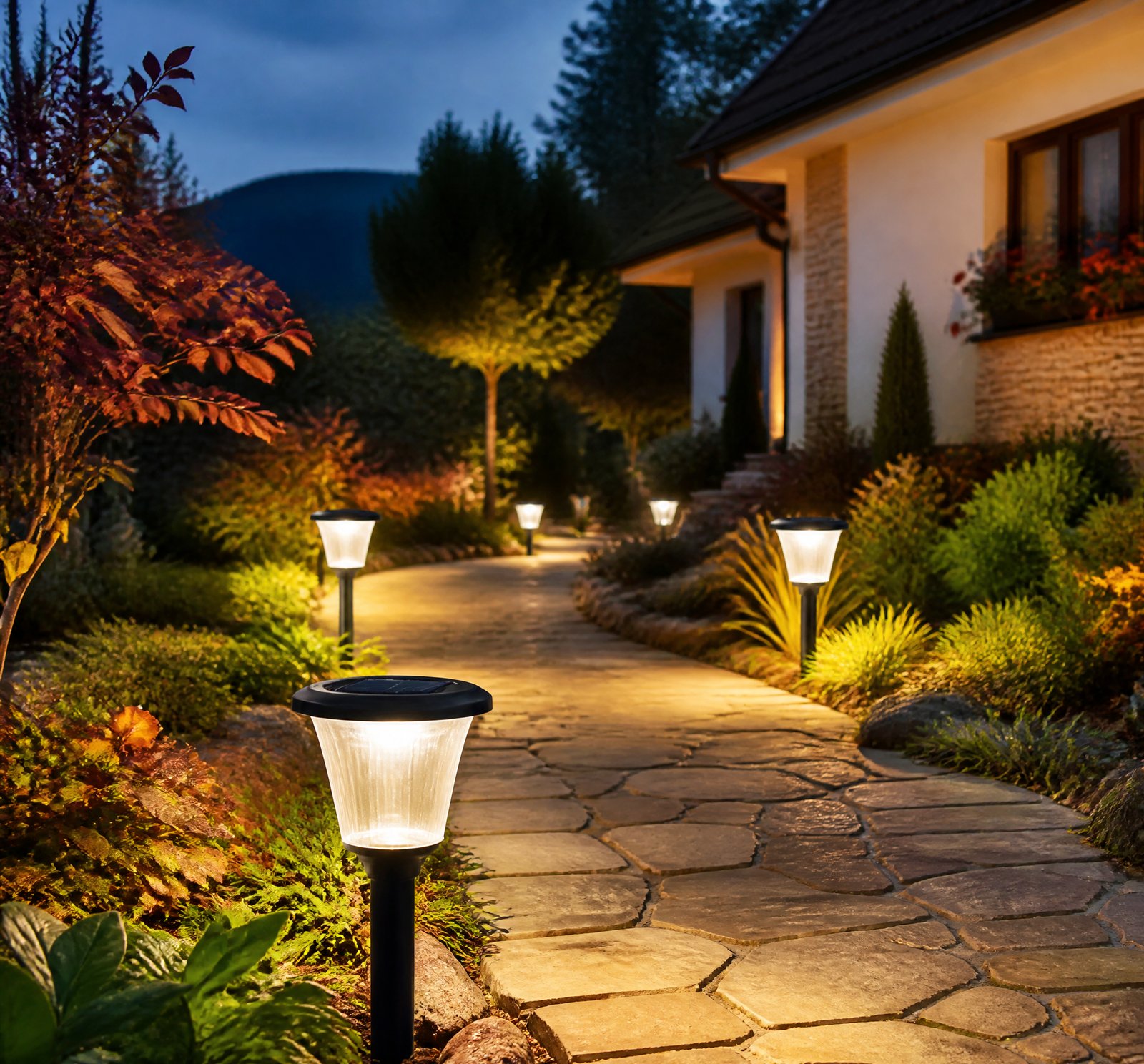
Quick answer: Proiectarea optică a lentilelor cu unghi larg de iluminare modelează distribuția luminii LED-urilor SMD eficiente pentru a minimiza zonele întunecate într-o curte rezidențială, asigurând o iluminare uniformă și eficientă prin controlul refracției și reflexiei luminii [23].
Proiectarea optică a lentilelor cu unghi larg de iluminare este esențială pentru a transforma lumina LED-urilor SMD eficiente într-o iluminare stabilă, uniformă și fără zone întunecate în curtea unei locuințe românești. Într-o epocă în care energia solară devine o soluție majoră pentru iluminatul exterior, alegerea corectă a sistemului optic nu este doar o chestiune de estetică, ci un factor-cheie al eficienței energetice și a siguranței.
Proiectarea optică: Căile pentru o iluminare fără umbre
Controlul distribuției luminii este un principiu fundamental în iluminatul cu LED-uri, mai ales pentru spațiile exterioare precum curțile. Lentilele și reflectoarele joacă un rol crucial în modelarea fasciculului de lumină emis de sursele LED, minimizând zonele întunecate și asigurând o distribuție constantă [19]. Principiul de bază al lentilelor este refractarea — schimbarea direcției razelor de lumină la trecerea dintr-un mediu într-altul — ceea ce permite concentrarea sau dispersia luminii în funcție de forma geometrică a lentilei [19].
Tipuri de lentile și funcționalitatea lor
Există mai multe tipuri de lentile utilizate în iluminatul cu LED, fiecare adaptat unor aplicații specifice. Lentilele Fresnel sunt proiectate pentru a concentra lumina într-un fascicul îngust, făcându-le ideale pentru aplicații de iluminat la distanță sau pentru faruri [15]. Pe de altă parte, lentilele cu formă liberă (freeform) oferă un control superior asupra distribuției luminii, putând genera modele asimetrice sau simetrice în funcție de necesități [23].
| Tip lentilă | Principiu de funcționare | Aplicație ideală |
|---|---|---|
| Fresnel | Concentrare prin refracție | Iluminat la distanță, faruri |
| Freeform | Distribuție personalizată | Iluminat uniform în curte |
Rolul reflectoarelor în distribuția luminii
Reflectoarele funcționează pe baza legii reflexiei, care afirmă că unghiul de incidență este egal cu unghiul de reflexie, dar cu semn opus [24]. Acestea pot fi proiectate pentru a concentra lumina într-un fascicul îngust sau pentru a distribui lumina într-o zonă mai largă, în funcție de design [19]. În practică, lentilele și reflectoarele sunt adesea combinate: o lentilă poate concentra lumina, iar un reflector poate distribui aceasta în mod uniform pe suprafața curții [13].
Implementarea în curți rezidențiale românești
Pentru a minimiza zonele întunecate într-o curte rezidențială, lentilele cu unghi larg de fascicul sunt esențiale. Acestea sunt proiectate pentru a dispersa lumina într-un model asimetric sau simetric, asigurând o iluminare constantă și fără umbre [23]. În România, unde multe case au curți de dimensiuni variate și geometrii neuniforme, această abordare este deosebit de relevantă pentru siguranță și confort.
LED-uri SMD și eficiență energetică
Pentru a maximiza rezultatele, se recomandă utilizarea LED-urilor eficiente, precum SMD (Surface Mount Device), care oferă un flux luminos ridicat și o distribuție uniformă a luminii [2]. Aceste surse pot fi combinate cu lentile personalizate pentru a obține modelul de lumină dorit, asigurând o iluminare eficientă și durabilă [2].
Concluzii cheie
- Proiectarea optică a lentilelor cu unghi larg este esențială pentru o iluminare eficientă și uniformă în curte [23].
- Lentilele cu formă liberă permit o distribuție personalizată a luminii, ideală pentru spații neuniforme [23].
- Combinația dintre lentile și reflectoare maximizează controlul asupra fasciculului de lumină [13].
- LED-urile SMD sunt recomandate pentru flux ridicat și eficiență energetică [2].
- Iluminatul solar cu distribuție optimizată reduce consumul de energie și îmbunătățește siguranța în curte [1].
Întrebări frecvente
Ce tip de lentilă este cel mai potrivit pentru o curte rezidențială în România?
Lentilele cu unghi larg de fascicul, mai ales cele cu formă liberă (freeform), sunt cele mai potrivite pentru a asigura o iluminare uniformă fără zone întunecate în curți. Ele permit distribuția asimetrică sau simetrică a luminii în funcție de geometria spațiului [23].
Cum contribuie LED-urile SMD la eficiența iluminatului solar?
LED-urile SMD oferă un flux luminos ridicat și o distribuție uniformă a luminii, ceea ce reduce consumul de energie și crește durata de viață. Sunt o alegere ideală pentru iluminatul solar în curți [2].
Este necesară combinarea lentilelor cu reflectoare într-un sistem de iluminat solar?
Da, combinarea lentilelor și reflectoarelor permite un control precis asupra fasciculului de lumină. O lentilă poate concentra lumina, iar un reflector o poate distribui uniform, asigurând o iluminare eficientă și fără umbre [13].
References
- [1] Energy-efficient lighting LED technology advances — book
source passage
the emitting spectrum is under control, the optical utilization factor of each agricultural lighting must be high enough for energy saving. That is to say, the lighting pattern has to match the planted areas, as shown in Fig. 4. In the application of agricultural lighting with high energy efficiency, a beam shaping technology to condense most of the lights onto the planted areas is desired. In this paper, a beam shaping of a LED luminaire with a reflector and a micro-lens array is proposed and demonstrated. The LED luminaire can not only effectively shape the lighting pattern into a rectangle of the planted areas but also can mix blue and red light uniformly for complete photosynthesis. Fig. 3 Suitable LEDs for a good spectral match. Proc. of SPIE Vol. 8128 812807-2 Downloaded From: http://proceedings.spiedigitallibrary.org/ on 06/22/2016 Terms of Use: http://spiedigitallibrary.org/ss/TermsOfUse.aspx Fig. 4 The lighting performance in LED luminaire. 2. METHODS Fisrt of all, two LEDs are chosen, and the spectra are shown in Fig. 5. Before we design the second optical components, the precise light source model must be established first. The relation of intensity versus angular distributions of the two LEDs will be measured in different distances (D) between LEDs and a power meter in the mid-field region. And the measured and simulated data will be compared to ensure the model is precise enough. In general, when the normalized correlated coefficient (NCC) is over 99.5 %, the two
- [2] LED Lighting Design Practical Applications, Second Edition — book
source passage
Sun C C, Lee T X, Ma S H, Lee Y L and Huang S M 2006 Optical modeling for LED in mid-field region,’ in Int. Optical Design Conf. J. Opt. Soc. Am. TuD7 June [41] Lewis J P 1995 Vision Interface 95 Canadian Image Processing and Pattern Recognition Society p 120 [42] Lo Y C, Cai J Y, Tasi M S, Tasi Z Y and Sun C C 2014 Side-illuminating LED luminaires with accurate projection in high uniformity and high optical utilization factor for large-area field illumination Opt. Express 22 A365–75 [43] DIALux (https://www.dial.de/en/dialux/) [44] Xue Z 2017 Sidewall effect on the blue/white light pattern of sapphire-based LEDs MS Dissertation National Central University [45] Sun C C et al 2014 Packaging efficiency in phosphor-converted white LEDs and its impact to the limit of luminous efficacy J. Solid State Lighting 1 1–17 [46] Lin H J, Sun C C, Wu C S, Lee X H, Yang T H, Lin S K, Lin Y J and Yu Y W 2019 Design of a bicycle head lamp using an atypical white light-emitting diode with separate dies Crystals 9 659 [47] Jen Y C 2016 The study of LED marine beacons MSc Thesis National Central University [48] Xue Z 2017 Side-wall effect on the blue/white light pattern of sapphire-based LEDs MSc Thesis National Central University [49] Li D R 2011 The study of package efficiency for white LEDs MSc Thesis National Central University [50] Chen K Y 2018 Study of high-performance LED projection lamp for long-distance projection MSc Thesis National Central University [51] Lin H J 2020 Optical design
- [13] LED Lighting Design Practical Applications, Second Edition — book
source passage
design for the secondary optics is to use a multi-segment reflector to direct the incoming light to the illumination target, as shown in figure 6.12. Each segment of the reflector has its specific curvature and orientation to redirect the light. Such a complex optical element is frequently used in automotive headlamps, which needs to meet a regulation with a strict cutoff line so that all the segments need to be well designed and fabricated [9]. Figure 6.12. (a) The structure of a multi-segment reflector, and (b) the prototype. 6.3 High-directional LED illumination In comparison with the other light sources, LED is rather smaller, and is a semiconductor component. The inherent characteristic of an LED light source is to form a directional light source through a secondary optical design. In general, a directional light source should be in high intensity, i.e., high optical flux in a unit solid angle. However, the compactness of an LED does not provide this advantage because the optical exitance of an LED in the typical size is smaller than the other traditional light sources, such as the high-intensity discharge (HID) lamp. Therefore, LED light sources are suitable to project to a distance as long as hundreds of meters rather than kilometers. If LEDs are used for long-range projection, LED clusters are needed, and the whole size will be large. Projection of the LED light to long distance is a complicated problem, which contains various considerations. The main problem is how t
- [15] LED Lighting Design Practical Applications, Second Edition — book
source passage
shown in figure 6.26, where the illumination light is a red laser with small lateral beam width so that the light pattern does not look uniform. Figure 6.24. The structure of an ML-diffuser. Figure 6.25. The three-generation molding samples in each sintering process. Figure 6.26. The simulated illumination patterns in flat rectangle shape from small (left) to large (right). Reprinted with permission from [15]. References [1] Lakshminarayanan V, Ghatak A K and Thyagarajan K 2002 Lagrangian Optics (Berlin: Springer) [2] Mahajan V N 1998 Optical Imaging and Aberrations: Ray Geometrical Optics (Bellingham, WA: SPIE Press) [3] Koshel R J 2013 Illumination Engineering: Design with Nonimaging Optics (New York: Wiley) [4] Chaves J 2016 Introduction to Nonimaging Optics 2nd edn (Boca Raton, FL: CRC Press) [5] Leutz R and Suzuki A 2001 Nonimaging Fresnel Lenses: Design and Performance of Solar Concentrators (Berlin: Springer) [6] Davis A and Kühnlenz F 2007 Optical design using Fresnel lenses: basic principles and some practical examples Opt. Photon. 2 52–5 [7] Xie W T, Dai Y J, Wang R Z and Sumathy K 2011 Concentrated solar energy applications using Fresnel lenses: a review Renew. Sust. Energ. Rev. 15 2588–606 [8] Winston R, Miñano J C and Benitez P G 2005 Nonimaging Optics (Amsterdam: Elsevier) [9] Sun C C, Wu C S, Lin Y S, Lin Y J, Hsieh C Y, Lin S K, Yang T H and Yu Y W 2021 Review of optical design for vehicle forward lighting based on white LEDs Opt. Eng. 60 091501 [10] Wu C S, C
- [19] LED Lighting Design Practical Applications — book
source passage
of light. The reflection control of the LED beam in LED lighting devices is generally achieved through the reflectors. The reflector mainly plays the role of convergence of LED beams and strengthens their directivity, such as in flashlights, down lamp, and so on. With the three- dimensional spatial distribution of various reflectors, large-scale lighting can be achieved through angle combination, such as road lights. In addition, the specially designed reflectors with a shaped surface (freeform surface for instance) can be provided with a convergent non- circular symmetrical light pattern, such as in the case of low-beam headlights. The refraction control of the LED beam in LED lighting devices is achieved by the lens. The lens can make LED beams converge and also make them diverge and the control is flexible. Especially in recent years, with the emergence of LED freeform surface lens technology, the light extraction efficiency of the lens has been further improved and the control of light energy is more accurate. Therefore, it is applied on more and more occasions such as the MR16 lamp, road light, and backlighting, and so on. 219 Design of LED Packaging Applications Among LED luminaires, the most widely used scattering component is the diffuser plate. The diffuser plate contains a lot of diffuse particles or diffuse structures, which can well scatter the incident rays, thus achieving uniform illumination on the diffuser plate surface. It is widely used in LED lighting devic
- [23] CA2776733C – Lens for asymmetrical light beam generation — patent
source passage
a punctual lambertian light source through an optical device as shown on figures 2 to 4. Such a light source normally leads to a round light beam. A LED 20 may be approximated as a punctual light source. 7 PCT/1B2010/054385 Figure 6 shows the effect of the lens 10 according to Fig. 2-5 on the conical light beam emitted by a lambertian LED 20. It appears that the rear portion 18 is optimized in order to maximize total internal reflection and therefore send to the front portion 19 light rays that would otherwise go rearward and the front portion 19 of the profile is optimized to transmit light as much as possible and therefore minimize light rays being bounced back to the rear part 18. Figure 6 shows the polar representation of the light beam at the exit diopter 12. This representation shows that the light beam is clearly asymmetrical. However, it may be desired to provide an exit light beam that is symmetrical. Figure 7 represents another embodiment of an optical device according to the invention. In this embodiment, two lenses 10 are facing together, the planar face 17 of a first lens 10 facing the planar face 17 of the second lens 10. The sagittal plane A of the lenses 10 are merging and said lenses 10 are positioned at a given distance d. Such construction allows the generation of a symmetrical light beam in such manner that said lens 10 can be used in the conception of luminaries generating a symmetrical light beam either an asymmetrical light beam. It should be noted that
- [24] LED Lighting Design Practical Applications — book
source passage
Lambertain light distribution is provided with a large beam divergence angle and nonuniform illumination distribution. Therefore, it is difficult for some lamps (such as the MR16 lamp, down lamp, auto headlights, and so on) to meet the demands of light beam convergence and light pattern uniformity. Therefore, LED luminaires are usually demanded to re-distribute the spatial distribution of LED’s light energy through the secondary optical system with a particular design and to accurately control the light pattern shape and uniformity of luminaires, thus achieving high-quality lighting. There are three main methods for the secondary optical system to control LED’s light- emitting: reflection, refraction, and scattering, as shown in Figure 6.4. The following is an introduction to these basic optical concepts. (1) Law of reflection The incident ray, reflection ray, and projection point normal are in the same plane; the absolute values of the incident angle and reflection angle are equal but with an opposite sign; that means that the incident ray and the reflection ray are at each side of the normal respectively. The law of reflection can be expressed in the following equation as: I= -I' (6.1) For the rough interface, when a beam of parallel incident light projects on it, the reflected light will no longer be parallel, resulting in an irregular diffuse reflection. However, as to any tiny reflecting surface on the rough surface, it still complies with the law of reflection. (2) Law
the emitting spectrum is under control, the optical utilization factor of each agricultural lighting must be high enough for energy saving. That is to say, the lighting pattern has to match the planted areas, as shown in Fig. 4. In the application of agricultural lighting with high energy efficiency, a beam shaping technology to condense most of the lights onto the planted areas is desired. In this paper, a beam shaping of a LED luminaire with a reflector and a micro-lens array is proposed and demonstrated. The LED luminaire can not only effectively shape the lighting pattern into a rectangle of the planted areas but also can mix blue and red light uniformly for complete photosynthesis. Fig. 3 Suitable LEDs for a good spectral match. Proc. of SPIE Vol. 8128 812807-2 Downloaded From: http://proceedings.spiedigitallibrary.org/ on 06/22/2016 Terms of Use: http://spiedigitallibrary.org/ss/TermsOfUse.aspx Fig. 4 The lighting performance in LED luminaire. 2. METHODS Fisrt of all, two LEDs are chosen, and the spectra are shown in Fig. 5. Before we design the second optical components, the precise light source model must be established first. The relation of intensity versus angular distributions of the two LEDs will be measured in different distances (D) between LEDs and a power meter in the mid-field region. And the measured and simulated data will be compared to ensure the model is precise enough. In general, when the normalized correlated coefficient (NCC) is over 99.5 %, the two
Sun C C, Lee T X, Ma S H, Lee Y L and Huang S M 2006 Optical modeling for LED in mid-field region,’ in Int. Optical Design Conf. J. Opt. Soc. Am. TuD7 June [41] Lewis J P 1995 Vision Interface 95 Canadian Image Processing and Pattern Recognition Society p 120 [42] Lo Y C, Cai J Y, Tasi M S, Tasi Z Y and Sun C C 2014 Side-illuminating LED luminaires with accurate projection in high uniformity and high optical utilization factor for large-area field illumination Opt. Express 22 A365–75 [43] DIALux (https://www.dial.de/en/dialux/) [44] Xue Z 2017 Sidewall effect on the blue/white light pattern of sapphire-based LEDs MS Dissertation National Central University [45] Sun C C et al 2014 Packaging efficiency in phosphor-converted white LEDs and its impact to the limit of luminous efficacy J. Solid State Lighting 1 1–17 [46] Lin H J, Sun C C, Wu C S, Lee X H, Yang T H, Lin S K, Lin Y J and Yu Y W 2019 Design of a bicycle head lamp using an atypical white light-emitting diode with separate dies Crystals 9 659 [47] Jen Y C 2016 The study of LED marine beacons MSc Thesis National Central University [48] Xue Z 2017 Side-wall effect on the blue/white light pattern of sapphire-based LEDs MSc Thesis National Central University [49] Li D R 2011 The study of package efficiency for white LEDs MSc Thesis National Central University [50] Chen K Y 2018 Study of high-performance LED projection lamp for long-distance projection MSc Thesis National Central University [51] Lin H J 2020 Optical design
design for the secondary optics is to use a multi-segment reflector to direct the incoming light to the illumination target, as shown in figure 6.12. Each segment of the reflector has its specific curvature and orientation to redirect the light. Such a complex optical element is frequently used in automotive headlamps, which needs to meet a regulation with a strict cutoff line so that all the segments need to be well designed and fabricated [9]. Figure 6.12. (a) The structure of a multi-segment reflector, and (b) the prototype. 6.3 High-directional LED illumination In comparison with the other light sources, LED is rather smaller, and is a semiconductor component. The inherent characteristic of an LED light source is to form a directional light source through a secondary optical design. In general, a directional light source should be in high intensity, i.e., high optical flux in a unit solid angle. However, the compactness of an LED does not provide this advantage because the optical exitance of an LED in the typical size is smaller than the other traditional light sources, such as the high-intensity discharge (HID) lamp. Therefore, LED light sources are suitable to project to a distance as long as hundreds of meters rather than kilometers. If LEDs are used for long-range projection, LED clusters are needed, and the whole size will be large. Projection of the LED light to long distance is a complicated problem, which contains various considerations. The main problem is how t
shown in figure 6.26, where the illumination light is a red laser with small lateral beam width so that the light pattern does not look uniform. Figure 6.24. The structure of an ML-diffuser. Figure 6.25. The three-generation molding samples in each sintering process. Figure 6.26. The simulated illumination patterns in flat rectangle shape from small (left) to large (right). Reprinted with permission from [15]. References [1] Lakshminarayanan V, Ghatak A K and Thyagarajan K 2002 Lagrangian Optics (Berlin: Springer) [2] Mahajan V N 1998 Optical Imaging and Aberrations: Ray Geometrical Optics (Bellingham, WA: SPIE Press) [3] Koshel R J 2013 Illumination Engineering: Design with Nonimaging Optics (New York: Wiley) [4] Chaves J 2016 Introduction to Nonimaging Optics 2nd edn (Boca Raton, FL: CRC Press) [5] Leutz R and Suzuki A 2001 Nonimaging Fresnel Lenses: Design and Performance of Solar Concentrators (Berlin: Springer) [6] Davis A and Kühnlenz F 2007 Optical design using Fresnel lenses: basic principles and some practical examples Opt. Photon. 2 52–5 [7] Xie W T, Dai Y J, Wang R Z and Sumathy K 2011 Concentrated solar energy applications using Fresnel lenses: a review Renew. Sust. Energ. Rev. 15 2588–606 [8] Winston R, Miñano J C and Benitez P G 2005 Nonimaging Optics (Amsterdam: Elsevier) [9] Sun C C, Wu C S, Lin Y S, Lin Y J, Hsieh C Y, Lin S K, Yang T H and Yu Y W 2021 Review of optical design for vehicle forward lighting based on white LEDs Opt. Eng. 60 091501 [10] Wu C S, C
of light. The reflection control of the LED beam in LED lighting devices is generally achieved through the reflectors. The reflector mainly plays the role of convergence of LED beams and strengthens their directivity, such as in flashlights, down lamp, and so on. With the three- dimensional spatial distribution of various reflectors, large-scale lighting can be achieved through angle combination, such as road lights. In addition, the specially designed reflectors with a shaped surface (freeform surface for instance) can be provided with a convergent non- circular symmetrical light pattern, such as in the case of low-beam headlights. The refraction control of the LED beam in LED lighting devices is achieved by the lens. The lens can make LED beams converge and also make them diverge and the control is flexible. Especially in recent years, with the emergence of LED freeform surface lens technology, the light extraction efficiency of the lens has been further improved and the control of light energy is more accurate. Therefore, it is applied on more and more occasions such as the MR16 lamp, road light, and backlighting, and so on. 219 Design of LED Packaging Applications Among LED luminaires, the most widely used scattering component is the diffuser plate. The diffuser plate contains a lot of diffuse particles or diffuse structures, which can well scatter the incident rays, thus achieving uniform illumination on the diffuser plate surface. It is widely used in LED lighting devic
a punctual lambertian light source through an optical device as shown on figures 2 to 4. Such a light source normally leads to a round light beam. A LED 20 may be approximated as a punctual light source. 7 PCT/1B2010/054385 Figure 6 shows the effect of the lens 10 according to Fig. 2-5 on the conical light beam emitted by a lambertian LED 20. It appears that the rear portion 18 is optimized in order to maximize total internal reflection and therefore send to the front portion 19 light rays that would otherwise go rearward and the front portion 19 of the profile is optimized to transmit light as much as possible and therefore minimize light rays being bounced back to the rear part 18. Figure 6 shows the polar representation of the light beam at the exit diopter 12. This representation shows that the light beam is clearly asymmetrical. However, it may be desired to provide an exit light beam that is symmetrical. Figure 7 represents another embodiment of an optical device according to the invention. In this embodiment, two lenses 10 are facing together, the planar face 17 of a first lens 10 facing the planar face 17 of the second lens 10. The sagittal plane A of the lenses 10 are merging and said lenses 10 are positioned at a given distance d. Such construction allows the generation of a symmetrical light beam in such manner that said lens 10 can be used in the conception of luminaries generating a symmetrical light beam either an asymmetrical light beam. It should be noted that
Lambertain light distribution is provided with a large beam divergence angle and nonuniform illumination distribution. Therefore, it is difficult for some lamps (such as the MR16 lamp, down lamp, auto headlights, and so on) to meet the demands of light beam convergence and light pattern uniformity. Therefore, LED luminaires are usually demanded to re-distribute the spatial distribution of LED’s light energy through the secondary optical system with a particular design and to accurately control the light pattern shape and uniformity of luminaires, thus achieving high-quality lighting. There are three main methods for the secondary optical system to control LED’s light- emitting: reflection, refraction, and scattering, as shown in Figure 6.4. The following is an introduction to these basic optical concepts. (1) Law of reflection The incident ray, reflection ray, and projection point normal are in the same plane; the absolute values of the incident angle and reflection angle are equal but with an opposite sign; that means that the incident ray and the reflection ray are at each side of the normal respectively. The law of reflection can be expressed in the following equation as: I= -I' (6.1) For the rough interface, when a beam of parallel incident light projects on it, the reflected light will no longer be parallel, resulting in an irregular diffuse reflection. However, as to any tiny reflecting surface on the rough surface, it still complies with the law of reflection. (2) Law