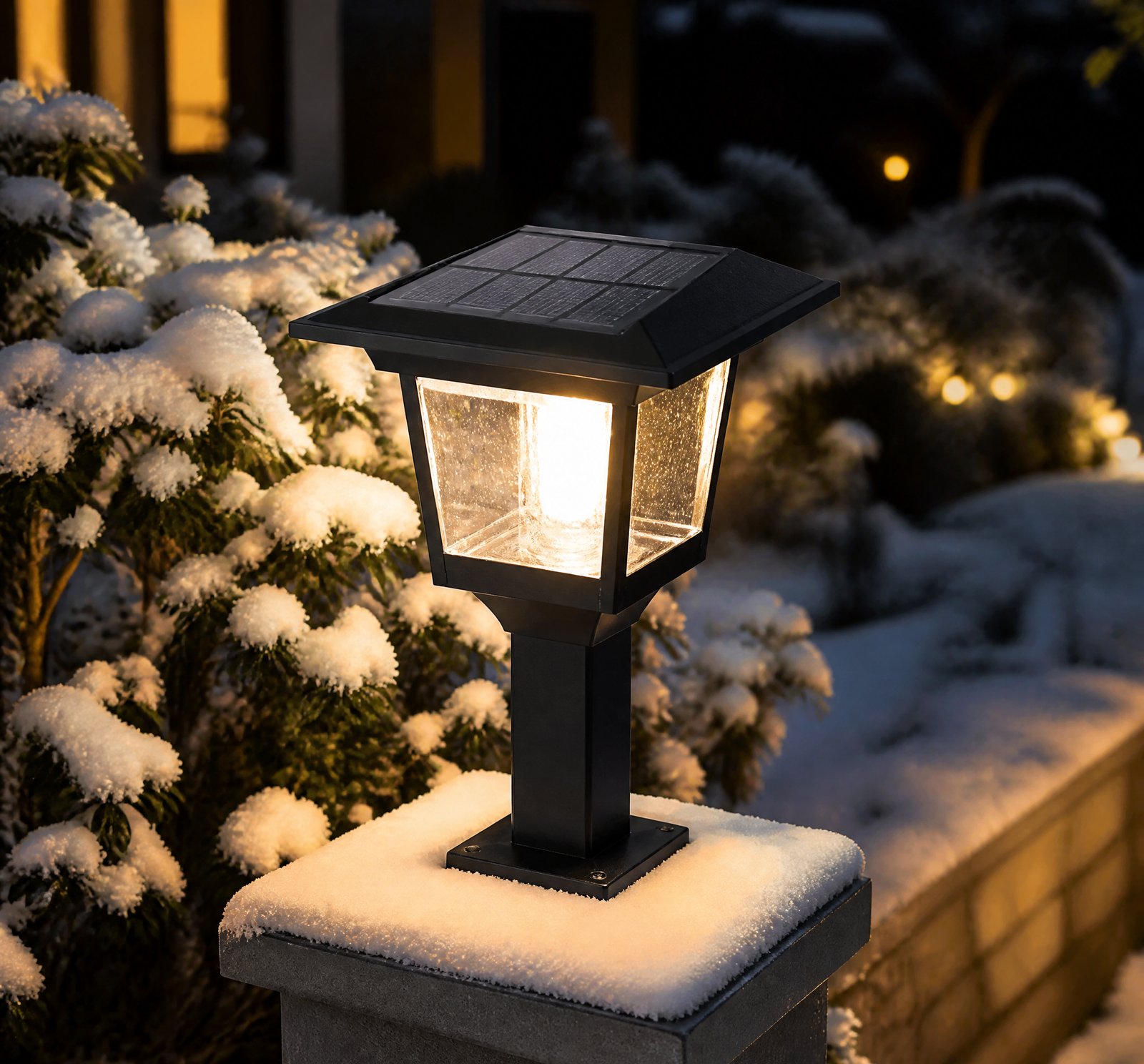
Quick answer: În iarna românească, autonomia bateriilor lămpilor solare scade din cauza zilelor scurte, cerului înnorat și acoperirii cu zăpadă a panourilor [1][4]. Performanța poate fi menținută prin ajustarea unghiului de instalare, folosirea bateriilor eficiente și funcții precum senzorii de mișcare și modurile de economisire a energiei [17][20][21][22][23][24].
În România, iarna nu este doar o perioadă de frig intens, ci și o provocare pentru sistemele solare de iluminat. Proprietarii de lămpi solare pot observa o reducere semnificativă a performanței în această perioadă, datorită mai multor factori sezonieri care afectează captarea și stocarea energiei. Zilele scurte, cerul înnorat și zăpada care acoperă panourile solare reduc timpul de încărcare a bateriilor, ceea ce duce la o autonomie mai scurtă a luminii [1][4]. Cu toate acestea, există strategii eficiente pentru a gestiona aceste comportamente sezoniere și a menține iluminatul funcțional în timpul lunilor reci.
Iarna și Reducerea Performanței Lămpilor Solare
În România, timpul de încărcare al panourilor solare scade semnificativ în iarnă din cauza zilelor scurte și a cerului înnorat, ceea ce afectează direct capacitatea bateriilor de a se încărca [1]. Această reducere a energiei solare disponibile poate duce la o autonomie mai scurtă a lămpilor, mai ales dacă sunt utilizate în dimineața sau seara timpurie, când lumina solară este limitată [4]. Producătorii de lămpi solare sunt conștienți de această realitate și implementează soluții tehnologice pentru a atenua impactul.
Ajustarea Unghiului de Instalare pentru Iarnă
O strategie eficientă este ajustarea unghiului de instalare al panourilor solare în funcție de sezon. În regiunile cu schimbări sezoniere distincte, monturile ajustabile permit modificarea unghiului sistemului în funcție de poziția soarelui, asigurând o expunere maximă la lumină solară [11]. De exemplu, în timpul iernii, un unghi mai mare poate fi mai potrivit pentru a evita acumularea de zăpadă și a maximiza captarea radiației solare la un unghi mai scăzut în cer [17]. Această adaptare poate crește eficiența sistemului cu până la 20% în perioadele reci.
Zăpadă și Suprafețe Auto-curățătoare
Zăpada care acoperă panourile solare poate reduce eficiența acestora cu până la 90% dacă nu este îndepărtată [17]. Pentru a preveni această problemă, se recomandă instalarea panourilor cu unghiuri ajustabile, care reduc acumularea de zăpadă și ploaie [17]. În plus, utilizarea unor materiale auto-curățătoare pentru suprafețele panourilor poate reduce frecarea și împiedica aderența zăpezii sau a murdăriei, menținând eficiența chiar și în condiții nefavorabile.
Senzori de Mișcare și Economisirea Energiei
O caracteristică esențială în lămpile solare moderne este senzorul de mișcare, care detectează mișcarea obiectelor la o anumită distanță [17]. Când este detecționată mișcarea, lampa funcționează la 100% din putere; în absența mișcării, funcționează la 20–40% din valoarea nominală, conform programării predefinite [17]. Această funcție reduce consumul de energie semnificativ, prelungind autonomia bateriei în condiții de lumină redusă.
De asemenea, modurile de economisire a energiei sunt un alt mijloc eficient. Acestea reduc luminozitatea becurilor, dar pot dubla timpul de funcționare [20][21][22][23][24]. Aceasta este o soluție ideală pentru iarna, când ziua are doar 7–8 ore de lumină naturală, iar iluminatul trebuie să fie eficient și durabil.
| Caracteristică | Eficiență în iarnă | Impact asupra autonomiei |
|---|---|---|
| Senzor de mișcare | Ridicat [17] | Dublează durata de funcționare în absență |
| Mod economisire energie | Foarte ridicat [20][21][22][23][24] | Dublează durata de funcționare |
| Unghi ajustabil | Ridicat [11][17] | Crește captarea luminii solare cu până la 20% |
| Suprafață auto-curățătoare | Ridicat [17] | Reduce pierderile de eficiență datorate zăpezii |
Concluzii cheie
- Autonomia bateriei scade în iarna românească din cauza zilelor scurte și norilor [1][4].
- Ajustarea unghiului de instalare poate crește eficiența panourilor în perioada rece [11][17].
- Senzorii de mișcare și modurile de economisire a energiei prelungesc funcționarea în condiții de lumină redusă [17][20][21][22][23][24].
- Zăpada poate reduce eficiența cu până la 90%, dar unghiul optim și materialele auto-curățătoare pot minimiza impactul [17].
Întrebări frecvente
Cât timp poate funcționa o lampă solară în iarnă fără încărcare suplimentară?
În condiții de iarnă, o lampă cu mod economisire energie poate funcționa până la dublul timpului în condiții normale [20][21][22][23][24].
Este recomandat să instalez un panou solar cu unghi ajustabil în România?
Da, în regiunile cu schimbări sezoniere, monturile ajustabile pot crește eficiența cu până la 20% în iarnă [11][17].
Cum pot preveni acumularea de zăpadă pe panourile solare?
Utilizarea unghiurilor de instalare ajustabile și a materialelor auto-curățătoare reduce semnificativ acumularea de zăpadă [17].
References
- [1] Impact of Solar Home Systems on Rural Livelihoods — book
source passage
The clients think this is working well. Despite this, 86% of the clients want to own the systems themselves rather than pay for the service from the ESCO. The main reason (50%) for this is that they wish to reduce the monthly expenses, but for many households (20%) they want to own the system so that they can bring it with them in case they are transferred to another location. The battery and the lamps are the weak part of the system, while panels have worked without problems. Lamps have been reported to break after only few oper- ating hours, and the lamp fittings have also broken. About 25–30% of the batteries have been replaced after only 2 years of operation. If the systems were operated a bit more carefully, it can be assumed that the batteries life span would increase. 3.4. Solar radiation Solar radiation in Nyimba is around 5 kW h/m2/day, and changes only slightly from season to season (Fig. 4). The level of solar radiation can be a problem dur- ing the rainy season, when the sky can be overcast for several days in a row. About a third of the respondents reported blackout problems that they feel were of seasonal character. In the rainy season, battery may not be fully charged in one day. This might take a few days of charge from the panel, even without any load on the system. The battery will keep low charge, which causes frequent cuts and wears the battery down. If only lamps and smaller appliances are used for short periods of time, a fully charged battery can be used
- [4] US20120020060A1 – Energy-efficient solar-powered – Google Patents — patent
source passage
of successful operation of the outdoor lighting was accomplished, without any tie to or contribution of energy from the electrical grid, without any replacement of the batteries, and without any energy input into the batterys or any part of the lighting system except from the amorphous PV cell material on each pole. – FIG. 50 one may see long periods of days and weeks of sky cover (measured in hours during the day, defined as “cloudy” or “overcast” as judged from the local weather report), but the system maintained minimum battery voltage above the important benchmark of approximately 11 volts all through the roughly two month winter period, except for the “waving tree limb” incident in December, described above. – FIGS. 51A and B which represent a different test, of a set of poles operating over about 2.5 winter months (the graph being split roughly in two), multiple poles operating independent of each other and autonomously (not tied to the grid) all performed continuously at or above 11 volts throughout the winter, despite long stretches of little or no sunshine per day. – a solar-powered outdoor lighting system comprising: a flexible photovoltaic solar collector panel curved at least 180 degrees around a generally cylindrical light pole and attached to the light pole so that the panel is generally vertical; a lighting fixture connected to the pole and comprising multiple light emitting diodes (LEDs); at least one battery operatively connected to the solar collector panel
- [11] Off-Grid Solar A Bright Spot in the Global Energy Transition — book
source passage
when they are perpendicular to the sun's rays. By altering the tilt according to the season, one can ensure maximum sunlight exposure. In regions with distinct seasonal changes, adjustable solar panel mounts can be a worthy investment. These allow the system's angle to be changed multiple times throughout the year. For instance, during summer, a lower tilt might be optimal, while in winter, a steeper angle might be more suitable. Seasonal System Checks Beyond adjusting panel angles, conducting regular seasonal system checks is essential. These checks can include: Cleaning Panels: As seasons change, so do environmental conditions. Autumn might bring fallen leaves, while winter could deposit snow or frost on panels. Regular cleaning ensures the panels remain unobstructed and efficient. Inspecting Wiring and Connections: Temperature fluctuations can affect the physical components of a solar system. Expansion and contraction due to varying temperatures might lead to loosened connections, warranting periodic checks. Calibrating Monitoring Systems: As the sun's trajectory changes, recalibrating monitoring systems ensures accurate performance tracking. It aids in identifying any deviations from expected energy production, indicating potential issues. Checking Inverters and Batteries: These components are sensitive to extreme temperatures. Ensuring they are well-protected and functioning efficiently is crucial, especially during the peak of summer or the depth of winter. For solar sy
- [17] US10563827B2 – Solar powered illumination system – Google Patents — patent
source passage
possesses high efficiency in cloudy, rainy, snowy and dusty areas due to efficient charging of the rechargeable battery and energy conservation. The illumination system further implements a programmable charge controller or a motion sensor in areas where the daytime is too short. The illumination system increases a power back-up to 14-20 days. When the motion sensor detects an object movement from a specific distance, the illumination system starts working with 100% of power, otherwise the illumination system works at 20-40% of a rated power value based on pre-defined programming. Furthermore, the charge controllers are programmed based on duration of a night in a geographical location such as 8 hours in summer and 12-14 hours in winter. On the basis of night duration, a light intensity is programmed to be at 100% for the first 4 hours, 50% for the following 4 hours and 20% for the rest of the night until the sunrise. According to one embodiment herein, for installing the illumination system in desert or snowy areas following customizations are adopted: – – a. Increasing a tilt angle of the solar panels during installation without decrease in the solar light absorption. The solution reduces an accumulation of dust, snow and rain on the surface of the solar panel. – b. Using a self-cleansing Nano-coating on the solar panels to decrease a friction on the surface of the solar panel which also prevents the accumulation of dust, snow and rain on the surface of the solar panel. Acc
- [20] The best solar lights in 2026 as tested by our reviews experts — reddit
source passage
at the end of the evening and protect local wildlife and keep your neighbours happy. Cable length. With string and fairy lights, keep an eye out for how much cable there is between the solar panel and the first bulb. At least a metre of this lead-in is useful, as it means you have more flexibility when placing your solar panel. With enough cable, you can still put your panel in a sunny spot and trail your lights up a trellis a few metres away, even if it’s in the shade. Brightness. Lumens is a measure of how bright your lights are. Atmospheric mood lights can be as low as 5 or 10 lumens, while more practical spotlights are usually 100-200 lumens. Lighting modes. Dimming, glowing, and twinkling light modes create ambience and enhance social areas of the garden, but they'll also extend your lights’ lifetime and how long they’ll light up on a given night. Some lights also have a power-saving mode, which reduces the brightness of the bulbs but doubles the runtime, so your lights turn on for longer during overcast weather and after the shorter hours of daylight in winter. Motion sensors. Particularly relevant for solar spotlights, motion sensors make lights come on as you approach or when there's activity nearby. This can extend your lights’ lifetime and, as they only light up in short bursts, they’re also less dependent on natural light levels, working just as well in the winter as the bright summer months. Weather resistance. The ingress protection (IP) rating indicates how easi
- [21] The best solar lights in 2026 as tested by our reviews experts — reddit
source passage
at the end of the evening and protect local wildlife and keep your neighbours happy. Cable length. With string and fairy lights, keep an eye out for how much cable there is between the solar panel and the first bulb. At least a metre of this lead-in is useful, as it means you have more flexibility when placing your solar panel. With enough cable, you can still put your panel in a sunny spot and trail your lights up a trellis a few metres away, even if it’s in the shade. Brightness. Lumens is a measure of how bright your lights are. Atmospheric mood lights can be as low as 5 or 10 lumens, while more practical spotlights are usually 100-200 lumens. Lighting modes. Dimming, glowing, and twinkling light modes create ambience and enhance social areas of the garden, but they'll also extend your lights’ lifetime and how long they’ll light up on a given night. Some lights also have a power-saving mode, which reduces the brightness of the bulbs but doubles the runtime, so your lights turn on for longer during overcast weather and after the shorter hours of daylight in winter. Motion sensors. Particularly relevant for solar spotlights, motion sensors make lights come on as you approach or when there's activity nearby. This can extend your lights’ lifetime and, as they only light up in short bursts, they’re also less dependent on natural light levels, working just as well in the winter as the bright summer months. Weather resistance. The ingress protection (IP) rating indicates how easi
- [22] The best solar lights in 2026 as tested by our reviews experts — reddit
source passage
at the end of the evening and protect local wildlife and keep your neighbours happy. Cable length. With string and fairy lights, keep an eye out for how much cable there is between the solar panel and the first bulb. At least a metre of this lead-in is useful, as it means you have more flexibility when placing your solar panel. With enough cable, you can still put your panel in a sunny spot and trail your lights up a trellis a few metres away, even if it’s in the shade. Brightness. Lumens is a measure of how bright your lights are. Atmospheric mood lights can be as low as 5 or 10 lumens, while more practical spotlights are usually 100-200 lumens. Lighting modes. Dimming, glowing, and twinkling light modes create ambience and enhance social areas of the garden, but they'll also extend your lights’ lifetime and how long they’ll light up on a given night. Some lights also have a power-saving mode, which reduces the brightness of the bulbs but doubles the runtime, so your lights turn on for longer during overcast weather and after the shorter hours of daylight in winter. Motion sensors. Particularly relevant for solar spotlights, motion sensors make lights come on as you approach or when there's activity nearby. This can extend your lights’ lifetime and, as they only light up in short bursts, they’re also less dependent on natural light levels, working just as well in the winter as the bright summer months. Weather resistance. The ingress protection (IP) rating indicates how easi
- [23] The best solar lights in 2026 tested and reviewed BBC Gardening Advice — reddit
source passage
at the end of the evening and protect local wildlife and keep your neighbours happy. Cable length. With string and fairy lights, keep an eye out for how much cable there is between the solar panel and the first bulb. At least a metre of this lead-in is useful, as it means you have more flexibility when placing your solar panel. With enough cable, you can still put your panel in a sunny spot and trail your lights up a trellis a few metres away, even if it’s in the shade. Brightness. Lumens is a measure of how bright your lights are. Atmospheric mood lights can be as low as 5 or 10 lumens, while more practical spotlights are usually 100-200 lumens. Lighting modes. Dimming, glowing, and twinkling light modes create ambience and enhance social areas of the garden, but they'll also extend your lights’ lifetime and how long they’ll light up on a given night. Some lights also have a power-saving mode, which reduces the brightness of the bulbs but doubles the runtime, so your lights turn on for longer during overcast weather and after the shorter hours of daylight in winter. Motion sensors. Particularly relevant for solar spotlights, motion sensors make lights come on as you approach or when there's activity nearby. This can extend your lights’ lifetime and, as they only light up in short bursts, they’re also less dependent on natural light levels, working just as well in the winter as the bright summer months. Weather resistance. The ingress protection (IP) rating indicates how easi
- [24] The best solar lights in 2026 as tested by our reviews experts — reddit
source passage
at the end of the evening and protect local wildlife and keep your neighbours happy. Cable length. With string and fairy lights, keep an eye out for how much cable there is between the solar panel and the first bulb. At least a metre of this lead-in is useful, as it means you have more flexibility when placing your solar panel. With enough cable, you can still put your panel in a sunny spot and trail your lights up a trellis a few metres away, even if it’s in the shade. Brightness. Lumens is a measure of how bright your lights are. Atmospheric mood lights can be as low as 5 or 10 lumens, while more practical spotlights are usually 100-200 lumens. Lighting modes. Dimming, glowing, and twinkling light modes create ambience and enhance social areas of the garden, but they'll also extend your lights’ lifetime and how long they’ll light up on a given night. Some lights also have a power-saving mode, which reduces the brightness of the bulbs but doubles the runtime, so your lights turn on for longer during overcast weather and after the shorter hours of daylight in winter. Motion sensors. Particularly relevant for solar spotlights, motion sensors make lights come on as you approach or when there's activity nearby. This can extend your lights’ lifetime and, as they only light up in short bursts, they’re also less dependent on natural light levels, working just as well in the winter as the bright summer months. Weather resistance. The ingress protection (IP) rating indicates how easi
The clients think this is working well. Despite this, 86% of the clients want to own the systems themselves rather than pay for the service from the ESCO. The main reason (50%) for this is that they wish to reduce the monthly expenses, but for many households (20%) they want to own the system so that they can bring it with them in case they are transferred to another location. The battery and the lamps are the weak part of the system, while panels have worked without problems. Lamps have been reported to break after only few oper- ating hours, and the lamp fittings have also broken. About 25–30% of the batteries have been replaced after only 2 years of operation. If the systems were operated a bit more carefully, it can be assumed that the batteries life span would increase. 3.4. Solar radiation Solar radiation in Nyimba is around 5 kW h/m2/day, and changes only slightly from season to season (Fig. 4). The level of solar radiation can be a problem dur- ing the rainy season, when the sky can be overcast for several days in a row. About a third of the respondents reported blackout problems that they feel were of seasonal character. In the rainy season, battery may not be fully charged in one day. This might take a few days of charge from the panel, even without any load on the system. The battery will keep low charge, which causes frequent cuts and wears the battery down. If only lamps and smaller appliances are used for short periods of time, a fully charged battery can be used
of successful operation of the outdoor lighting was accomplished, without any tie to or contribution of energy from the electrical grid, without any replacement of the batteries, and without any energy input into the batterys or any part of the lighting system except from the amorphous PV cell material on each pole. – FIG. 50 one may see long periods of days and weeks of sky cover (measured in hours during the day, defined as “cloudy” or “overcast” as judged from the local weather report), but the system maintained minimum battery voltage above the important benchmark of approximately 11 volts all through the roughly two month winter period, except for the “waving tree limb” incident in December, described above. – FIGS. 51A and B which represent a different test, of a set of poles operating over about 2.5 winter months (the graph being split roughly in two), multiple poles operating independent of each other and autonomously (not tied to the grid) all performed continuously at or above 11 volts throughout the winter, despite long stretches of little or no sunshine per day. – a solar-powered outdoor lighting system comprising: a flexible photovoltaic solar collector panel curved at least 180 degrees around a generally cylindrical light pole and attached to the light pole so that the panel is generally vertical; a lighting fixture connected to the pole and comprising multiple light emitting diodes (LEDs); at least one battery operatively connected to the solar collector panel
when they are perpendicular to the sun's rays. By altering the tilt according to the season, one can ensure maximum sunlight exposure. In regions with distinct seasonal changes, adjustable solar panel mounts can be a worthy investment. These allow the system's angle to be changed multiple times throughout the year. For instance, during summer, a lower tilt might be optimal, while in winter, a steeper angle might be more suitable. Seasonal System Checks Beyond adjusting panel angles, conducting regular seasonal system checks is essential. These checks can include: Cleaning Panels: As seasons change, so do environmental conditions. Autumn might bring fallen leaves, while winter could deposit snow or frost on panels. Regular cleaning ensures the panels remain unobstructed and efficient. Inspecting Wiring and Connections: Temperature fluctuations can affect the physical components of a solar system. Expansion and contraction due to varying temperatures might lead to loosened connections, warranting periodic checks. Calibrating Monitoring Systems: As the sun's trajectory changes, recalibrating monitoring systems ensures accurate performance tracking. It aids in identifying any deviations from expected energy production, indicating potential issues. Checking Inverters and Batteries: These components are sensitive to extreme temperatures. Ensuring they are well-protected and functioning efficiently is crucial, especially during the peak of summer or the depth of winter. For solar sy
possesses high efficiency in cloudy, rainy, snowy and dusty areas due to efficient charging of the rechargeable battery and energy conservation. The illumination system further implements a programmable charge controller or a motion sensor in areas where the daytime is too short. The illumination system increases a power back-up to 14-20 days. When the motion sensor detects an object movement from a specific distance, the illumination system starts working with 100% of power, otherwise the illumination system works at 20-40% of a rated power value based on pre-defined programming. Furthermore, the charge controllers are programmed based on duration of a night in a geographical location such as 8 hours in summer and 12-14 hours in winter. On the basis of night duration, a light intensity is programmed to be at 100% for the first 4 hours, 50% for the following 4 hours and 20% for the rest of the night until the sunrise. According to one embodiment herein, for installing the illumination system in desert or snowy areas following customizations are adopted: – – a. Increasing a tilt angle of the solar panels during installation without decrease in the solar light absorption. The solution reduces an accumulation of dust, snow and rain on the surface of the solar panel. – b. Using a self-cleansing Nano-coating on the solar panels to decrease a friction on the surface of the solar panel which also prevents the accumulation of dust, snow and rain on the surface of the solar panel. Acc
at the end of the evening and protect local wildlife and keep your neighbours happy. Cable length. With string and fairy lights, keep an eye out for how much cable there is between the solar panel and the first bulb. At least a metre of this lead-in is useful, as it means you have more flexibility when placing your solar panel. With enough cable, you can still put your panel in a sunny spot and trail your lights up a trellis a few metres away, even if it’s in the shade. Brightness. Lumens is a measure of how bright your lights are. Atmospheric mood lights can be as low as 5 or 10 lumens, while more practical spotlights are usually 100-200 lumens. Lighting modes. Dimming, glowing, and twinkling light modes create ambience and enhance social areas of the garden, but they'll also extend your lights’ lifetime and how long they’ll light up on a given night. Some lights also have a power-saving mode, which reduces the brightness of the bulbs but doubles the runtime, so your lights turn on for longer during overcast weather and after the shorter hours of daylight in winter. Motion sensors. Particularly relevant for solar spotlights, motion sensors make lights come on as you approach or when there's activity nearby. This can extend your lights’ lifetime and, as they only light up in short bursts, they’re also less dependent on natural light levels, working just as well in the winter as the bright summer months. Weather resistance. The ingress protection (IP) rating indicates how easi
at the end of the evening and protect local wildlife and keep your neighbours happy. Cable length. With string and fairy lights, keep an eye out for how much cable there is between the solar panel and the first bulb. At least a metre of this lead-in is useful, as it means you have more flexibility when placing your solar panel. With enough cable, you can still put your panel in a sunny spot and trail your lights up a trellis a few metres away, even if it’s in the shade. Brightness. Lumens is a measure of how bright your lights are. Atmospheric mood lights can be as low as 5 or 10 lumens, while more practical spotlights are usually 100-200 lumens. Lighting modes. Dimming, glowing, and twinkling light modes create ambience and enhance social areas of the garden, but they'll also extend your lights’ lifetime and how long they’ll light up on a given night. Some lights also have a power-saving mode, which reduces the brightness of the bulbs but doubles the runtime, so your lights turn on for longer during overcast weather and after the shorter hours of daylight in winter. Motion sensors. Particularly relevant for solar spotlights, motion sensors make lights come on as you approach or when there's activity nearby. This can extend your lights’ lifetime and, as they only light up in short bursts, they’re also less dependent on natural light levels, working just as well in the winter as the bright summer months. Weather resistance. The ingress protection (IP) rating indicates how easi
at the end of the evening and protect local wildlife and keep your neighbours happy. Cable length. With string and fairy lights, keep an eye out for how much cable there is between the solar panel and the first bulb. At least a metre of this lead-in is useful, as it means you have more flexibility when placing your solar panel. With enough cable, you can still put your panel in a sunny spot and trail your lights up a trellis a few metres away, even if it’s in the shade. Brightness. Lumens is a measure of how bright your lights are. Atmospheric mood lights can be as low as 5 or 10 lumens, while more practical spotlights are usually 100-200 lumens. Lighting modes. Dimming, glowing, and twinkling light modes create ambience and enhance social areas of the garden, but they'll also extend your lights’ lifetime and how long they’ll light up on a given night. Some lights also have a power-saving mode, which reduces the brightness of the bulbs but doubles the runtime, so your lights turn on for longer during overcast weather and after the shorter hours of daylight in winter. Motion sensors. Particularly relevant for solar spotlights, motion sensors make lights come on as you approach or when there's activity nearby. This can extend your lights’ lifetime and, as they only light up in short bursts, they’re also less dependent on natural light levels, working just as well in the winter as the bright summer months. Weather resistance. The ingress protection (IP) rating indicates how easi
at the end of the evening and protect local wildlife and keep your neighbours happy. Cable length. With string and fairy lights, keep an eye out for how much cable there is between the solar panel and the first bulb. At least a metre of this lead-in is useful, as it means you have more flexibility when placing your solar panel. With enough cable, you can still put your panel in a sunny spot and trail your lights up a trellis a few metres away, even if it’s in the shade. Brightness. Lumens is a measure of how bright your lights are. Atmospheric mood lights can be as low as 5 or 10 lumens, while more practical spotlights are usually 100-200 lumens. Lighting modes. Dimming, glowing, and twinkling light modes create ambience and enhance social areas of the garden, but they'll also extend your lights’ lifetime and how long they’ll light up on a given night. Some lights also have a power-saving mode, which reduces the brightness of the bulbs but doubles the runtime, so your lights turn on for longer during overcast weather and after the shorter hours of daylight in winter. Motion sensors. Particularly relevant for solar spotlights, motion sensors make lights come on as you approach or when there's activity nearby. This can extend your lights’ lifetime and, as they only light up in short bursts, they’re also less dependent on natural light levels, working just as well in the winter as the bright summer months. Weather resistance. The ingress protection (IP) rating indicates how easi
at the end of the evening and protect local wildlife and keep your neighbours happy. Cable length. With string and fairy lights, keep an eye out for how much cable there is between the solar panel and the first bulb. At least a metre of this lead-in is useful, as it means you have more flexibility when placing your solar panel. With enough cable, you can still put your panel in a sunny spot and trail your lights up a trellis a few metres away, even if it’s in the shade. Brightness. Lumens is a measure of how bright your lights are. Atmospheric mood lights can be as low as 5 or 10 lumens, while more practical spotlights are usually 100-200 lumens. Lighting modes. Dimming, glowing, and twinkling light modes create ambience and enhance social areas of the garden, but they'll also extend your lights’ lifetime and how long they’ll light up on a given night. Some lights also have a power-saving mode, which reduces the brightness of the bulbs but doubles the runtime, so your lights turn on for longer during overcast weather and after the shorter hours of daylight in winter. Motion sensors. Particularly relevant for solar spotlights, motion sensors make lights come on as you approach or when there's activity nearby. This can extend your lights’ lifetime and, as they only light up in short bursts, they’re also less dependent on natural light levels, working just as well in the winter as the bright summer months. Weather resistance. The ingress protection (IP) rating indicates how easi