
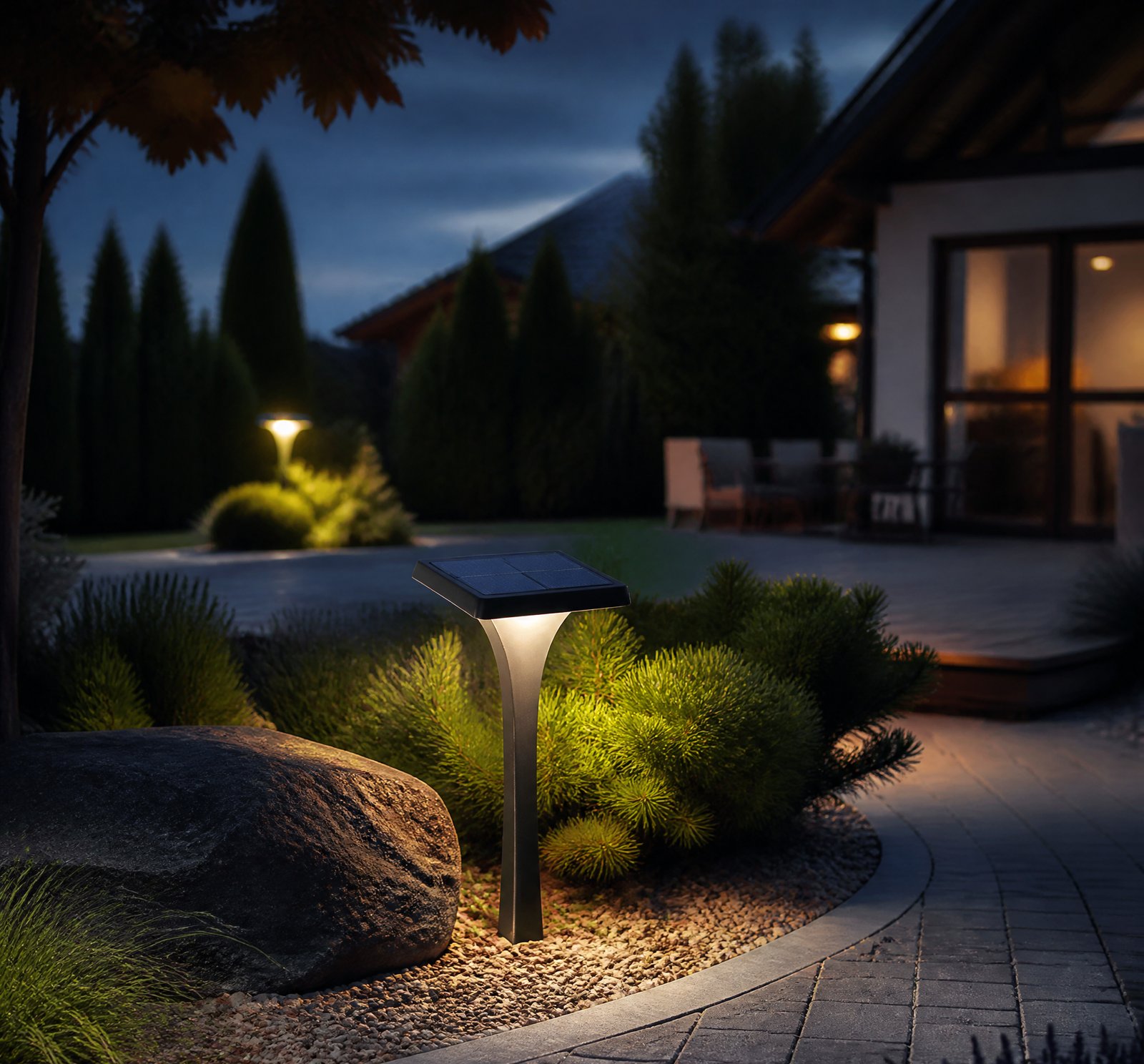
> Quick answer: A solar lamp can remain bright all night if its battery capacity is sufficient relative to power consumption, its solar panel is efficient and properly positioned, and it has intelligent energy management systems that adjust output based on real-time data [13][25].
Ensuring your solar lamps stay bright throughout the night in Romania requires a combination of factors including battery capacity, solar panel efficiency, and smart energy management. These elements work together to ensure consistent performance under varying conditions.
Battery Capacity and Energy Storage
A critical factor in sustained nighttime brightness is the battery’s energy storage capacity relative to the lamp’s power consumption. The AEM10941 solar lighting system demonstrated that a single charge could sustain up to 10 hours of lighting [22][23]. However, performance can vary based on environmental conditions like winter months or low-light situations [25].
The quality and type of battery also play significant roles. Solar lamps commonly use gel electrolyte batteries effective in deep discharging and extreme temperatures [16]. Other types include lead-acid, nickel metal hydride, nickel cadmium, and lithium-ion batteries [16]. One user reported that a batch of Richarm lights failed due to defective lithium-ion batteries but was restored by battery replacement [25], highlighting the importance of reliable components.
Solar Panel Efficiency and Exposure
Solar panel efficiency and exposure are equally vital. The AEM10941 system charges fully within three hours under bright sunshine, indicating that a sufficiently efficient panel can achieve full charge in a short time [22][23]. However, undersized solar panels may prevent full charging regardless of brand [25].
Optimal placement is crucial — facing south, elevated, and unobstructed. Even rain can improve panel efficiency by cleaning dust [14], emphasizing the importance of environmental factors in daily energy capture.
Energy Management Systems
Energy management systems are perhaps the most decisive factor in maintaining consistent brightness. Patents describe systems that dynamically adjust light output based on battery state and historical solar input [13][24]. For example, one system dims the lamp when battery voltage drops or adjusts lighting based on previous day’s solar production [13].
This suggests that a lamp with smart control algorithms can optimize usage better than a large battery alone. Features like motion detection dimming and pre-dawn brightening further support sustained performance [13].
Dusk to Dawn Operation
The presence of a „dusk to dawn” photocell is another common feature, enabling automatic operation [18][19][20][21]. However, this does not guarantee full brightness all night but ensures it operates only when needed. Some lights offer a “light timer” mode that limits runtime to 2, 4, or 6 hours before turning off automatically [18][19][20][21].
Dual-Battery Systems
Using multiple batteries is a sophisticated solution for uninterrupted operation. One patent describes a system with two batteries that alternate daily — one charges during the day while the other powers the lamp at night [17]. This prevents partial charging and provides redundancy, enhancing reliability.
Key Takeaways
- Battery Capacity: Sufficient battery capacity relative to power consumption is crucial.
- Solar Panel Efficiency: Optimal placement and efficient solar panels ensure full charge.
- Energy Management Systems: Smart control algorithms balance consumption with availability effectively.
Frequently Asked Questions
[
{„q”: „What type of batteries are best for solar lamps?”, „a”: „Gel electrolyte batteries are effective in deep discharging and extreme temperatures, but lithium-ion batteries are also commonly used. Ensure the battery quality is reliable to maintain performance [16][25].”},
{„q”: „How does environmental exposure affect a solar lamp’s performance?”, „a”: „Optimal placement facing south, elevated, and unobstructed improves charging efficiency. Rain can improve panel efficiency by cleaning dust, enhancing daily energy capture [14][25].”},
{„q”: „Are dual-battery systems more reliable than single batteries?”, „a”: „Yes, dual-battery systems ensure uninterrupted operation with one battery charging while the other powers the lamp at night, providing redundancy and preventing partial charging issues [17].”}
]
References
- [13] US20120020060A1_-_Energy-efficient_solar-powered_-_Google_Patents__619c8cff — patent
source passage
to 100% for 10 minutes after the last-detected motion. It then dims back down to the lower setting over one minute. Towards dawn, the light will brighten back up to full brightness approximately 30 minutes (factory preset) prior to dawn. When the photocell threshold for dawn is crossed, the light will turn off. – FIG. 47 portrays examples of how system conditions can be utilized to determine the appropriate energy modes based on current states to modify power delivered, to the light or other loads, beyond or instead of the “normal” changes over time shown in FIG. 46 . – the voltage of the batteries (on the right of the figure) is one indicator of how much energy is available in the battery storage. As the battery voltage drops, the energy mode is adjusted so that energy can be conserved. – the Ah decision block is referring to the solar production (in Amp-Hours, Ah) from the previous day. This Ah information is also an indicator of whether or not energy needs to be conserved. On any given day, if the energy produced is less than normal, then the energy mode is adjusted to conserve energy, over and above the adjustments shown in FIG. 46 , preferably during the following night. – Modes E1 through E6 Energy Savings Modes are available (modes E1 through E6), and selection of the modes is determined by the measuring the battery voltage at the end of the day. – modes E1 and E2 the light is still brought up to full brightness initially & then dimmed down to less than 25% brightness
- [14] 12_Best_Solar_Lamp_Posts_Top_Rated_Lamps_to_Buy__191c85e0 — blog
source passage
higher elevation than surrounding structures. Solar panels will continue to function even if the light is deflected or partially covered by clouds. The rain helps your solar panels run more efficiently by wiping away dust and debris. First, make sure your solar panel is in a sunny location. The brighter it is, the more power it generates and the longer it will keep your lights on. Second, angle your solar lights so that they face south. It will provide them with direct sunlight and allow them to charge more quickly. The brightest solar lights are task lights or spotlights, and the greatest ones may produce brightness comparable to a 40-watt incandescent bulb. That is still not as bright as a standard outdoor spotlight, so in areas where you need powerful, direct light, double or triple up. Solar lights turn off automatically during the day since they convert light into energy to store in batteries. This energy is used to power the light at night. While solar lights require little to no maintenance, they require thorough cleaning to maintain efficacy during their lives. Solar street lights are the sustainable solution for extensive lighting, lowering carbon emissions and environmental impact while increasing community safety and satisfaction. Yes, even on cloudy days, solar lights charge. Although the battery does not charge as quickly, small efficient solar panels can still provide electricity when it is partly cloudy or overcast. In most cases, you do not need to manually tu
- [16] Solar_lamp_-_Wikipedia__3c516988 — wikipedia
source passage
could cause problems.[6] A battery is usually housed within a metal or plastic case. Inside the case are electrodes including cathodes and anodes where chemical reactions occur. A separator also exists between cathode and anode which stops the electrodes reacting together at the same time as allowing electrical charge to flow freely between the two. Lastly, the collector conducts a charge from the battery to outside.[7] Batteries inside solar lamps usually use gel electrolyte technology with high performance in deep discharging, in order to enable use in extreme ranges of temperature.[citation needed] It may also use lead-acid, nickel metal hydride, nickel cadmium, or lithium. This part of the lamp saves up energy from the solar panel and provides power when needed at night when there is no light energy available. In general, the efficiency of photovoltaic energy conversion is limited for physical reasons. Around 24% of solar radiation of a long wavelength is not absorbed. 33% is heat lost to surroundings, and further losses are of approximately 15-20%. Only 23% is absorbed, which means a battery is a crucial part of solar lamp.[8] This section controls the entire working systems to protect battery charge. It ensures, under any circumstances including extreme weather conditions with large temperature difference, the battery does not overcharge or over discharge and damage the battery even further.[citation needed] This section also includes additional parts such as light cont
- [17] US9920895B2_-_Street_light_-_Google_Patents__b32f25f2 — patent
source passage
sets of batteries may be duplicated. This enables one battery to be charged as much as possible during one day from the solar panel. The other battery having been previously fully charged is then used during the night following the one day. The one battery is then fully charged following solar charging during the night's low tariff period. The next day the other battery is solar charged and so on. For this the charging controller is arranged to interchange battery use and charging on a daily basis. This arrangement avoids the battery being solar charged ending the period of solar charging in an inadequately charged state for the following night's usage. This arrangement avoids the need for the charging circuit to be programmed to take account of the variation in the number of daylight hours that the solar panel will receive throughout the year. Claims (26) 1. A street light comprising: a lamp standard, a lamp mounted on the lamp standard, at least two batteries installable with the lamp standard for powering the lamp, means for connection of the lamp standard to a mains electricity grid, a rectifier for charging the batteries from the mains electricity grid, a solar panel and/or a wind turbine for charging of the batteries and means for controlling illumination of the lamp and charging of the batteries arranged to interchange battery use and charging on a daily basis for: the one of the batteries used during the previous night to be solar and/or wind charged during the follow
- [18] 10_Best_Solar_Street_Lights_-_High_Brightness_Solar_Lights__fa826f6f — reddit
source passage
– Always: the light will stay ON at full brightness all night long. – Induction / Radar: the light will stay ON at 30% of brightness and barely detects movement it will turn ON at full brightness, then it will go back at 30% of brightness if it doesn't detect more movement. – Light Timer: the light can be set up to stay ON at full brightness during 6, 4 or 2 hours, then it will automatically turn OFF. FREQUENTLY ASKED QUESTIONS – How long does delivery take? – After placing your order, you can expect your package to arrive in 3-5 days via FedEx. We offer FREE Shipping on all orders. Our warehouses are based in: – Los Angeles, California. United States. – What's the company's warranty policy? – We offer 60 days money-back guarantee. After that period we provide 2-years warranty for replacements in case it is needed. – What type of Photocell do the lights use? – Our LED solar lights work with photocell dusk to dawn which means that they will automatically turn ON and OFF with the sense of natural light, plus they can be manually turned ON and OFF by using the switch/button that is integrated with the lights. – How long the lights stay ON during the night? – Our outdoor solar lights can stay ON all night long. – Do they need any wires for installation? – Our solar lights are 100% wires free. All you have to do is putting it in the desired place, push the turn ON/OFF button in the lamp, and that's it. That simple! – What is the minimum and maximum temperature that the lights can
- [19] Long_Lasting_Solar_Lights_-_100_Best_Outdoor_Solar_Lights__86f04cb5 — reddit
source passage
– Always: the light will stay ON at full brightness all night long. – Induction / Radar: the light will stay ON at 30% of brightness and barely detects movement it will turn ON at full brightness, then it will go back at 30% of brightness if it doesn't detect more movement. – Light Timer: the light can be set up to stay ON at full brightness during 6, 4 or 2 hours, then it will automatically turn OFF. FREQUENTLY ASKED QUESTIONS – How long does delivery take? – After placing your order, you can expect your package to arrive in 3-5 days via FedEx. We offer FREE Shipping on all orders. Our warehouses are based in: – Los Angeles, California. United States. – What's the company's warranty policy? – We offer 60 days money-back guarantee. After that period we provide 2-years warranty for replacements in case it is needed. – What type of Photocell do the lights use? – Our LED solar lights work with photocell dusk to dawn which means that they will automatically turn ON and OFF with the sense of natural light, plus they can be manually turned ON and OFF by using the switch/button that is integrated with the lights. – How long the lights stay ON during the night? – Our outdoor solar lights can stay ON all night long. – Do they need any wires for installation? – Our solar lights are 100% wires free. All you have to do is putting it in the desired place, push the turn ON/OFF button in the lamp, and that's it. That simple! – What is the minimum and maximum temperature that the lights can
- [20] Led_Solar_Street_Light_-_High_Brightness_Solar_Lights__af10d99a — patent
source passage
– Always: the light will stay ON at full brightness all night long. – Induction / Radar: the light will stay ON at 30% of brightness and barely detects movement it will turn ON at full brightness, then it will go back at 30% of brightness if it doesn't detect more movement. – Light Timer: the light can be set up to stay ON at full brightness during 6, 4 or 2 hours, then it will automatically turn OFF. FREQUENTLY ASKED QUESTIONS – How long does delivery take? – After placing your order, you can expect your package to arrive in 3-5 days via FedEx. We offer FREE Shipping on all orders. Our warehouses are based in: – Los Angeles, California. United States. – What's the company's warranty policy? – We offer 60 days money-back guarantee. After that period we provide 2-years warranty for replacements in case it is needed. – What type of Photocell do the lights use? – Our LED solar lights work with photocell dusk to dawn which means that they will automatically turn ON and OFF with the sense of natural light, plus they can be manually turned ON and OFF by using the switch/button that is integrated with the lights. – How long the lights stay ON during the night? – Our outdoor solar lights can stay ON all night long. – Do they need any wires for installation? – Our solar lights are 100% wires free. All you have to do is putting it in the desired place, push the turn ON/OFF button in the lamp, and that's it. That simple! – What is the minimum and maximum temperature that the lights can
- [21] Outdoor_Solar_Garden_Lights_-_100_Best_Outdoor_Solar_Lights__366bd5aa — blog
source passage
– Always: the light will stay ON at full brightness all night long. – Induction / Radar: the light will stay ON at 30% of brightness and barely detects movement it will turn ON at full brightness, then it will go back at 30% of brightness if it doesn't detect more movement. – Light Timer: the light can be set up to stay ON at full brightness during 6, 4 or 2 hours, then it will automatically turn OFF. FREQUENTLY ASKED QUESTIONS – How long does delivery take? – After placing your order, you can expect your package to arrive in 3-5 days via FedEx. We offer FREE Shipping on all orders. Our warehouses are based in: – Los Angeles, California. United States. – What's the company's warranty policy? – We offer 60 days money-back guarantee. After that period we provide 2-years warranty for replacements in case it is needed. – What type of Photocell do the lights use? – Our LED solar lights work with photocell dusk to dawn which means that they will automatically turn ON and OFF with the sense of natural light, plus they can be manually turned ON and OFF by using the switch/button that is integrated with the lights. – How long the lights stay ON during the night? – Our outdoor solar lights can stay ON all night long. – Do they need any wires for installation? – Our solar lights are 100% wires free. All you have to do is putting it in the desired place, push the turn ON/OFF button in the lamp, and that's it. That simple! – What is the minimum and maximum temperature that the lights can
- [22] PV-driven_lighting_solution_for_rural_areas_pv_magazine_International__e2bf7e67 — magazine
source passage
the need for light per night in remote communities in Cameroon is four hours. Performance evaluation tests revealed that the AEM10941 effectively charges the battery to full capacity within three hours. Additionally, in indoor mode, a single charge can sustain up to 10 hours of lighting, demonstrating the lamp’s efficiency and reliability in providing prolonged illumination. “Moreover, reliable lighting enhances safety by illuminating pathways and deterring potential threats, contributing to a sense of security within the community. Additionally, by reducing reliance on hazardous kerosene lamps, solar lamps promote better health outcomes by minimizing exposure to harmful fumes and reducing the risk of accidents,” the academics added. The system was presented in “Design and implementation of AEM10941 based solar energy system harvester for domestic lighting as a sustainable lighting solution for rural areas,” published in Scientific Reports. The research was conducted by scientists from Cameroon’s University of Buea and the African Scientific Association for Innovative and Entrepreneurship (ASAIE).
- [23] PV-driven_lighting_solution_for_rural_areas_pv_magazine_International__e2bf7e67 — authority
source passage
the need for light per night in remote communities in Cameroon is four hours. Performance evaluation tests revealed that the AEM10941 effectively charges the battery to full capacity within three hours. Additionally, in indoor mode, a single charge can sustain up to 10 hours of lighting, demonstrating the lamp’s efficiency and reliability in providing prolonged illumination. “Moreover, reliable lighting enhances safety by illuminating pathways and deterring potential threats, contributing to a sense of security within the community. Additionally, by reducing reliance on hazardous kerosene lamps, solar lamps promote better health outcomes by minimizing exposure to harmful fumes and reducing the risk of accidents,” the academics added. The system was presented in “Design and implementation of AEM10941 based solar energy system harvester for domestic lighting as a sustainable lighting solution for rural areas,” published in Scientific Reports. The research was conducted by scientists from Cameroon’s University of Buea and the African Scientific Association for Innovative and Entrepreneurship (ASAIE).
- [24] US20120020060A1_-_Energy-efficient_solar-powered_-_Google_Patents__619c8cff — patent
source passage
photovoltaic material having an efficiency in bright sunshine in the range of 10-16%. 20. A method as in claim 15 , further comprising determining an amount to dim said luminaire, during a nighttime when said at least one motion sensor is not sensing motion near the pole, based on a method comprising measuring battery voltage of said at least one battery at dusk prior to said nighttime. 21. A method as in claim 15 , further comprising determining an amount to dim said luminaire, during a nighttime when said at least one motion sensor is not sensing motion near the pole, based on a method comprising measuring and recording energy production in amp-hours by said solar collector panel in a previous time period comprising one or more days. 22. A method as in claim 15 , further comprising determining an amount to dim said luminaire, during a nighttime when said at least one motion sensor is not sensing motion near the pole, based on a method comprising measuring and recording historical data of energy collection by the solar collector panel over a period one year earlier. 23. A method as in claim 15 , wherein said first fraction is 25% or less of full brightness. 24. A method as in claim 15 , wherein a plurality of batteries are provided and the method further comprises disconnected selected batteries of said plurality of batteries when said selected batteries fail. 25. A method as in claim 15 , further comprising not raising brightness of said luminaire in response to motion dete
- [25] Long_Term_Solar_Lighting_Test_Part_2_electrical_forum_at_permies__343857ed — reddit
source passage
# Long Term Solar Lighting Test, Part 2 Source: Blog/Web URL: https://permies.com/t/170975/Long-Term-Solar-Lighting-Test Author: Date: 2021-11-30 In my exciting previous thread, https://permies.com/t/169620/Long-Term-Solar-Lighting-Test#1336129 I laid out my thoughts on these lights and potential issues (i.e., the solar panel is too small) and how I planned on fixing that. Keep in mind that these solar lights can also be charged via USB. These lights are remote controlled, can come on automatically, be turned on manually, have a dimmer, have a timer for 2,4 and 6 hours. I also use these lights indoors for nighttime lighting. After more discussion with the distributor, Richarm, out of Jamaica, N.Y., the point of which is that they apparently had a batch of bad lithium-ion batteries. I intend to take apart the two offending lights and replace the batteries myself. To aid me with that, Richarm sent me a new set of lights, two 15 foot USB charge cables and 4 short USB charge cables, all gratis. These 2 lights I'll be doing my first fast charging testing on. The thing is with these solar outdoor lights – and these are the best one's I've ever owned – one of two things always happens. 1. They don't charge fully because of undersized solar panels (doesn't matter what style or brand). 2. They do not stay lit from dusk to dawn (especially in the winter). These Richarm lights have that issue solved – they are able to stay on all night, even in the winter. It's the charging where the ha
to 100% for 10 minutes after the last-detected motion. It then dims back down to the lower setting over one minute. Towards dawn, the light will brighten back up to full brightness approximately 30 minutes (factory preset) prior to dawn. When the photocell threshold for dawn is crossed, the light will turn off. – FIG. 47 portrays examples of how system conditions can be utilized to determine the appropriate energy modes based on current states to modify power delivered, to the light or other loads, beyond or instead of the “normal” changes over time shown in FIG. 46 . – the voltage of the batteries (on the right of the figure) is one indicator of how much energy is available in the battery storage. As the battery voltage drops, the energy mode is adjusted so that energy can be conserved. – the Ah decision block is referring to the solar production (in Amp-Hours, Ah) from the previous day. This Ah information is also an indicator of whether or not energy needs to be conserved. On any given day, if the energy produced is less than normal, then the energy mode is adjusted to conserve energy, over and above the adjustments shown in FIG. 46 , preferably during the following night. – Modes E1 through E6 Energy Savings Modes are available (modes E1 through E6), and selection of the modes is determined by the measuring the battery voltage at the end of the day. – modes E1 and E2 the light is still brought up to full brightness initially & then dimmed down to less than 25% brightness
higher elevation than surrounding structures. Solar panels will continue to function even if the light is deflected or partially covered by clouds. The rain helps your solar panels run more efficiently by wiping away dust and debris. First, make sure your solar panel is in a sunny location. The brighter it is, the more power it generates and the longer it will keep your lights on. Second, angle your solar lights so that they face south. It will provide them with direct sunlight and allow them to charge more quickly. The brightest solar lights are task lights or spotlights, and the greatest ones may produce brightness comparable to a 40-watt incandescent bulb. That is still not as bright as a standard outdoor spotlight, so in areas where you need powerful, direct light, double or triple up. Solar lights turn off automatically during the day since they convert light into energy to store in batteries. This energy is used to power the light at night. While solar lights require little to no maintenance, they require thorough cleaning to maintain efficacy during their lives. Solar street lights are the sustainable solution for extensive lighting, lowering carbon emissions and environmental impact while increasing community safety and satisfaction. Yes, even on cloudy days, solar lights charge. Although the battery does not charge as quickly, small efficient solar panels can still provide electricity when it is partly cloudy or overcast. In most cases, you do not need to manually tu
could cause problems.[6] A battery is usually housed within a metal or plastic case. Inside the case are electrodes including cathodes and anodes where chemical reactions occur. A separator also exists between cathode and anode which stops the electrodes reacting together at the same time as allowing electrical charge to flow freely between the two. Lastly, the collector conducts a charge from the battery to outside.[7] Batteries inside solar lamps usually use gel electrolyte technology with high performance in deep discharging, in order to enable use in extreme ranges of temperature.[citation needed] It may also use lead-acid, nickel metal hydride, nickel cadmium, or lithium. This part of the lamp saves up energy from the solar panel and provides power when needed at night when there is no light energy available. In general, the efficiency of photovoltaic energy conversion is limited for physical reasons. Around 24% of solar radiation of a long wavelength is not absorbed. 33% is heat lost to surroundings, and further losses are of approximately 15-20%. Only 23% is absorbed, which means a battery is a crucial part of solar lamp.[8] This section controls the entire working systems to protect battery charge. It ensures, under any circumstances including extreme weather conditions with large temperature difference, the battery does not overcharge or over discharge and damage the battery even further.[citation needed] This section also includes additional parts such as light cont
sets of batteries may be duplicated. This enables one battery to be charged as much as possible during one day from the solar panel. The other battery having been previously fully charged is then used during the night following the one day. The one battery is then fully charged following solar charging during the night's low tariff period. The next day the other battery is solar charged and so on. For this the charging controller is arranged to interchange battery use and charging on a daily basis. This arrangement avoids the battery being solar charged ending the period of solar charging in an inadequately charged state for the following night's usage. This arrangement avoids the need for the charging circuit to be programmed to take account of the variation in the number of daylight hours that the solar panel will receive throughout the year. Claims (26) 1. A street light comprising: a lamp standard, a lamp mounted on the lamp standard, at least two batteries installable with the lamp standard for powering the lamp, means for connection of the lamp standard to a mains electricity grid, a rectifier for charging the batteries from the mains electricity grid, a solar panel and/or a wind turbine for charging of the batteries and means for controlling illumination of the lamp and charging of the batteries arranged to interchange battery use and charging on a daily basis for: the one of the batteries used during the previous night to be solar and/or wind charged during the follow
– Always: the light will stay ON at full brightness all night long. – Induction / Radar: the light will stay ON at 30% of brightness and barely detects movement it will turn ON at full brightness, then it will go back at 30% of brightness if it doesn't detect more movement. – Light Timer: the light can be set up to stay ON at full brightness during 6, 4 or 2 hours, then it will automatically turn OFF. FREQUENTLY ASKED QUESTIONS – How long does delivery take? – After placing your order, you can expect your package to arrive in 3-5 days via FedEx. We offer FREE Shipping on all orders. Our warehouses are based in: – Los Angeles, California. United States. – What's the company's warranty policy? – We offer 60 days money-back guarantee. After that period we provide 2-years warranty for replacements in case it is needed. – What type of Photocell do the lights use? – Our LED solar lights work with photocell dusk to dawn which means that they will automatically turn ON and OFF with the sense of natural light, plus they can be manually turned ON and OFF by using the switch/button that is integrated with the lights. – How long the lights stay ON during the night? – Our outdoor solar lights can stay ON all night long. – Do they need any wires for installation? – Our solar lights are 100% wires free. All you have to do is putting it in the desired place, push the turn ON/OFF button in the lamp, and that's it. That simple! – What is the minimum and maximum temperature that the lights can
– Always: the light will stay ON at full brightness all night long. – Induction / Radar: the light will stay ON at 30% of brightness and barely detects movement it will turn ON at full brightness, then it will go back at 30% of brightness if it doesn't detect more movement. – Light Timer: the light can be set up to stay ON at full brightness during 6, 4 or 2 hours, then it will automatically turn OFF. FREQUENTLY ASKED QUESTIONS – How long does delivery take? – After placing your order, you can expect your package to arrive in 3-5 days via FedEx. We offer FREE Shipping on all orders. Our warehouses are based in: – Los Angeles, California. United States. – What's the company's warranty policy? – We offer 60 days money-back guarantee. After that period we provide 2-years warranty for replacements in case it is needed. – What type of Photocell do the lights use? – Our LED solar lights work with photocell dusk to dawn which means that they will automatically turn ON and OFF with the sense of natural light, plus they can be manually turned ON and OFF by using the switch/button that is integrated with the lights. – How long the lights stay ON during the night? – Our outdoor solar lights can stay ON all night long. – Do they need any wires for installation? – Our solar lights are 100% wires free. All you have to do is putting it in the desired place, push the turn ON/OFF button in the lamp, and that's it. That simple! – What is the minimum and maximum temperature that the lights can
– Always: the light will stay ON at full brightness all night long. – Induction / Radar: the light will stay ON at 30% of brightness and barely detects movement it will turn ON at full brightness, then it will go back at 30% of brightness if it doesn't detect more movement. – Light Timer: the light can be set up to stay ON at full brightness during 6, 4 or 2 hours, then it will automatically turn OFF. FREQUENTLY ASKED QUESTIONS – How long does delivery take? – After placing your order, you can expect your package to arrive in 3-5 days via FedEx. We offer FREE Shipping on all orders. Our warehouses are based in: – Los Angeles, California. United States. – What's the company's warranty policy? – We offer 60 days money-back guarantee. After that period we provide 2-years warranty for replacements in case it is needed. – What type of Photocell do the lights use? – Our LED solar lights work with photocell dusk to dawn which means that they will automatically turn ON and OFF with the sense of natural light, plus they can be manually turned ON and OFF by using the switch/button that is integrated with the lights. – How long the lights stay ON during the night? – Our outdoor solar lights can stay ON all night long. – Do they need any wires for installation? – Our solar lights are 100% wires free. All you have to do is putting it in the desired place, push the turn ON/OFF button in the lamp, and that's it. That simple! – What is the minimum and maximum temperature that the lights can
– Always: the light will stay ON at full brightness all night long. – Induction / Radar: the light will stay ON at 30% of brightness and barely detects movement it will turn ON at full brightness, then it will go back at 30% of brightness if it doesn't detect more movement. – Light Timer: the light can be set up to stay ON at full brightness during 6, 4 or 2 hours, then it will automatically turn OFF. FREQUENTLY ASKED QUESTIONS – How long does delivery take? – After placing your order, you can expect your package to arrive in 3-5 days via FedEx. We offer FREE Shipping on all orders. Our warehouses are based in: – Los Angeles, California. United States. – What's the company's warranty policy? – We offer 60 days money-back guarantee. After that period we provide 2-years warranty for replacements in case it is needed. – What type of Photocell do the lights use? – Our LED solar lights work with photocell dusk to dawn which means that they will automatically turn ON and OFF with the sense of natural light, plus they can be manually turned ON and OFF by using the switch/button that is integrated with the lights. – How long the lights stay ON during the night? – Our outdoor solar lights can stay ON all night long. – Do they need any wires for installation? – Our solar lights are 100% wires free. All you have to do is putting it in the desired place, push the turn ON/OFF button in the lamp, and that's it. That simple! – What is the minimum and maximum temperature that the lights can
the need for light per night in remote communities in Cameroon is four hours. Performance evaluation tests revealed that the AEM10941 effectively charges the battery to full capacity within three hours. Additionally, in indoor mode, a single charge can sustain up to 10 hours of lighting, demonstrating the lamp’s efficiency and reliability in providing prolonged illumination. “Moreover, reliable lighting enhances safety by illuminating pathways and deterring potential threats, contributing to a sense of security within the community. Additionally, by reducing reliance on hazardous kerosene lamps, solar lamps promote better health outcomes by minimizing exposure to harmful fumes and reducing the risk of accidents,” the academics added. The system was presented in “Design and implementation of AEM10941 based solar energy system harvester for domestic lighting as a sustainable lighting solution for rural areas,” published in Scientific Reports. The research was conducted by scientists from Cameroon’s University of Buea and the African Scientific Association for Innovative and Entrepreneurship (ASAIE).
the need for light per night in remote communities in Cameroon is four hours. Performance evaluation tests revealed that the AEM10941 effectively charges the battery to full capacity within three hours. Additionally, in indoor mode, a single charge can sustain up to 10 hours of lighting, demonstrating the lamp’s efficiency and reliability in providing prolonged illumination. “Moreover, reliable lighting enhances safety by illuminating pathways and deterring potential threats, contributing to a sense of security within the community. Additionally, by reducing reliance on hazardous kerosene lamps, solar lamps promote better health outcomes by minimizing exposure to harmful fumes and reducing the risk of accidents,” the academics added. The system was presented in “Design and implementation of AEM10941 based solar energy system harvester for domestic lighting as a sustainable lighting solution for rural areas,” published in Scientific Reports. The research was conducted by scientists from Cameroon’s University of Buea and the African Scientific Association for Innovative and Entrepreneurship (ASAIE).
photovoltaic material having an efficiency in bright sunshine in the range of 10-16%. 20. A method as in claim 15 , further comprising determining an amount to dim said luminaire, during a nighttime when said at least one motion sensor is not sensing motion near the pole, based on a method comprising measuring battery voltage of said at least one battery at dusk prior to said nighttime. 21. A method as in claim 15 , further comprising determining an amount to dim said luminaire, during a nighttime when said at least one motion sensor is not sensing motion near the pole, based on a method comprising measuring and recording energy production in amp-hours by said solar collector panel in a previous time period comprising one or more days. 22. A method as in claim 15 , further comprising determining an amount to dim said luminaire, during a nighttime when said at least one motion sensor is not sensing motion near the pole, based on a method comprising measuring and recording historical data of energy collection by the solar collector panel over a period one year earlier. 23. A method as in claim 15 , wherein said first fraction is 25% or less of full brightness. 24. A method as in claim 15 , wherein a plurality of batteries are provided and the method further comprises disconnected selected batteries of said plurality of batteries when said selected batteries fail. 25. A method as in claim 15 , further comprising not raising brightness of said luminaire in response to motion dete
# Long Term Solar Lighting Test, Part 2 Source: Blog/Web URL: https://permies.com/t/170975/Long-Term-Solar-Lighting-Test Author: Date: 2021-11-30 In my exciting previous thread, https://permies.com/t/169620/Long-Term-Solar-Lighting-Test#1336129 I laid out my thoughts on these lights and potential issues (i.e., the solar panel is too small) and how I planned on fixing that. Keep in mind that these solar lights can also be charged via USB. These lights are remote controlled, can come on automatically, be turned on manually, have a dimmer, have a timer for 2,4 and 6 hours. I also use these lights indoors for nighttime lighting. After more discussion with the distributor, Richarm, out of Jamaica, N.Y., the point of which is that they apparently had a batch of bad lithium-ion batteries. I intend to take apart the two offending lights and replace the batteries myself. To aid me with that, Richarm sent me a new set of lights, two 15 foot USB charge cables and 4 short USB charge cables, all gratis. These 2 lights I'll be doing my first fast charging testing on. The thing is with these solar outdoor lights – and these are the best one's I've ever owned – one of two things always happens. 1. They don't charge fully because of undersized solar panels (doesn't matter what style or brand). 2. They do not stay lit from dusk to dawn (especially in the winter). These Richarm lights have that issue solved – they are able to stay on all night, even in the winter. It's the charging where the ha