
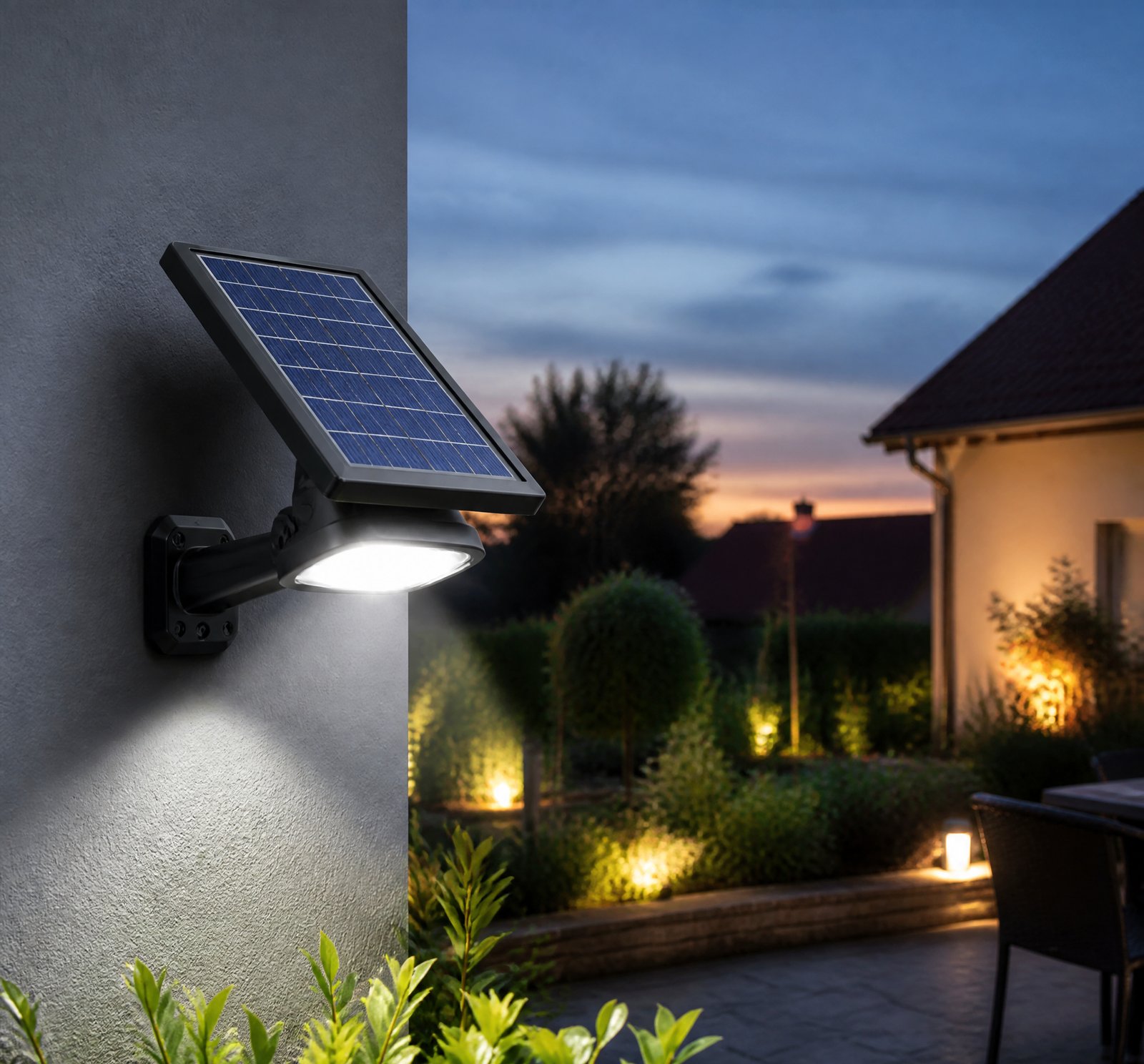
Quick answer: Pe o perioadă de 5 ani, o lampă solară LiFePO4 de 2000 de lumeni are un cost total de posesiune semnificativ mai mic decât o lampă LED alimentată de la rețea în România, din cauza cheltuielilor aproape nule de energie electrică și a costurilor de instalare reduse, chiar dacă investiția inițială este mai mare [8][11]. Aceasta se datorează faptului că costurile de energie sunt cea mai importantă cheltuială recurentă [19], iar sistemul solar nu are consum de energie [8][11].
În România, alegerea dintre o lampă solară LiFePO4 și una LED alimentată de la rețea nu se reduce doar la prețul de cumpărare. Adevărata diferență apare pe termen lung, unde costul total de posesiune (TCO) poate fi decisiv. O lampă solară cu baterie LiFePO4, proiectată pentru funcționare în condiții extreme (până la -25 °C), oferă lumină puternică (2000 lumeni la 6500K) fără nevoia de cabluri electrice, în timp ce o lampă LED clasică necesită instalare electrică și consum constant de energie [8][11].
Costul inițial: Investiție mai mare, dar justificată
Cheltuielile inițiale pentru o lampă solară LiFePO4 sunt în general mai mari decât pentru o lampă LED alimentată de la rețea [4]. Totuși, sursele nu oferă prețuri exacte pentru România, iar prețurile pentru sisteme solare variază între 20 și 200 USD [8]. Deși acestea nu includ întotdeauna costul instalării, o lampă solară „all-in-one” poate reduce semnificativ nevoia de intervenții electrice [4]. În schimb, o lampă LED de tip floodlight necesită cabluri, cutii de conexiuni, întrerupătoare și servicii ale unui electrician — costuri care pot ajunge între 100 și 300 USD în contexte generale [8], dar care pot fi mult mai mari în zonele rurale sau cu acces dificil.
Cheltuieli de energie: Diferența care face diferența
Cel mai important factor în TCO este consumul de energie. Lămpile solare nu consumă energie electrică, fiind alimentate exclusiv de energie solară [8][11]. În schimb, lămpile LED alimentate de la rețea au cheltuieli anuale semnificative, care depind de puterea dispozitivului și de prețul kWh-ului [5][19]. Chiar dacă costurile de energie pot fi reduse cu până la 80% prin senzori de mișcare [18], acestea rămân o cheltuială recurentă. Într-un mediu cu prețuri de energie ridicat, aceste costuri se acumulează rapid pe termen lung.
Durabilitate și întreținere: O viață lungă, costuri mici
LED-urile au o durată de viață între 25.000 și 100.000 de ore [3][14], iar un sistem de control inteligent poate reduce timpul efectiv de funcționare la sub 20% [18]. Totuși, chiar și în această situație, lampa LED consumă energie. Lămpile solare, cum ar fi cele de la Neosimply, care au un senzor crepuscular și PIR, funcționează pe baza senzorilor pentru a economisi energie [10][17]. Bateriile LiFePO4 sunt cunoscute pentru durabilitatea lor — o sursă menționează că un model ECOWOMLIGHT funcționează încă după patru ani [2], ceea ce indică o durată de viață stabilă a produselor de calitate.
Instalare: Simplu, rapid, fără costuri ascunse
Lămpile solare sunt „uşor de instalat” și nu necesită cabluri sau conexiuni electrice [4][11]. Aceasta este o beneficiu major în România, unde instalarea electrică în terenuri îndepărtate sau cu acces limitat poate fi costisitoare sau imposibilă. Deși sursele nu oferă costuri exacte pentru România, estimările generale indică că costurile de instalare pentru solare pot fi mult mai mici decât pentru rețea [8].
| Caracteristică | Lampă Solară LiFePO4 | Lampă LED cu Rețea |
|---|---|---|
| Cost inițial | Mai mare [4] | Mai mic [8] |
| Cheltuieli de energie | Aproape nule [8][11] | Semnificative [19] |
| Cost instalare | Foarte scăzut [4][11] | Între 100–300 USD [8] |
| Durată de viață LED | 25.000–100.000 ore [3][14] | 25.000–100.000 ore [3][14] |
| Intervenții de întreținere | Minime [2] | Periodice (înlocuire becuri) |
Concluzii cheie
- Costul total de posesiune pe 5 ani pentru o lampă solară LiFePO4 este semnificativ mai mic datorită consumului aproape nul de energie [8][11].
- Instalarea simplă reduce semnificativ costul total, mai ales în zonele rurale [4][11].
- Cheltuielile de energie sunt cea mai importantă cheltuială recurentă [19], iar acestea sunt eliminate complet în cazul solar.
- Chiar și cu control inteligent, o lampă LED alimentată de la rețea necesită energie [18], în timp ce o lampă solară nu.
- Bateriile LiFePO4 și senzorii de mișcare contribuie la o eficiență maximă și durabilitate [2][10][17].
References
- [2] Is it feasible to install solar lights in the yard – Solar Panels – So — reddit
source passage
one det assemblies they sell. Bruce RoeComment – I bought the solar lights in 2020. They are still working well now. The total price of the two lights was a bit expensive, about $150, and I bought them at my local hardware store. But I think it's worth it compared to replacing the solar lights every year. The brand name is ECOHOMLIGHT.Comment – Thanks for sharing. I found them for sale online. What model did you buuy? I bought the solar lights in 2020. They are still working well now. The total price of the two lights was a bit expensive, about $150, and I bought them at my local hardware store. But I think it's worth it compared to replacing the solar lights every year. The brand name is ECOHOMLIGHT.Comment – Who/what/where are these guys? When I go to their website and click "About us", all I get is this nonsense: I bought the solar lights in 2020. They are still working well now. The total price of the two lights was a bit expensive, about $150, and I bought them at my local hardware store. But I think it's worth it compared to replacing the solar lights every year. The brand name is ECOHOMLIGHT. "ECOHOMLIGHT: Where eco-conscious living meets the brilliance of solar lighting. We're not just a solar light company, we're a movement. We believe in harnessing the power of the sun to create beautiful, sustainable homes that shine both inside and out." Is it even a real company?Comment – Great to hear. It's been so long. I think it should be this link. (link removed) Mod edit: N
- [3] New IDA LED Lighting Practical Guide DarkSky International — authority
source passage
of potentially harmful blue light. (see below). Relative to other commonly-used outdoor lamps, LEDs are thought to be extremely long-lived. Laboratory studies indicate lifetime ratings in the range of 25,000-100,000 hours of continuous operation, making them virtually maintenance-free. When turned on, LEDs are instantly at full brightness, unlike HID lamps that have a significant time delay. LEDs also have very low minimum energy thresholds to produce light, meaning they can be dimmed to much lower illumination levels when less light is needed, resulting in further energy savings. Product Selection Considerations Choosing LED products for outdoor lighting applications involves a series of considerations and tradeoffs. These include: – Luminous Efficiency (Watts-to-lumens): How many lumens of light are produced per input Watt of electricity? More importantly, how many lumens from the light source are meeting the task (“Fixture Lumens” vs. “Lamp Lumens”) – Lumen Output: How much light is produced relative to the amount required for a particular task? When replacing existing fixtures it is important to use the only level of illumination needed, and not to adopt unneeded increases in brightness. – Correlated Color Temperature (CCT): Does the light have a “warm” or “cool” color quality? – Color Rendering Index (CRI): How accurately does the light render colors to the human eye? A high CRI is not needed for all situations. The need for good color rendition should be considered rela
- [4] Best practices for solar street lighting systems Buildings — authority
source passage
output as that of a grid-connected LED light for that duration. This is the general operating principle of solar lights available in the marketplace. However, the technology is in its infancy, and different manufacturers are adopting different product designs. A solar lighting system offers several benefits, including ease of installation, cost savings, and energy savings. The installation is comparatively straightforward for stand-alone solar lights, which are available in two different categories: an all-in-one solar light package, which includes a PV panel, battery, controller, and LED light module; and a remote solar, or split, system, which has a remote PV or controller, battery, and a light head mounted onto the fixture’s arm. Neither of these types requires a mains connection with AC input or the related electrical wiring or cabling. While the overall overhead expense is less, the unit hardware cost is higher than that of most conventional lights. For grid-connected solar lighting systems, the benefit is limited to the cost savings of electricity from the grid. Grid-tied solar lights are wired to the grid and operate similarly as a stand-alone solar streetlight for a specified period, say nighttime peak hours, or until the battery storage drops to a set value; the system then switches to grid power. They typically do not require huge battery storage or a large PV panel, which reduces the unit cost as compared to nongrid-connected, portable solar streetlights. Like many
- [5] LED Lighting in Museums and Art Galleries Technical – Canadaca — authority
source passage
$0.12 per kWh. We have added a calculation for the common situation where an equal number of luminaires would be used (32). Source: DOE (2010). Demonstration Assessment of Light-emitting Diode (LED) Accent Lighting. Prepared by Pacific Northwest National Laboratory under Contract DE-AC05-76RL01830. Using the data of Table 2, one obtains a payback time based on electricity costs alone of 3.3 years for the 26 luminaires and 17 years for a one-to-one replacement (32 LEDs). In this project, the DOE estimated a reduction in payback time of about 35% if one included electrical savings due to lower cooling costs plus lower costs for lamp maintenance. This would mean a payback time of about 11 years for one-to-one replacement. The Field Museum noted that as the LEDs were dimmed by the control system, the illuminance decreased but the measured current did not. This has been noted by others as well and means that although the LEDs save significant energy, any further savings from dimming may be small. All three sustainability pillars drive decisions to implement lighting conversions as described above. The economic pillar drives the long-term reduction of electrical costs and maintenance costs; the social pillar drives the museum’s goal of heritage preservation; and the environmental pillar drives the selection of lower energy and lower toxicity solutions. A comparison of incandescent, CFL and LED lamps using life-cycle assessment of energy and environmental impacts done by DOE (2013)
- [8] Best Solar Flood Lights Of 2025 – SolarReviews — authority
source passage
the light’s battery capacity. The battery capacity of a solar flood light will often range between 2,000 mAh to 4,000 mAh. For a longer-lasting battery, you should look for solar flood lights with a higher mAh rating. Warranty A product warranty ensures you of its quality and is a testament to the confidence that the manufacturer has in the product. That is why a lot can be taken from the warranty that brands provide. Solar flood light warranties can vary widely depending on the manufacturer and brand. Some reputable brands will offer warranties as short as three months, while others offer up to three years. When purchasing a solar flood light, make sure that you have investigated the product’s warranty and understand exactly what the warranty covers. Price Another key factor to consider before buying solar flood lights is whether they will fit your budget. Their price will range anywhere from $20 to $200, depending on the manufacturer, size, and quality. This price range doesn’t include installation which can cost between $100 and $300. Solar flood lights have little to no operational costs compared to other options. This is due to solar flood lights not needing to operate on a power grid and instead being powered by renewable solar energy. Coverage distance The coverage distance will tell you exactly how far the light will reach and will largely depend on the light’s brightness. Every solar flood light you’re looking at should supply information regarding the light’s covera
- [10] Solar Signify — authority
source passage
# Solar Source: Blog/Web URL: https://www.signify.com/global/prof/outdoor-luminaires/solar/SMC_SOLAR_CA/category Author: Date: 2026-06-12 Solar Meet your sustainability goals with our innovative solar lighting solutions. Our easy-to-install range of solar powered lighting products include solar lights, solar panels, and solar battery sub-systems, and have been designed with performance and energy efficiency in mind. FAQs Signify's solar portfolio spans street and road lighting, floodlighting, pathway and garden lighting, post-top luminaires, wall lights, lowbay fittings, and waterproof utility luminaires. Representative families include the GreenVision All-in-one Solar Street Light, the SunCrest All-in-one Solar Post Top, and the Tango Pro Solar Floodlight, covering applications from arterial road lighting to residential pathways. Luminous flux across the range spans from 600 lm to 6,000 lm, and efficacy reaches up to 220 lm/W. These figures reflect the breadth of the portfolio — from compact pathway fittings to specification-grade street luminaires — and should be validated against the specific family datasheet for the installation's illuminance and uniformity requirements. CCT options span from 2,700 K to 6,500 K, supporting everything from warm decorative schemes to cool-white road and area lighting. CRI reaches up to 80 across the range. Specifiers should confirm the CCT and CRI of each shortlisted family against the intended application's visual-comfort and colour-render
- [11] Best Solar Lamp Post Our Top 5 Picks Reviewed — blog
source passage
made the prototypes. It’s interesting to think that it’s been around since Einstein’s day, although it would take decades before you could find a solar lamppost for your backyard. Related Article: How Long Do Solar Lights Last? The Advantages of Using an Outside Solar Lamp Post The benefits of using this type of outdoor lighting are evident. You can put them wherever you need someplace illuminated even if you don’t have an outlet nearby. Even so, a wireless option is the better choice without having to worry about securing it or wildlife chewing on an exposed cord. Then, there are the energy savings. Let’s put it into context with lighting a tree in your front yard with a variety of light sources. According to the US Department of Energy, it’ll cost you about $10 a year to illuminate it using incandescent C-9 bulbs. LEDs bring it down to only $0.82. If you have a lot of area to cover, those expenses add up quickly. There are other pros in favor of this LED-solar option including: – Less heat generation – Better long-term investment – Durability for everyday use Of course, you can’t discount the convenience factor. Most products will turn on when the ambient light reaches a specific level. That means that you needn’t remember to flip a switch, especially because you’ll likely figure out that it’s off at the most impractical time like when you’re coming home with an armful of groceries. Been there, done that. And the prices of bright solar post lights are much more reasonable t
- [14] CN2861737Y – LED solar streetlight – Google Patents — patent
source passage
# LED solar street light Source: Blog/Web URL: https://patents.google.com/patent/CN2861737Y/en Author: Date: 2006-03-27 The LED solar street light Technical field The utility model and a kind of solar street light more particularly, relate to the solar street light of a kind of LED of employing as light source. Background technology The normal in the market street lamp that adopts is high-low pressure sodium vapor lamp, metal halid lamp or electricity-saving lamp, its light source power from tens watts to several hectowatts, its shortcoming is that power consumption is big, installing engineering expense and maintenance cost height.Recently solar street light day by day more sees, but, because present solar street light adopts conventional light source more, power consumption is big, for reaching normal lighting hours and brightness of illumination, all there are high requirement area and sunshine-duration to solar panel in the street lamp, cause present solar street light production cost height, are difficult to carry out. Along with the raising of LED technology level, adopt led light source to become possibility as illuminations.Reaching under the situation of same brightness, the LED power consumption be sodium vapor lamp 1/5th in addition also to economize on electricity 80% than electricity-saving lamp, its life-span reaches 100,000 hours, is more than ten times of other lamp life-span; But because the illuminator of single led light source has stronger directionality,
- [17] Solar Signify — authority
source passage
# Solar Source: Blog/Web URL: https://www.lighting.philips.com/prof/outdoor-luminaires/solar/SOLAR_CA/category Author: Date: 2026-06-12 Solar Meet your sustainability goals with our innovative solar lighting solutions. Our easy-to-install range of solar powered lighting products include solar lights, solar panels, and solar battery sub-systems, and have been designed with performance and energy efficiency in mind. FAQs Signify's solar portfolio spans street and road lighting, floodlighting, pathway and garden lighting, post-top luminaires, wall lights, lowbay fittings, and waterproof utility luminaires. Representative families include the GreenVision All-in-one Solar Street Light, the SunCrest All-in-one Solar Post Top, and the Tango Pro Solar Floodlight, covering applications from arterial road lighting to residential pathways. Luminous flux across the range spans from 600 lm to 6,000 lm, and efficacy reaches up to 220 lm/W. These figures reflect the breadth of the portfolio — from compact pathway fittings to specification-grade street luminaires — and should be validated against the specific family datasheet for the installation's illuminance and uniformity requirements. CCT options span from 2,700 K to 6,500 K, supporting everything from warm decorative schemes to cool-white road and area lighting. CRI reaches up to 80 across the range. Specifiers should confirm the CCT and CRI of each shortlisted family against the intended application's visual-comfort and colour-renderin
- [18] Intelligent LED luminaires save energy and costs — magazine
source passage
8 months since the project began. In the long term, the project partners expect that the LED luminaires will spend less than 20 percent of the time in the activated mode, on average. Depending on how the price of electricity develops, this could result in energy cost savings of between €20,000 and 25,000 per year.
- [19] Lighting Technologies – energypediaREPORT ON THE INSPECTION OF THE SOL — authority
source passage
complete with necessary accessories. While specifying lamp prices, it is better to consider unit prices rather than just the lamp prices. For instance, a kerosene lamp may have the frame, a glass chimney, a wick, etc. whereas an incandescent lamp may have a lamp holder. Fluorescent lamps use a frame, a starter, a ballast, besides the lamp. A CFL may have a ballast and a holder. An LED light system typically has a circuit board with some electronic components, besides the LED or LEDs. As a lighting device is a total unit composing of these various components, it is always necessary to find out the total unit price. The prices are expressed in U.S. dollars for ease of use, as a standard unit of currency, in this document. Annual Operating Costs To take a sensible decision on choosing an appropriate lighting technology for a given situation, one of the most important criteria is the annual operating costs, which is the total amount of money one has to spend in one year to have the said benefits of lighting. The cost analysis is explained in the following chapter, in detail. SCOPE – A Layman’s Approachfor Appropriate Lighting Design Designing a lighting system appears complex and hence, it is better to have a systematic approach to arrive at a fair conclusion. Here, a simple practical approach to designing an optimum lighting system for a given setting is explained by five successive steps, namely, SCOPE. This approach might be adopted by any ordinary lighting designer aiming to
one det assemblies they sell. Bruce RoeComment – I bought the solar lights in 2020. They are still working well now. The total price of the two lights was a bit expensive, about $150, and I bought them at my local hardware store. But I think it's worth it compared to replacing the solar lights every year. The brand name is ECOHOMLIGHT.Comment – Thanks for sharing. I found them for sale online. What model did you buuy? I bought the solar lights in 2020. They are still working well now. The total price of the two lights was a bit expensive, about $150, and I bought them at my local hardware store. But I think it's worth it compared to replacing the solar lights every year. The brand name is ECOHOMLIGHT.Comment – Who/what/where are these guys? When I go to their website and click "About us", all I get is this nonsense: I bought the solar lights in 2020. They are still working well now. The total price of the two lights was a bit expensive, about $150, and I bought them at my local hardware store. But I think it's worth it compared to replacing the solar lights every year. The brand name is ECOHOMLIGHT. "ECOHOMLIGHT: Where eco-conscious living meets the brilliance of solar lighting. We're not just a solar light company, we're a movement. We believe in harnessing the power of the sun to create beautiful, sustainable homes that shine both inside and out." Is it even a real company?Comment – Great to hear. It's been so long. I think it should be this link. (link removed) Mod edit: N
of potentially harmful blue light. (see below). Relative to other commonly-used outdoor lamps, LEDs are thought to be extremely long-lived. Laboratory studies indicate lifetime ratings in the range of 25,000-100,000 hours of continuous operation, making them virtually maintenance-free. When turned on, LEDs are instantly at full brightness, unlike HID lamps that have a significant time delay. LEDs also have very low minimum energy thresholds to produce light, meaning they can be dimmed to much lower illumination levels when less light is needed, resulting in further energy savings. Product Selection Considerations Choosing LED products for outdoor lighting applications involves a series of considerations and tradeoffs. These include: – Luminous Efficiency (Watts-to-lumens): How many lumens of light are produced per input Watt of electricity? More importantly, how many lumens from the light source are meeting the task (“Fixture Lumens” vs. “Lamp Lumens”) – Lumen Output: How much light is produced relative to the amount required for a particular task? When replacing existing fixtures it is important to use the only level of illumination needed, and not to adopt unneeded increases in brightness. – Correlated Color Temperature (CCT): Does the light have a “warm” or “cool” color quality? – Color Rendering Index (CRI): How accurately does the light render colors to the human eye? A high CRI is not needed for all situations. The need for good color rendition should be considered rela
output as that of a grid-connected LED light for that duration. This is the general operating principle of solar lights available in the marketplace. However, the technology is in its infancy, and different manufacturers are adopting different product designs. A solar lighting system offers several benefits, including ease of installation, cost savings, and energy savings. The installation is comparatively straightforward for stand-alone solar lights, which are available in two different categories: an all-in-one solar light package, which includes a PV panel, battery, controller, and LED light module; and a remote solar, or split, system, which has a remote PV or controller, battery, and a light head mounted onto the fixture’s arm. Neither of these types requires a mains connection with AC input or the related electrical wiring or cabling. While the overall overhead expense is less, the unit hardware cost is higher than that of most conventional lights. For grid-connected solar lighting systems, the benefit is limited to the cost savings of electricity from the grid. Grid-tied solar lights are wired to the grid and operate similarly as a stand-alone solar streetlight for a specified period, say nighttime peak hours, or until the battery storage drops to a set value; the system then switches to grid power. They typically do not require huge battery storage or a large PV panel, which reduces the unit cost as compared to nongrid-connected, portable solar streetlights. Like many
$0.12 per kWh. We have added a calculation for the common situation where an equal number of luminaires would be used (32). Source: DOE (2010). Demonstration Assessment of Light-emitting Diode (LED) Accent Lighting. Prepared by Pacific Northwest National Laboratory under Contract DE-AC05-76RL01830. Using the data of Table 2, one obtains a payback time based on electricity costs alone of 3.3 years for the 26 luminaires and 17 years for a one-to-one replacement (32 LEDs). In this project, the DOE estimated a reduction in payback time of about 35% if one included electrical savings due to lower cooling costs plus lower costs for lamp maintenance. This would mean a payback time of about 11 years for one-to-one replacement. The Field Museum noted that as the LEDs were dimmed by the control system, the illuminance decreased but the measured current did not. This has been noted by others as well and means that although the LEDs save significant energy, any further savings from dimming may be small. All three sustainability pillars drive decisions to implement lighting conversions as described above. The economic pillar drives the long-term reduction of electrical costs and maintenance costs; the social pillar drives the museum’s goal of heritage preservation; and the environmental pillar drives the selection of lower energy and lower toxicity solutions. A comparison of incandescent, CFL and LED lamps using life-cycle assessment of energy and environmental impacts done by DOE (2013)
the light’s battery capacity. The battery capacity of a solar flood light will often range between 2,000 mAh to 4,000 mAh. For a longer-lasting battery, you should look for solar flood lights with a higher mAh rating. Warranty A product warranty ensures you of its quality and is a testament to the confidence that the manufacturer has in the product. That is why a lot can be taken from the warranty that brands provide. Solar flood light warranties can vary widely depending on the manufacturer and brand. Some reputable brands will offer warranties as short as three months, while others offer up to three years. When purchasing a solar flood light, make sure that you have investigated the product’s warranty and understand exactly what the warranty covers. Price Another key factor to consider before buying solar flood lights is whether they will fit your budget. Their price will range anywhere from $20 to $200, depending on the manufacturer, size, and quality. This price range doesn’t include installation which can cost between $100 and $300. Solar flood lights have little to no operational costs compared to other options. This is due to solar flood lights not needing to operate on a power grid and instead being powered by renewable solar energy. Coverage distance The coverage distance will tell you exactly how far the light will reach and will largely depend on the light’s brightness. Every solar flood light you’re looking at should supply information regarding the light’s covera
# Solar Source: Blog/Web URL: https://www.signify.com/global/prof/outdoor-luminaires/solar/SMC_SOLAR_CA/category Author: Date: 2026-06-12 Solar Meet your sustainability goals with our innovative solar lighting solutions. Our easy-to-install range of solar powered lighting products include solar lights, solar panels, and solar battery sub-systems, and have been designed with performance and energy efficiency in mind. FAQs Signify's solar portfolio spans street and road lighting, floodlighting, pathway and garden lighting, post-top luminaires, wall lights, lowbay fittings, and waterproof utility luminaires. Representative families include the GreenVision All-in-one Solar Street Light, the SunCrest All-in-one Solar Post Top, and the Tango Pro Solar Floodlight, covering applications from arterial road lighting to residential pathways. Luminous flux across the range spans from 600 lm to 6,000 lm, and efficacy reaches up to 220 lm/W. These figures reflect the breadth of the portfolio — from compact pathway fittings to specification-grade street luminaires — and should be validated against the specific family datasheet for the installation's illuminance and uniformity requirements. CCT options span from 2,700 K to 6,500 K, supporting everything from warm decorative schemes to cool-white road and area lighting. CRI reaches up to 80 across the range. Specifiers should confirm the CCT and CRI of each shortlisted family against the intended application's visual-comfort and colour-render
made the prototypes. It’s interesting to think that it’s been around since Einstein’s day, although it would take decades before you could find a solar lamppost for your backyard. Related Article: How Long Do Solar Lights Last? The Advantages of Using an Outside Solar Lamp Post The benefits of using this type of outdoor lighting are evident. You can put them wherever you need someplace illuminated even if you don’t have an outlet nearby. Even so, a wireless option is the better choice without having to worry about securing it or wildlife chewing on an exposed cord. Then, there are the energy savings. Let’s put it into context with lighting a tree in your front yard with a variety of light sources. According to the US Department of Energy, it’ll cost you about $10 a year to illuminate it using incandescent C-9 bulbs. LEDs bring it down to only $0.82. If you have a lot of area to cover, those expenses add up quickly. There are other pros in favor of this LED-solar option including: – Less heat generation – Better long-term investment – Durability for everyday use Of course, you can’t discount the convenience factor. Most products will turn on when the ambient light reaches a specific level. That means that you needn’t remember to flip a switch, especially because you’ll likely figure out that it’s off at the most impractical time like when you’re coming home with an armful of groceries. Been there, done that. And the prices of bright solar post lights are much more reasonable t
# LED solar street light Source: Blog/Web URL: https://patents.google.com/patent/CN2861737Y/en Author: Date: 2006-03-27 The LED solar street light Technical field The utility model and a kind of solar street light more particularly, relate to the solar street light of a kind of LED of employing as light source. Background technology The normal in the market street lamp that adopts is high-low pressure sodium vapor lamp, metal halid lamp or electricity-saving lamp, its light source power from tens watts to several hectowatts, its shortcoming is that power consumption is big, installing engineering expense and maintenance cost height.Recently solar street light day by day more sees, but, because present solar street light adopts conventional light source more, power consumption is big, for reaching normal lighting hours and brightness of illumination, all there are high requirement area and sunshine-duration to solar panel in the street lamp, cause present solar street light production cost height, are difficult to carry out. Along with the raising of LED technology level, adopt led light source to become possibility as illuminations.Reaching under the situation of same brightness, the LED power consumption be sodium vapor lamp 1/5th in addition also to economize on electricity 80% than electricity-saving lamp, its life-span reaches 100,000 hours, is more than ten times of other lamp life-span; But because the illuminator of single led light source has stronger directionality,
# Solar Source: Blog/Web URL: https://www.lighting.philips.com/prof/outdoor-luminaires/solar/SOLAR_CA/category Author: Date: 2026-06-12 Solar Meet your sustainability goals with our innovative solar lighting solutions. Our easy-to-install range of solar powered lighting products include solar lights, solar panels, and solar battery sub-systems, and have been designed with performance and energy efficiency in mind. FAQs Signify's solar portfolio spans street and road lighting, floodlighting, pathway and garden lighting, post-top luminaires, wall lights, lowbay fittings, and waterproof utility luminaires. Representative families include the GreenVision All-in-one Solar Street Light, the SunCrest All-in-one Solar Post Top, and the Tango Pro Solar Floodlight, covering applications from arterial road lighting to residential pathways. Luminous flux across the range spans from 600 lm to 6,000 lm, and efficacy reaches up to 220 lm/W. These figures reflect the breadth of the portfolio — from compact pathway fittings to specification-grade street luminaires — and should be validated against the specific family datasheet for the installation's illuminance and uniformity requirements. CCT options span from 2,700 K to 6,500 K, supporting everything from warm decorative schemes to cool-white road and area lighting. CRI reaches up to 80 across the range. Specifiers should confirm the CCT and CRI of each shortlisted family against the intended application's visual-comfort and colour-renderin
8 months since the project began. In the long term, the project partners expect that the LED luminaires will spend less than 20 percent of the time in the activated mode, on average. Depending on how the price of electricity develops, this could result in energy cost savings of between €20,000 and 25,000 per year.
complete with necessary accessories. While specifying lamp prices, it is better to consider unit prices rather than just the lamp prices. For instance, a kerosene lamp may have the frame, a glass chimney, a wick, etc. whereas an incandescent lamp may have a lamp holder. Fluorescent lamps use a frame, a starter, a ballast, besides the lamp. A CFL may have a ballast and a holder. An LED light system typically has a circuit board with some electronic components, besides the LED or LEDs. As a lighting device is a total unit composing of these various components, it is always necessary to find out the total unit price. The prices are expressed in U.S. dollars for ease of use, as a standard unit of currency, in this document. Annual Operating Costs To take a sensible decision on choosing an appropriate lighting technology for a given situation, one of the most important criteria is the annual operating costs, which is the total amount of money one has to spend in one year to have the said benefits of lighting. The cost analysis is explained in the following chapter, in detail. SCOPE – A Layman’s Approachfor Appropriate Lighting Design Designing a lighting system appears complex and hence, it is better to have a systematic approach to arrive at a fair conclusion. Here, a simple practical approach to designing an optimum lighting system for a given setting is explained by five successive steps, namely, SCOPE. This approach might be adopted by any ordinary lighting designer aiming to