
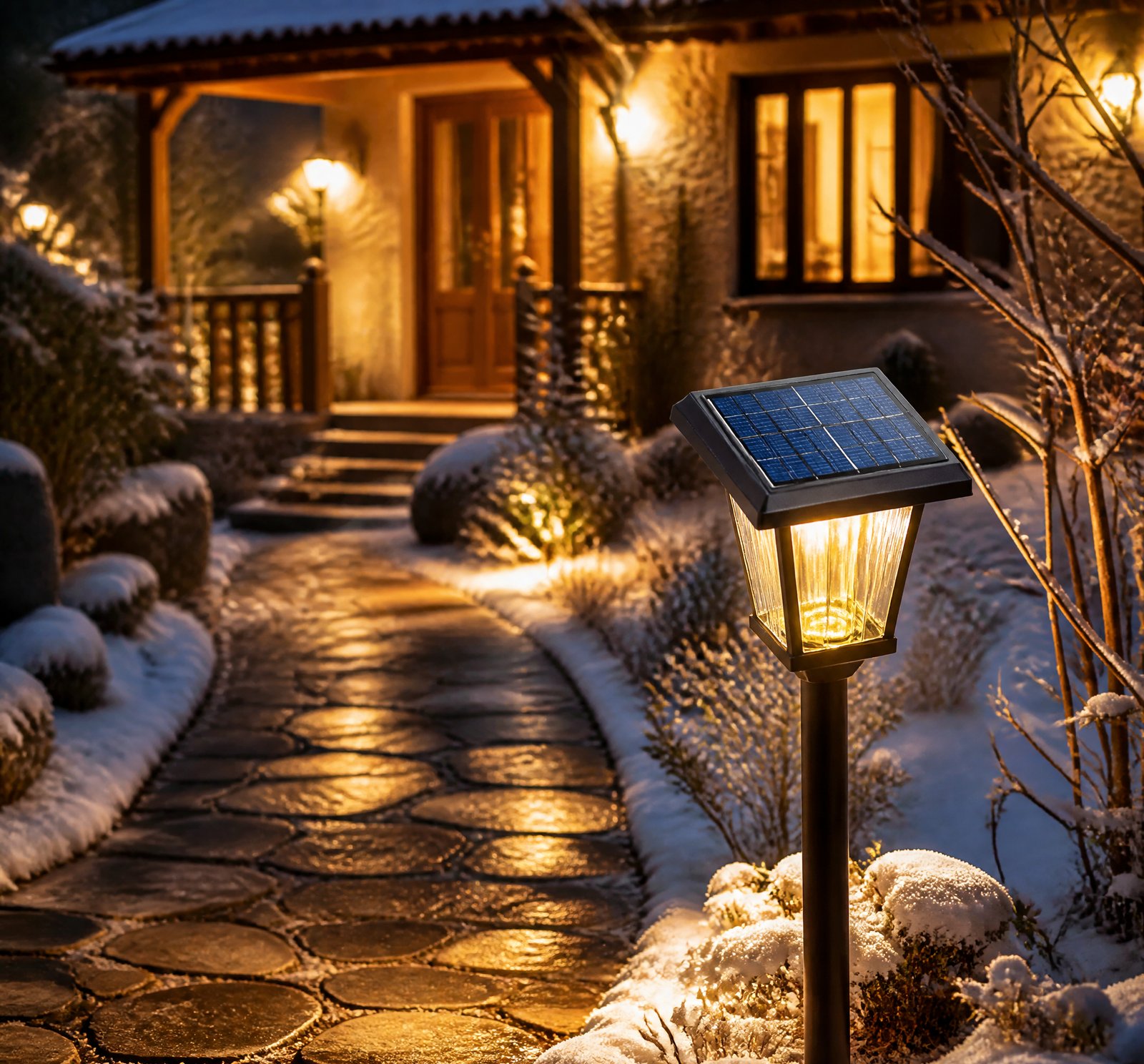
Quick answer: Panourile solare monocristaline oferă o eficiență mai mare (17–22% [8]) și o performanță superioară în condiții de lumină redusă sau unghiuri mici ale soarelui, fiind preferabile pentru iluminatul solar în România, în timp ce cele policristaline, deși mai ieftine, sunt mai puțin eficiente în iarnă și pe cer înnorat [1][8][9].
Într-o țară unde iarna este lungă, zilele scurte și cerul deschis este rar, eficiența sistemelor de iluminat solar devine crucială. Întrebarea dacă panourile solare policristaline sau monocristaline sunt mai potrivite pentru lămpi exterioare în România nu este doar teoretică — este o alegere care influențează funcționalitatea pe tot parcursul anului. Deși cele policristaline sunt mai accesibile din punct de vedere financiar [8], sursele indică clar că monocristalinele sunt preferabile în condiții de lumină difuză, unghiuri mici ale soarelui și zile înnorate [1][15].
Performanța în condiții de lumină redusă și iarnă
În România, unghiul soarelui în ianuarie poate fi sub 15°, iar lumina directă este limitată. În aceste condiții, eficiența panourilor solare scade semnificativ. Sursele arată că panourile monocristaline sunt mai eficiente în lumină difuză sau parțială, fiind mai potrivite pentru zonele cu multe zile înnorate sau pentru instalații care nu primesc lumină directă pe tot parcursul zilei [1][15]. Deși nu există date cantitative specifice pentru România, concluzia este clară: pentru iluminatul care trebuie să funcționeze în iarnă, monocristalinele sunt superioare [1].
În contrast, panourile policristaline, cu un randament eficient în intervalul de 17–22% [8], au o eficiență mai scăzută decât monocristalinele, care beneficiază de o structură de cristal unic, permițând un flux mai ușor al electronilor și o conversie mai eficientă a luminii solare în energie electrică [8][9]. Această diferență de eficiență se accentuează în condiții de lumină slabă, unde monocristalinele păstrează o performanță mai stabilă.
Compararea măsurabilă: policristaline vs monocristaline
| Caracteristică | Panouri policristaline | Panouri monocristaline |
|---|---|---|
| Eficiență | 17–22% [8] | Mai mare decât policristalinele [8][9] |
| Performanță în lumină difuză | Mai redusă | Mai bună [1][15] |
| Preț | Mai accesibil [8] | Mai ridicat |
| Rezistență la temperatură | Nu specificat | Coeficient de temperatură mai bun, pierderi mai mici în căldură [18] |
| Durată de viață | Nu specificat | Mai durabile pe termen lung [6][12] |
Influența unghiului solar și a configurației
Unghiul redus al soarelui în iarnă din România face ca panourile orientate vertical sau cu expunere de 360° să fie mai eficiente, deoarece pot capta lumină dimineața și seara [5][13][21]. Această caracteristică este esențială în condiții de lumină limitată, dar sursele nu indică dacă panourile policristaline beneficiază mai puțin de această configurație față de monocristaline în astfel de instalații.
Rezistență la condiții extreme și zăpadă
Panourile policristaline sunt descrise ca fiind mai rezistente la impacturi și vânt comparativ cu cele subțiri (thin-film), dar nu sunt specificate performanțele lor în condiții de îngheț sau zăpadă [6]. Un studiu relevant arată că panourile bifazice pot reduce pierderile de energie datorate zăpezii la doar 2% anual, în comparație cu 10–20% pentru cele monofazice, datorită reflexiei zăpezii [14]. Deși această eficiență nu se aplică direct panourilor policristaline, sugerează că configurații avansate pot compensa limitele în iarnă.
Concluzii cheie
- Panourile monocristaline sunt mai eficiente în condiții de lumină redusă și unghiuri mici ale soarelui, fiind preferabile pentru România [1][15].
- Deși mai ieftine, panourile policristaline nu sunt recomandate pentru aplicații care necesită lumină puternică pe termen lung în iarnă [1][8][9].
- Panourile monocristaline au un coeficient de temperatură mai bun, ceea ce reduce pierderile în vară [18].
- Configurații verticale sau cu expunere de 360° pot compensa unghiul scăzut al soarelui [5][13][21].
- Panourile bifazice pot fi mult mai eficiente în zăpadă, dar nu se aplică direct panourilor policristaline [14].
References
- [1] Outdoor Solar Lights 5 Facts To Know Before You Shop — reddit
source passage
less than a cold-toned one. There's plenty you can do to limit the effect of lighting on wildlife, too. Warm Tones for a Cozy Ambience 4. Solar Panel Material Solar lights work by using a solar panel to harness the power of sunlight and convert it into electricity. These panels are typically constructed from silicon-based photovoltaic cells – but not all are created equal. On older, cheaper products, you’re likely to find polycrystalline panels, which absorb less sunlight than more expensive monocrystalline panels. If you live in a sunny climate, or if the product isn’t emitting a high level of lumens, then a polycrystalline panel is perfectly adequate. But if you want lights with a high lumen output to work well even in cloudy conditions or on short winter days, it’s worth paying the extra for a product with a more efficient panel made from monocrystalline. Mono panels are a smart move, too, if the light will be positioned where it only gets sun for part of the day. These Solar Deck Lights from Amazon and these Solar Security Lights, also from Amazon, look pretty similar, but the first has monocrystalline panels, the second polycrystalline. I know which ones I’d buy. Products with monocrystalline panels usually state this fact but, if there’s no indication, you can take an educated guess by the color: poly panels often have a blue hue, while mono panels tend to be black. Poly panels may also carry the abbreviation PET. 5. Battery Capacity While we’re talking about cloudy, sh
- [5] Best Solar Lamp Post Our Top 5 Picks Reviewed — blog
source passage
pollution and frankly, wasted energy—and money. That’s where you need to think about the ultimate purpose of your purchase. If you’re planning on having them to light your way into the house, the temperature of the light won’t matter too much as long as they’re bright enough to prevent a fall. However, if you want to linger on your deck, you might find that warmer temps in the 2700 degree Kelvin range are less glaring and easier on your eyes. You’ll find this information along with the wattage, cost, and energy usage on the product’s label. Related Articles: Best Solar Pool Covers LEDs You’ll find a variety of products with a broad spectrum of numbers and lumens for the LEDs. It’s a smart idea to make a note of these figures for comparison purposes, especially if you’re new to using these items. Look for the quantity and light temperature which you’ll find with the list of specs. Solar Panels The construction and layout of the solar panels is one sure way that you can differentiate a quality product from one that may pose problems down the road. Sometimes, there’s not a lot you can do when it comes to getting the optimal amount of light to your solar-powered devices. However, you can look over the design to see if it’s one that tries to maximize its usefulness. We prefer lamp posts that have a 360-degree exposure to sunlight to ensure that the unit is getting as much sun as possible even with the limitations that are beyond your control. You’ll often see that these products a
- [6] Types of solar panels monocrystalline polycrystalline and — authority
source passage
Most homeowners aren’t too keen on the aesthetics of polycrystalline panels. Fun fact! Crystalline panels are more durable than thin film Thin film panels tend to have lower wind and hail ratings than mono and polycrystalline panels. So, while thin film panels might look nice at first, one bad storm could cause significant damage. What is the right type of solar panel for your home? Monocrystalline solar panels are the best solar panels for residential solar installations. Although you will be paying a slightly higher price, you’ll get a system with a subtle appearance without having to sacrifice performance or durability. Plus, the high efficiency and power output ratings you get with monocrystalline panels can provide you with better savings over the lifetime of your system. If you’re on a tight budget, polycrystalline panels might make more sense for you. We do not recommend thin film solar panels for residential installations – their performance and durability don’t make the low cost worth it, and it’s unlikely you’ll have nearly enough space to install the number of thin film panels you would need to cover your household electricity usage. Here’s a quick summary to help you choose the right one for your home! Monocrystalline solar panels Characterized by smooth, black appearance and high-quality silicon Occupy less space and have a longer lifespan Formed through energy-intensive production process which generates a lot of waste Carry a higher price tag for installers and
- [8] How Is Solar Panel Efficiency Measured – Technical ArticlesNext-Gen So — authority
source passage
photovoltaic cells. Type of Solar Panel Technology There are three primary categories of solar photovoltaic cells: polycrystalline, monocrystalline, thin-film, and passivated emitter and rear. Following are the distinctions between these groups and their respective efficacy levels. – Monocrystalline Solar Panels: These are constructed from a single, unadulterated silicon crystal sliced into multiple wafers. The dark black hue of these panels is an identifiable characteristic resulting from their utilization of pure silicon. Monocrystalline panels are the most efficient for space utilization and longevity. – Polycrystalline Solar Panels: These are made by melting and pouring silicon fragments from multiple crystals into a square mold, resulting in lower purity and efficiency than monocrystalline panels. They are more affordable due to minimal wastage but have a lower tolerance to high temperatures and are less effective in energy conversion and space utilization. – Passivated Emitter and Rear Cell (PERC) Panels: PERCs improve upon traditional monocrystalline cells by adding a passivation layer to the rear surface. This layer reflects light into the cell, reduces electron recombination, and prevents higher wavelengths from heating the cell. PERC panels offer greater energy collection in limited spaces and are only slightly more expensive to produce than traditional panels, but their efficiency can lead to a lower average cost per watt. – Thin-film Solar Panels: These are flexib
- [9] Types of solar panels monocrystalline polycrystalline and — authority
source passage
solar cells. 3. Thin-film Thin film solar cells are mostly used in large-scale industrial and utility solar installations because of their lower efficiency ratings, but you can purchase portable thin-film solar panels from BougeRV. Thin film solar panels are made by depositing a thin layer of a photovoltaic substance onto a solid surface, like glass. Some of these photovoltaic substances include Amorphous silicon (a-Si), copper indium gallium selenide (CIGS), and cadmium telluride (CdTe). Each of these materials creates a different ‘type’ of solar panel, however, they all fall under the thin film solar cell umbrella. During the manufacturing process, the photovoltaic substance forms a thin lightweight sheet that is, in some cases, flexible. Solar panel type by performance Highest performance: Monocrystalline Efficiency ratings of monocrystalline solar panels range from 17% to 22%, earning them the title of the most efficient solar panel type. The higher efficiency rating of monocrystalline panels makes them ideal for homes with limited roof space, as you’ll need fewer panels to generate the electricity you need. Monocrystalline solar panels have their manufacturing process to thank for being so efficient. Because monocrystalline solar cells are made of a single crystal of silicon, electrons are able to easily flow throughout the cell, increasing overall efficiency. Not only do monocrystalline panels have the highest efficiency ratings, they typically also have the highest pow
- [12] Monocrystalline silicon – Wikipedia — wikipedia
source passage
for the electronics industry. In the past, monocrystalline solar panels have historically taken up a significantly smaller market share of PV solar manufacturing globally compared to polysilicon technologies due to the latter's lower cost and ease of manufacture. However monocrystalline market share has been growing rapidly since at least 2018.[7] In recent years the price gap between the two technologies has narrowed, both in an absolute sense (panel cost per watt), and in LCoE[8]. This has contributed in monocrystalline becoming the dominant technology, with some studies even showing faster payback periods for monocrystalline despite higher upfront cost.[7][9] This is especially true if space is considered, since the higher efficiency panels can either use less land or roof-space, or produce more energy in the same area. With a recorded single-junction cell lab efficiency of 26.7%, monocrystalline silicon has the highest confirmed conversion efficiency out of all commercial PV technologies, ahead of poly-Si (22.3%) and established thin-film technologies, such as CIGS cells (21.7%), CdTe cells (21.0%), and a-Si cells (10.2%). Solar module efficiencies for mono-Si—which are always lower than those of their corresponding cells—finally crossed the 20% mark for in 2012 and hit 24.4% in 2016.[10] The high efficiency is largely attributable to the lack of recombination sites in the single crystal and better absorption of photons due to its black color, as compared to the character
- [13] US20240364260A1 – Vertical autonomous solar streetlight system — patent
source passage
panels. – the placement of the solar panels around the light pole also allows the solar array to capture light from all angles around the light pole, while also being highly resistant to strong winds due to its low profile, its aerodynamic shape. – An advantage of the present invention is that it provides an autonomous solar streetlight that requires next to zero maintenance. – Another advantage of the present invention is that it provides an autonomous solar streetlight that has a maximum efficiency to capture solar energy. – Yet another advantage of the present invention is that it provides an autonomous solar streetlight that produces enough energy to operate continuously for prolonged periods. – Yet still another advantage of the present invention is that it provides an autonomous solar streetlight that captures part of its own residual energy. – a further advantage of the present invention is that it provides an autonomous solar streetlight that is not affected by snowfall. – Yet a further advantage of the present invention is that it provides an autonomous solar streetlight that is aerodynamic. Landscapes – Engineering & Computer Science (AREA) – General Engineering & Computer Science (AREA) – Life Sciences & Earth Sciences (AREA) – Sustainable Development (AREA) – Photovoltaic Devices (AREA) Abstract A vertical autonomous solar streetlight system. The vertical autonomous solar streetlight system uses a vertical solar array that surrounds the lateral sides of a light po
- [14] Bifacial solar modules shine in snowy – pv magazine Global — authority
source passage
# Bifacial solar modules shine in snowy environments – pv magazine Global Source: Blog/Web URL: https://www.pv-magazine.com/2022/05/23/bifacial-solar-modules-shine-in-snowy-environments/ Author: Anne Fischer Date: 2022-05-23 From pv magazine USA As solar costs have dropped, it now makes economic sense to implement them even in the deep north, yet there is concern about the effects of snow on energy generation. While solar panels operate best in colder temperatures, panels covered in snow will generate less energy, known as snow loss. A study conducted at Western University in Ontario, Canada, shows how to beat snow losses using solar energy systems. The difference between bifacial and monofacial modules is that bifacial modules absorb light from the front and back, while monofacial only collect sunlight on the front. The study analyzed snow losses on these two types of systems using hourly data including energy, solar irradiation and albedo, the measure of the diffuse reflection of solar radiation. The researchers found by using bifacial solar modules instead of trading monofacial, snow losses could be cut from double digits to just 2% on an annual basis. The bifacial solar installation had a 19% gain largely from the reflection of the snow compared to the traditional monofacial systems. The study was conducted at a pair of solar arrays that used both monofacial and bifacial modules, and data was generated in both summer and winter to determine snow loss. A camera was aimed a
- [15] US20120020060A1 – Energy-efficient solar-powered – Google Patents — patent
source passage
much more shade tolerant than non-amorphous solar panels, which is am important advantage above and beyond the advantage of being economical compared to the high-efficiency (greater than 25% efficient, for example) PV cells. It is better at collecting solar energy when it is cloudy, and it is also better at collecting scattered and incident light; see the discussion of shade-tolerance and collection of diffused light earlier in this Example. The inventors contend that cloudy/diffuse-light days are when performance of a solar-powered lighting system is most critical; when the collection opportunity is hampered by shade/diffuse light, the preferred amorphous PV cell material is actually is more efficient under such conditions than a crystalline PV system. – The vertically-mounted “wrapped” configuration of the solar collector on a round pole, in the preferred embodiments, is superior in two ways. First of all, the collector always has a good portion of its surface area facing the sun. So, if there is great sun in the morning, but limited sun after noon, then the total for the day is still good due to the morning collection. The system can collect much more than a conventional system because a conventional system only faces the optimum location at noon—missing out on possible opportunities in the morning or late afternoon. The second advantage of the preferred system is the fact that the angle of the sun with respect to the solar collector is optimum in the morning & late aftern
- [18] Types of solar panels monocrystalline polycrystalline and — authority
source passage
power ratings above 300 watts. However, new technologies and manufacturing processes have given the efficiency and power ratings of polycrystalline panels a slight boost over the years, slowly closing the performance gap between mono and polycrystalline panels. Lowest performance: Thin-film Thin-film solar panels have incredibly low efficiency ratings. As recently as a few years ago, thin-film efficiencies were in the single digits. Researchers have recently achieved 23.4% efficiency with thin film cell prototypes but thin-film panels that are commercially available generally have efficiency in the 10–13% range. In order to meet your energy needs, you would need to install more thin-film panels over a large area to produce the same amount of electricity as crystalline silicon solar panels. This is why thin-film solar panels don’t really make sense for residential installations where space is limited. Fun fact! Thin film panels have excellent temperature coefficients! Despite having lower performance specs in most other categories, thin film panels tend to have the lowest temperature coefficient, which means as the temperature of a solar panel increases, the panel produces less electricity. The temperature coefficient tells you how much the power output will decrease by for every 1°C over 25°C the panel gets. The standard temperature coefficient for mono and polycrystalline panels typically falls somewhere between -0.3% and -0.5% per °C. Thin film panels, on the other hand, ar
- [21] US20240364260A1 – Vertical autonomous solar streetlight system — patent
source passage
panels to flow downward and not to stay stagnant on the faces of the solar panels. The placement of the solar panels around the light pole also allows the solar array to capture light from all angles around the light pole, while also being highly resistant to strong winds due to its low profile, its aerodynamic shape. – An advantage of the present invention is that it provides an autonomous solar streetlight that requires next to zero maintenance. – Another advantage of the present invention is that it provides an autonomous solar streetlight that has a maximum efficiency to capture solar energy. – Yet another advantage of the present invention is that it provides an autonomous solar streetlight that produces enough energy to operate continuously for prolonged periods. – Yet still another advantage of the present invention is that it provides an autonomous solar streetlight that captures part of its own residual energy. – A further advantage of the present invention is that it provides an autonomous solar streetlight that is not affected by snowfall. – Yet a further advantage of the present invention is that it provides an autonomous solar streetlight that is aerodynamic. – The embodiments of the vertical autonomous solar streetlight system described herein are exemplary and numerous modifications, combinations, variations, and rearrangements can be readily envisioned to achieve an equivalent result, all of which are intended to be embraced within the scope of the appended cl
less than a cold-toned one. There's plenty you can do to limit the effect of lighting on wildlife, too. Warm Tones for a Cozy Ambience 4. Solar Panel Material Solar lights work by using a solar panel to harness the power of sunlight and convert it into electricity. These panels are typically constructed from silicon-based photovoltaic cells – but not all are created equal. On older, cheaper products, you’re likely to find polycrystalline panels, which absorb less sunlight than more expensive monocrystalline panels. If you live in a sunny climate, or if the product isn’t emitting a high level of lumens, then a polycrystalline panel is perfectly adequate. But if you want lights with a high lumen output to work well even in cloudy conditions or on short winter days, it’s worth paying the extra for a product with a more efficient panel made from monocrystalline. Mono panels are a smart move, too, if the light will be positioned where it only gets sun for part of the day. These Solar Deck Lights from Amazon and these Solar Security Lights, also from Amazon, look pretty similar, but the first has monocrystalline panels, the second polycrystalline. I know which ones I’d buy. Products with monocrystalline panels usually state this fact but, if there’s no indication, you can take an educated guess by the color: poly panels often have a blue hue, while mono panels tend to be black. Poly panels may also carry the abbreviation PET. 5. Battery Capacity While we’re talking about cloudy, sh
pollution and frankly, wasted energy—and money. That’s where you need to think about the ultimate purpose of your purchase. If you’re planning on having them to light your way into the house, the temperature of the light won’t matter too much as long as they’re bright enough to prevent a fall. However, if you want to linger on your deck, you might find that warmer temps in the 2700 degree Kelvin range are less glaring and easier on your eyes. You’ll find this information along with the wattage, cost, and energy usage on the product’s label. Related Articles: Best Solar Pool Covers LEDs You’ll find a variety of products with a broad spectrum of numbers and lumens for the LEDs. It’s a smart idea to make a note of these figures for comparison purposes, especially if you’re new to using these items. Look for the quantity and light temperature which you’ll find with the list of specs. Solar Panels The construction and layout of the solar panels is one sure way that you can differentiate a quality product from one that may pose problems down the road. Sometimes, there’s not a lot you can do when it comes to getting the optimal amount of light to your solar-powered devices. However, you can look over the design to see if it’s one that tries to maximize its usefulness. We prefer lamp posts that have a 360-degree exposure to sunlight to ensure that the unit is getting as much sun as possible even with the limitations that are beyond your control. You’ll often see that these products a
Most homeowners aren’t too keen on the aesthetics of polycrystalline panels. Fun fact! Crystalline panels are more durable than thin film Thin film panels tend to have lower wind and hail ratings than mono and polycrystalline panels. So, while thin film panels might look nice at first, one bad storm could cause significant damage. What is the right type of solar panel for your home? Monocrystalline solar panels are the best solar panels for residential solar installations. Although you will be paying a slightly higher price, you’ll get a system with a subtle appearance without having to sacrifice performance or durability. Plus, the high efficiency and power output ratings you get with monocrystalline panels can provide you with better savings over the lifetime of your system. If you’re on a tight budget, polycrystalline panels might make more sense for you. We do not recommend thin film solar panels for residential installations – their performance and durability don’t make the low cost worth it, and it’s unlikely you’ll have nearly enough space to install the number of thin film panels you would need to cover your household electricity usage. Here’s a quick summary to help you choose the right one for your home! Monocrystalline solar panels Characterized by smooth, black appearance and high-quality silicon Occupy less space and have a longer lifespan Formed through energy-intensive production process which generates a lot of waste Carry a higher price tag for installers and
photovoltaic cells. Type of Solar Panel Technology There are three primary categories of solar photovoltaic cells: polycrystalline, monocrystalline, thin-film, and passivated emitter and rear. Following are the distinctions between these groups and their respective efficacy levels. – Monocrystalline Solar Panels: These are constructed from a single, unadulterated silicon crystal sliced into multiple wafers. The dark black hue of these panels is an identifiable characteristic resulting from their utilization of pure silicon. Monocrystalline panels are the most efficient for space utilization and longevity. – Polycrystalline Solar Panels: These are made by melting and pouring silicon fragments from multiple crystals into a square mold, resulting in lower purity and efficiency than monocrystalline panels. They are more affordable due to minimal wastage but have a lower tolerance to high temperatures and are less effective in energy conversion and space utilization. – Passivated Emitter and Rear Cell (PERC) Panels: PERCs improve upon traditional monocrystalline cells by adding a passivation layer to the rear surface. This layer reflects light into the cell, reduces electron recombination, and prevents higher wavelengths from heating the cell. PERC panels offer greater energy collection in limited spaces and are only slightly more expensive to produce than traditional panels, but their efficiency can lead to a lower average cost per watt. – Thin-film Solar Panels: These are flexib
solar cells. 3. Thin-film Thin film solar cells are mostly used in large-scale industrial and utility solar installations because of their lower efficiency ratings, but you can purchase portable thin-film solar panels from BougeRV. Thin film solar panels are made by depositing a thin layer of a photovoltaic substance onto a solid surface, like glass. Some of these photovoltaic substances include Amorphous silicon (a-Si), copper indium gallium selenide (CIGS), and cadmium telluride (CdTe). Each of these materials creates a different ‘type’ of solar panel, however, they all fall under the thin film solar cell umbrella. During the manufacturing process, the photovoltaic substance forms a thin lightweight sheet that is, in some cases, flexible. Solar panel type by performance Highest performance: Monocrystalline Efficiency ratings of monocrystalline solar panels range from 17% to 22%, earning them the title of the most efficient solar panel type. The higher efficiency rating of monocrystalline panels makes them ideal for homes with limited roof space, as you’ll need fewer panels to generate the electricity you need. Monocrystalline solar panels have their manufacturing process to thank for being so efficient. Because monocrystalline solar cells are made of a single crystal of silicon, electrons are able to easily flow throughout the cell, increasing overall efficiency. Not only do monocrystalline panels have the highest efficiency ratings, they typically also have the highest pow
for the electronics industry. In the past, monocrystalline solar panels have historically taken up a significantly smaller market share of PV solar manufacturing globally compared to polysilicon technologies due to the latter's lower cost and ease of manufacture. However monocrystalline market share has been growing rapidly since at least 2018.[7] In recent years the price gap between the two technologies has narrowed, both in an absolute sense (panel cost per watt), and in LCoE[8]. This has contributed in monocrystalline becoming the dominant technology, with some studies even showing faster payback periods for monocrystalline despite higher upfront cost.[7][9] This is especially true if space is considered, since the higher efficiency panels can either use less land or roof-space, or produce more energy in the same area. With a recorded single-junction cell lab efficiency of 26.7%, monocrystalline silicon has the highest confirmed conversion efficiency out of all commercial PV technologies, ahead of poly-Si (22.3%) and established thin-film technologies, such as CIGS cells (21.7%), CdTe cells (21.0%), and a-Si cells (10.2%). Solar module efficiencies for mono-Si—which are always lower than those of their corresponding cells—finally crossed the 20% mark for in 2012 and hit 24.4% in 2016.[10] The high efficiency is largely attributable to the lack of recombination sites in the single crystal and better absorption of photons due to its black color, as compared to the character
panels. – the placement of the solar panels around the light pole also allows the solar array to capture light from all angles around the light pole, while also being highly resistant to strong winds due to its low profile, its aerodynamic shape. – An advantage of the present invention is that it provides an autonomous solar streetlight that requires next to zero maintenance. – Another advantage of the present invention is that it provides an autonomous solar streetlight that has a maximum efficiency to capture solar energy. – Yet another advantage of the present invention is that it provides an autonomous solar streetlight that produces enough energy to operate continuously for prolonged periods. – Yet still another advantage of the present invention is that it provides an autonomous solar streetlight that captures part of its own residual energy. – a further advantage of the present invention is that it provides an autonomous solar streetlight that is not affected by snowfall. – Yet a further advantage of the present invention is that it provides an autonomous solar streetlight that is aerodynamic. Landscapes – Engineering & Computer Science (AREA) – General Engineering & Computer Science (AREA) – Life Sciences & Earth Sciences (AREA) – Sustainable Development (AREA) – Photovoltaic Devices (AREA) Abstract A vertical autonomous solar streetlight system. The vertical autonomous solar streetlight system uses a vertical solar array that surrounds the lateral sides of a light po
# Bifacial solar modules shine in snowy environments – pv magazine Global Source: Blog/Web URL: https://www.pv-magazine.com/2022/05/23/bifacial-solar-modules-shine-in-snowy-environments/ Author: Anne Fischer Date: 2022-05-23 From pv magazine USA As solar costs have dropped, it now makes economic sense to implement them even in the deep north, yet there is concern about the effects of snow on energy generation. While solar panels operate best in colder temperatures, panels covered in snow will generate less energy, known as snow loss. A study conducted at Western University in Ontario, Canada, shows how to beat snow losses using solar energy systems. The difference between bifacial and monofacial modules is that bifacial modules absorb light from the front and back, while monofacial only collect sunlight on the front. The study analyzed snow losses on these two types of systems using hourly data including energy, solar irradiation and albedo, the measure of the diffuse reflection of solar radiation. The researchers found by using bifacial solar modules instead of trading monofacial, snow losses could be cut from double digits to just 2% on an annual basis. The bifacial solar installation had a 19% gain largely from the reflection of the snow compared to the traditional monofacial systems. The study was conducted at a pair of solar arrays that used both monofacial and bifacial modules, and data was generated in both summer and winter to determine snow loss. A camera was aimed a
much more shade tolerant than non-amorphous solar panels, which is am important advantage above and beyond the advantage of being economical compared to the high-efficiency (greater than 25% efficient, for example) PV cells. It is better at collecting solar energy when it is cloudy, and it is also better at collecting scattered and incident light; see the discussion of shade-tolerance and collection of diffused light earlier in this Example. The inventors contend that cloudy/diffuse-light days are when performance of a solar-powered lighting system is most critical; when the collection opportunity is hampered by shade/diffuse light, the preferred amorphous PV cell material is actually is more efficient under such conditions than a crystalline PV system. – The vertically-mounted “wrapped” configuration of the solar collector on a round pole, in the preferred embodiments, is superior in two ways. First of all, the collector always has a good portion of its surface area facing the sun. So, if there is great sun in the morning, but limited sun after noon, then the total for the day is still good due to the morning collection. The system can collect much more than a conventional system because a conventional system only faces the optimum location at noon—missing out on possible opportunities in the morning or late afternoon. The second advantage of the preferred system is the fact that the angle of the sun with respect to the solar collector is optimum in the morning & late aftern
power ratings above 300 watts. However, new technologies and manufacturing processes have given the efficiency and power ratings of polycrystalline panels a slight boost over the years, slowly closing the performance gap between mono and polycrystalline panels. Lowest performance: Thin-film Thin-film solar panels have incredibly low efficiency ratings. As recently as a few years ago, thin-film efficiencies were in the single digits. Researchers have recently achieved 23.4% efficiency with thin film cell prototypes but thin-film panels that are commercially available generally have efficiency in the 10–13% range. In order to meet your energy needs, you would need to install more thin-film panels over a large area to produce the same amount of electricity as crystalline silicon solar panels. This is why thin-film solar panels don’t really make sense for residential installations where space is limited. Fun fact! Thin film panels have excellent temperature coefficients! Despite having lower performance specs in most other categories, thin film panels tend to have the lowest temperature coefficient, which means as the temperature of a solar panel increases, the panel produces less electricity. The temperature coefficient tells you how much the power output will decrease by for every 1°C over 25°C the panel gets. The standard temperature coefficient for mono and polycrystalline panels typically falls somewhere between -0.3% and -0.5% per °C. Thin film panels, on the other hand, ar
panels to flow downward and not to stay stagnant on the faces of the solar panels. The placement of the solar panels around the light pole also allows the solar array to capture light from all angles around the light pole, while also being highly resistant to strong winds due to its low profile, its aerodynamic shape. – An advantage of the present invention is that it provides an autonomous solar streetlight that requires next to zero maintenance. – Another advantage of the present invention is that it provides an autonomous solar streetlight that has a maximum efficiency to capture solar energy. – Yet another advantage of the present invention is that it provides an autonomous solar streetlight that produces enough energy to operate continuously for prolonged periods. – Yet still another advantage of the present invention is that it provides an autonomous solar streetlight that captures part of its own residual energy. – A further advantage of the present invention is that it provides an autonomous solar streetlight that is not affected by snowfall. – Yet a further advantage of the present invention is that it provides an autonomous solar streetlight that is aerodynamic. – The embodiments of the vertical autonomous solar streetlight system described herein are exemplary and numerous modifications, combinations, variations, and rearrangements can be readily envisioned to achieve an equivalent result, all of which are intended to be embraced within the scope of the appended cl